


Trace Gas Orbiter: Frosty crater on Mars

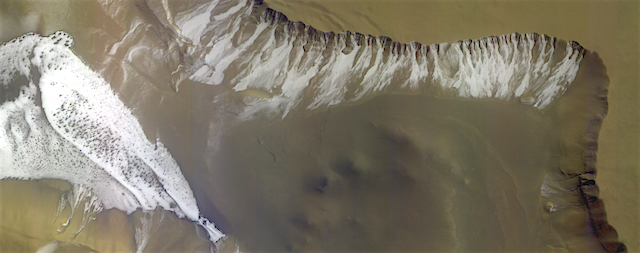
Frosty_crater_on_MarsThis image shows the south-facing rim of a pit crater at 68°S in the Sisyphi Planum region of Mars. It is a colour composite made from images acquired on 2 September 2018 by the Colour and Stereo Surface Imaging System, CaSSIS, onboard the joint ESA-Roscosmos ExoMars Trace Gas Orbiter, when the southern hemisphere of Mars was in late spring.

Most striking are the bright residual carbon dioxide ice deposits on south-facing slopes of the crater. In colder months carbon dioxide and some water vapour freezes on the surface. Then, as the Sun gets higher in the sky again, the ice sublimates away, revealing the underlying surface.

This particular crater is known to have active gullies – small, incised networks of narrow channels at the rim of the crater that are associated with debris flows. Ice-rich landslide-like flows of material down-slope can be seen in this image – perhaps related to the ‘defrosting’ of the ice as the seasons change….  [More at link]
Posted in Reports | Tagged , , , , , , , , , , , | Comments Off

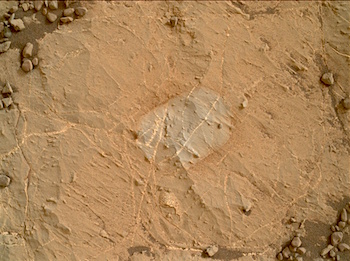
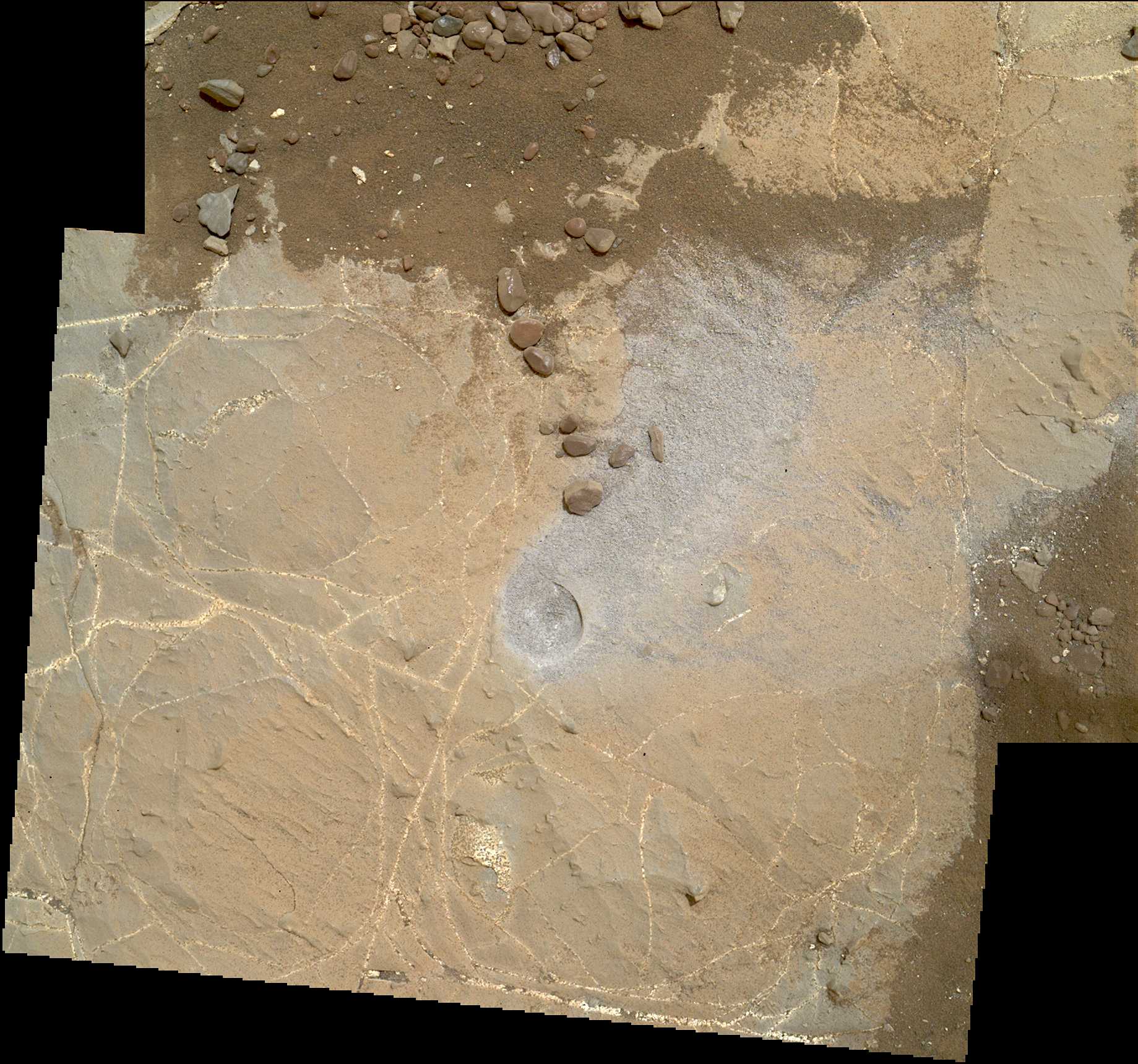
Curiosity: Shallow drill pit at Inverness

2172-mahliSol 2172, September 15, 2018. The rover’s MAHLI camera recorded the results of the drill’s action at the Inverness target — a shallow pit rather than a hole. Click image to enlarge it.

Sol 2172 raw images (from all cameras).

Posted in Reports | Tagged , , , , , , , | Comments Off

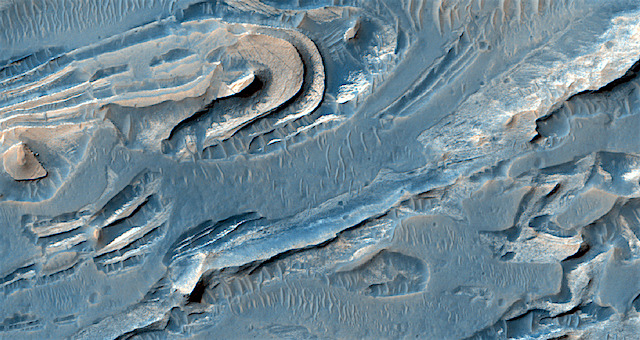
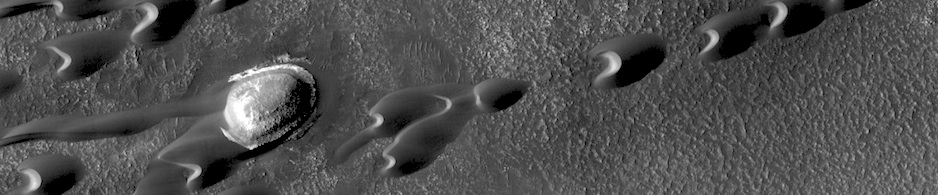
HiRISE: Stratified deposits in Crommelin Crater

tumblr_pf0m6pruXr1rlz4gso2_1280Stratified deposits in Crommelin Crater. This target contains light-toned deposits, a key area to investigate the geometrical and geological relationship between the central bulge and the partially sediment-covered crater floor. Also: swirls!

Beautiful Mars series. [More at links]

Posted in Reports | Tagged , , , , , , , , , | Comments Off

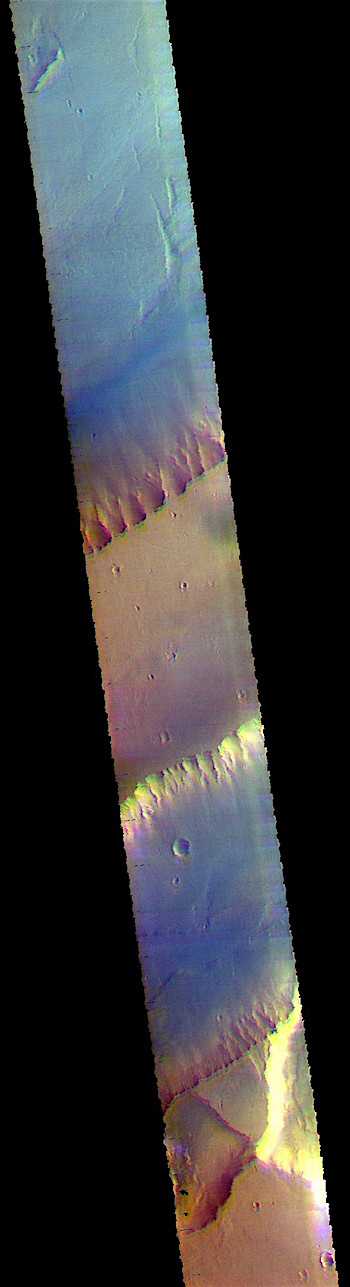
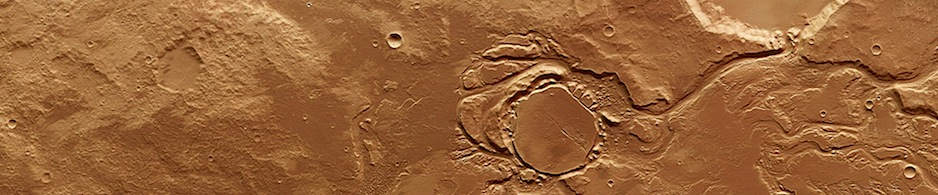
THEMIS: Lunae Mensa in Kasei Valles

Kasei Valles in false color (THEMIS_IOTD_20180917)THEMIS Image of the Day, September 17, 2018. Today’s image shows a portion of Kasei Valles. The plateau in the center of the image is called Lunae Mensa.

The THEMIS VIS camera contains 5 filters. The data from different filters can be combined in multiple ways to create a false color image. These false color images may reveal subtle variations of the surface not easily identified in a single band image.

See more THEMIS Images of the Day by geological subject.

Posted in Reports | Tagged , , , , , , , , , , | Comments Off

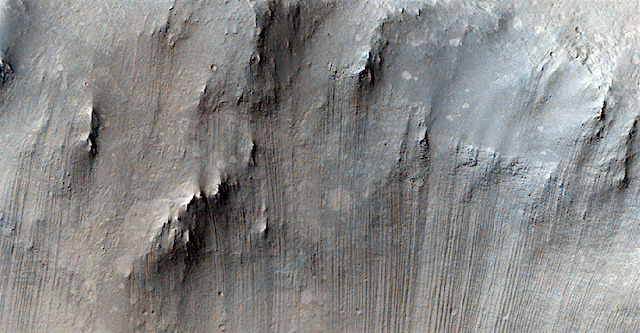
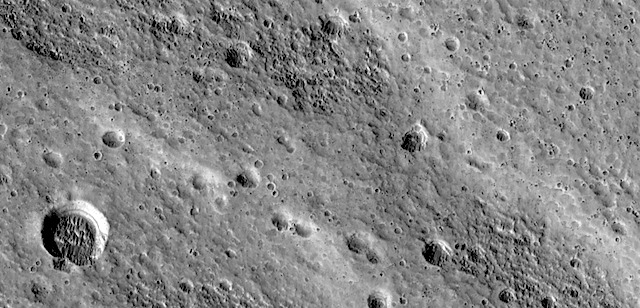
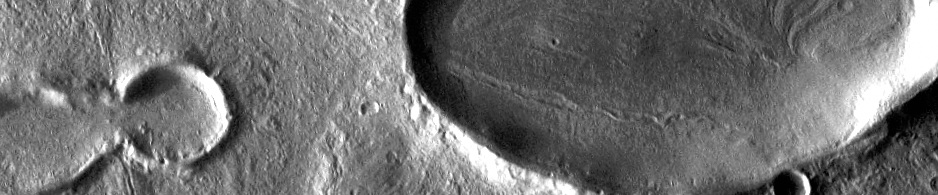
HiRISE: Channels and ripples along crater walls

tumblr_pez5wjRLoW1rlz4gso2_1280Channels and ripples along crater walls. From the science rationale: “We would like a HiRISE image of the selected area to look for evidence of both fluvial and aeolian processes on the crater wall. Specifically, we are looking for channels that would be evident of erosion. It would be useful to know how widespread fluvial processes are across the surface of Mars and the timescale on which these processes take place.”

Beautiful Mars series. [More at links]

Posted in Reports | Tagged , , , , , , , , , , , | Comments Off

Weather update from Gale Crater

Posted in Reports | Tagged , , , , , , , , | Comments Off

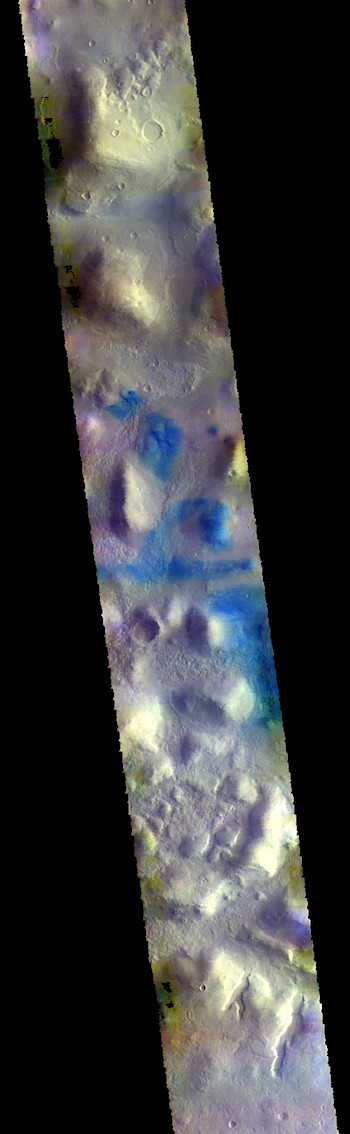
THEMIS: Basaltic sand amid hills in Terra Sabaea

Hills of Terra Sabaea (THEMIS_IOTD_20180914)THEMIS Image of the Day, September 14, 2018. Today’s VIS image shows part of northern Terra Sabaea, where hills are common. The blue tones are usually locations of basaltic sand.

The THEMIS VIS camera contains 5 filters. The data from different filters can be combined in multiple ways to create a false color image. These false color images may reveal subtle variations of the surface not easily identified in a single band image.

See more THEMIS Images of the Day by geological subject.

Posted in Reports | Tagged , , , , , , , , , , | Comments Off

MarCO makes space for small explorers

PIA22317_hiresTwenty years ago, CubeSats — a class of boxy satellites small enough to fit in a backpack — were used by universities as a teaching aid. Simpler, smaller and cheaper than traditional satellites, they’ve made space more accessible to private companies and science agencies.

This summer, NASA has been flying the first two next-generation CubeSats to deep space. They’re currently on their way to Mars, trailing thousands of miles behind the InSight spacecraft. InSight and its CubeSat tag-alongs are already more than halfway to the Red Planet.

The mini-mission, called Mars Cube One (MarCO), has already proved this class of spacecraft can survive the deep-space environment. It will next test the use of miniaturized communication technology to relay data when InSight attempts to land in November. Relaying landing data is one of the jobs of NASA’s orbiters, which will record InSight’s descent; engineers learn more from every landing attempt. MarCO will test whether this technology can ably perform the relay job for future missions… [More at link]

Posted in Reports | Tagged , , , , , , , | Comments Off

HiRISE: Rubicon Valles

tumblr_pez5jfIGQg1rlz4gso1_1280Rubicon Valles. We dare you to cross this! Beautiful Mars series. [More at links]

Posted in Reports | Tagged , , , , , , , | Comments Off

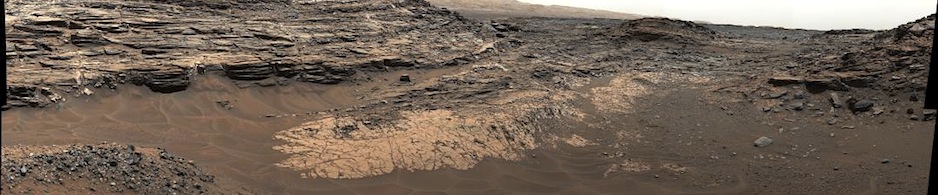
Curiosity update: Go for drill at Inverness

2168MH0004650010802877C00_DXXX-br2Sols 2170-71, September 13, 2018, update by MSL scientist Catherine O’Connell: In our previous plan, we assessed the suitability of the Inverness target for drilling. We used APXS to determine if it fell within the required geochemical parameters, first brushing to remove excess dust and then using curium to irradiate the target and acquire whole-rock geochemical data. Curiosity also did a series of “stress tests” to test the integrity of the target, and check whether it would be strong enough to withstand our percussive drill technique without shattering. At the beginning of today’s planning, we received data which confirmed that Inverness had passed our tests. Drilling begins tomorrow (sol 2170) on what will hopefully be our 18th successful drill hole in Gale crater!

If successful, the resulting sample will be processed internally by CheMin (to assess mineralogical composition) and possibly SAM (to look for chemical signatures). The remaining collected drill sample will be dumped at a later date, so MAHLI will take imagery of potential dump locations on sol 2170 to help with later analysis. A pile of “tailings” will also be generated around the drill hole by the drilling activity. These tailings will be analyzed by ChemCam, APXS and MAHLI in the coming weeks – Mastcam will acquire images of the drill-hole and multispectral images on the tailings on sol 2171… [More at link]

Posted in Reports | Tagged , , , , , , , , , , , , | Comments Off