
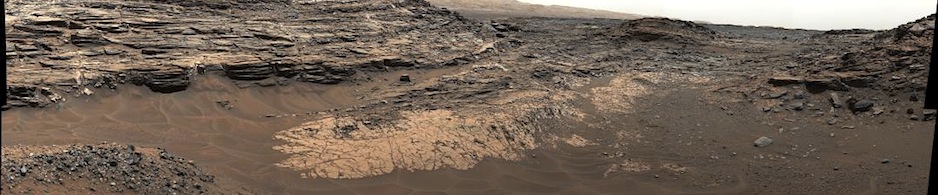
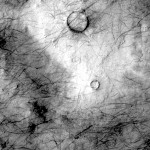
THEMIS image: More dust devils in Utopia

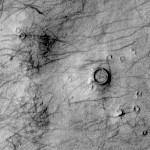
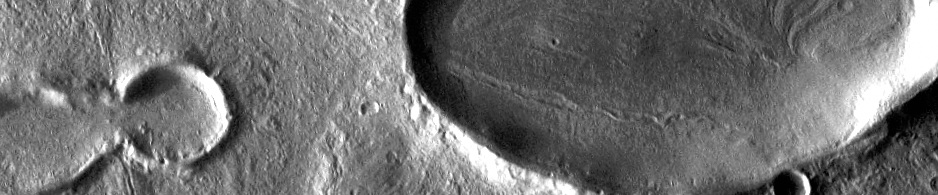
THEMIS Image of the Day, February 13, 2014. Looking at yet another portion of Utopia Planitia, we still find hundreds of dust devil tracks. More THEMIS Images of the Day by geological topic.
Posted in Reports | Tagged , , , , , , , , , | Comments Off

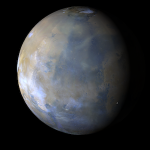
MARCI weather report, February 3-9, 2014

Dust-raising activity occurred along the perennial northern cap edge in Tempe and Acidalia as well as in Utopia. Local dust storm activity was also observed in Ophir Planum north of Valles Marineris. Diffuse water ice clouds were present over the tropics in Noachis and Aonia, in the equatorial regions, and over the major shield volcanoes. Frost and relatively dense water ice cloud cover was observed in Hellas.… [More at link]

Posted in Reports | Tagged , , , , , , , , , , | Comments Off

THEMIS orbit shifting to focus on Mars at daybreak and sunset

A change in the orbit of NASA’s Mars Odyssey spacecraft will give the Thermal Emission Imaging System (THEMIS) camera new views of Mars at a different local time of day: around sunrise and sunset. The spacecraft has been drifting toward the new orbit for more than a year, and a small engine burn on February 11, 2014 accelerated the drift; Odyssey will reach its new orbit in November 2015.

During the transition, THEMIS will continue observations as the orbital time of day changes from its current afternoon and pre-dawn local times. The new orbit will provide scientists with systematic views of Mars around local sunrise and sunset for the first time since the two Viking orbiters ceased operations more than a generation ago.

“We don’t know exactly what we’ll find when we get to an orbit where we see Mars just after sunrise,” says Philip Christensen (Arizona State University), who designed the new observing plan. He is THEMIS’ principal investigator.

Besides revealing landscapes in sharp relief thanks to the low Sun angle, the new orbital time of day for THEMIS promises to let scientists explore frosts, ground fogs, early morning clouds and hazes, and other transient atmosphere-related features that usually vanish as the Martian day goes on.

In addition, THEMIS will measure ground temperatures at thousands of locations. These observations can yield insight about materials in the ground and about temperature-driven processes. These include warm-season flows of water or brine seen on some slopes, and geysers fed by spring thawing of carbon dioxide ice near Mars’ south pole.

“Mars is a dynamic world,” says Christensen, “And for a generation we’ve not been positioned to explore this part of it so thoroughly.”

Posted in Reports | Tagged , , , , , | Comments Off

HiRISE image: Craters, dunes, and ridges in Nili Patera

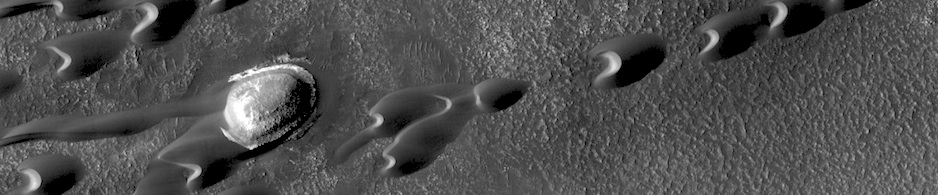
Beautiful Mars series: Craters, dunes, and ridges in Nili Patera’s caldera.  More Beautiful Mars images.

Posted in Reports | Tagged , , , , , , , , , , , | Comments Off

Curiosity animation: Dingo Gap dune in the rearview mirror

The series of nine images making up this animation were taken by the rear Hazard-Avoidance Camera (rear Hazcam) on NASA’s Curiosity Mars rover as the rover drove over a dune spanning “Dingo Gap” on Mars. The Hazcam, mounted low on the vehicle’s chassis, provides a wide-angle view… [Larger animation at link]

Posted in Reports | Tagged , , , , , , , , | Comments Off

THEMIS image: More Utopia dust devils

THEMIS Image of the Day, February 12, 2014. Today’s VIS image shows a different part of Utopia Planitia than yesterday’s image. Both are marked with hundreds of dust devil tracks. More THEMIS Images of the Day by geological topic.

Posted in Reports | Tagged , , , , , , , , , , | Comments Off

HRSC image: Flood after the impact

Large and small, hundreds of thousands of craters scar the surface of Mars, hollowed out by a multitude of asteroids and comets that impacted the Red Planet throughout its history. This image shows a region of the planet’s northern hemisphere known as Hephaestus Fossae – after the Greek god of fire – that was imaged by the high-resolution stereo camera on ESA’s Mars Express orbiter on 28 December 2007… [More at link]

Posted in Reports | Tagged , , , , , , , | Comments Off

Following Curiosity with HiRISE

The blog run by Emily Lakdawalla at the Planetary Society’s site has a fascinating and useful post about HiRISE imaging of the area traversed by Mars rover Curiosity on its trek to Mt. Sharp. After explaining how HiRISE works, she presents two mosaics she assembled. One shows the footprints of digital terrain models based on HiRISE stereo images, the other shows mosaics of HiRISE color images. These cover the rover’s path to date and a possible future traverse to Mt. Sharp. The post also gives tables with links describing the DTM and color frames.

Posted in Reports | Tagged , , , , , , , , , , , , , | Comments Off

HiRISE image: Rolling boulder track in Hale Crater

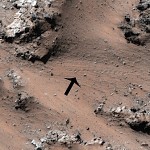
Beautiful Mars series: Slope Monitoring in Hale Crater; you can also see the path of a boulder that rolled down at some point. More Beautiful Mars images.

Posted in Reports | Tagged , , , , , , , , | Comments Off

Curiosity raw image: Sol 539, February 10, 2014

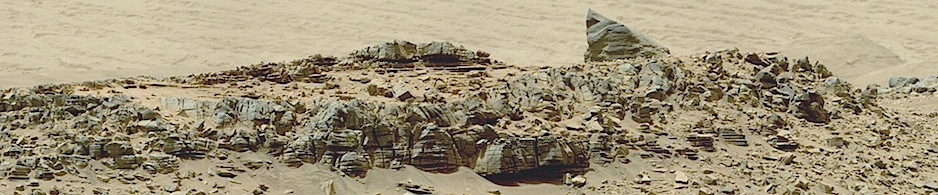
Leaving Dingo Gap dune behind (note tracks down the face of the dune, right rear). This image was taken by Navcam: Right B (NAV_RIGHT_B) onboard NASA’s Mars rover Curiosity on Sol 539 (2014-02-10 23:04:47 UTC). More Sol 539 images (all cameras).

Posted in Reports | Tagged , , , , , , , , | Comments Off