

-
Recent Posts
Archives
Links
general
mission instruments
- CRISM: Compact Reconnaissance Imaging Spectrometer for Mars
- CTX: Context Camera
- HiRISE: High Resolution Imaging Science Experiment
- MARSIS: Mars Advanced Radar for Subsurface and Ionosphere Sounding
- SHARAD: Shallow Radar
- THEMIS: Thermal Emission Imaging System
missions
- All Mars missions list
- Curiosity rover
- ExoMars
- Hope (al-Amal) orbiter
- InSight
- Mars Atmosphere and Volatile Evolution Mission (MAVEN)
- Mars Exploration Rovers (MER)
- Mars Express (MEX)
- Mars Odyssey
- Mars Orbiter Mission (MOM) / Mangalyaan
- Mars Reconnaissance Orbiter (MRO)
- Mars Science Laboratory (MSL)
- Perseverance Rover
- Tianwen-1 orbiter/rover
news
Tag Archives: basins
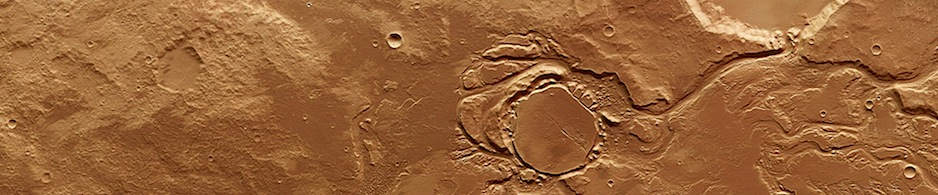
Geological evidence of a planet‐wide groundwater system on Mars
[Ed. note: Earlier reports about this research here and here.] Planetary Geomorphology Image of the Month, July 1, 2019: Francesco Salese (Utrecht University). Groundwater had a greater role in shaping the Martian surface and may have sheltered primitive life forms … Continue reading
Mars Express: Geological evidence of a global groundwater system
[Ed. note: This research was reported earlier here.] Mars Express has revealed the first geological evidence of a system of ancient interconnected lakes that once lay deep beneath the Red Planet’s surface, five of which may contain minerals crucial to … Continue reading
Posted in Reports
Tagged aquifers, basins, ESA, European Space Agency, groundwater, Mars Express, MEX
Comments Off
Geological evidence for a planet-wide groundwater system on Mars
[Editor’s note: From a paper by Francesco Salese and four co-authors recently published in the Journal of Geophysical Research.] Geological evidence of planet-wide groundwater system on Mars • Geological evidence supporting Martian planet-wide groundwater upwelling • Water-saturated zone intercepted by … Continue reading
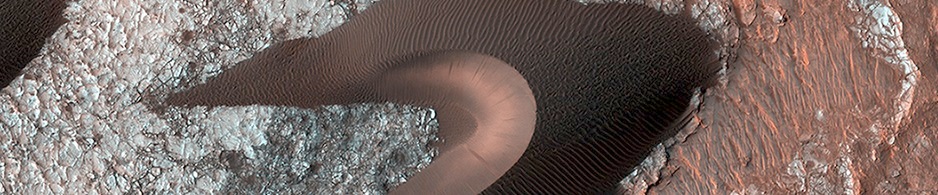
HiRISE: Irregular basin floor material
Irregular basin floor material. Beautiful Mars series.
Posted in Reports
Tagged basins, Beautiful Mars, High Resolution Imaging Science Experiment, HiRISE, Mars Reconnaissance Orbiter, MRO, NASA, Noachis Terra, University of Arizona
Comments Off
HiRISE: Basin and channel features
Basin and channel features in Terra Sirenum intercrater terrain. Beautiful Mars series.
Posted in Reports
Tagged basins, Beautiful Mars, channels, High Resolution Imaging Science Experiment, HiRISE, Mars Reconnaissance Orbiter, MRO, NASA, Terra Sirenum, University of Arizona
Comments Off
Did big impacts disrupt heat flow in the Martian mantle?
Mars shows more than 20 impact basins with diameters of at least 1,000 kilometers (600 miles), and five of these are 2,500 km wide or larger. Based on crater counts, most of the basins appear to have occurred between in … Continue reading
Big bangs
Really large meteorites produce impact scars big enough to be called basins. Although not defined by a particular size, basins differ from smaller craters in that the floor of a basin follows the planet’s curvature. New calculations published in the … Continue reading
Chips off the old block?
Are Martian moons Phobos and Deimos escaped asteroids, as sometimes proposed? Robert Craddock (National Air and Space Museum) suggests in a paper in the February 2011 issue of Icarus they may have come from a large impact on Mars instead. … Continue reading