
-
Recent Posts
Archives
Links
general
mission instruments
- CRISM: Compact Reconnaissance Imaging Spectrometer for Mars
- CTX: Context Camera
- HiRISE: High Resolution Imaging Science Experiment
- MARSIS: Mars Advanced Radar for Subsurface and Ionosphere Sounding
- SHARAD: Shallow Radar
- THEMIS: Thermal Emission Imaging System
missions
- All Mars missions list
- Curiosity rover
- ExoMars
- Hope (al-Amal) orbiter
- InSight
- Mars Atmosphere and Volatile Evolution Mission (MAVEN)
- Mars Exploration Rovers (MER)
- Mars Express (MEX)
- Mars Odyssey
- Mars Orbiter Mission (MOM) / Mangalyaan
- Mars Reconnaissance Orbiter (MRO)
- Mars Science Laboratory (MSL)
- Perseverance Rover
- Tianwen-1 orbiter/rover
news
Tag Archives: climate change
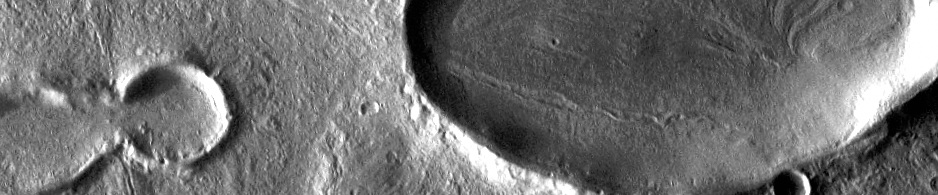
HiRISE: Floor and north rim of Dokka Crater
Floor and north rim of Dokka Crater. Dokka Crater is 52-kilometers in diameter and located in the north polar region of Mars. Its interior is presumably a remnant of a former polar cap with larger extension, so it could provide … Continue reading
Posted in Reports
Tagged climate change, climate cycles, Dokka Crater, High Resolution Imaging Science Experiment, HiPOD, HiRISE, HiRISE Picture of the Day, ice, Mars Reconnaissance Orbiter, MRO, NASA, north polar ice cap, University of Arizona
Comments Off
THEMIS: Layers in the north polar ice cap
THEMIS Image of the Day, July 22, 2019. Millions of years of alternating seasons have created the north polar cap. Ice is laid down during the winter and dust coats the ice in summer. The ice/dust cycle creates layers as … Continue reading
Posted in Reports
Tagged Arizona State University, ASU, climate change, climate cycles, Mars Odyssey, NASA, north polar ice cap, north polar layered deposits, THEMIS, THEMIS Image of the Day, Thermal Emission Imaging System
Comments Off
Orbital changes drive deposition of south polar layered deposits
[Editor’s note: From a paper by Patricio Becerra and seven co-authors recently published in Geophysical Research Letters.] Timescales of the Climate Record in the South Polar Ice Cap of Mars • Patterns in the stratigraphy of Mars’ south polar ice … Continue reading
Posted in Reports
Tagged climate change, climate cycles, north polar ice cap, north polar layered deposits, orbital oscillations, south polar ice cap, south polar layered deposits
Comments Off
How the James Webb Space Telescope will study Mars
In the summer of 2018, a dust storm blanketed the entire planet Mars. From the surface, the Sun would have looked like tiny orb in a murky brown sky. Dust carpeted the solar panels of NASA’s intrepid Opportunity rover, which … Continue reading
Posted in Reports
Tagged atmosphere, climate change, James Webb Space Telescope, JWST, weather
Comments Off
Multiple former ice caps lie under the northern cap
Scientists have discovered remnants of ancient ice sheets buried in sand a mile beneath Mars’s north pole, they report in a new study. The findings show conclusive evidence of the waxing and waning of polar ice on the red planet … Continue reading
Posted in Reports
Tagged climate change, climate cycles, north polar ice cap, north polar layered deposits, Shallow Radar, SHARAD
Comments Off
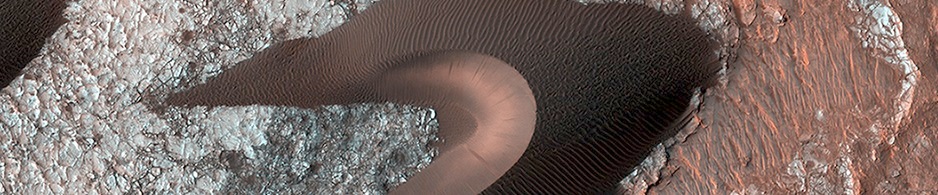
HiRISE: Terrain near Idaeus Fossae
Terrain near Idaeus Fossae. Many valleys occur all over Mars that reveal an extensive ancient history of liquid water erosion. While these valley systems are typically now covered with fine soils and sand dunes, the overall scale and shape of … Continue reading
Posted in Reports
Tagged climate change, fluvial erosion, High Resolution Imaging Science Experiment, HiPOD, HiRISE, HiRISE Picture of the Day, Idaeus Fossae, Mars Reconnaissance Orbiter, MRO, NASA, University of Arizona, valleys
Comments Off
THEMIS: Eroded layers in the south polar ice cap
THEMIS Image of the Day, March 21, 2019. This VIS image shows layering in the south polar cap. Such layers are laid down by the seasonal changes and interweave dust and ice. Then they are eroded by winds and seasonal … Continue reading
Posted in Reports
Tagged climate change, climate cycles, south polar ice cap, south polar layered deposits
Comments Off
THEMIS: Wood-grain patterns in ice and dust
THEMIS Image of the Day, March 20, 2019. This VIS image shows layering in the south polar cap. The layers are formed over thousands of years of seasonal change, reflecting ice and dust surface deposition. Where the layers appear close … Continue reading
Posted in Reports
Tagged Arizona State University, ASU, climate change, Mars Odyssey, NASA, south polar ice cap, south polar layered deposits, THEMIS, THEMIS Image of the Day, Thermal Emission Imaging System
Comments Off
HiRISE: Everything is (well) illuminated
The south polar layered deposits are icy layers that have been deposited over millions of years, preserving a climate history of Mars. In this image the layers are well illuminated to accentuate the topography. A prior image of this location … Continue reading
Posted in Reports
Tagged climate change, climate cycles, High Resolution Imaging Science Experiment, HiRISE, Mars Reconnaissance Orbiter, MRO, NASA, south polar ice cap, south polar layered deposits, University of Arizona
Comments Off
THEMIS: South polar ice cap layers
THEMIS Image of the Day, March 15, 2019. This VIS image is located on the South Polar cap. The linear features are the steep side of a polar trough. At troughs the extensive layering of the ice is exposed. The … Continue reading
Posted in Reports
Tagged Arizona State University, ASU, climate change, climate cycles, ice, Mars Odyssey, NASA, south polar ice cap, south polar layered deposits, THEMIS, THEMIS Image of the Day, Thermal Emission Imaging System
Comments Off