

-
Recent Posts
Archives
Links
general
mission instruments
- CRISM: Compact Reconnaissance Imaging Spectrometer for Mars
- CTX: Context Camera
- HiRISE: High Resolution Imaging Science Experiment
- MARSIS: Mars Advanced Radar for Subsurface and Ionosphere Sounding
- SHARAD: Shallow Radar
- THEMIS: Thermal Emission Imaging System
missions
- All Mars missions list
- Curiosity rover
- ExoMars
- Hope (al-Amal) orbiter
- InSight
- Mars Atmosphere and Volatile Evolution Mission (MAVEN)
- Mars Exploration Rovers (MER)
- Mars Express (MEX)
- Mars Odyssey
- Mars Orbiter Mission (MOM) / Mangalyaan
- Mars Reconnaissance Orbiter (MRO)
- Mars Science Laboratory (MSL)
- Perseverance Rover
- Tianwen-1 orbiter/rover
news
Tag Archives: HiRISE
HiRISE: Layers in Danielson Crater
This image shows sedimentary rock and sand within Danielson Crater, an impact crater 67 kilometers in diameter, located in the southwest Arabia Terra region of Mars. The rock was formed millions or billions of years ago when loose sediments settled … Continue reading
Posted in Reports
Tagged Arabia Terra, Danielson Crater, High Resolution Imaging Science Experiment, HiRISE, Mars Reconnaissance Orbiter, MRO, NASA, sedimentary deposits, stratigraphy, University of Arizona
Comments Off
HiRISE: Frost highlights in springtime
This image of a crater rim strikingly shows what appear to be bright white flows coming from gullies in the crater wall. However, HiRISE has been watching these gullies for some time (going all the way back to our first … Continue reading
Posted in Reports
Tagged frost, gullies, High Resolution Imaging Science Experiment, HiRISE, Mars Reconnaissance Orbiter, MRO, NASA, University of Arizona
Comments Off
HiRISE: Bedrock riddles of Nili Fossae
This image of the Nili Fossae region, to the west of the great Isidis basin, shows layered bedrock with many impact craters. Nili Fossae is one of the most mineralogically important sites on Mars. Remote observations by the infrared spectrometer … Continue reading
Posted in Reports
Tagged bedrock, carbonate minerals, clay minerals, dunes, High Resolution Imaging Science Experiment, HiRISE, iron oxides, Isidis Basin, Mars Reconnaissance Orbiter, MRO, NASA, Nili Fossae, sand dunes, TARs, transverse dunes, transverse eolian ridges, University of Arizona
Comments Off
HiRISE: Avalanche season
Every spring the sun shines on the side of the stack of layers at the North Pole of Mars known as the north polar layered deposits. The warmth destabilizes the ice and blocks break loose. When they reach the bottom … Continue reading
Posted in Reports
Tagged avalanches, High Resolution Imaging Science Experiment, HiRISE, Mars Reconnaissance Orbiter, MRO, NASA, north polar ice cap, north polar layered deposits, University of Arizona
Comments Off
HiRISE: Raindrops of sand in Copernicus Crater
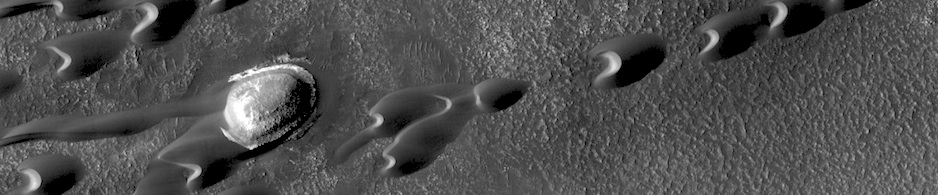
Raindrops of sand in Copernicus Crater. The dark features here look like raindrops, but are actually sand dunes rich in the mineral olivine. These types of dunes are rare on Earth as olivine rapidly weathers to clays in a wet … Continue reading
Posted in Reports
Tagged Copernicus Crater, eolian processes, High Resolution Imaging Science Experiment, HiPOD, HiRISE, HiRISE Picture of the Day, Mars Reconnaissance Orbiter, MRO, NASA, olivine, sand, sand dunes, University of Arizona
Comments Off
HiRISE: Stairway to Danielson
Stairway to Danielson. Previous images showed possible recurring slope lineae here in Danielson Crater. Additional images are needed to confirm their existence, but it’s the stair-stepped layers that also capture our attention for their stark beauty. HiRISE Picture of the … Continue reading
Posted in Reports
Tagged Danielson Crater, High Resolution Imaging Science Experiment, HiPOD, HiRISE, HiRISE Picture of the Day, layered deposits, Mars Reconnaissance Orbiter, MRO, NASA, recurring slope lineae, RSL, University of Arizona
Comments Off
HiRISE: Two flows
Two flows. The objective of this observation is to examine two flows near the base of a mound. There seem to be a number of flows like these in the region. Reull Vallis is believed to have formed when running … Continue reading
HiRISE: A beveled circular feature
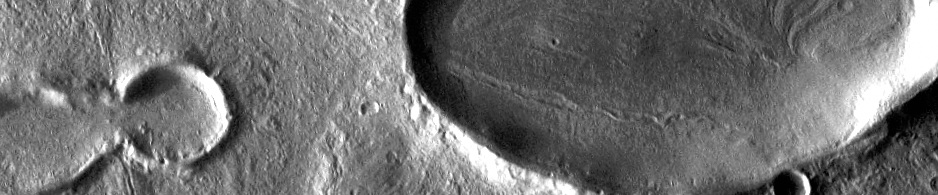
A beveled circular feature. This very interesting, beveled and flat circular surface is surrounded by craters. It is itself a pedestal crater or could it be a small ancient volcano? High resolution can afford us a closer look at the … Continue reading
Posted in Reports
Tagged High Resolution Imaging Science Experiment, HiPOD, HiRISE, HiRISE Picture of the Day, landscape evolution, Mars Reconnaissance Orbiter, MRO, NASA, pedestal craters, Terra Sabaea, University of Arizona
Comments Off
HiRISE: Hellas Planitia ridge network
A ridge network in Hellas Planitia. The objective of this observation is to examine a ridge network that seems to be forming from an upper layer of material. There are many exposures of ridges in this location, and this spot … Continue reading
Posted in Reports
Tagged Hellas Planitia, High Resolution Imaging Science Experiment, HiPOD, HiRISE, HiRISE Picture of the Day, landscape evolution, Mars Reconnaissance Orbiter, MRO, NASA, ridge networks, University of Arizona
Comments Off
HiRISE: Into the dune database
Into the dune database. Dunes are particularly suited to comprehensive planetary studies because they are abundant over a wide range of elevations and terrain types. Observations like this one are used to aid in classification and volume estimates of dunes … Continue reading
Posted in Reports
Tagged dunes, eolian processes, High Resolution Imaging Science Experiment, HiPOD, HiRISE, HiRISE Picture of the Day, Mars Reconnaissance Orbiter, MRO, NASA, sand dunes, University of Arizona
Comments Off