


-
Recent Posts
Archives
Links
general
mission instruments
- CRISM: Compact Reconnaissance Imaging Spectrometer for Mars
- CTX: Context Camera
- HiRISE: High Resolution Imaging Science Experiment
- MARSIS: Mars Advanced Radar for Subsurface and Ionosphere Sounding
- SHARAD: Shallow Radar
- THEMIS: Thermal Emission Imaging System
missions
- All Mars missions list
- Curiosity rover
- ExoMars
- Hope (al-Amal) orbiter
- InSight
- Mars Atmosphere and Volatile Evolution Mission (MAVEN)
- Mars Exploration Rovers (MER)
- Mars Express (MEX)
- Mars Odyssey
- Mars Orbiter Mission (MOM) / Mangalyaan
- Mars Reconnaissance Orbiter (MRO)
- Mars Science Laboratory (MSL)
- Perseverance Rover
- Tianwen-1 orbiter/rover
news
Tag Archives: wind
MARCI weather report, August 26-27, 2019
Weather patterns were fairly typical last week for this time of Mars year. In the north, local-scale dust storms were spotted along seasonal north polar cap edge. Diffuse water-ice clouds associated with the aphelion cloud-belt continued to be more dominant … Continue reading
Posted in Reports
Tagged atmosphere, clouds, dust, dust storms, haze, Malin Space Science Systems, MARCI, Mars Color Imager, Mars Reconnaissance Orbiter, MRO, MSSS, NASA, storms, weather, wind
Comments Off
MARCI weather report, August 19-25, 2019
Afternoon weather conditions were again very seasonal this past week. Local dust storms were observed along the seasonal receding north polar cap edge and at southern low-to-mid latitudes. The developing aphelion cloud belt continued to be prominent at equatorial latitudes. … Continue reading
Posted in Reports
Tagged aphelion cloud belt, Arsia Mons, Ascraeus Mons, atmosphere, clouds, Curiosity, dust, dust storms, Elysium Planitia, Gale Crater, haze, InSight, Malin Space Science Systems, MARCI, Mars Color Imager, Mars Reconnaissance Orbiter, MRO, MSSS, NASA, Olympus Mons, orographic clouds, Pavonis Mons, storms, weather, wind
Comments Off
MARCI weather report, August 12-18, 2019
Afternoon weather conditions were very seasonal this past week. Local dust storms were observed along the seasonal receding north polar cap edge (north of Acidalia) and at southern low-latitudes (Margaritifer and Solis) and mid-latitudes (from Aonia to Cimmeria). Condensate clouds … Continue reading
Posted in Reports
Tagged atmosphere, clouds, dust, dust storms, haze, Malin Space Science Systems, MARCI, Mars Color Imager, Mars Reconnaissance Orbiter, MRO, MSSS, NASA, storms, weather, wind
Comments Off
MARCI weather report, August 5-11, 2019
During the past week on Mars, transient dust storms were observed along the edge of the south polar hood in Sirenum and Aonia. While in the northern hemisphere, storms developed along the seasonal cap edge, with one arcuate-shaped storm propagating … Continue reading
Posted in Reports
Tagged atmosphere, clouds, dust, dust storms, haze, Malin Space Science Systems, MARCI, Mars Color Imager, Mars Reconnaissance Orbiter, MRO, MSSS, NASA, storms, weather, wind
Comments Off
MARCI weather report, July 15-21, 2019
For the past week on Mars, small sporadic dust storms continued along the south polar hood. Dust activity was also observed a bit further north over Solis Planum, central Cimmeria, and just south of eastern Valles Marineris. Looking to the … Continue reading
Posted in Reports
Tagged atmosphere, clouds, dust, dust storms, haze, Malin Space Science Systems, MARCI, Mars Color Imager, Mars Reconnaissance Orbiter, MRO, MSSS, NASA, storms, weather, wind
Comments Off
THEMIS: Patterns on patterns in the Olympia Undae dunes
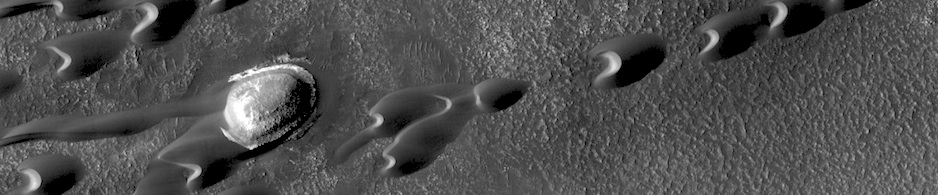
THEMIS Image of the Day, July 19, 2019. Today’s VIS image shows a small portion of Olympia Undae. Olympia Undae is a large dune field that dominates the plains along part of the north polar cap. This image was collected … Continue reading
Posted in Reports
Tagged Arizona State University, ASU, Mars Odyssey, NASA, north polar sand sea, northern plains, Olympia Undae, sand, sand dunes, THEMIS, THEMIS Image of the Day, Thermal Emission Imaging System, wind
Comments Off
MARCI weather report, July 8-14, 2019
Dust-lifting occurred northwest of Argyre at the beginning of the week, giving rise to dusty conditions over eastern Valles Marineris for several afternoons. Looking eastward across the southern highlands, numerous small short-lived dust events were observed over Terra Cimmeria. The … Continue reading
Posted in Reports
Tagged atmosphere, clouds, dust, dust storms, haze, Malin Space Science Systems, MARCI, Mars Color Imager, Mars Reconnaissance Orbiter, MRO, MSSS, NASA, storms, weather, wind
Comments Off
MARCI weather report, July 1-7, 2019
Dust storm activity picked-up over the northern lowlands of Mars this past week. Near the middle of the week, long arcuate-shaped dust storms propagated eastward across the plains of Acidalia. Subsequent dust events swept northward over the perennial north polar … Continue reading
Posted in Reports
Tagged atmosphere, clouds, dust, dust storms, haze, Malin Space Science Systems, MARCI, Mars Color Imager, Mars Reconnaissance Orbiter, MRO, MSSS, NASA, storms, weather, wind
Comments Off
MARCI weather report, June 24-30, 2019
There was a slight uptick in frequency of dust-lifting events over the southern hemisphere of Mars this past week. Dust storms north of Argyre were once again advected equatorwards — this time extending past eastern Valles Marineris to Xanthe Terra. … Continue reading
Posted in Reports
Tagged atmosphere, clouds, dust, dust storms, haze, Malin Space Science Systems, MARCI, Mars Color Imager, Mars Reconnaissance Orbiter, MRO, MSSS, NASA, storms, weather, wind
Comments Off
What makes martian methane vanish so quickly?
The processes behind the release and consumption of methane on Mars have been discussed since methane was measured for the first time for approximately 15 years ago. Now, an interdisciplinary research group from Aarhus University has proposed a previously overlooked … Continue reading