

-
Recent Posts
Archives
Links
general
mission instruments
- CRISM: Compact Reconnaissance Imaging Spectrometer for Mars
- CTX: Context Camera
- HiRISE: High Resolution Imaging Science Experiment
- MARSIS: Mars Advanced Radar for Subsurface and Ionosphere Sounding
- SHARAD: Shallow Radar
- THEMIS: Thermal Emission Imaging System
missions
- All Mars missions list
- Curiosity rover
- ExoMars
- Hope (al-Amal) orbiter
- InSight
- Mars Atmosphere and Volatile Evolution Mission (MAVEN)
- Mars Exploration Rovers (MER)
- Mars Express (MEX)
- Mars Odyssey
- Mars Orbiter Mission (MOM) / Mangalyaan
- Mars Reconnaissance Orbiter (MRO)
- Mars Science Laboratory (MSL)
- Perseverance Rover
- Tianwen-1 orbiter/rover
news
Monthly Archives: May 2011
Home Plate: Worth a second visit?
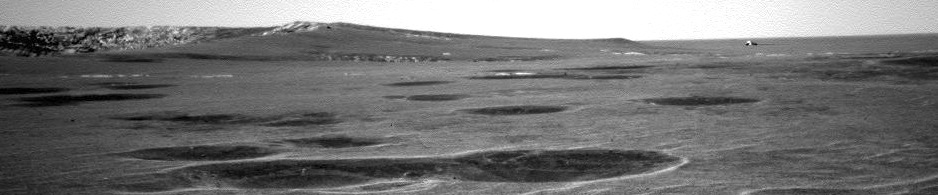
In Gusev Crater’s Columbia Hills, explored by the Mars Exploration Rover Spirit, a low plateau about 100 yards wide dubbed Home Plate has turned out to be a Pretty Big Deal. Although a deep bed of soft sand on its … Continue reading
Posted in Reports
Tagged geysers, Gusev Crater, Home Plate, hot springs, Mars Exploration Rovers, MER, silica, Spirit
Comments Off
About that methane….
Methane is a greenhouse gas that on Earth most often has a biological origin, although it can also come from volcanic activity. Because of the biological implications – and because any Martian methane will be destroyed by oxygen in the … Continue reading
How to date a volcano
Without rock samples to analyze in a laboratory, how can you tell the age of a Martian volcano? A team led by Stuart Robbins (University of Colorado) used high-resolution images to count craters in the calderas (summit collapse pits) of … Continue reading
Big bangs
Really large meteorites produce impact scars big enough to be called basins. Although not defined by a particular size, basins differ from smaller craters in that the floor of a basin follows the planet’s curvature. New calculations published in the … Continue reading
Chips off the old block?
Are Martian moons Phobos and Deimos escaped asteroids, as sometimes proposed? Robert Craddock (National Air and Space Museum) suggests in a paper in the February 2011 issue of Icarus they may have come from a large impact on Mars instead. … Continue reading
Killing Earth bugs thoroughly
Mars seems earthlike in numerous ways, but it’s still a rugged environment for life. A team of scientists led by A. P. Johnson (Indiana University) examined just how rough Mars is for several terrestrial organisms and amino acids by subjecting … Continue reading