
-
Recent Posts
Archives
Links
general
mission instruments
- CRISM: Compact Reconnaissance Imaging Spectrometer for Mars
- CTX: Context Camera
- HiRISE: High Resolution Imaging Science Experiment
- MARSIS: Mars Advanced Radar for Subsurface and Ionosphere Sounding
- SHARAD: Shallow Radar
- THEMIS: Thermal Emission Imaging System
missions
- All Mars missions list
- Curiosity rover
- ExoMars
- Hope (al-Amal) orbiter
- InSight
- Mars Atmosphere and Volatile Evolution Mission (MAVEN)
- Mars Exploration Rovers (MER)
- Mars Express (MEX)
- Mars Odyssey
- Mars Orbiter Mission (MOM) / Mangalyaan
- Mars Reconnaissance Orbiter (MRO)
- Mars Science Laboratory (MSL)
- Perseverance Rover
- Tianwen-1 orbiter/rover
news
Monthly Archives: February 2013
What Earth’s saltiest pond says about Mars
An Antarctic pond that’s the saltiest natural body of water on Earth stays wet in part by pulling moisture out of the air, scientists have discovered. And that has implications for possible brine seeps and reservoirs on Mars. Don Juan … Continue reading
Posted in Reports
Tagged Antarctica, brine seeps, brines, calcium chloride, deliquescence, Don Juan Pond, ice, lineae, liquid water, ponds, recurring slope lineae, RSL, water
Comments Off
Blowing sand and moving dunes in Gale Crater
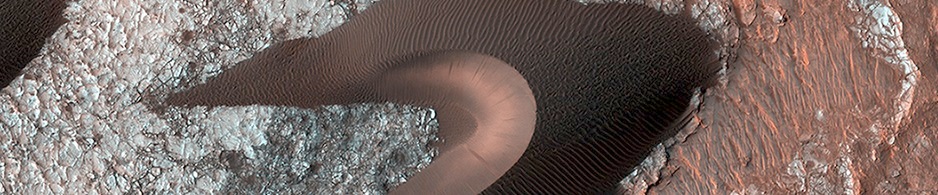
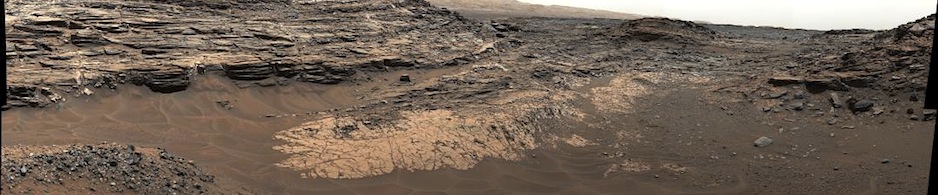
Curiosity, NASA’s Mars Science Laboratory rover, is exploring the floor of Gale Crater. Its main science target, however, is the giant stack of water-altered sediments that make up Mount Sharp, Gale Crater’s central mound. But to reach the mound, the … Continue reading
Posted in Reports
Tagged Curiosity, dunes, Gale Crater, HiRISE, Mars Science Laboratory, sand, sand dunes, sand ripples, wind
Comments Off
Grooving on Phobos
Phobos, the larger moon of Mars, has a surface covered in craters, dust, boulders – and a great many semi-parallel and intersecting grooves. One theory for the grooves’ origin, proposed in 2011, holds that they are impact scars from chains … Continue reading