






Opportunity report, Sol 5222, by A.J.S. Rayl, The Planetary Society

20181004_3-Calling-Oppy-goldstone_f840October 4, 2018: Team Initiates Plan to Recover Oppy, Orbiter Sends Postcard, Storm Ends: As the global storm that wrapped the Red Planet in a cloud of dust since late June finally gave up the ghost in September, the sky continued to clear over Endeavour Crater and the Mars Exploration Rovers (MER) mission initiated the NASA-approved two-step plan to reestablish contact with Opportunity.

The mission operations team at the Jet Propulsion Laboratory (JPL), home to all of NASA’s Mars spacecraft, launched the first phase of the strategy on September 11th, by increasing attempts to search for Opportunity’s signal from three times a week to multiple times each day and electronically nudge the rover awake. The team also began listening and looking for the rover’s signal over a broader range of times and frequencies recorded by the Deep Space Network’s (DSN’s) most sensitive radio receivers. But the nearly 15-year-old pioneer explorer has not yet phoned home.

(…)

Most mission operations team members quickly concluded then that they would be waiting for a good long while. “We knew a few days after we lost contact that it was going to be three, four, five months before we might her from Opportunity again,” said JPL System Engineer Michael Staab. One of the mission’s four flight directors, he was tapped to be lead engineer for dust storm ops a couple of weeks before the “mother of all dust storms,” as he described it, stopped the rover in her tracks.

(…)

September’s end marked 112 sols or Martian days without communication. Over the past 14 years and nine months, this team has never gone long without communicating with Opportunity, and never this long. They have no idea of the rover’s current state of health or how many faults she has tripped, or the state of her batteries, or how dirty her solar arrays are. “The team is very worried about the future of Opportunity,” acknowledged MER Project Manager John Callas, of JPL.

The second step of the strategy to recover the rover, known as passive listening, an expanded version of what the ops team has been doing since losing contact in June, is currently scheduled to begin in a few weeks, near the end of October. This phase – which will run at least through January 2019 – will essentially continue ‘keeping an ear out’ for Opportunity through the DSN’s global array of sensitive radio receivers around Earth.

“Walking away anytime before the end of January would mean we could be leaving a potentially perfectly working spacecraft on the surface because we’re impatient,” said Staab… [Much more at link]
Posted in Reports | Tagged , , , , , , | Comments Off

Mars dirt for sale: $20 a kilogram, made in USA

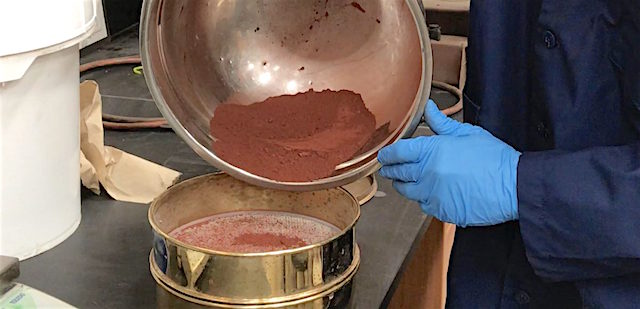
UCF-mars-dirtThe University of Central Florida is selling Martian dirt, $20 a kilogram plus shipping.

This is not fake news. A team of UCF astrophysicists has developed a scientifically based, standardized method for creating Martian and asteroid soil known as simulants.

The team published its findings this month in the journal Icarus.

“The simulant is useful for research as we look to go to Mars,” says Physics Professor Dan Britt, a member of UCF’s Planetary Sciences Group. “If we are going to go, we’ll need food, water and other essentials. As we are developing solutions, we need a way to test how these ideas will fare.”

For example, scientists looking for ways to grow food on Mars — cue the 2015 film The Martian — need to test their techniques on soil that most closely resembles the stuff on Mars.

“You wouldn’t want to discover that your method didn’t work when we are actually there,” Britt says. “What would you do then? It takes years to get there.”

UCF’s formula is based on the chemical signature of the soils on Mars collected by the Curiosity rover. Britt built two calibration targets that were part of Curiosity rover… [More at links]

Posted in Reports | Tagged | Comments Off

Opportunity: No signal since June

NASA Mars Exploration Rover Status Report, October 5, 2018:No signal from Opportunity has been heard since Sol 5111 (June 10, 2018).

It is expected that Opportunity has experienced a low-power fault, a mission clock fault and an up-loss timer fault. The dust storm on Mars continues to abate with atmospheric opacity (tau) over the rover site around 1.1.

The project has been listening for the rover over a broad range of times using the Deep Space Network (DSN) Radio Science Receiver and commanding “sweep and beeps” throughout their daily DSN pass to address a possible complexity with certain conditions within the mission clock fault… [More at link]

Posted in Reports | Tagged , , , , , , | Comments Off

Curiosity update: Geology, it’s like investigating a crime scene

pia19927_Blaney7-br2[Ed note: Post by planetary geologist Susanne Schwenzer, The Open University, Milton Keynes, UK]

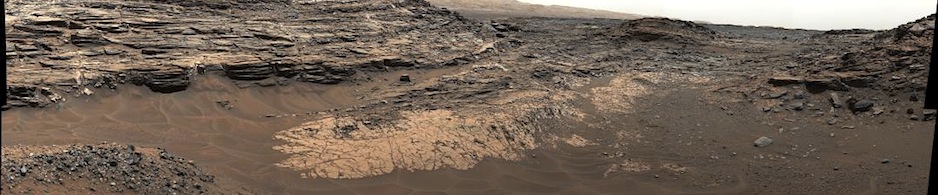
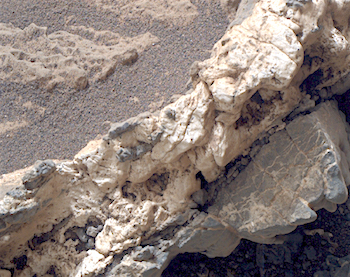
Sometimes planetary geology is like forensics. We are presented with a crime scene: Something broke down the original igneous rock, and made all those clays, veins and hematite nodules. We know this something was a fluid, but in order to find out exactly what has happened, we need to examine all the evidence we have. That often starts with investigating the images, and in great detail. That’s when we look at Mastcam images for the geologic context, then RMI and/or MAHLI for the close-up details. But what about the chemistry?

We are a small team here in the UK, specializing in what is called “thermochemical modelling.” Thermochemical modelling uses mathematical equations that are based on known reactions of minerals with water. The models combine many thousands of such reactions into equations, which can be solved iteratively to arrive at a reaction path for a known rock composition. And once we determine what reacted and how, we can also infer which chemical elements remained in the water because they were not included in the reaction products.

In other words, we can find out how the chemical elements are distributed between the fluid and the newly forming minerals. Some of our French and American colleagues use this method too, and we always have great discussions to advance our work. We take all the data that we have, images and chemistry from ChemCam and APXS, and where available also mineralogy from CheMin. That’s the evidence at our crime scene. But who broke the rock and left all those clays and white veins? [More at link]

Posted in Reports | Tagged , , , , , , , , | Comments Off

HiRISE: Erosion within Cerberus Fossae

tumblr_pg519ly8Hp1rlz4gso2_1280A Context Camera image shows a small bench in the middle of the Cerberus Fossae at the head of Athabasca Valles. Small cataracts appear on this bench. Do these reflect erosion as water drained back into the subsurface at the conclusion of the flood?

Beautiful Mars series. [More at links]

Posted in Reports | Tagged , , , , , , , , , , | Comments Off

Curiosity to temporarily switch ‘brains’

PIA22486b-16Engineers at NASA’s Jet Propulsion Laboratory in Pasadena, California, this week commanded the agency’s Curiosity rover to switch to its second computer. The switch will enable engineers to do a detailed diagnosis of a technical issue that has prevented the rover’s active computer from storing science and some key engineering data since Sept. 15.

Like many NASA spacecraft, Curiosity was designed with two, redundant computers — in this case, referred to as a Side-A and a Side-B computer — so that it can continue operations if one experiences a glitch. After reviewing several options, JPL engineers recommended that the rover switch from Side B to Side A, the computer the rover used initially after landing.

The rover continues to send limited engineering data stored in short-term memory when it connects to a relay orbiter. It is otherwise healthy and receiving commands. But whatever is preventing Curiosity from storing science data in long-term memory is also preventing the storage of the rover’s event records, a journal of all its actions that engineers need in order to make a diagnosis. The computer swap will allow data and event records to be stored on the Side-A computer… [More at link]

Posted in Reports | Tagged , , , , | Comments Off

THEMIS: Crater mounds in Crommelin and Firsoff craters

Crater mounds in false colorTHEMIS Image of the Day, October 8, 2018. This VIS image shows parts of Crommelin and Firsoff Craters. Both craters contain large mounds of layered materials on the crater floor. This material was deposited after the craters formed and may have been created by the same processes. These craters are located near Meridiani Planum.

The THEMIS VIS camera contains 5 filters. The data from different filters can be combined in multiple ways to create a false color image. These false color images may reveal subtle variations of the surface not easily identified in a single band image.

See more THEMIS Images of the Day by geological subject.

Posted in Reports | Tagged , , , , , , , , , | Comments Off

HiRISE: Crazy terrain in Utopia

tumblr_pfmiivhPRE1rlz4gso2_1280That crazy terrain. This is the floor of a crater in Utopia Planitia.

Beautiful Mars series. [More at links]

Posted in Reports | Tagged , , , , , , , , , , | Comments Off

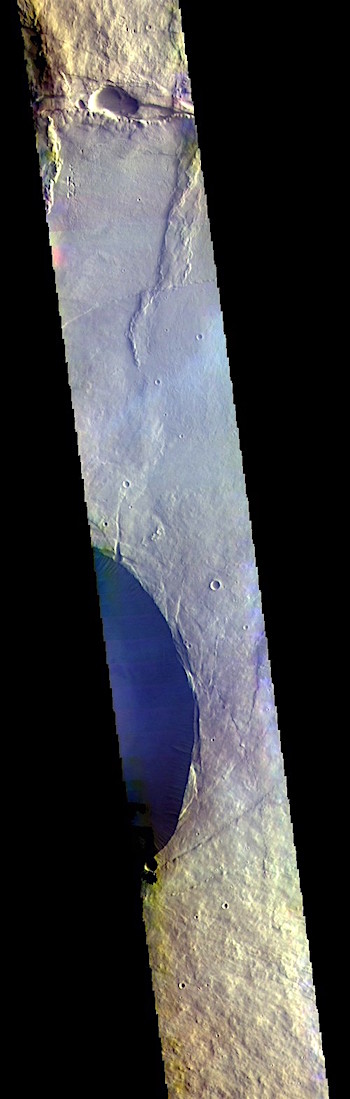
THEMIS: Over the summit of Pavonis Mons

Over the summit of Pavonis Mons (THEMIS_IOTD_20180928)THEMIS Image of the Day, September 28, 2018. Today’s VIS image crosses the flanks and summit of Pavonis Mons. Calderas are down-dropped areas which collapse when lava inside the volcano withdraws, removing its support for the heavy rock layers above.

The THEMIS VIS camera contains 5 filters. The data from different filters can be combined in multiple ways to create a false color image. These false color images may reveal subtle variations of the surface not easily identified in a single band image.

See more THEMIS Images of the Day by geological subject.

Posted in Reports | Tagged , , , , , , , , , , | Comments Off

HiRISE: Knobs on the rim of a circular feature

tumblr_pfki2rV1nD1rlz4gso1_1280Knobs on the rim of a circular feature. And there might be clays on this cluster of knobs which as a unit, look very interesting.

Beautiful Mars series. [More at links]

Posted in Reports | Tagged , , , , , , , , | Comments Off