





Tiny motor on Curiosity detected onset of global dust storm at Gale Crater

dust-predictionNASA’s Mars Reconnaissance Orbiter (MRO) provided the earliest insights on May 30 when it observed an accumulation of dust in the atmosphere near Perseverance Valley, where NASA’s Opportunity rover is exploring.

The increasingly hazy storm, the biggest since 2007, forced Opportunity to shut down science operations by June 8, given that sunlight couldn’t penetrate the dust to power the rover’s solar panels. Scientists are anxiously waiting for the roving explorer to regain power and phone home.

Meanwhile, on June 5, evidence quietly materialized on the other side of the globe that the storm was growing and beginning to affect Gale Crater, the research site of NASA’s Curiosity rover. (The storm was officially classified as global on June 20.)

It came from an unexpected source: an actuator, or motor, that powers a lid to a funnel that takes in samples of powdered Martian rock dropped in by Curiosity’s drill. The samples then undergo chemical analysis by the portable Sample Analysis at Mars (SAM) chemistry lab, designed by scientists at NASA’s Goddard Space Flight Center in Greenbelt, Maryland, and built into Curiosity’s belly.

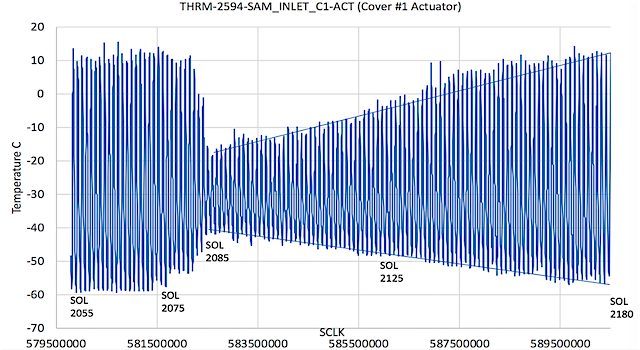
Benito Prats, a Goddard electromechanical engineer, noticed the dust storm slowly reaching Curiosity through the continuous temperature readings he collected from actuator sensors.

“All my charts showed the dust storm effect on the actuator because it’s exposed; it’s sitting out there on the rover deck,” said Prats. “All of a sudden, I saw the daytime temperature drop really quickly.”

At night, too, said Prats, he saw temperatures rising above normal levels. This happens during a dust storm because less sun penetrates the dusty atmosphere during the day, cooling the surface of the planet, while at night, the warmer, dusty atmosphere heats the ground. Other weather tools on the explorer, such as the Rover Environmental Monitoring Station, which measures air temperature, atmospheric pressure, and other environmental conditions, were also beginning to indicate accumulating dust… [More at link]
Posted in Reports | Tagged , , , , , , , , , , , , | Comments Off

HiRISE: Intricate CO2 frost patterns

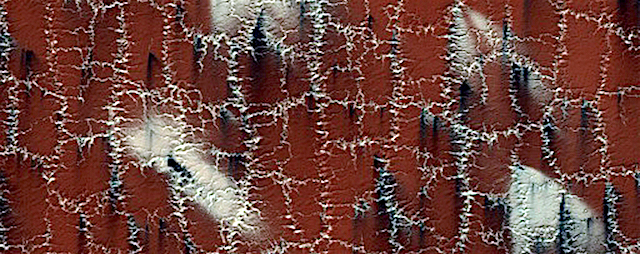
ESP_056195_0950This polar terrain is cut by an intricate pattern of channels. Carbon dioxide frost in the channels make them bright at this time of year. [More at link]

Posted in Reports | Tagged , , , , , , , , | Comments Off

THEMIS: Landslide in Mutch Crater

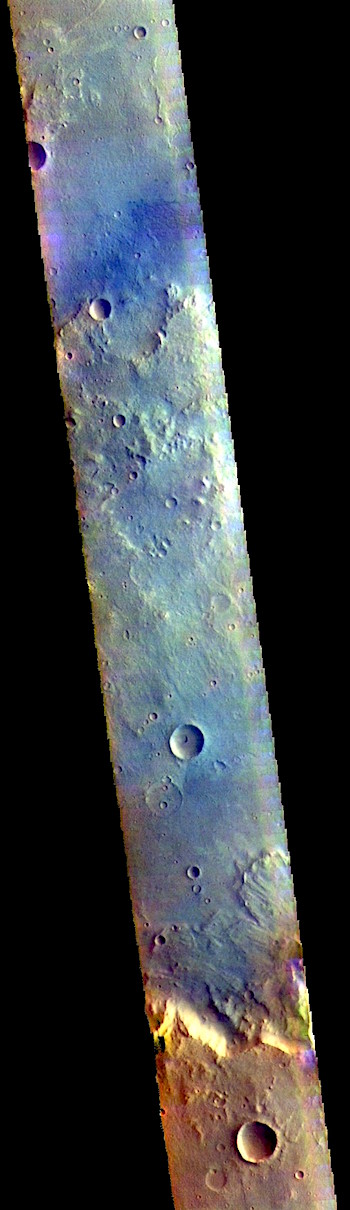
False-color slice across Mutch Crater (THEMIS_IOTD_20180927)THEMIS Image of the Day, September 27, 2018. Today’s image shows part of Mutch Crater in Xanthe Terra.

At the bottom of the image, visible in warm tones, is a short section of the crater’s southern rim. Note the landslide debris that flowed off the rim-wall onto the crater floor. The slide was triggered by the impact of a large meteorite on the crater’s rim, just outside the field of view to the right.

The THEMIS VIS camera contains 5 filters. The data from different filters can be combined in multiple ways to create a false color image. These false color images may reveal subtle variations of the surface not easily identified in a single band image.

See more THEMIS Images of the Day by geological subject.

Posted in Reports | Tagged , , , , , , , , , , | Comments Off

HiRISE: Clay outcrop near Maja Valles

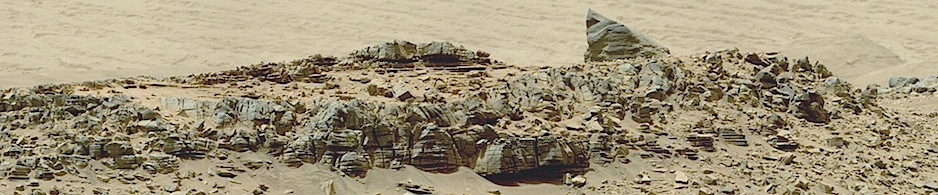
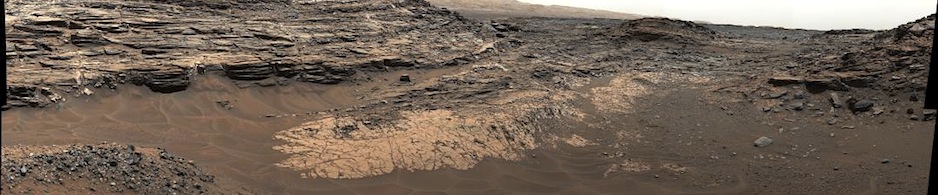
tumblr_pfkhqkNRrt1rlz4gso2_1280A clay outcrop near Maja Valles. Maja Valles is a large, ancient outflow channel in the Lunae Palus quadrangle on Mars. The name is a Nepali word for “Mars”, and parts of the system have been partially buried by thin volcanic debris.

Beautiful Mars series. [More at links]

Posted in Reports | Tagged , , , , , , , , , , , , , | Comments Off

MARCI weather report: September 17-23, 2018

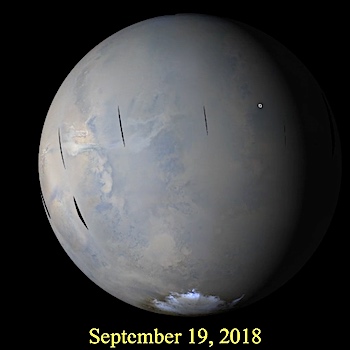
MARCI-September-19-2018During the past week, dusty conditions continued along the retreating seasonal south polar ice cap edge. Sites of activity included Aonia, southern Sirenum, and southwest of Hellas — near the ‘Mountains of Mitchel.’ Looking further northward, dust lifting was relatively uneventful apart from a local-scale dust storm over northern Amazonis near week’s end. Condensate water ice clouds endured above Arsia Mons… [More at link, including video]

Posted in Reports | Tagged , , , , , , , , , , , , , , , , | Comments Off

Early Mars: Right ingredients for subsurface life

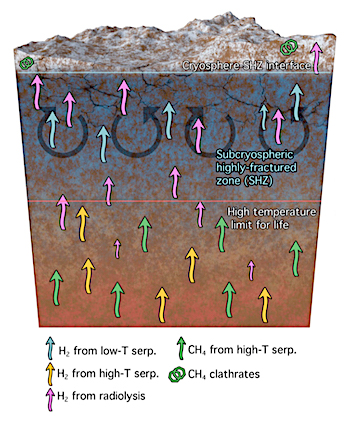
figure-6A new study shows that the breakdown of water molecules trapped in ancient Martian rocks likely produced enough chemical energy to sustain microorganisms for hundreds of millions of years beneath the Red Planet’s surface. (…)

“We showed, based on basic physics and chemistry calculations, that the ancient Martian subsurface likely had enough dissolved hydrogen to power a global subsurface biosphere,” said Jesse Tarnas, a graduate student at Brown University and lead author of a study published in Earth and Planetary Science Letters. “Conditions in this habitable zone would have been similar to places on Earth where underground life exists.”

Earth is home to what are known as subsurface lithotrophic microbial ecosystems — SliMEs for short. Lacking energy from sunlight, these subterranean microbes often get their energy by peeling electrons off of molecules in their surrounding environments. Dissolved molecular hydrogen is a great electron donor and is known to fuel SLiMEs on Earth.

This new study shows that radiolysis, a process through which radiation breaks water molecules into their constituent hydrogen and oxygen parts, would have created plenty of hydrogen in the ancient Martian subsurface. The researchers estimate that hydrogen concentrations in the crust around 4 billion years ago would have been in the range of concentrations that sustain plentiful microbes on Earth today. (…)

“People have a conception that a cold early Mars climate is bad for life, but what we show is that there’s actually more chemical energy for life underground in a cold climate,” Tarnas said. “That’s something we think could change people’s perception of the relationship between climate and past life on Mars.” [More at links]

Posted in Reports | Tagged , , | Comments Off

THEMIS: Sands of Tombaugh Crater

Sands of Tombaugh Crater (THEMIS_IOTD_20180926)THEMIS Image of the Day, September 26, 2018. Tombaugh Crater is in the center of this VIS image. Dark blue tones are basaltic sands of the floor of the crater.

The THEMIS VIS camera contains 5 filters. The data from different filters can be combined in multiple ways to create a false color image. These false color images may reveal subtle variations of the surface not easily identified in a single band image.

See more THEMIS Images of the Day by geological subject.

Posted in Reports | Tagged , , , , , , , , , | Comments Off

Opportunity: Still mum, but at least it’s visible

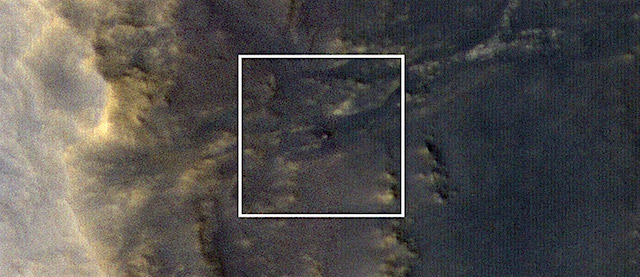
PIA22549-16NASA still hasn’t heard from the Opportunity rover, but at least the agency can see it again. A new image produced by HiRISE shows a small object on the slopes of Perseverance Valley. That object is Opportunity, which was descending into the Martian valley, when a dust storm swept over the region a little more than 100 days ago.

That storm was one of several that stirred up enough dust to enshroud most of the Red Planet in a planet-encircling dust event and blocked sunlight from reaching the surface. The global dust levels have steadily decreased in the past several weeks. The current tau—an exponential measure of how much sunlight reaches the surface—was estimated to be about 1.3 by MRO’s Mars Color Imager (MARCI) camera, meaning that about 25 percent of the direct sunlight is now reaching the surface.

A lack of sunlight caused solar-powered Opportunity to go into hibernation. The rover’s team at NASA’s Jet Propulsion Laboratory in Pasadena, California, hasn’t heard from the rover since. However, given the current level of dust clearing, JPL last week began increasing the frequency of commands it beams to the 14-year-old rover.

A key unknown is how much dust has fallen on the solar arrays. The HiRISE image shows some reddening of the surrounding area, suggesting dust fallout, but it is not possible to determine how much dust is on the arrays themselves. As the dusty sky continues to clear, the frequent commanding will continue and imaging will be repeated…. [More at link, including a then-and-now animated GIF]

Posted in Reports | Tagged , , , , , , , , | Comments Off

Mars Orbiter Mission: Four years in orbit

42500870_2138042709766995_2351649441015922688_n42414585_2146744218882262_8552218048927367168_nIt’s been four years since [India's] Mars Orbiter successfully got inserted into Martian orbit on September 24, 2014 in its first attempt. MOM‘s mission life was expected to be six months! So far, the Mars Colour Camera has acquired 980+ images. Mars Atlas is also ready. [More at link]

Posted in Reports | Tagged , , , , , , | Comments Off

THEMIS: North polar dunes meet Escorial Crater

Escorial Crater and polar dunes (THEMIS_IOTD_20180925)THEMIS Image of the Day, September 25, 2018. At the bottom of this image is Escorial Crater. The dune field to the north are called Hyperboreae Undae. The subtle blue and yellow arcs over the crater are clouds.

The THEMIS VIS camera contains 5 filters. The data from different filters can be combined in multiple ways to create a false color image. These false color images may reveal subtle variations of the surface not easily identified in a single band image.

See more THEMIS Images of the Day by geological subject.

Posted in Reports | Tagged , , , , , , , , , , , | Comments Off