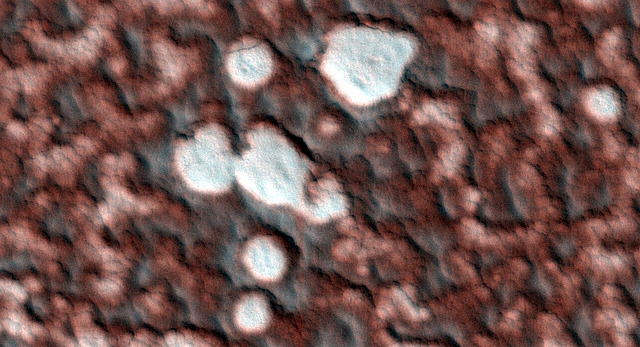



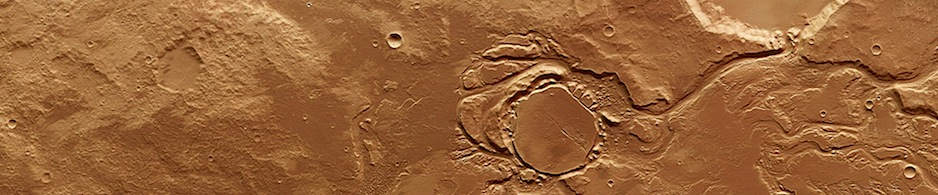
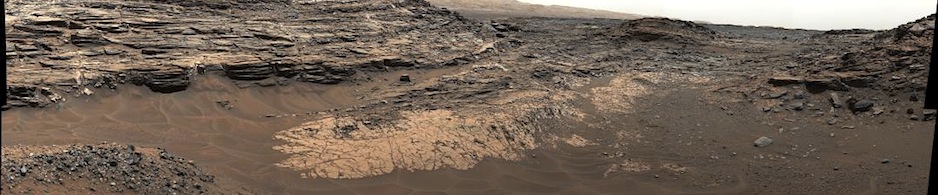
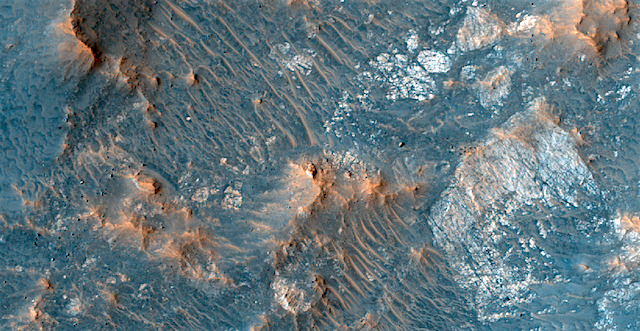
HiRISE: Clays in a well-preserved impact crater in Acidalia Planitia

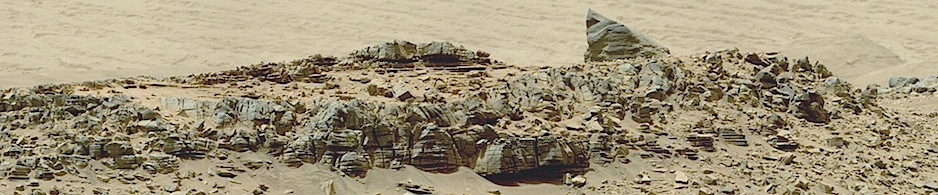
tumblr_pfkhd9pDvN1rlz4gso2_1280Clays in a well-preserved impact crater in Acidalia Planitia. Beautiful Mars series. [More at links]
Posted in Reports | Tagged , , , , , , , , , | Comments Off

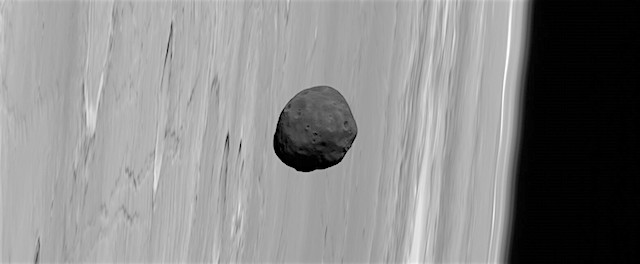
Phobos may have come from big impact on Mars

phoboslimb_marsexpressSpectral fingerprints of Phobos’ surface support an ancient big crash origin for the Martian moon.

The weird shapes and colors of the tiny Martian moons Phobos and Deimos have inspired a long-standing debate about their origins.

The dark faces of the moons resemble the primitive asteroids of the outer solar system, suggesting the moons might be asteroids caught long ago in Mars’ gravitational pull. But the shapes and angles of the moons’ orbits do not fit this capture scenario.

A fresh look at 20-year-old data from the Mars Global Surveyor mission lends support to the idea the moons of Mars formed after a large impact on the planet threw a lot of rock into orbit, according to a new study published in the Journal of Geophysical Research: Planets, a publication of the American Geophysical Union.

The dataset held unplumbed clues to the stuff Phobos is made of, which may be more similar to the crust of the Red Planet than it appears, according to the study’s authors.

“The fun part for me has been taking a poke at some of the ideas out there using an old dataset that’s has been underutilized,” said Tim Glotch, a geoscientist at Stony Brook University in New York and the lead author of the new study.

Marc Fries, a planetary scientist and curator of cosmic dust at NASA’s Johnson Space Center, who was not involved in the new study, said the inability to explain the genesis of two moons around a neighboring planet is a glaring shortcoming in scientists’ understanding of moon formation… [More at links]

Posted in Reports | Tagged , , | Comments Off

Curiosity team confident rover will bounce back from glitch

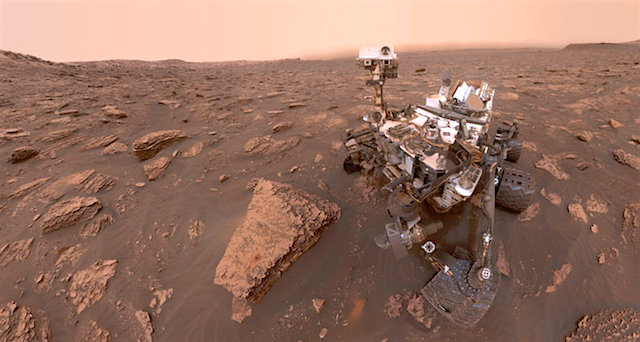
aHR0cDovL3d3dy5zcGFjZS5jb20vaW1hZ2VzL2kvMDAwLzA3OS81Njgvb3JpZ2luYWwvbWFycy1kdXN0LXN0b3JtLTIwMTgtY3VyaW9zaXR5LmpwZw==[From Space.com] It’s still unclear exactly what’s ailing NASA’s Curiosity Mars rover, but mission team members are optimistic they can get the six-wheeled robot up and running again.

Since last Saturday night (Sept. 15), Curiosity has had trouble beaming home to Earth certain science and engineering data stored in its memory. Curiosity has stood down from all science operations while the mission team investigates the problem.

The issue is related to the rover’s internal file system. Something is preventing the rover from accessing the locations where the affected data are stored, said Curiosity deputy project manager Steve Lee, of NASA’s Jet Propulsion Laboratory in Pasadena, California… [More at link]

Posted in Reports | Tagged , , , , , , , , | Comments Off

HiRISE: Up above the dust clouds

ESP_056010_1985When much of Mars was enshrouded by a recent massive dust storm, HiRISE captured this clear view of the surface because of the target’s unique location.

Olympus Mons is the biggest volcano in the Solar System, reaching a height of nearly 25 kilometers, almost 3 times taller than Mount Everest on Earth. This view of the western flank of Olympus Mons shows the surface at an elevation of 21.3 kilometers, far above the swirling dust clouds. In this picture, we can see details of the flows that erupted over millions of years to form the enormous shield volcano.

A similar situation unfolded in the early days of Mars exploration, when NASA’s Mariner 9 spacecraft reached orbit around Mars in 1971 and was soon joined by two Soviet space probes, Mars 2 and Mars 3. Mars was blanketed at the time by a global dust storm that persisted for months and completely obscured the surface of the planet. As the storm ended and the dust began to settle out of the atmosphere, the tops of the giant volcanoes were the first portions of the surface to be seen… [More at link]

Posted in Reports | Tagged , , , , , , , , , , | Comments Off

MAVEN: Four (Earth) years in Mars orbit

[Ed. note: The video shows a presentation on September 20, 2018, by MAVEN principal investigator Bruce Jakosky providing an update on the latest data from the mission. The story excerpted below is on the MAVEN mission website.]

Today [September 21], NASA’s MAVEN spacecraft celebrates four years in orbit studying the upper atmosphere of the Red Planet and how it interacts with the Sun and the solar wind. To mark the occasion, the team has released a selfie image of the spacecraft at Mars.

“MAVEN has been a tremendous success,” said Bruce Jakosky, MAVEN principal investigator from the University of Colorado Boulder. “The spacecraft and instruments continue to operate as planned, and we’re looking forward to further exploration of the Martian upper atmosphere and its influence on climate.”

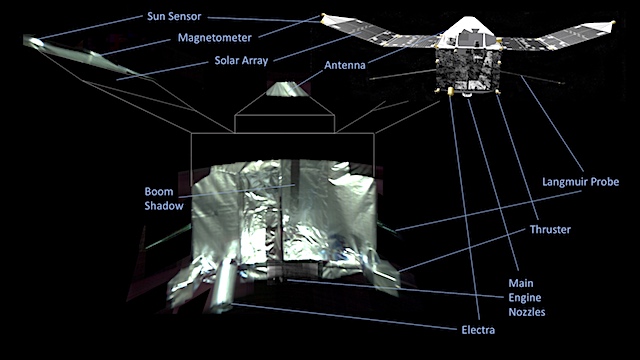
MAVEN has obtained a selfie image [below], looking at ultraviolet wavelengths of sunlight reflected off of components of the spacecraft. The image was obtained with the Imaging Ultraviolet Spectrograph (IUVS) instrument that normally looks at ultraviolet emissions from the Martian upper atmosphere. The IUVS instrument is mounted on a platform at the end of a 1.2-m boom (its own “selfie stick”), and by rotating around the boom can look back at the spacecraft. The selfie was made from 21 different images, obtained with the IUVS in different orientations, that have been stitched together… [More at links]

selfie_composite_annotated

Posted in Reports | Tagged , , , , , , | Comments Off

HiRISE: Martian haze

ESP_056411_2000A massive, planet-encircling dust storm occurred on Mars during the summer of 2018, resulting in many images where the surface could not be seen due to the dust. This is a problem for HiRISE but also gives us an exciting opportunity to see how the dust storm changed the surface.

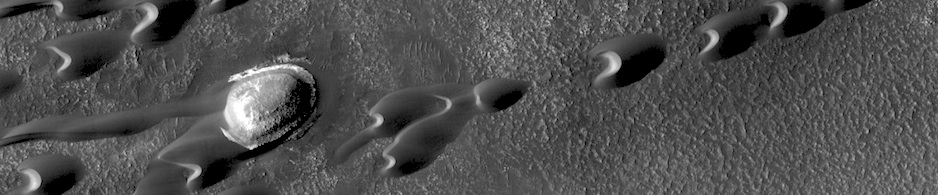
We acquired this image as the storm was just starting to end and shows a region of dark sand dunes. The surface is only barely visible. However, taking images like this will let us see the effects of the storm as soon as possible. Despite the murk, some surface features are visible.

The cutout shows a comparison between this image and ESP_044240_2000, which covered the same spot in 2016. The old image shows a dark sand dune with streaks where sand has slumped down the steep slope. The new image, despite the haze, shows a different pattern of streaks. Because the storm has coated everything with dust, these are probably new sand avalanches that occurred within the last few weeks. [More at link]

Posted in Reports | Tagged , , , , , , , , , , , | Comments Off

THEMIS: Arabia Terra landscape in false color

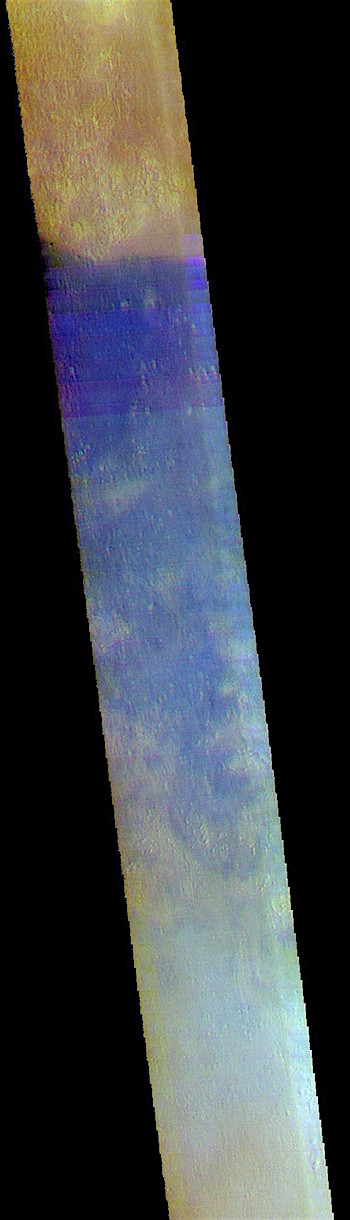
Arabia Terra landscape in false color (THEMIS_IOTD_20180924)THEMIS Image of the Day, September 24, 2018. Today’s VIS image shows part of Arabia Terra.

The THEMIS VIS camera contains 5 filters. The data from different filters can be combined in multiple ways to create a false color image. These false color images may reveal subtle variations of the surface not easily identified in a single band image.

See more THEMIS Images of the Day by geological subject.

Posted in Reports | Tagged , , , , , , , , , | Comments Off

HiRISE: Crater on north polar layered deposits

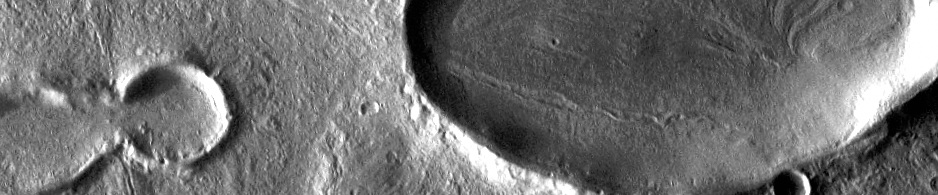
tumblr_pf9lrw0fF61rlz4gso2_1280Crater on north polar layered deposits. Even at HiRISE resolution, it’s difficult to spot in black and white, but the color enhanced picture at full resolution tells a different story.

Beautiful Mars series. [More at links]

Posted in Reports | Tagged , , , , , , , , | Comments Off

NASA seeks partner in contest to name next Mars rover

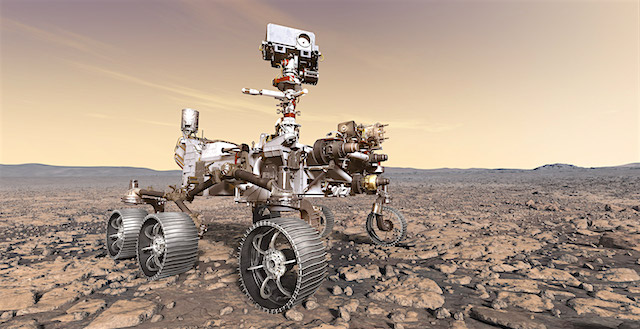
PIA22109-16NASA has a class assignment for corporations, nonprofits and educational organizations involved in science and space exploration: partner with the agency to inspire future engineers and scientists by sponsoring a contest to name the next rover to venture to the Red Planet.

The contest will allow U.S. students in grades K-12 to propose a name for NASA’s next Mars rover (currently being built at NASA’s Jet Propulsion Laboratory in Pasadena, California) and write an essay about their choice. The partner will work with NASA to conduct the contest during the 2019 academic year.

The announcement for proposals can be found here. All proposals must be received by Oct. 9, 2018, to be considered. Questions by corporations, nonprofits and educational organizations interested in participating should be sent by email to: hqmars2020namingproposals@mail.nasa.gov.

“We’ve been doing naming contests since the very first Mars rover back in 1997,” said Thomas Zurbuchen, associate administrator for the Science Mission Directorate at NASA Headquarters, in Washington. “Thousands of kids participate, and their enthusiasm for the contest and Mars is infectious.” [More at link]

Posted in Reports | Tagged , , , | Comments Off

THEMIS: Amazonis Planitia in false color

Amazonis Planitia in false color (THEMIS_IOTD_20180921)THEMIS Image of the Day, September 21, 2018. This image shows a portion of Amazonis Planitia, part of the vast northern lowlands of Mars.

The THEMIS VIS camera contains 5 filters. The data from different filters can be combined in multiple ways to create a false color image. These false color images may reveal subtle variations of the surface not easily identified in a single band image.

See more THEMIS Images of the Day by geological subject.

Posted in Reports | Tagged , , , , , , , , , | Comments Off