
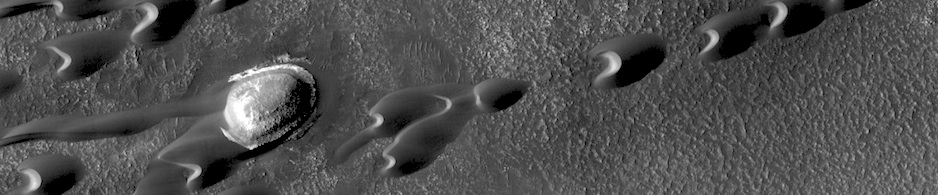

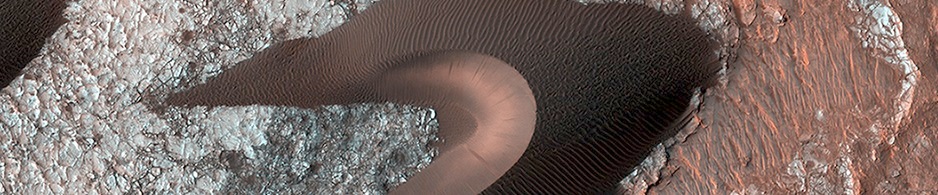
 Dark dunes in Ius Chasma. This image is part of a campaign to monitor the dunes over three Martian years.
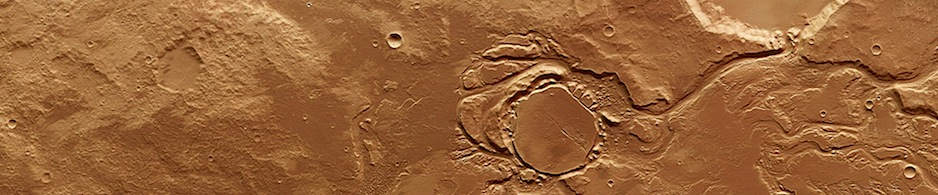
Beautiful Mars series. [More at links]
Dark dunes in Ius Chasma. This image is part of a campaign to monitor the dunes over three Martian years.
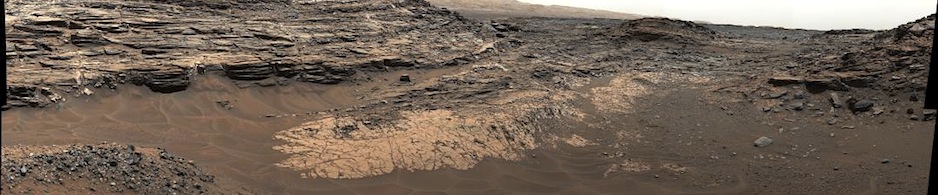
Beautiful Mars series. [More at links]
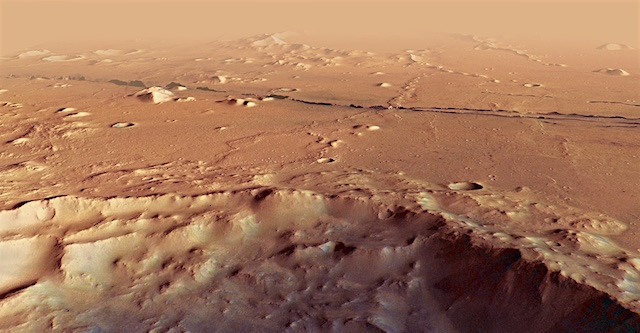 These prominent trenches were formed by faults that pulled the planet’s surface apart less than 10 million years ago. The images were taken by ESA’s Mars Express on 27 January, and capture part of the Cerberus Fossae system in the Elysium Planitia region near the martian equator.
The fossae – meaning ‘ditches’ or ‘trenches’ in Latin – stretch for more than 1000 kilometres from the northwest to the southeast. They cut through impact craters and hills along the way, as well as 10 million year old volcanic plains, indicating the relative youth of their formation.
They vary in width, typically from a few tens of metres to over a kilometre wide, and are thought to be tectonic features originating from faults that stretch the upper layers of the surface apart.
They could be linked to injections of lava at depth deforming the surface above, perhaps originating from the trio of volcanoes that are located to the northwest… [More at link]
NASA Mars Exploration Rover Status Report, September 18, 2018: The Opportunity team is increasing the frequency of commands it beams to the rover via the dishes of NASA’s Deep Space Network from three times a week to multiple times per day.
No signal from Opportunity has been heard since Sol 5111 (June 10, 2018). That’s nearly 100 sols (days) without communication. It is expected that Opportunity has experienced a low-power fault, perhaps, a mission clock fault and an up-loss timer fault. The dust storm on Mars continues its decay with atmospheric opacity (tau) over the rover site below 1.5. The project has been listening for the rover over a broad range of times using the Deep Space Network Radio Science Receiver and commanding “sweep and beeps” to address a possible complexity with certain conditions within the mission clock fault. [More at link]
 Analogue astronauts have successfully trialed a radar that could help future Mars explorers identify where to dig for water. ScanMars is an Italian experiment that was used to identify subsurface water features in the Mars-like Dhofar region of Oman during the AMADEE-18 analogue mission in February 2018. The results will be presented by Alessandro Frigeri of the Istituto Nazionale di Astrofisica (INAF) at the European Planetary Science Congress (EPSC) 2018 in Berlin.
The ScanMars ground penetrating radar has been developed by a group of Italian scientists from INAF’s Istituto di Astrofisica e Planetologia Spaziali and the University of Perugia. The radar has an appearance similar to a metal detector, with a pack of instrumentation pulled along the ground at the end of a pole. The radar investigates the subsurface by transmitting and receiving radio-wave impulses into the ground. Regions with different geological characteristics react in different ways to the radio-waves, and enable an image of the subsoil structure and boundaries to be built up from the reflected signals. [More at links]
 As part of the Planet Four citizen science effort, volunteers searched Context Camera images for possible new locations on Mars with “spiders,” or features with radial troughs from which fans emanate in the springtime.
We planned this HiRISE image over one such location, to verify that they are spiders. There are thousands of them in this image! [More at link]
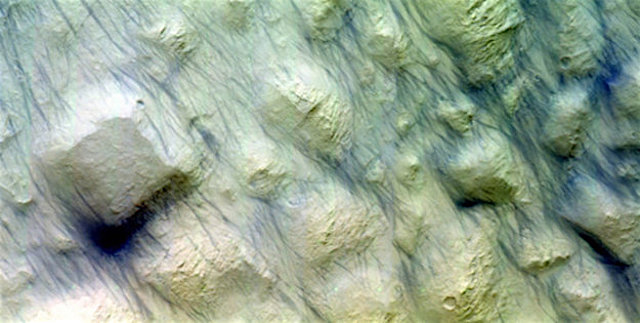
 THEMIS Image of the Day, September 20, 2018. Nepenthes Mensae is the region of hills and mesas north of Terra Cimmeria. The dark blue part of the image is a region of basaltic sands.
The THEMIS VIS camera contains 5 filters. The data from different filters can be combined in multiple ways to create a false color image. These false color images may reveal subtle variations of the surface not easily identified in a single band image.
 Astronauts on a mission to Mars would be exposed to at least 60% of the total radiation dose limit recommended for their career during the journey itself to and from the Red Planet, according to data from the ESA-Roscosmos ExoMars Trace Gas Orbiter being presented at the European Planetary Science Congress, EPSC, in Berlin, Germany, this week.
The orbiter’s camera team are also presenting new images of Mars during the meeting. They will also highlight the challenges faced from the recent dust storm that engulfed the entire planet, preventing high-quality imaging of the surface.
The Trace Gas Orbiter began its science mission at Mars in April, and while its primary goals are to provide the most detailed inventory of martian atmospheric gases to date – including those that might be related to active geological or biological processes – its radiation monitor has been collecting data since launch in 2016.
The Liulin-MO dosimeter of the Fine Resolution Epithermal Neutron Detector (FREND) provided data on the radiation doses recorded during the orbiter’s six-month interplanetary cruise to Mars, and since the spacecraft reached orbit around the planet.
On Earth, a strong magnetic field and thick atmosphere protects us from the unceasing bombardment of galactic cosmic rays, fragments of atoms from outside our Solar System that travel at close to the speed of light and are highly penetrating for biological material.
In space this has the potential to cause serious damage to humans, including radiation sickness, an increased lifetime risk for cancer, central nervous system effects, and degenerative diseases, which is why ESA is researching ways to best protect astronauts on long spaceflight missions.
The ExoMars measurements cover a period of declining solar activity, corresponding to a high radiation dose. Increased activity of the Sun can deflect the galactic cosmic rays, although very large solar flares and eruptions can themselves be dangerous to astronauts.
“One of the basic factors in planning and designing a long-duration crewed mission to Mars is consideration of the radiation risk,” says Jordanka Semkova of the Bulgarian Academy of Sciences and lead scientist of the Liulin-MO instrument… [More at link]
 Multiple local-scale dust storms picked up along the seasonal south polar ice cap of Mars this past week. This activity that extended over Aonia, Cimmeria, and near the Mountains of Mitchel generated a diffuse dust cloud along the cap edge. Looking to the mid-to-low latitudes, dust storms were more sporadic with occurrences spotted over Noachis and Cimmeria. Afternoon water ice clouds… [More at link, including video]
 The other Pan’s labyrinth. These polar dunes are located near source of gypsum.
Beautiful Mars series. [More at links]