






Opportunity report, Sol 5193, by A.J.S. Rayl, The Planetary Society

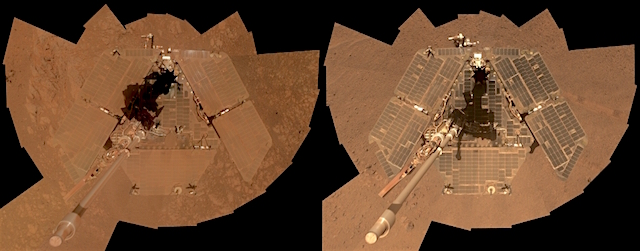
20180908_10-Curse-kiss-of-Martian-winds-Oppy-dusty-and-clean-arraysSeptember 9, 2018: NASA Focuses on Recovering Opportunity as Storm Diminishes and Dust Settles: The dust raising power of the storms that wrapped Mars in a cloud in June and July diminished in August, sending all that powdery stuff back down onto the surface of the Red Planet. On Earth, the Mars Exploration Rovers (MER) team at NASA’s Jet Propulsion Laboratory (JPL) reviewed recovery plans, conducted additional simulations, and began wrapping the month with newfound reasons to believe Opportunity can emerge from her hibernation.

Then, on August 30th, NASA and JPL, home to all NASA’s Mars spacecraft, issued a press release announcing that the MER mission would soon begin “a two-step plan to provide the highest probability of successfully communicating with the rover and bringing it back online.”

Step one will be a period of actively attempting to communicate with the rover by sending it commands through NASA’s Deep Space Network (DSN) antennas. “Assuming that we hear back from Opportunity, we will begin the process of discerning its status, and bringing it back online,” MER Project Manager John Callas stated in the release.

That effort – which could begin as early as September 10th – will last 45 days, according to the press release. If that 45-day effort does not succeed in picking up a signal from Opportunity, a small core group of MER team members would stay on for “several months” more to continue listening “passively.”

Forty-five days is all most people took in. With no live press conference and what read like a rushed out release, forty-five days is what people read and what they spread. The end seemed near. What “passive listening” and that part of the effort actually meant for Opportunity was not explained and was all but lost in furious translation as the story hit the most popular social media sites and science hangouts before moving into the mainstream news.

Over the next few days, there was reaction and confusion about what was going to happen to Opportunity. Even before the dust had a chance to settle on Earth, one thing became immediately clear: this rover is still loved around the world. It also seemed clear that there was more to this story than was being reported or understood… [More at link]

Posted in Reports | Tagged , , , , , , , , , , , | Comments Off

Curiosity update: Things that go bump…

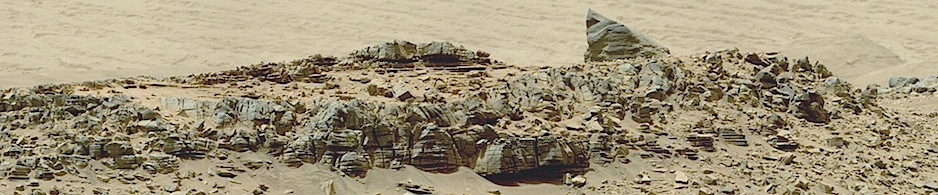
2161ML0116380080803465E01_DXXX-br2Sols 2163-64, September 5, 2018, update by MSL scientist Lucy Thompson: In our case, the Curiosity rover! The main focus of our 2-sol (sol – martian day) plan today is to bump (drive ~15 m) the rover into place for an attempt at drilling an interesting grey coloured patch of bedrock, identified from orbit within the Jura member of the Murray formation on the Vera Rubin Ridge, referred to as “Loch Eriboll.” We want to figure out how these patches of bedrock differ from the surrounding tan coloured rocks, more typical of what we see from orbit.

We had the potential to do a “touch and go” in the plan, whereby we would unstow the arm and use the APXS and MAHLI instruments to examine the chemistry and texture of a target close-up, before driving away. However, the workspace consists of a lot of broken up, smaller pieces of rock and we already have a lot of compositional and textural information of similar rocks. The ability to use the arm is instead being utilized to acquire MAHLI close-up imaging of the REMS UV sensor. This is requested periodically to check for dust and the general health of the sensor…. [More at link]

Posted in Reports | Tagged , , , , , , , , , , , , , , , | Comments Off

THEMIS: False-color Nili Fossae

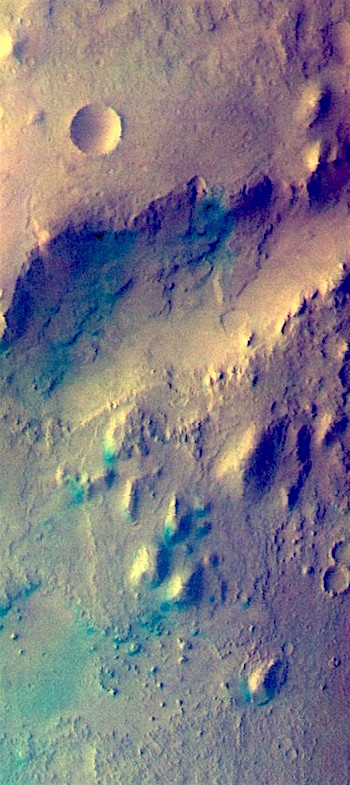
Nili Fossae in false color (THEMIS_IOTD_20180910)THEMIS Image of the Day, September 10, 2018. This image shows a small section of Nili Fossae. The darker blue tones are usually indications of basaltic sands.

The THEMIS VIS camera contains 5 filters. The data from different filters can be combined in multiple ways to create a false color image. These false color images may reveal subtle variations of the surface not easily identified in a single band image.

See more THEMIS Images of the Day by geological subject.

Posted in Reports | Tagged , , , , , , , , | Comments Off

Curiosity report, Sols 2093-2162, by Emily Lakdawalla, The Planetary Society

20180831_hematite_parameter_ESP_042682_1755_color_comparison_2_f840September 6, 2018: Three Tries to Successful Drill Atop Vera Rubin Ridge: Heedless of the (now-dissipating) dust storm, Curiosity has achieved its first successful drill into rocks that form the Vera Rubin ridge, and is hopefully on the way to a second. It took three attempts for Curiosity to find a soft enough spot, with Voyageurs and Ailsa Craig being too tough, but Stoer proved obligingly soft on sol 2136. The rover delivered samples to both of its analytical laboratory instruments before driving away.

There have been lots and lots of images landing on Earth in the last several weeks, as Curiosity is ramping up data relay through MAVEN and ExoMars Trace Gas Orbiter. Once InSight lands, Curiosity will have to give up most of its Mars Reconnaissance Orbiter data relay to the lander — InSight’s landing site is just a couple hundred kilometers north of Curiosity, so both missions want the same data relay passes as the polar-orbiting spacecraft passes overhead. For Curiosity, switching to MAVEN and ExoMars relay can replace the volume, but not the rhythmic repeatability, of Mars Reconnaissance Orbiter’s twice-a-day-like-clockwork relay sessions. Until InSight lands, though, Curiosity gets to hog all the data volume — so the team is taking advantage of the bounty while it lasts… [More at link]

Posted in Reports | Tagged , , , , , , , , , , , , , | Comments Off

HiRISE: Hanging sand dunes in Coprates Chasma

ESP_034856_1655Dune fields located among canyon wall slopes are also known as “wall dune fields” and are further identified as either climbing or falling. Falling dunes are defined as large bedforms with lee faces on the downhill side—indicating that this is the direction of their migration—and on moderate slopes greater than 10 to 12 degrees. (A lee face is the the down-wind side of a dune.)

On Earth and Mars, these types of dunes are largely controlled by what is called “microtopography.” Physical obstacles can accelerate and decelerate airflow, create turbulence, potentially enhancing erosion, deposition, and/or transport of dune sediment… [More at link]

Posted in Reports | Tagged , , , , , , , , | Comments Off

THEMIS: Storm clouds over Utopia

Storm clouds over Utopia (THEMIS_IOTD_20180907)THEMIS Image of the Day, September 7, 2018. This VIS image shows the cloud tops of a large storm over Utopia Planitia. The clouds are composed mainly of dust and completely hide the surface.

The THEMIS VIS camera contains 5 filters. The data from different filters can be combined in multiple ways to create a false color image. These false color images may reveal subtle variations of the surface not easily identified in a single band image.

See more THEMIS Images of the Day by geological subject.

Posted in Reports | Tagged , , , , , , , , , | Comments Off

Curiosity surveys a mystery under dusty skies

curiosity20180830-16After snagging a new rock sample on Aug. 9, NASA’s Curiosity rover surveyed its surroundings on Mars, producing a 360-degree panorama of its current location on Vera Rubin Ridge.

The panorama includes umber skies, darkened by a fading global dust storm. It also includes a rare view by the Mast Camera of the rover itself, revealing a thin layer of dust on Curiosity’s deck. In the foreground is the rover’s most recent drill target, named “Stoer” after a town in Scotland near where important discoveries about early life on Earth were made in lakebed sediments.

The new drill sample delighted Curiosity’s science team, because the rover’s last two drill attempts were thwarted by unexpectedly hard rocks. Curiosity started using a new drill method earlier this year to work around a mechanical problem. Testing has shown it to be as effective at drilling rocks as the old method, suggesting the hard rocks would have posed a problem no matter which method was used.

There’s no way for Curiosity to determine exactly how hard a rock will be before drilling it, so for this most recent drilling activity, the rover team made an educated guess. An extensive ledge on the ridge was thought to include harder rock, able to stand despite wind erosion; a spot below the ledge was thought more likely to have softer, erodible rocks. That strategy seems to have panned out, but questions still abound as to why Vera Rubin Ridge exists in the first place.

The rover has never encountered a place with so much variation in color and texture, according to Ashwin Vasavada, Curiosity’s project scientist at NASA’s Jet Propulsion Laboratory in Pasadena, California. JPL leads the Mars Science Laboratory mission that Curiosity is a part of.

“The ridge isn’t this monolithic thing — it has two distinct sections, each of which has a variety of colors,” Vasavada said. “Some are visible to the eye and even more show up when we look in near-infrared, just beyond what our eyes can see. Some seem related to how hard the rocks are.” [More at link, including a panorama video]

Posted in Reports | Tagged , , , , , , , , , , , | Comments Off

HiRISE: Fan with inverted channels

ESP_055505_1520This image shows inverted channels within a fan whose origin could be either fluvial (produced by the action of a stream) or alluvial (created by sedimentary deposits).

If the fan is alluvial, then it formed on dry land. If the fan is fluvial, then it could have formed in water, like a delta. Similar fans with inverted channels are found in Eberswalde and Jezero craters, both of which are interpreted as deltas and are considered candidate locations of future rover landing sites. [More at link]

Posted in Reports | Tagged , , , , , , , , , | Comments Off

THEMIS: False color on Thaumasia Planum and Coracis Fossae

Thaumasia Planum in false color (THEMIS_IOTD_20180906)THEMIS Image of the Day, September 6, 2018. Today’s VIS image is located on the margin between Thaumasia Planum and Coracis Fossae.

The THEMIS VIS camera contains 5 filters. The data from different filters can be combined in multiple ways to create a false color image. These false color images may reveal subtle variations of the surface not easily identified in a single band image.

See more THEMIS Images of the Day by geological subject.

Posted in Reports | Tagged , , , , , , , , , , | Comments Off

MARCI weather report, Aug 27-Sept 2, 2018

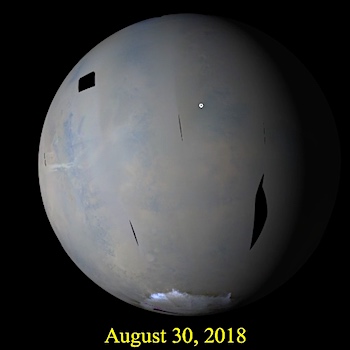
MARCI-August-30-2018Dusty atmospheric conditions resulting from the planetary-encircling dust event continued to wane across much of Mars for the past week. Looking to the equatorial latitudes, a couple short-lived dust events were observed over North Central Noachis Terra. Further west, dust hazes partially obscured the floors of Valles Marineris. Afternoon orographic water ice clouds endured over the slopes of Arsia Mons, the southernmost… [More at link, including video]

Posted in Reports | Tagged , , , , , , , , , , , , , , , | Comments Off