


-
Recent Posts
Archives
Links
general
mission instruments
- CRISM: Compact Reconnaissance Imaging Spectrometer for Mars
- CTX: Context Camera
- HiRISE: High Resolution Imaging Science Experiment
- MARSIS: Mars Advanced Radar for Subsurface and Ionosphere Sounding
- SHARAD: Shallow Radar
- THEMIS: Thermal Emission Imaging System
missions
- All Mars missions list
- Curiosity rover
- ExoMars
- Hope (al-Amal) orbiter
- InSight
- Mars Atmosphere and Volatile Evolution Mission (MAVEN)
- Mars Exploration Rovers (MER)
- Mars Express (MEX)
- Mars Odyssey
- Mars Orbiter Mission (MOM) / Mangalyaan
- Mars Reconnaissance Orbiter (MRO)
- Mars Science Laboratory (MSL)
- Perseverance Rover
- Tianwen-1 orbiter/rover
news
Weather update from Gale Crater
Posted in Reports
Tagged Curiosity, dust storms, Gale Crater, global dust storms, Mars Science Laboratory, MSL, NASA, temperature, weather
Comments Off
HiRISE: Pitted cones: possible methane sources?
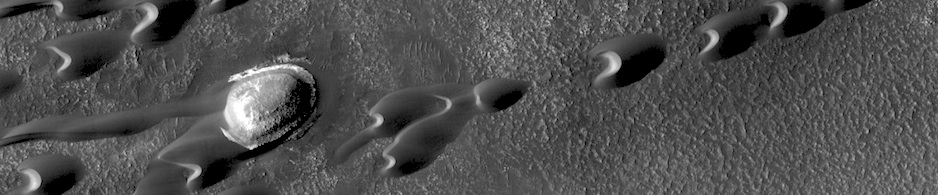
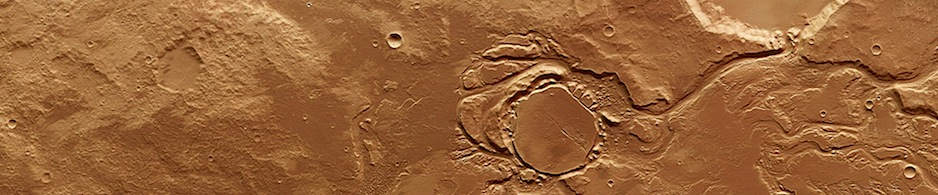
 This observation shows relatively bright mounds scattered throughout darker and diverse surfaces in Chryse Planitia. These mounds are hundreds of meters in size. The largest of the mounds shows a central pit, similar to the collapsed craters found at the summit of some volcanoes on Earth. The origins of these pitted mounds or cratered cones are uncertain. They could be the result of the interaction of lava and water, or perhaps formed from the eruption of hot mud originating from beneath the surface.
These features are very interesting to scientists who study Mars, especially to those involved in the ExoMars Trace Gas Orbiter mission. If these mounds are indeed mud–related, they may be one of the long sought after sources for transient methane on Mars. [More at link]
Posted in Reports
Tagged Chryse Planitia, High Resolution Imaging Science Experiment, HiRISE, Mars Reconnaissance Orbiter, MRO, NASA, pitted mounds, rootless cones, Trace Gas Orbiter, University of Arizona
Comments Off
Curiosity: Heading south on the Ridge
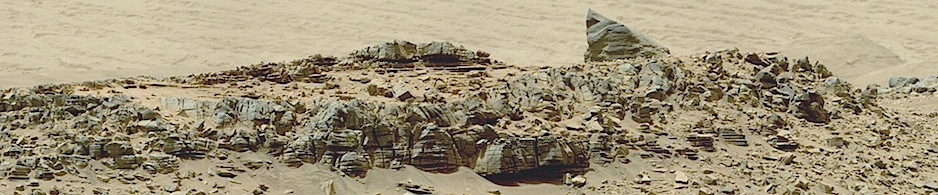
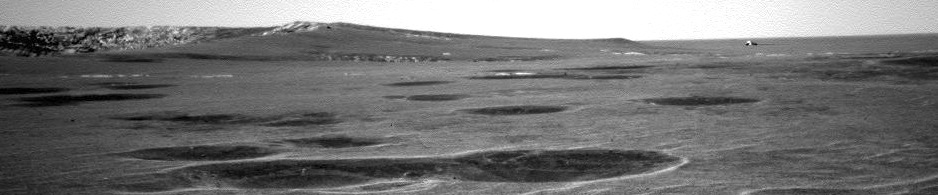
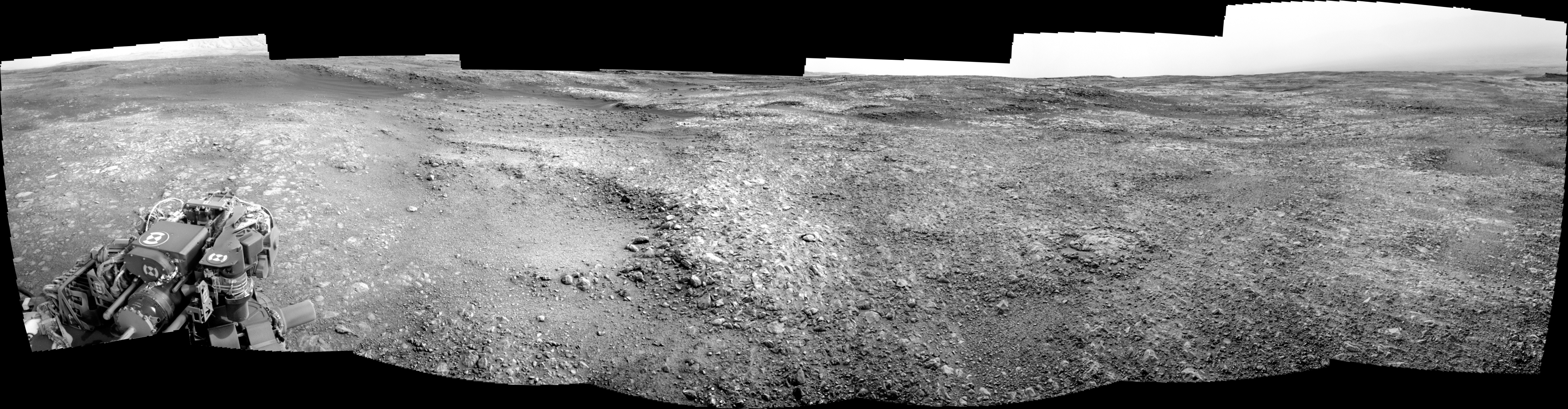
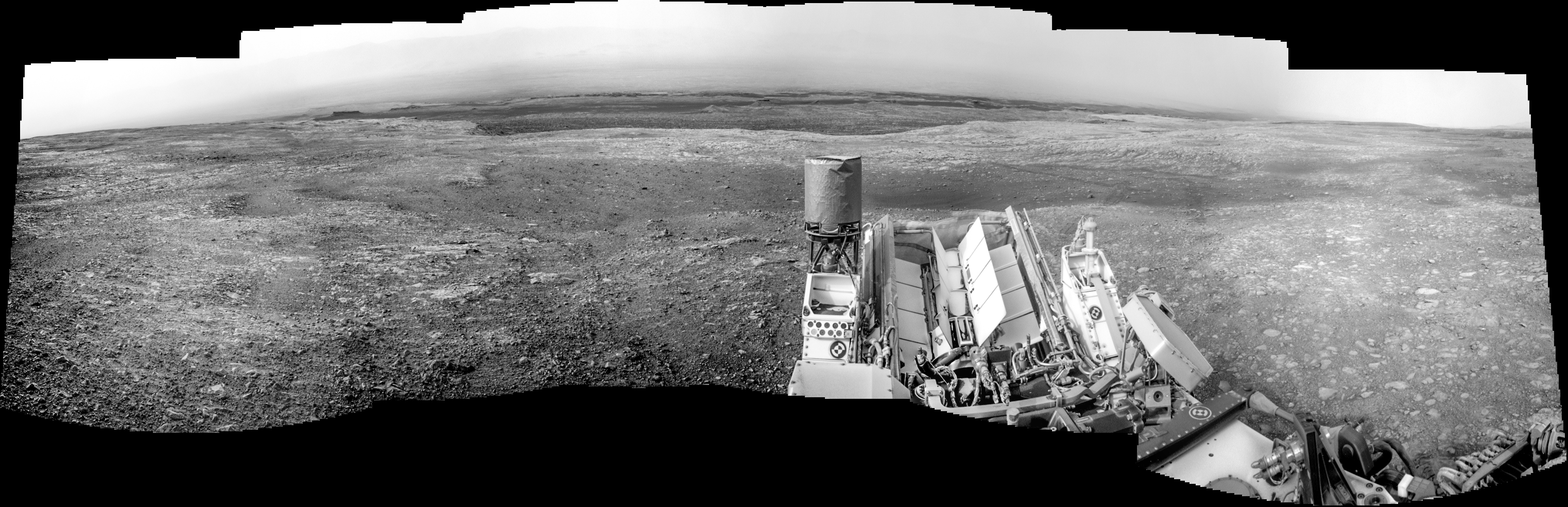 Sol 2161, September 4, 2018. After a 32-meter (105 foot) drive southward, Curiosity stopped and took its standard Navcam panorama. Above: Looking back to the north, where clearing skies are gradually lifting the haze. Below: Looking southward, with rolling terrain (and sand traps) ahead. Click either image to enlarge it.
Sol 2161 raw images (from all cameras).
Posted in Reports
Tagged Aeolis Mons, Curiosity, Gale Crater, Mars Science Laboratory, Mount Sharp, MSL, Murray Formation, NASA, Vera Rubin Ridge
Comments Off
THEMIS: Ophir Chasma in false color
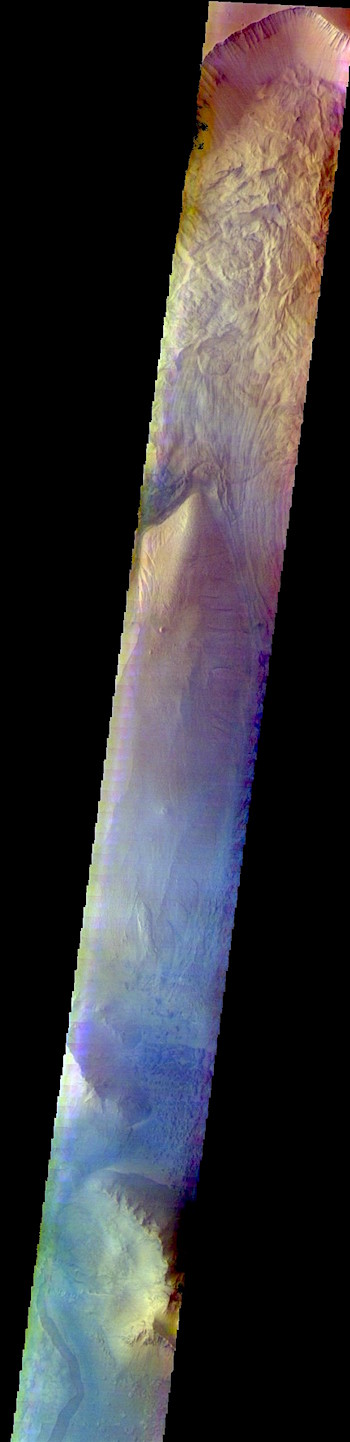 THEMIS Image of the Day, September 5, 2018. Today’s VIS image shows part of Ophir Chasma, where landslide debris mingles with probable sediments from long-vanished lakes.
The THEMIS VIS camera contains 5 filters. The data from different filters can be combined in multiple ways to create a false color image. These false color images may reveal subtle variations of the surface not easily identified in a single band image.
Posted in Reports
Tagged Arizona State University, ASU, false color, lake bed sediments, landslides, Mars Odyssey, NASA, Ophir Chasma, THEMIS, THEMIS Image of the Day, Thermal Emission Imaging System, Valles Marineris
Comments Off
Webcast on Curiosity and Mars, September 6
 The Lunar and Planetary Institute (LPI) in Houston is presenting a webcast by Kirsten Siebach (Rice University) on the subject of Curiosity and our evolving view of Mars.
The talk, which is part of LPI’s Cosmic Explorations Speaker Series, will be streamed live through the USRA Ustream channel on September 6, beginning at 7:30 p.m. Central Daylight Time. (For those in the Houston area, the free presentation will be held at the USRA building at 3600 Bay Area Boulevard, Houston.)
Recordings of past presentations can be viewed on the LPI YouTube channel and in the Cosmic Exploration Speaker Series archive.
Posted in Reports
Tagged Curiosity, LPI, Lunar and Planetary Institute, Mars, Mars Science Laboratory, MSL
Comments Off
HiRISE: Crater gullies and fractures in Acidalia Planitia
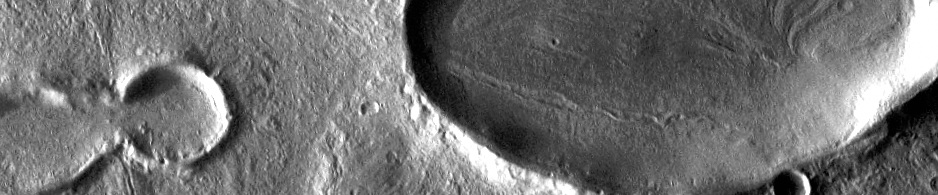
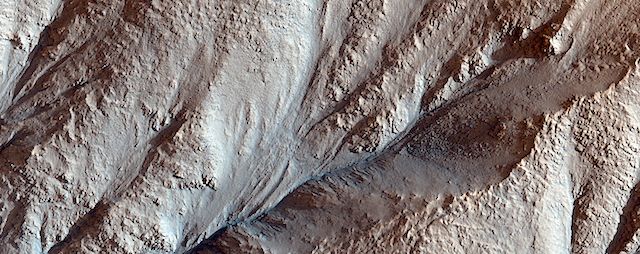 This image shows the gullied western slopes of an unnamed crater (about 10 kilometers wide) in Acidalia Planitia. These slopes have gone through a complicated history of gully erosion of the bedrock layers in the upper section, followed by the formation of fractures along the lower slopes.
As the gullies continued to form, fractures cut across them and their debris fans in the lower part of the slopes. A prominent cliff has been eroded by more recent gully activity. The curved ridges and lobes on the crater floor, downslope of the debris fans, along with multiple fractures, suggest that the subsurface was ice-rich. This is an example of how geologists can utilize the concept of superposition to unravel the relative timing of geological events in the crater’s history. [More at link]
Posted in Reports
Tagged Acidalia Planitia, gullies, High Resolution Imaging Science Experiment, HiRISE, Mars Reconnaissance Orbiter, MRO, NASA, tectonics, University of Arizona
Comments Off
The largest delta on Mars?
 Planetary Geomorphology Image of the Month, September 1, 2018: Jacob Adler (Arizona State University). Ancient river deltas are found in many locations on Mars [see Di Achile & Hynek, 2010 and references therein], and are formed as sediment drops out of suspension in water as it approaches a wider shoreline of a lake, sea, or (debatably) an ocean.
Some proposed deltas on Mars are found in closed basins (e.g. an impact crater) away from the Martian dichotomy boundary, implying an ancient climate during which the crater ponded with water [e.g. Eberswalde or Jezero]. Occasionally, inlet and outlet river valleys are seen at different elevations along the crater rim, lending further evidence to the hypothesis that the crater filled with liquid water at least up to the outlet elevation.
Deltas found in open basins, on the other hand, imply a larger body of standing water, and Mars scientists look for other clues to support the deltaic rather than alluvial fan formation mechanism. In our recent papers, we tested whether the Hypanis fan-shaped deposit (Image 1) could be a delta, and discussed whether this supports the hypothesis that there was once a large sea or ocean in the Northern plains of Mars… [More at link]
Posted in Reports
Tagged alluvial fan deposits, alluvial fans, deltas, fluvial deposits, fluvial landforms, fluvial processes, Hypanis Valles
Comments Off
Curiosity update: Lots of bits!
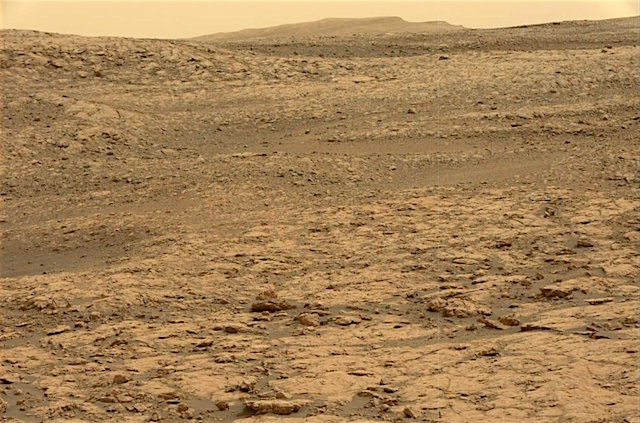 Sols 2159-62, September 3, 2018, update by MSL scientist Dawn Sumner: Curiosity’s plan for the weekend is extra large – 4 sols and almost 3 gigabits of data! We planned 4 sols due to the Labor Day weekend, and the hefty data volume is courtesy of extra downlink from two special orbiters. Curiosity sends her data back to Earth through various orbiters around Mars. Usually, we use the Mars Reconnaissance Orbiter (MRO) and Mars Odyssey (ODY) to transmit our data, and we get an average of 500 megabits of data per sol. (Note that 8 bits = 1 byte, so our average bandwidth is about 60 megabytes of data per sol. In contrast, DSL bandwidths are ~10 megabytes per second, so we get about 6 seconds worth of internet per sol!)
Recently, we have been getting lots of extra downlink. NASA’s InSight mission will land in November, and MRO will be dedicated to relaying InSight data for its prime mission. Curiosity will shift to downlinking data through NASA’s Mars Atmosphere and Volatile Evolution (MAVEN) orbiter and the European Space Agency’s Trace Gas Orbiter (TGO). In preparation, we have been downlinking extra data using MAVEN and TGO. This has allowed us to downlink a backlog of images. In today’s plan, we were able to take some large multispectral mosaics to fill an extra ~2 gigabits of downlink we expect next week. That’s an extra 4 sols worth of bits! [More at link]
Posted in Reports
Tagged Aeolis Mons, Ben Haint, Ben Vorlich, Curiosity, Gale Crater, Mars Science Laboratory, Mount Sharp, MSL, Murray Formation, NASA, Rhinns of Galloway, Rosie, Tayvallich, Vera Rubin Ridge
Comments Off
HiRISE: The Case of the Lurking Frost
 HiRISE and the Case of the Lurking Frost. Sheltered by these cliffs, we can see frost build up, along with lots of sedimentary rocks. This area is also a good candidate for recurring slope lineae.
Beautiful Mars series. [More at links]
Posted in Reports
Tagged Beautiful Mars, frost, High Resolution Imaging Science Experiment, HiRISE, Mars Reconnaissance Orbiter, MRO, NASA, recurring slope lineae, RSL, sedimentary deposits, University of Arizona
Comments Off
Curiosity update: I’ll take the Quela to go, please!
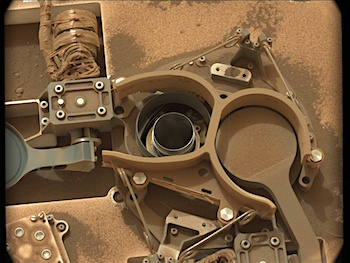 Sols 2157-58, September 3, 2018, update by MSL scientist Brittney Cooper: Today in Gale Crater, Curiosity begins with a short (but sweet) science block that utilizes ChemCam, Mastcam, and Navcam to observe the Martian surface and atmosphere. We start off with a ChemCam LIBS raster of the target “Cairntoul,” and then Mastcam mosaics of the same target, as well as “Monar Dam.”
The block is finished off with a Navcam line of sight (LOS) observation to continue monitoring dust in the crater as the optical depth slowly wanes. The Navcam LOS differs from the other dust-monitoring observation, the Mastcam tau, by looking at the amount of dust in Curiosity’s line of sight to the crater rim. The Mastcam tau determines the amount of dust in the entire atmospheric column by looking at the Sun in a controlled and protected way.
The sol continues with a drive to the new workspace where contact science will be planned over the weekend, and ends with an over-night cleaning of the SAM “scrubbers” and “getters” in preparation for the SAM noble gas experiment in the early hours of sol 2159. Sol 2158 is spent sleeping and recharging, with only REMS environmental monitoring… [More at link]
Posted in Reports
Tagged Aeolis Mons, Cairntoul, Curiosity, Gale Crater, Mars Science Laboratory, Monar Dam, Mount Sharp, MSL, Murray Buttes, Murray Formation, NASA, Quela, Vera Rubin Ridge
Comments Off