THEMIS: Wind-driven blowouts in Eumenides Dorsum

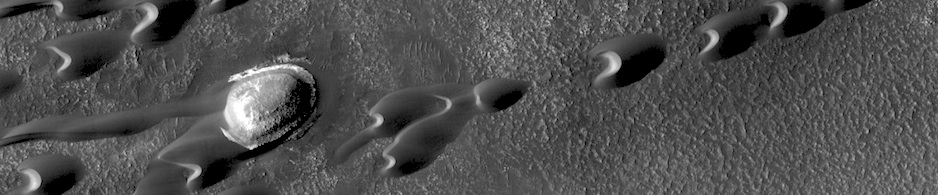
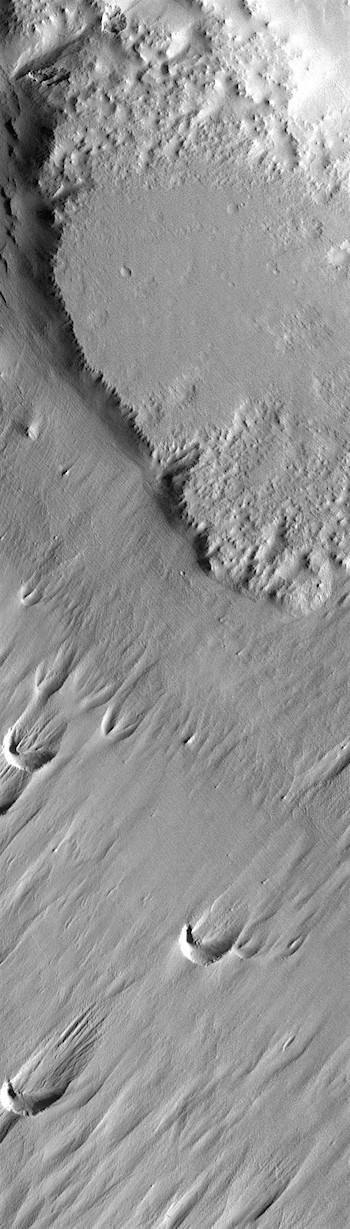
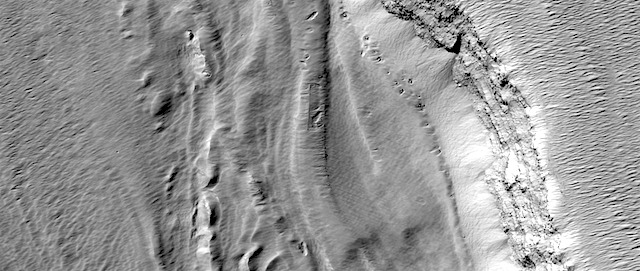
Wind-driven blowouts in Eumenides Dorsum (THEMIS_IOTD_20180817)THEMIS Image of the Day, August 17, 2018. Eumenides Dorsum is a large linear rise located in southern Amazonis Planitia. Erosion by wind action is prevalent in this region.

The horseshoe shaped depressions, called blowouts, indicate the major wind direction in this region is from lower left to upper right.

See more THEMIS Images of the Day by geological subject.

Posted in Reports | Tagged , , , , , , , , , , | Comments Off

Opportunity recovery efforts: Six things

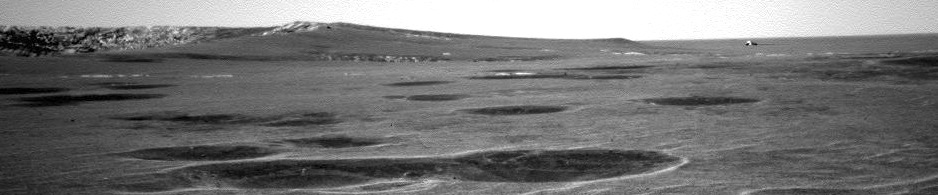
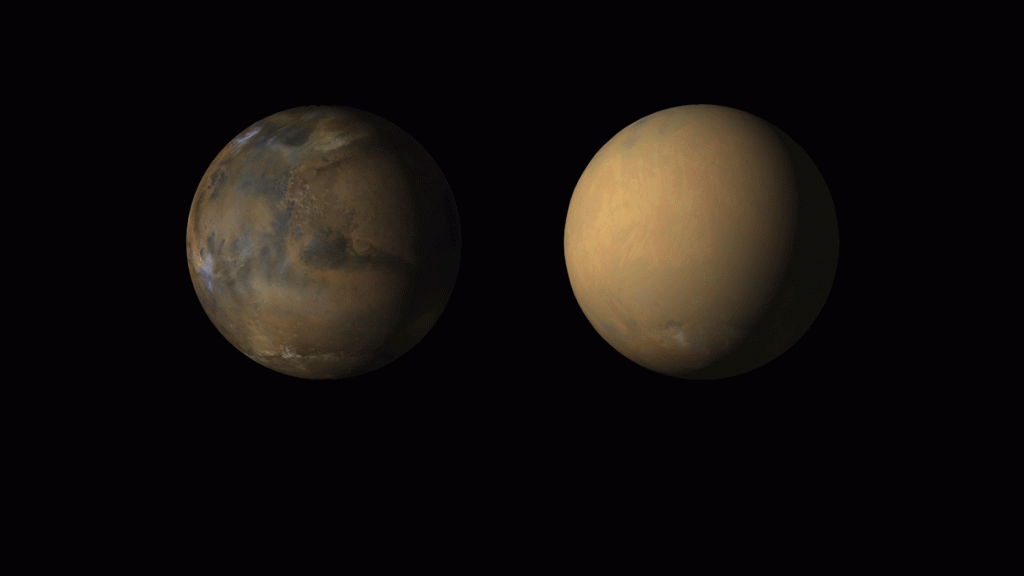
PIA22487NASA’s Opportunity rover has been silent since June 10, when a planet-encircling dust storm cut off solar power for the nearly-15-year-old rover. Now that scientists think the global dust storm is “decaying” — meaning more dust is falling out of the atmosphere than is being raised back into it — skies might soon clear enough for the solar-powered rover to recharge and attempt to “phone home.”

No one will know how the rover is doing until it speaks. But the team notes there’s reason to be optimistic: They’ve performed several studies on the state of its batteries before the storm, and temperatures at its location. Because the batteries were in relatively good health before the storm, there’s not likely to be too much degradation. And because dust storms tend to warm the environment — and the 2018 storm happened as Opportunity’s location on Mars entered summer — the rover should have stayed warm enough to survive.

What will engineers at NASA’s Jet Propulsion Laboratory in Pasadena, California, be looking for — and what will those signs mean for recovery efforts?  [More at link]

Posted in Reports | Tagged , , , , , , , , , , , | Comments Off

Curiosity update: False alarm!

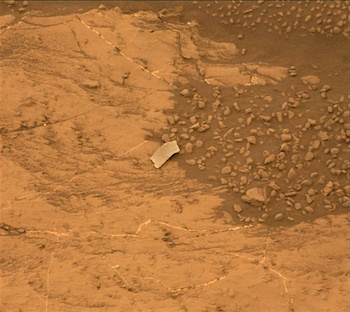
2139MR0114810000205100E01_DXXX-br2Sols 2143-44, August 16, 2018, update by MSL scientist Brittney Cooper: The planning day began with an interesting result from the previous plan’s ChemCam RMI analysis of a target that was referred to as “Pettegrove Point Foreign Object Debris” (PPFOD), and speculated to be a piece of spacecraft debris. In fact it was found to be a very thin flake of rock, so we can all rest easy tonight – Curiosity has not begun to shed its skin! Perhaps the target should have been given a different name befitting the theme of the current quadrangle in which Curiosity resides: “Rabhadh Ceàrr”, or “False Alarm” in Scottish Gaelic.

While indications of mechanical success from the previous plan’s CheMin analysis of the drill sample at the “Stoer” target were received, the data will not be down until late this evening, so the drill campaign is taking a small hiatus to do some remote observations in this two-sol plan. [More at link]

Posted in Reports | Tagged , , , , , , , , , , , , , , , , , , , , , , , | Comments Off

HiRISE: Boundary of glacial-like flow on Arsia Mons

tumblr_pdgmgu7Mnl1rlz4gso1_1280Boundary of glacial-like flow on Arsia Mons. The exposed bedrock layers on the eastern edge of this glacial-like formation are of scientific interest because they will allow us to understand the composition of the underlying bedrock. In addition, we are interested in the depositional layers and how they relate to different climate cycles.

Beautiful Mars series. [More at links]

Posted in Reports | Tagged , , , , , , , , | Comments Off

South polar layers deposited regionally

regional_Mars_deposits-800x600Shallow Radar correlation of discrete units in one of the Red Planet’s largest ice reservoirs suggests that its material was emplaced as a single, regional deposit.

One of Mars’s largest water ice reservoirs, the south polar layered deposits, consists of a thick stack of alternating bands of dust and ice that encompasses an area nearly the size of Alaska. Previous studies have suggested that variations in the obliquity of the Red Planet’s axis, which can wobble up to 10° from its current 25° tilt, have controlled the accretion of these layers and that they therefore preserve a long-term record of Mars’s ancient climate.

Building upon earlier research, which identified four distinct periods of ice accumulation in the south polar deposits, Whitten and Campbell [writing in the Journal of Geophysical Research] utilize Shallow Radar (SHARAD) data collected by the Mars Reconnaissance Orbiter to investigate the structure and continuity of the deposits’ subsurface layers…

[From the paper’s abstract:] “Only one major deviation from near- horizontality of the reflectors, located to the east of Australe Mensa, was identified. There is no evidence for major unconformities that suggest multiple depositional centers that later merged into the South Polar Layered Deposits. Instead, SHARAD data suggest that the materials of the SPLD were deposited regionally, superposing materials from previous depositional episodes.” [More at links]
Posted in Reports | Tagged , , , , , | Comments Off

THEMIS: Channel flow in Sacra Fossae

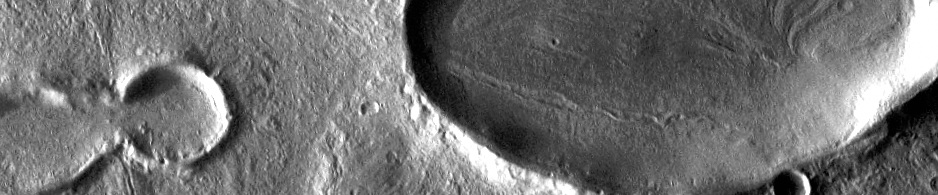
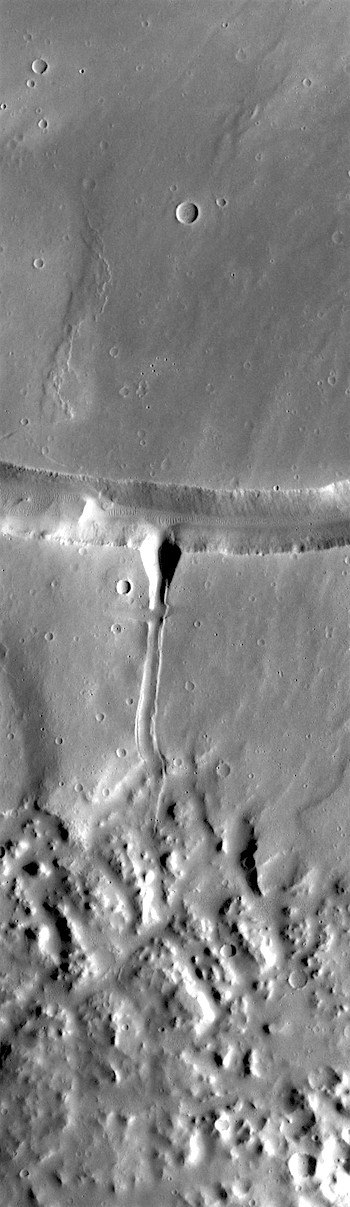
Flow in Sacra Fossae (THEMIS_IOTD_20180816)THEMIS Image of the Day, August 16, 2018. The right-angle intersection of the depressions in this VIS image is one of the graben that form Sacra Fossae. The fossae are located on Sacra Mensa, near the beginning of Kasei Valles. Graben are depressions caused by parallel faults where a block of material drops down along the fault face.

Here a close look shows that something flowed out of the graben into the chaotic terrain at the bottom of the image.

See more THEMIS Images of the Day by geological subject.

Posted in Reports | Tagged , , , , , , , , , , | Comments Off

Weather update from Gale Crater

Posted in Reports | Tagged , , , , , , , , | Comments Off

HiRISE: Semi-sinuous ridge and stratified material in Arabia Terra

tumblr_pdgljnBX9v1rlz4gso1_1280Semi-sinuous ridge and stratified material in Arabia Terra. Looks like inverted stream channels that contributed to a lake or pond, with stratified sedimentary rock units in the depression. Important imaging for understanding how to best distinguish cratered, erosion-resistant sedimentary rock units from volcanic and impact melt rocks.

Beautiful Mars series. [More at links]

Posted in Reports | Tagged , , , , , , , , , , | Comments Off

MARCI weather report, August 6-12, 2018

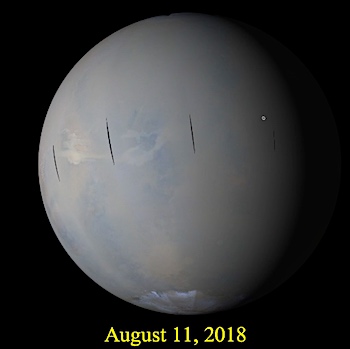
MARCI-August-11-2018Bright and dark regions of Mars continued to become more apparent through the planet-encircling dust haze as dust continued to slowly settle out of the atmosphere last week. Each sol, thick hazes still lingered above the martian lowlands including over the floors of Valles Marineris. Across the northern highlands, some crater rims, dune fields, and wind streaks faintly came into view. Looking to the southern hemisphere… [More at link, including video]

Posted in Reports | Tagged , , , , , , , , , , , , , , , | Comments Off

THEMIS: Dark streaks on the rim of Orcus Patera

Dark streaks on rim of Orcus Patera (THEMIS_IOTD_20180815)THEMIS Image of the Day, August 15, 2018. Today’s VIS image is located on the western margin of Orcus Patera. Dark slope streaks are present on most ridges in the image.

Formation of these features is linked to a change in the surface, either removal of the dusty surface revealing darker rock beneath the dust, or a volatile flow along the cliff face.

See more THEMIS Images of the Day by geological subject.

Posted in Reports | Tagged , , , , , , , , , , | Comments Off