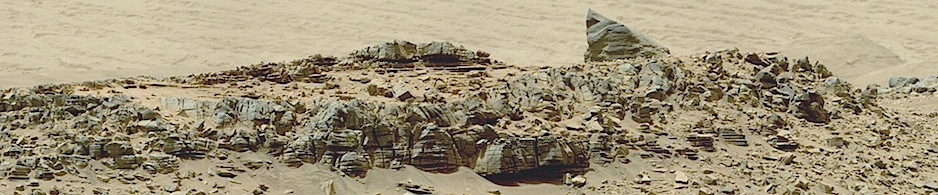



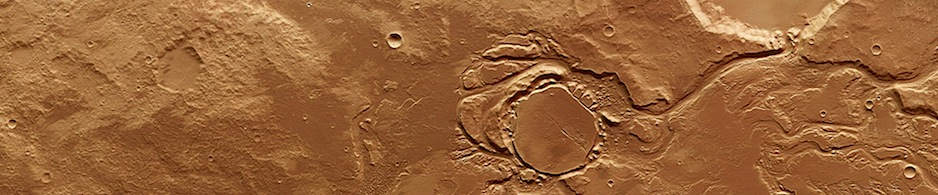
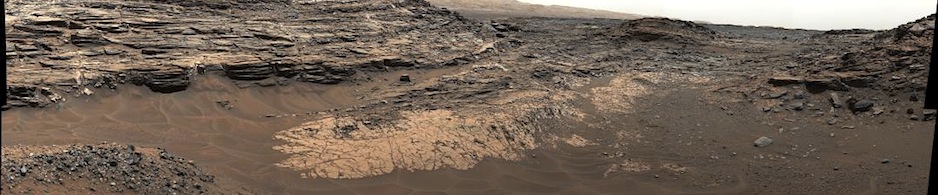
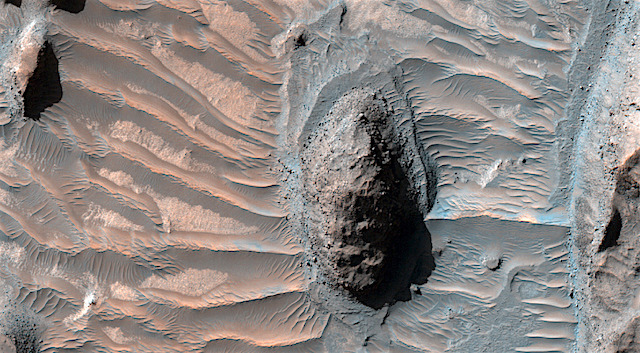
 Exposed bedrock in Millochau Crater. There are some very nice sediments here. The crater measures 115 kilometers in diameter and was named after French astronomer Gaston Millochau.
Beautiful Mars series. [More at links]
Exposed bedrock in Millochau Crater. There are some very nice sediments here. The crater measures 115 kilometers in diameter and was named after French astronomer Gaston Millochau.
Beautiful Mars series. [More at links]
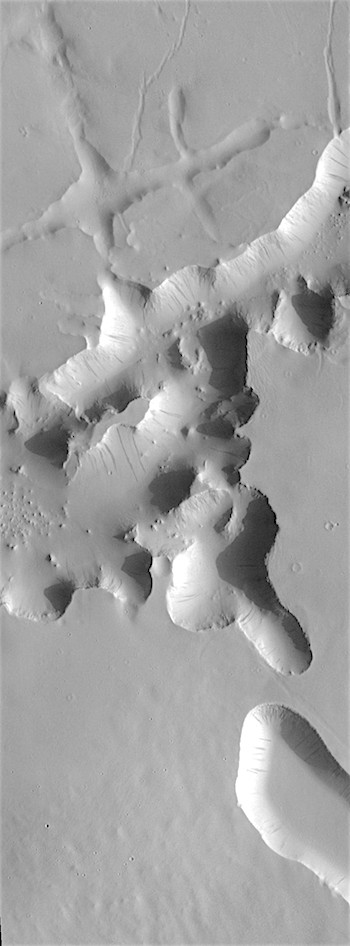 THEMIS Image of the Day, August 14, 2018. Lycus Sulci is a very complex region surrounding the northern and western flanks of Olympus Mons.
This VIS image shows some of the tectonic features found in Lycus Sulci as well as the dark slope streaks that are common in this region.
Right angle intersections of valleys indicate tectonic fracturing. Bowl-shaped channel heads may form by release of a liquid such as melted subsurface ice.
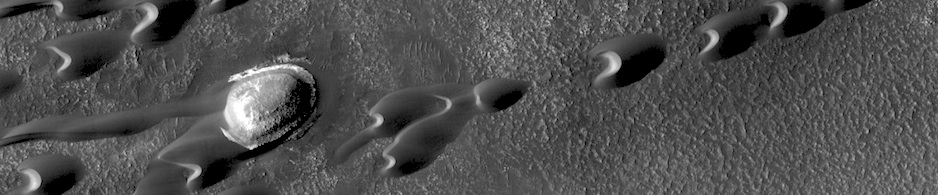
 Ongoing dune activity in Ganges Chasma. Beautiful Mars series. [More at links]
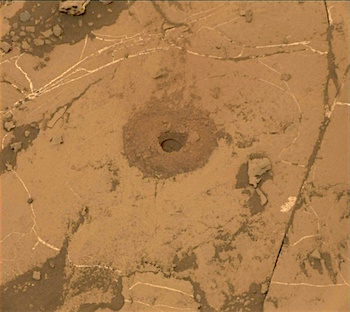 Sols 2141-42, August 13, 2018, update by MSL scientist Ashley Stroupe: In today’s plan, Curiosity begins analysis of the long-awaited Pettegrove Point drill sample at the “Stoer” target, which was successfully collected last week (and I had the pleasure of helping to sequence as a Rover Planner). Our main activity is the drop-off of sample to CheMin, based on the characterization of the drop-off portion size done in the weekend plan. There is still a good bit of wind, so the drop-off is around noon, during the calmest time. Overnight, CheMin will be busy analyzing the sample; we’ll have the results down late Wednesday, which can then inform decisions about dropping off sample to SAM as early as this weekend’s plan for analysis early next week. [More at link]
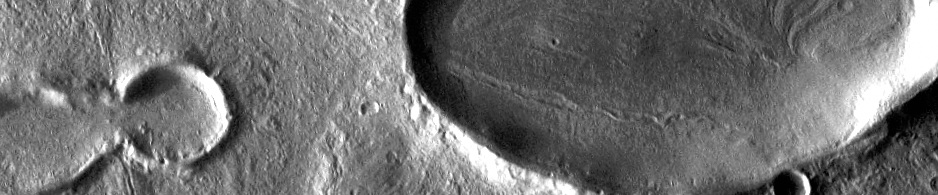
 A linear ridge network to the north of Antoniadi Crater. The objective of this observation is to examine a linear ridge network. This network may have been a consequence of fluids raised along faults created by impacts. They have also been associated with clays.
Beautiful Mars series. [More at links]
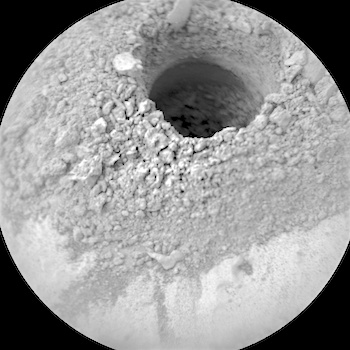 Sols 2138-40, August 13, 2018, update by MSL scientist : On our third attempt at drilling within the Pettegrove Point member on the Vera Rubin Ridge, we have success! Curiosity has successfully drilled, and generated a pile of drill tailings.
This weekend’s plan is focused on the Stoer drill hole, the tailings derived from the drill and on portion characterization observations. The portion characterization is done prior to sending samples to the analytical instruments, SAM and CheMin, to ensure that the materials will not pose any threat to the instruments. ChemCam passive and Mastcam multispectral imaging will be taken of the drill tailings to identify any potential differences… [More at link]
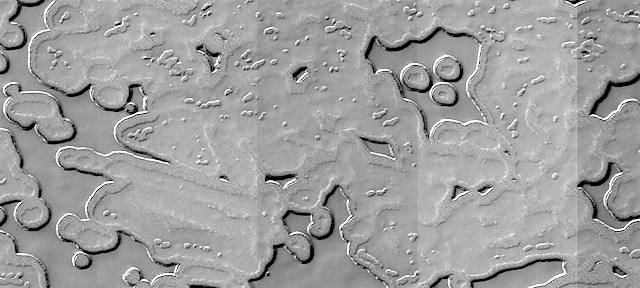 We’ll always have the South Pole. While the global dust storm has obscured much of the surface, we’ve still been able to get some good images of the polar region. Can you also spot the example of pareidolia here?
Beautiful Mars series. [More at links]
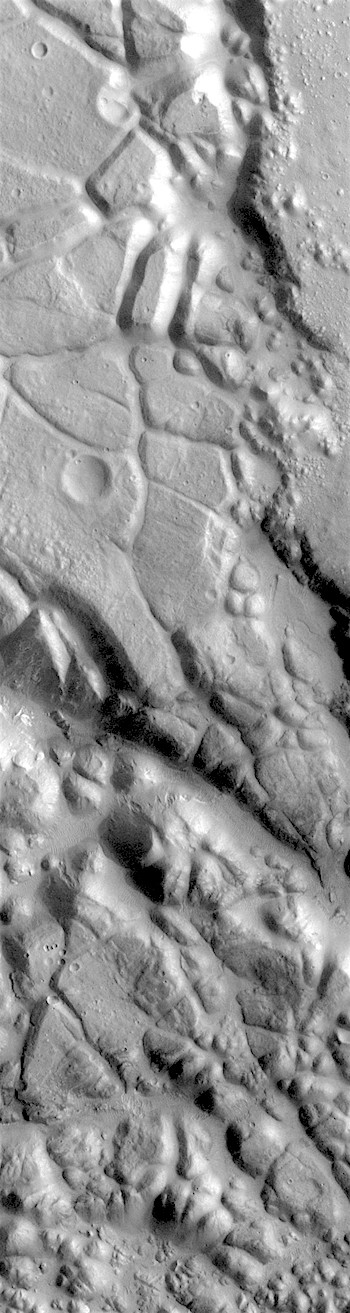 THEMIS Image of the Day, August 13, 2018. Today’s VIS image shows part of Aram Chaos. Aram Chaos was initially formed by a large impact.
Over time the crater interior was modified by several different processes, including liquid water. Located near Ares Vallis, a narrow channel links the Aram Chaos crater with Ares Vallis indicating a substantial amount of water was located in the crater.
Chaos forms from erosion of the surface into mesa features. With time the valleys expand creating the jumble of hills seen in the image.
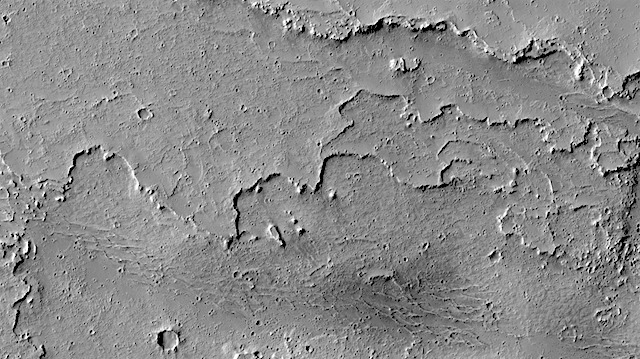 Source of flow to the east of Olympus Mons. Here we see part of a linear depression with branching segments in Amazonian volcanic plains east of Olympus Mons. The flow source from this feature that exhibit volcanic and/or fluvial characteristics.
Beautiful Mars series. [More at links]
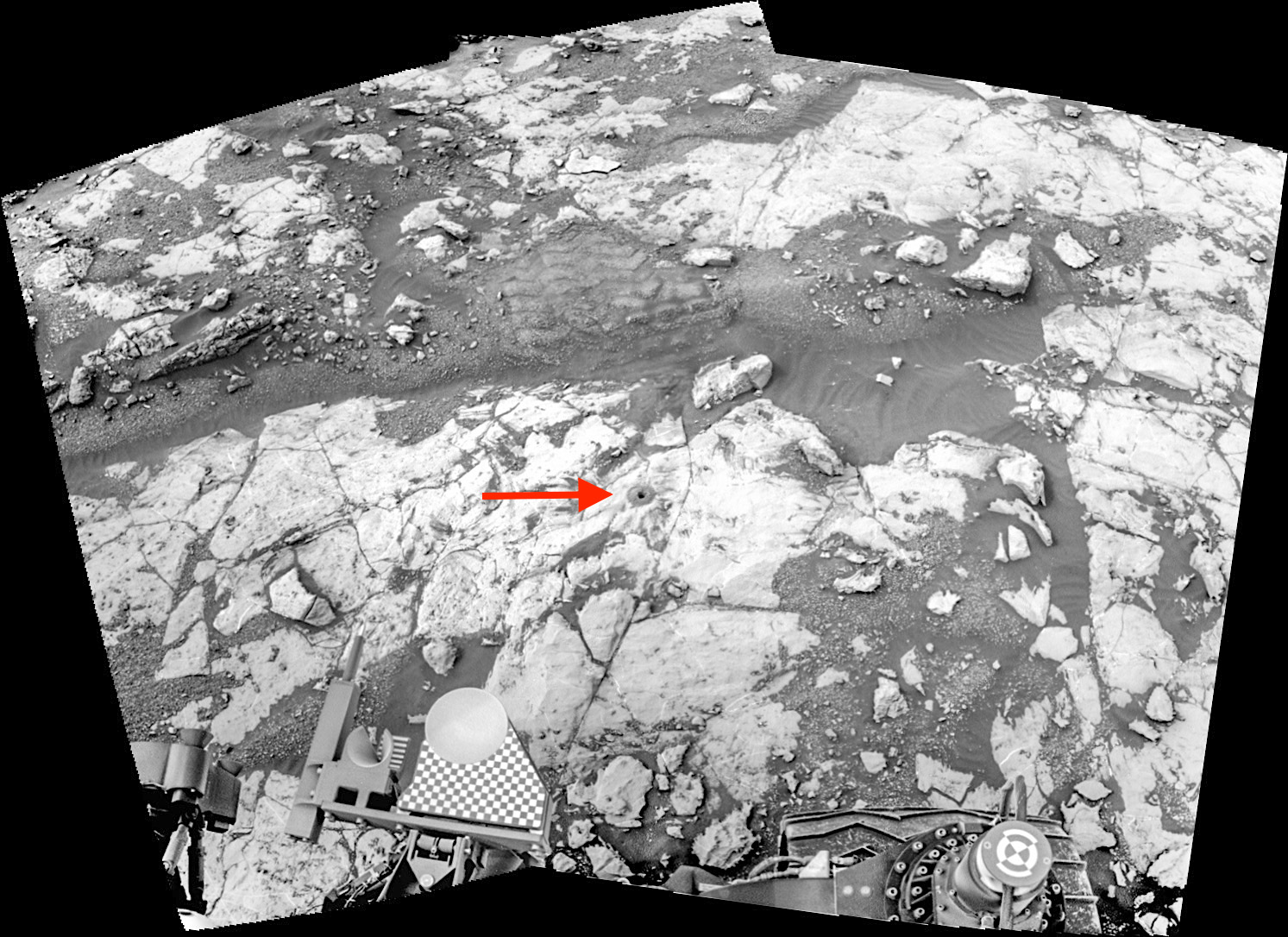 Sol 2136, August 9, 2018. Must be a case of third-time-lucky — Curiosity’s drill dug into the Pettegrove Point rock at Stoer and produced a respectable pile of tailings around the drill hole. Click the image to enlarge it. (Pre-drill Mastcam color view)