

THEMIS: Double impact at Buvinda Vallis

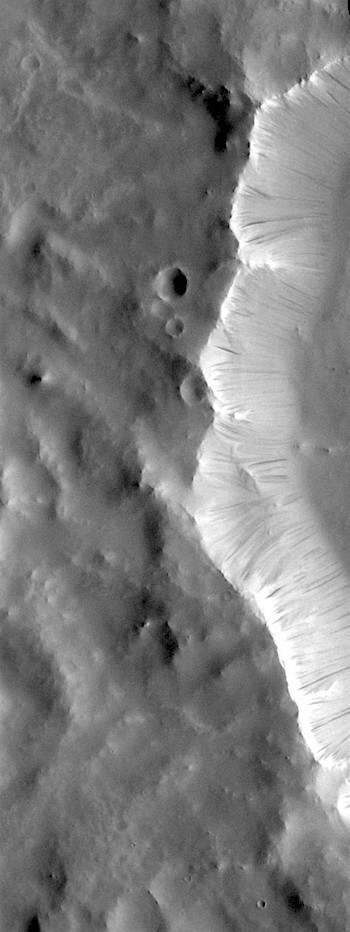
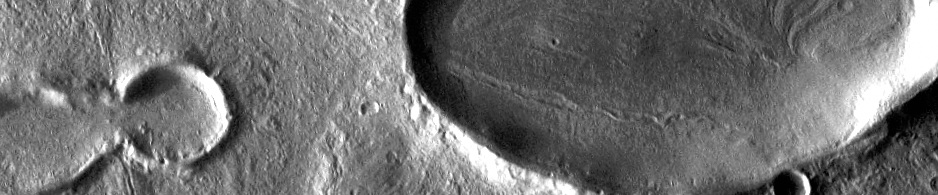
Lava channel Buvinda Vallis (THEMIS_IOTD_20180810)THEMIS Image of the Day, August 10, 2018. Today’s VIS image shows a portion of Buvinda Vallis, a channel near the flank of Hecates Tholus. The closeness of the volcano suggests that the channel was eroded by a lava flow, perhaps in a couple of stages.

The double impact, however, shows a definite sequence of events. First, a smaller impact hit close to the channel, then a larger one followed almost immediately after. With the larger crater showing a complete, round bowl, the impacts were not simultaneous but separated by a brief interval, perhaps only a couple of seconds. (Had the impactors struck together, the wall between the two craters would have been straight.)

Double asteroids are fairly common in the Main Belt, next outward from Mars’ orbit. This pair must have had at least a little distance between them.
See more THEMIS Images of the Day by geological subject.

Posted in Reports | Tagged , , , , , , , , , , , , | Comments Off

Weather update from Gale Crater

Posted in Reports | Tagged , , , , , , , , | Comments Off

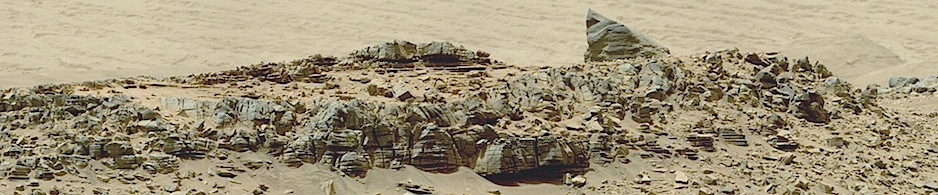
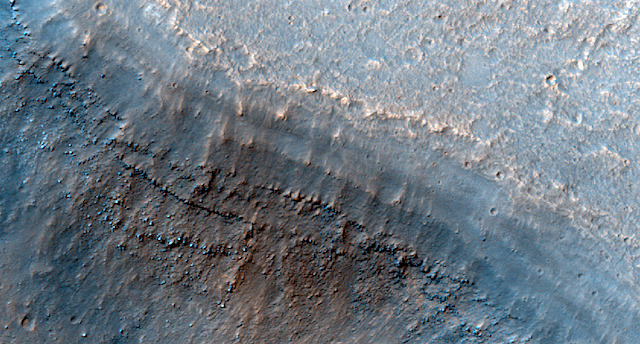
HiRISE: Layers in a collapse trough near Aromatum Chaos

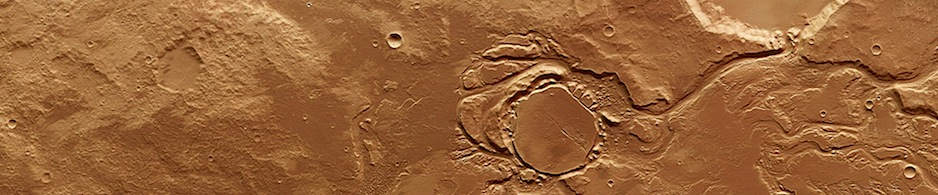
tumblr_pd3leesCxR1rlz4gso2_1280Layers in a collapse trough near Aromatum Chaos. Aromatum Chaos is a large depression, possibly formed due to a catastrophic flood event.

Beautiful Mars series. [More at links]

Posted in Reports | Tagged , , , , , , , , , , | Comments Off

Mars CO2 ice cap throughout the martian year

PIA22546This animation shows a side-by-side comparison of CO2 ice at the north (left) and south (right) Martian poles over the course of a typical year (two Earth years). This simulation isn’t based on photos; instead, the data used to create it came from two infrared instruments capable of studying the poles even when they’re in complete darkness.

As Mars enters fall and winter, reduced sunlight allows CO2 ice to grow, covering each pole. While ice at the north pole is fairly symmetrical, it’s somewhat asymmetrical during its retreat from the south pole for reasons scientists still don’t understand. Scientists are especially interested in studying how global dust events affect the growth and retreat of this polar ice. Mars’ seasons are caused by a tilt in the planet, resulting in winter at one of the planet’s poles while it’s summer at the other…. [More at link]

Posted in Reports | Tagged , , , , , , , , , , | Comments Off

Curiosity update: Try, try, and try again

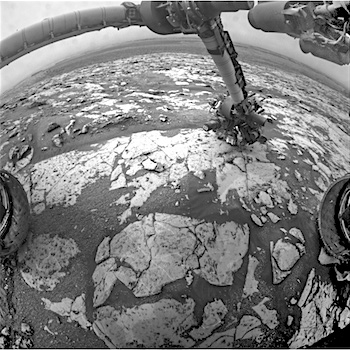
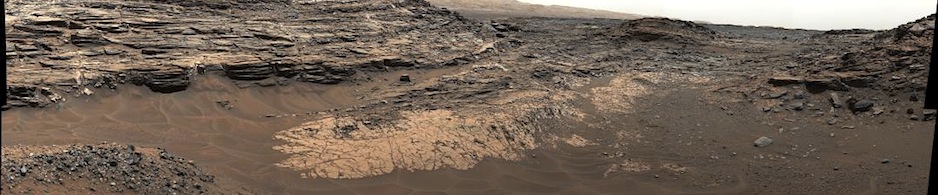
FRB_586942111EDR_F0721316FHAZ00337M_-br2Sols 2136-37, August 8, 2018, update by MSL scientist Sarah Lamm: After two sols of analyzing our intended drill site in the Pettegrove Point member, we began plans to drill the target “Stoer.” Stoer has had Mastcam images, MAHLI images, APXS, and ChemCam observations acquired over the past two sols. The two previous drill attempts in this geologic member have not been able to get to successful depth since the rocks have been more resistant than what we saw earlier in the mission. Pettegrove Point is an important area to get a drill sample from because it is categorized as lower Vera Rubin Ridge. Curiosity has previously visited this area of Pettegrove Point on Sol 2097. On that sol we had a target “Caithness” which is close to our intended drill hole, Stoer. This is the last drill attempt in Pettegrove Point… [More at link]

Posted in Reports | Tagged , , , , , , , , , , , , , , , | Comments Off

THEMIS: Terra Sabaea dark slope streaks

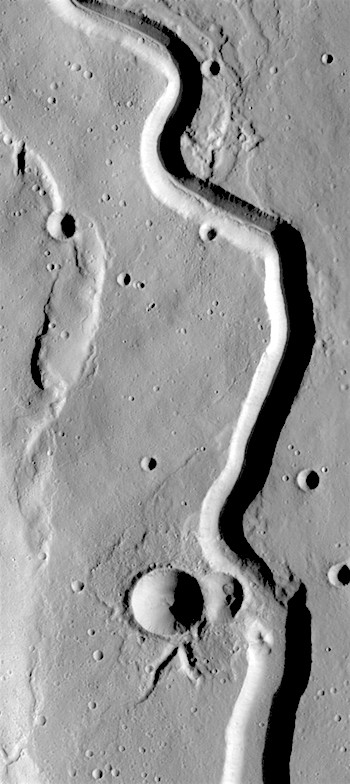
Dark slope streaks (THEMIS_IOTD_20180809)THEMIS Image of the Day, August 9, 2018. This VIS image is located in Terra Sabaea. The ridge near the right side of the image contains dark slope streaks.

These features are thought to form by downslope movement of material which either reveals the darker rock beneath the dust coating, or creates the darker surface by flow of a volatile just beneath the dust coating.

See more THEMIS Images of the Day by geological subject.

Posted in Reports | Tagged , , , , , , , , , , | Comments Off

MARCI weather report, July 30-August 5, 2018

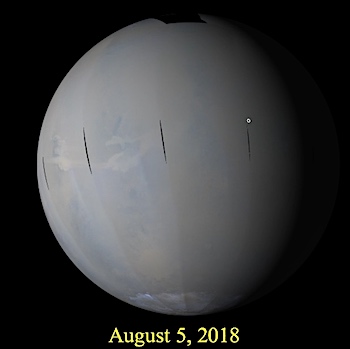
MARCI-August-5-2018The planetary-encircling dust event continued to decay across Mars last week. Looking to the southern highlands, short-lived local-scale dust storms were observed over Solis-Sinai and along the seasonal south polar ice cap edge, which has retreated to ~65° S. latitude. Poleward of the cap’s boundary, afternoon dust hazes propagated eastward from southern Sirenum to southwestern Noachis Terra…. [More at link, including video]

Posted in Reports | Tagged , , , , , , , , , , , , , , , | Comments Off

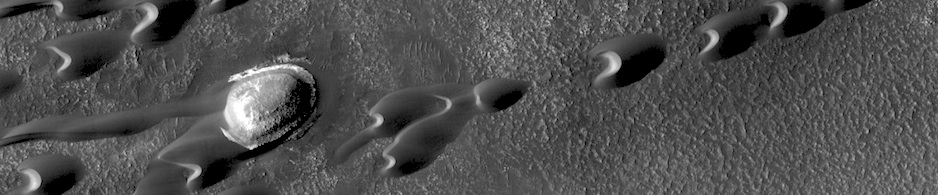
Bagnold Dunes sand movement observed by Curiosity

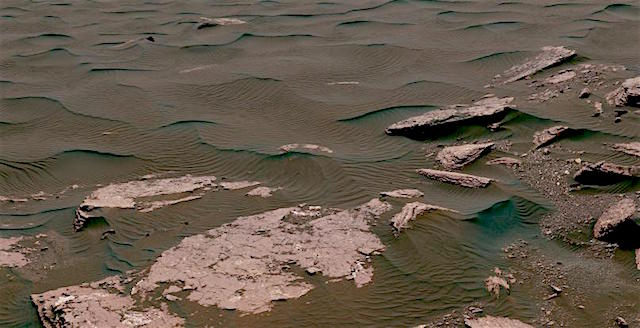
PIA11242_modest[Editor’s note: From a paper by Mariah Baker and nine co-authors recently published in Geophysical Research Letters.]

The Bagnold Dunes in Southern Summer: Active Sediment Transport on Mars Observed by the Curiosity Rover

•  Curiosity’s imaging campaigns in the Bagnold Dune Field reveal that impact ripples migrate up to ∼3 cm/sol during southern summer.
• Impact ripples generally migrated towards the southwest within a 70 degree range about their mean migration direction.
• Sand-flux estimates are consistent with low-flux saltation occurring below the fluid threshold of sand transport.

A wealth of orbital images have revealed that wind is actively moving sand on the surface of Mars; landed instruments enable a closer look at these processes. Images acquired during southern summer by the Curiosity rover in Gale crater revealed high levels of wind activity, in contrast to previous imaging done during southern winter. A majority of ripple migration occurs towards the southwest, with ripples moving up to 2.8 cm per day.

These findings are consistent with models that predict southern summer to be the windiest season at this location on Mars, with strong regional winds flowing over the northern crater rim and causing strong southwestward flow along the floor of the crater within the vicinity of the rover. Despite the fact that bedforms are active, models do not predict that the wind should be strong enough to initiate motion, which challenges our understanding of the physics of sediment transport under Martian conditions. [More at link]

Posted in Reports | Tagged , , , , , , , , , , , , , , , | Comments Off

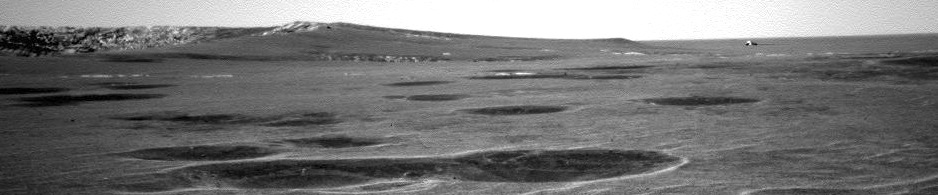
Opportunity: Still no change in status

NASA Mars Exploration Rover Status Report, August 7, 2018: There is no news since the last status update.

As reported last week, the planet-encircling dust storm on Mars is showing indications of peaking and perhaps decaying. Dust lifting sites have decreased in extent and some surface features are starting to become visible. The storm has sustained high atmospheric opacity conditions over the Opportunity site, although there are some preliminary indications that the opacity might be decreasing there. Since the last contact with the rover on Sol 5111 (June 10, 2018), Opportunity has likely experienced a low-power fault and perhaps, a mission clock fault and now an up-loss fault.

The science team is continuing to listen every day for the rover either during the expected fault communication windows or listening over a broader range of times using the Deep Space Network Radio Science Receiver. For the near term, the project will continue to send a command three times a week to elicit a beep if the rover happens to be awake.

The science team does not expect to hear anything from Opportunity until there has been a significant reduction in the atmospheric opacity over the rover site. [More at link]

Posted in Reports | Tagged , , , , , , , , , , | Comments Off

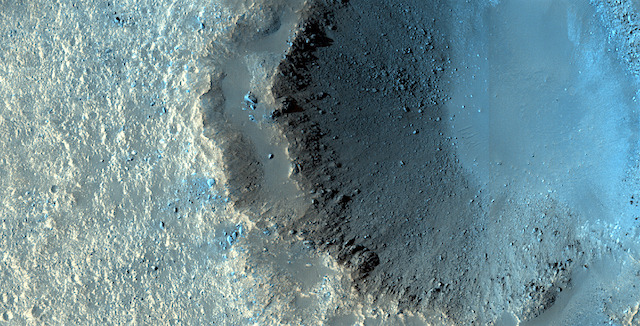
HiRISE: Impact crater on the Kasei Valles floor

tumblr_pcwfa96U7x1rlz4gso2_1280An impact crater on the floor of Kasei Valles. This impact crater is on platy-ridged material on the floor of Kasei Valles. We might be able to distinguish between lava and mud in the area.

Beautiful Mars series. [More at links]

Posted in Reports | Tagged , , , , , , , , | Comments Off