THEMIS: Complex feature in Hephaestus Fossae

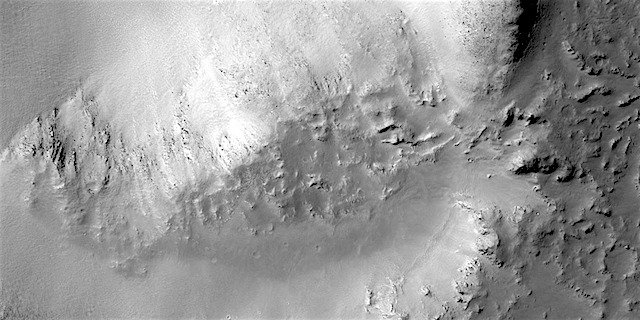
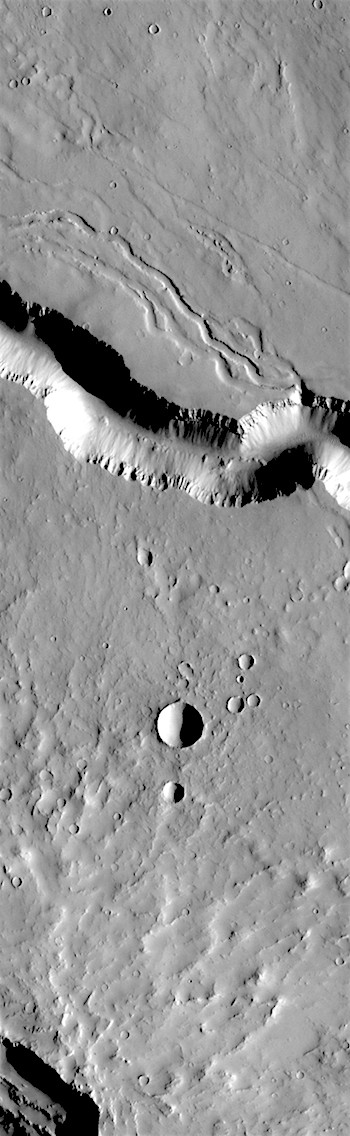
Hephaestus Fossae (THEMIS_IOTD_20180808)THEMIS Image of the Day, August 8, 2018. This VIS image is located at the eastern end of Hephaestus Fossae. Hephaestus Fossae is a channel system in Utopia Planitia near Elysium Mons.

It has been proposed that the channel formed by the release of melted subsurface ice during the impact event that created a large crater west of this image. The method of formation for this complex feature at end of the channel is still unknown.

See more THEMIS Images of the Day by geological subject.

Posted in Reports | Tagged , , , , , , , , , , , | Comments Off

Curiosity: Mastcam scouts the Stoer drill site

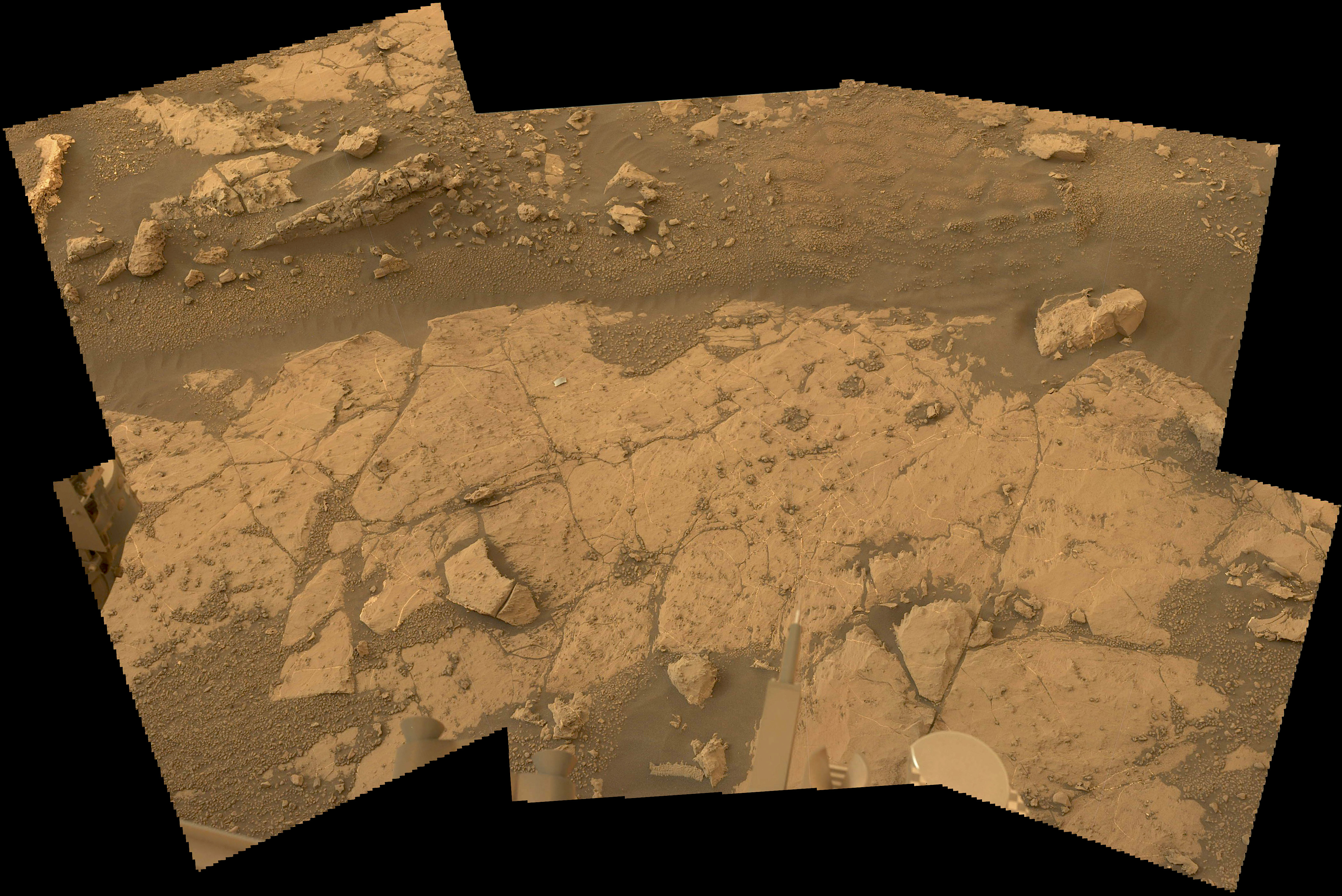
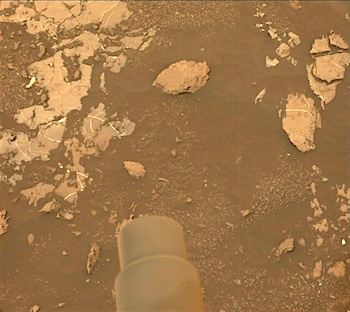
2132-mastcam34Sol 2132, August 5, 2018. Curiosity’s Mastcam (34 mm lens) looked down and documented the proposed drill site, dubbed Stoer, for the third attempt to penetrate the hematite-hardened rock atop Vera Rubin Ridge.

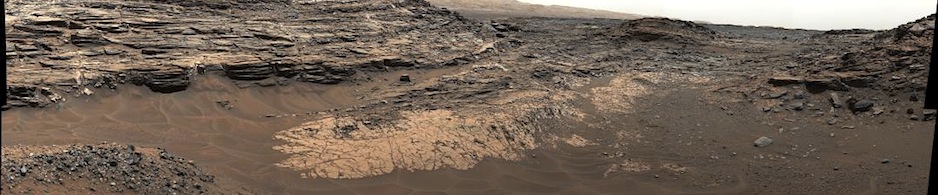
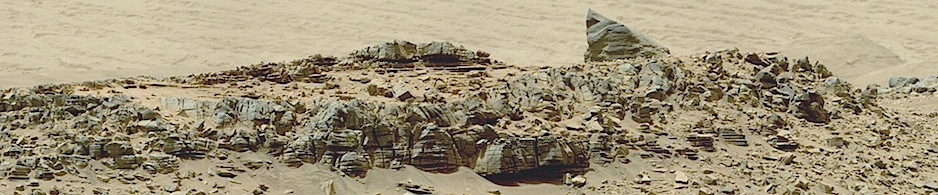
Below is another Mastcam composite, one which looks to the south at the next higher layer of the ridge and, dimly visible beyond the ridgeline, the slopes of Mt. Sharp. Click either image to enlarge it.

Sol 2132 raw images (from all cameras).

2132-mastcam-ridge

Posted in Reports | Tagged , , , , , , , , , , | Comments Off

HiRISE: Gullies in a crater in Acidalia Planitia

tumblr_pcwcuoyUMy1rlz4gso2_1280Gullies in a crater in Acidalia Planitia. The objective of this observation is to examine gullies on the north wall of a crater. The slope looks quite steep and the gullies are fairly straight.

Beautiful Mars series. [More at links]

Posted in Reports | Tagged , , , , , , , , , , , | Comments Off

Curiosity update: Third time’s a charm?

NRB_586769652EDR_F0721316NCAM00353M_-br2Sols 2134-35, August 6, 2018, update by MSL scientist Rachel Kronyak: After a weekend full of contact science, remote science, and driving, Curiosity arrived at her next drill site within the Pettegrove Point member. Our previous two drilling attempts within the Pettegrove Point member haven’t been as successful as we’d have hoped; the rocks in this area are much harder than we’re used to – all the more reason to acquire and analyze a drill sample. We’re hopeful that our third drilling attempt does the trick!

Today we planned two sols to kick off our drilling campaign. On Sol 2134 we will perform triage contact science observations to document our new drill target, which we’ve named “Stoer.” We’ll use our Dust Removal Tool (DRT) to brush away some of the surface dust over Stoer before imaging it with the MAHLI camera and performing chemical analyses with the APXS instrument. To prepare for drilling, we’ll then perform a “pre-load” test, where we position the drill in contact with the Stoer rock surface and press down. This allows our mission engineers to verify that the rock is stable enough for drilling… [More at link]

Posted in Reports | Tagged , , , , , , , , , , , | Comments Off

THEMIS: Dark slope streaks in Terra Sabaea

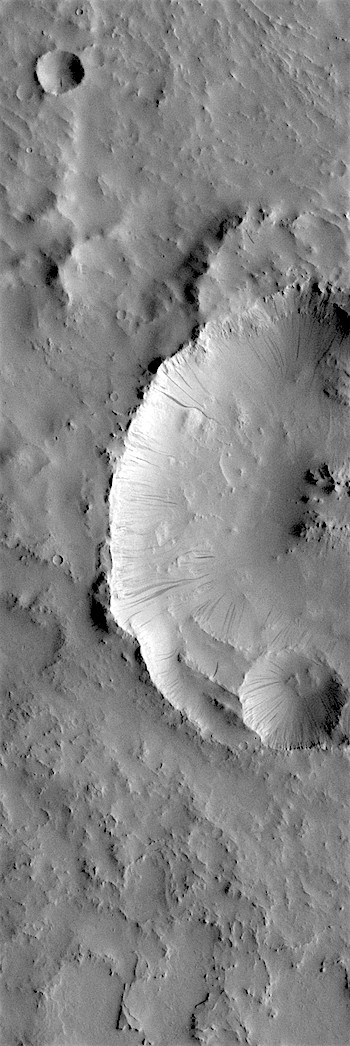
Dusty slopes in Terra Sabaea (THEMIS_IOTD_20180807)THEMIS Image of the Day, August 7, 2018. This VIS image is located in an unnamed crater in Terra Sabaea. The entire inner rim of the crater near the center of the image contains dark slope streaks.

These features are thought to form by downslope movement of material which either reveals the darker rock beneath the dust coating, or creates the darker surface by flow of a volatile just beneath the dust coating.

See more THEMIS Images of the Day by geological subject.

Posted in Reports | Tagged , , , , , , , , , , | Comments Off

MAVEN: Loss of atmosphere drove climate change on Mars

MarsSolarStormIonLossMAVEN research shows that atmospheric loss to space has been the major process driving climate change on Mars. Research using MAVEN data indicates that Mars’ atmospheric loss over time has been at least 0.8 bar CO₂ or the equivalent of a 23 meter-deep layer of H₂O across the entire Red Planet.

These results, based on current processes whose escape rates in the past are adjusted according to expected solar evolution, suggest that loss of gas to space has been the dominant process responsible for changing the climate of Mars from an early, wet, warmer environment to the cold, dry one that we see today.

The results have been published online in the ScienceDirect journal Icarus. [More at links]

Posted in Reports | Tagged , , , , , | Comments Off

HiRISE: Flow over a crater rim in Daedalia Planum

tumblr_pcuh6kpezW1rlz4gso1_1280A flow over a crater rim in far eastern Daedalia Planum.  Lava flow over-topped crater rim and some lava poured down crater wall. Perhaps it is possible to use knowledge of crater rim, wall (slope), etc., as well as lava flow surface morphology, to deduce flow physical properties at the time of emplacement.

Beautiful Mars series. [More at links]

Posted in Reports | Tagged , , , , , , , , | Comments Off

Curiosity update: Color abounds in Pettegrove Point

2129ML0114100000802579E01_DXXX-br2Sols 2131-33, August 6, 2018, update by MSL scientist Vivian Sun: Curiosity is currently preparing to bump to her next drill site in the Pettegrove Point member, but not before gathering many observations at our current location. There are interesting color variations in today’s workspace, with grey, tan, and red gradients across the outcrop that can be seen in the above image. Curiosity will document these color variations in detail with images from Mastcam and the Mars Hand Lens Imager (MAHLI) and chemical measurements from the ChemCam and Alpha Particle X-Ray Spectrometer (APXS) instruments. This is a lot of data to relay, but we expect downlinks from both the Mars Odyssey and the ExoMars Trace Gas Orbiter spacecrafts over the weekend… [More at link]

Posted in Reports | Tagged , , , , , , , , , , , , , , , | Comments Off

THEMIS: Elysium Fossae’s channels

Elysium Fossae (THEMIS_IOTD_20180806)THEMIS Image of the Day, August 6, 2018. Today’s VIS image contains a section of one of the many channel forms found on the northwestern side of the Elysium Mons volcanic complex. The channel features are thought to have both a tectonic and volcanic origin.

The linear depression resembles a graben (formed by tectonic forces) and the smaller sinuous channels extending to the top of the image more closely resemble features caused by fluid flow — either lava or water created by melting subsurface ice by volcanic heating.

See more THEMIS Images of the Day by geological subject.

Posted in Reports | Tagged , , , , , , , , , , | Comments Off

Opportunity: Dust storm may have peaked

NASA Mars Exploration Rover Status Report, August 2, 2018: The planet-encircling dust storm on Mars is showing indications of peaking and perhaps decaying.

Dust lifting sites have decreased in extent and some surface features are starting to become visible. The storm has sustained high atmospheric opacity conditions over the Opportunity site, although there are some preliminary indications that the opacity might be decreasing there. Since the last contact with the rover on Sol 5111 (June 10, 2018), Opportunity has likely experienced a low-power fault and perhaps, a mission clock fault and now an up-loss fault.

The science team is continuing to listen every day for the rover either during the expected fault communication windows or listening over a broader range of times using the Deep Space Network Radio Science Receiver. For the near term, the science team will continue to send a command three times a week to elicit a beep if the rover happens to be awake.

It is not expected to hear anything from Opportunity until there has been a significant reduction in the atmospheric opacity over the rover site… [More at link]
Posted in Reports | Tagged , , , , , , , , , , | Comments Off