HST images dusty Mars (and Phobos and Deimos) at opposition

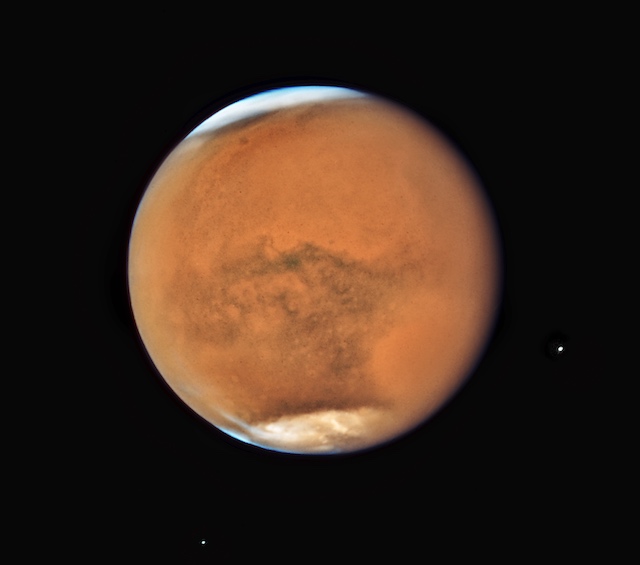
Stormy Mars in opposition in 2018With both Saturn and Mars coming to opposition — lying directly opposite the Sun in the sky — this summer, scientists used the Hubble Space Telescope to image both planets. But unlike the previous opposition, Mars is experiencing a planet-wide dust storm which has heavily obscured its surface.

Hubble shot its portrait of Mars on 18 July, just 13 days before Mars reached its closest approach to Earth. (The moon Phobos lies to the right of Mars, while Deimos is below and to the left of the planet.)

This year Mars will get as close as 57.6 million kilometres [35.8 million miles] from Earth. This makes it the closest approach since 2003, when the red planet made its way closer to us than at any other time in almost 60,000 years.

(…) Still visible are the white polar caps, Terra Meridiani, the Schiaparelli Crater, and Hellas Basin — but all of these features are slightly blurred by the dust in the atmosphere. [More at link]

Posted in Reports | Tagged , , , , , , | Comments Off

Curiosity update: Preparing to drill at ‘Ailsa Craig’

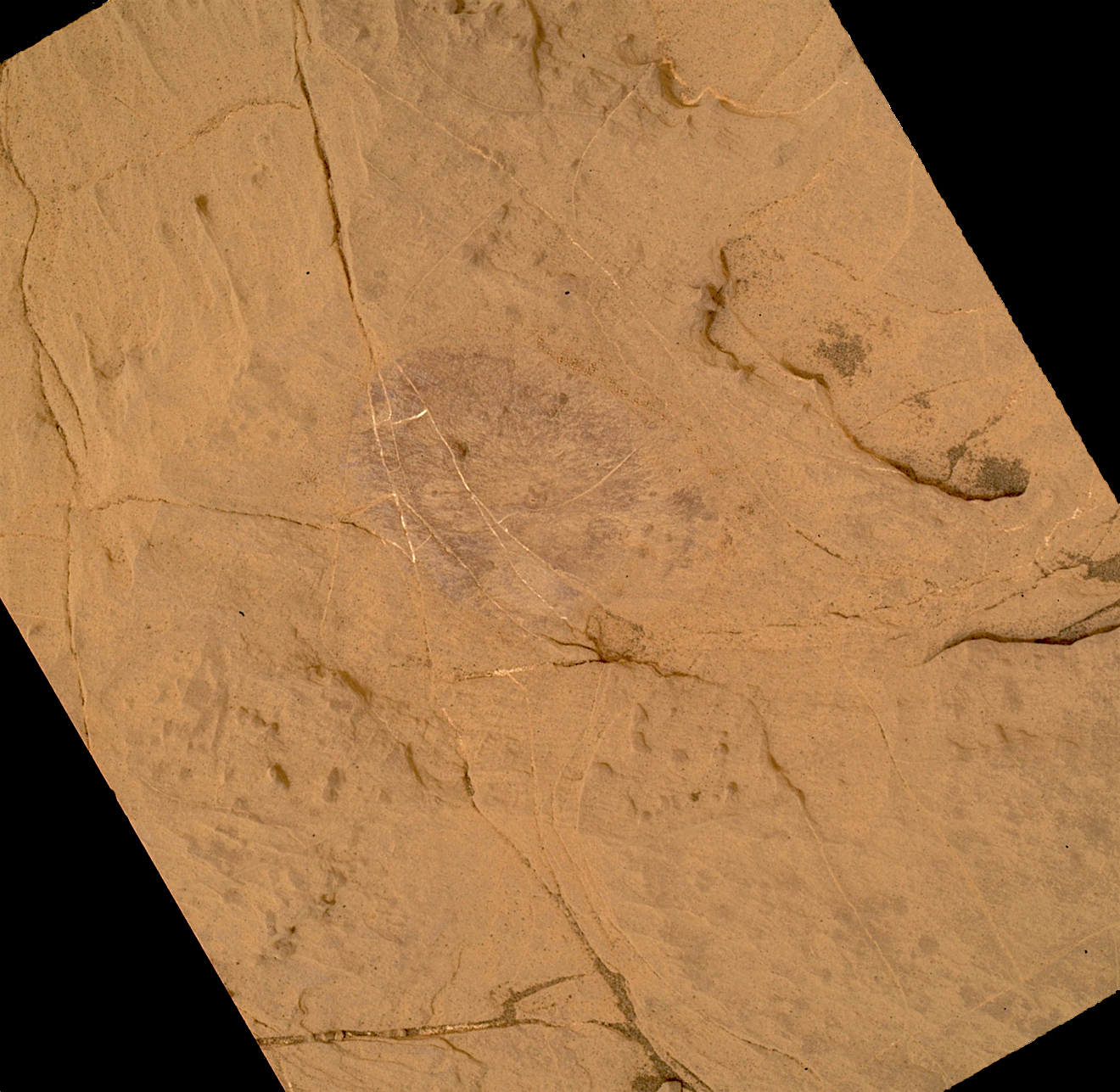
2121MH0004650010802552C00_DXXX-br2Sols 2122-23, July 25, 2018, update by MSL scientist Rachel Kronyak: Yesterday, the science team chose a new drill target, “Ailsa Craig,” and we spent the day triaging the target with our contact science instruments, DRT, MAHLI, and APXS. The image above is one of the MAHLI images that we collected after the DRT removed some of the surface dust over the drill target.

Today, we’re planning two sols. Sol 2122 is devoted to drilling the target Ailsa Craig! We’ll collect some complementary observations to document our drilling activities with the Mastcam, MAHLI, and ChemCam RMI cameras. We’ll spend most of Sol 2123 recharging, but we also managed to squeeze in a few additional science observations, including two ChemCam LIBS analyses on nearby bedrock targets… [More at link]

Posted in Reports | Tagged , , , , , , , , , , , , , | Comments Off

THEMIS: Lava flow dodges impact crater’s ejecta

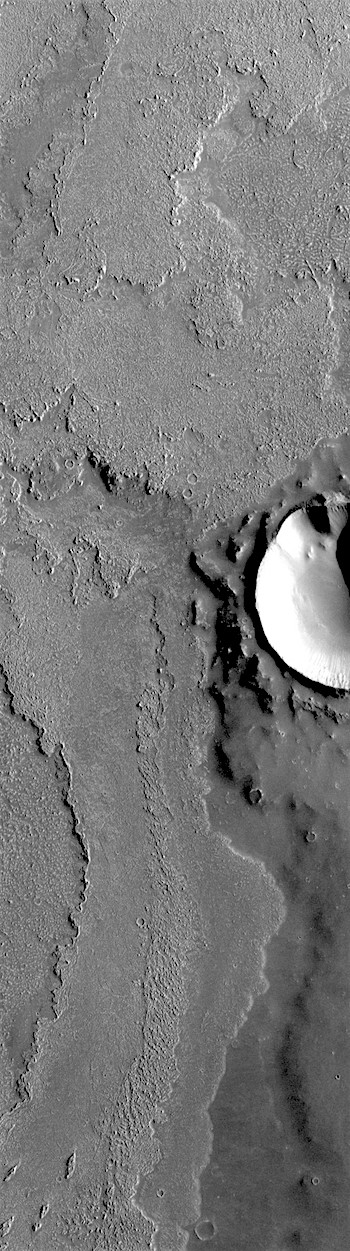
Lava flow dodges a crater on Daedalia Planum (THEMIS_IOTD_20180726)THEMIS Image of the Day, July 26, 2018. This VIS image shows a small portion of the vast lava flow field of Daedalia Planum. The flows originate at Arsia Mons, the youngest of the three Tharsis volcanoes.

See more THEMIS Images of the Day by geological subject.

Posted in Reports | Tagged , , , , , , , , , , | Comments Off

Curiosity: Giving Ailsa Craig the brushoff

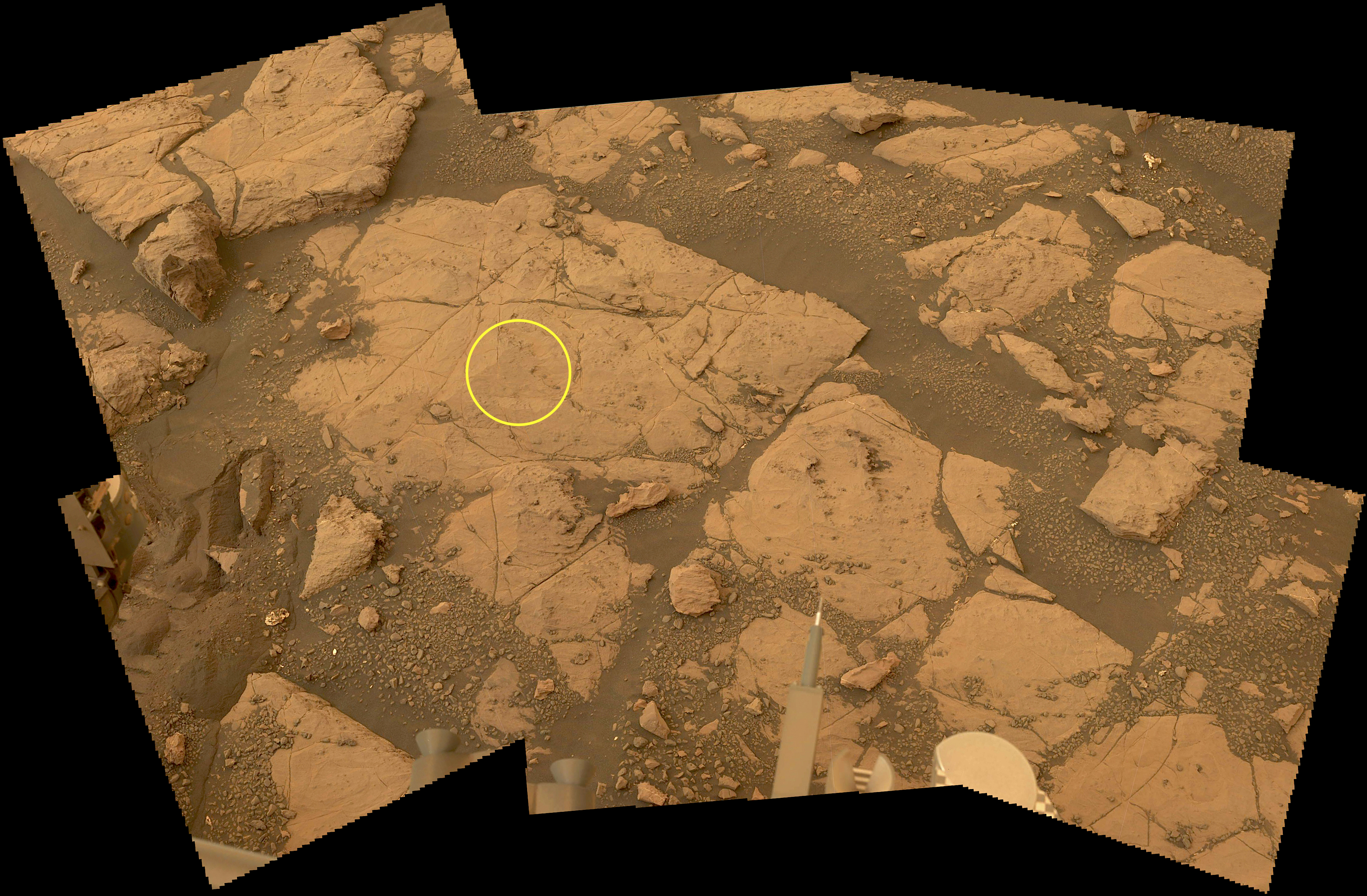
2120-mastcam2121-MAHLI-ailsacraigSol 2120-21, July 24-25, 2018. With Curiosity positioned to drill at Ailsa Craig (circled in the Sol 2120 Mastcam composite above), mission scientists first brushed off the target rock. The brushed area is seen as a darker oval area in the center of this Sol 2121 Mars Hand Lens Imager shot (right). Both images enlarge when clicked.

Sol 2120 raw images (from all cameras).

Posted in Reports | Tagged , , , , , , , , , | Comments Off

MARCI weather report, July 16-22, 2018

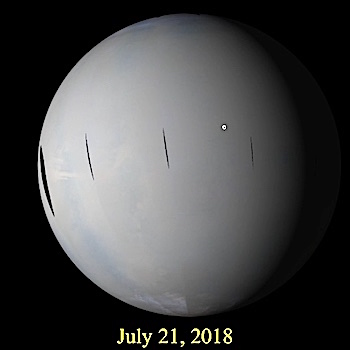
MARCI-July-21-2018Dust clouds and hazes still loomed over Mars last week. Some atmospheric clearing was spotted over Noachis and Aonia Terra as the planet-encircling dust event transitioned to a decay phase. The edges of the canyons that make up Valles Marineris were also discernible most afternoons. Looking to the northern mid-to-high latitudes, a number of local-scale dust storms and water-ice clouds were observed along the polar vortex… [More at link, including video]

Posted in Reports | Tagged , , , , , , , , , , , , , , , | Comments Off

HiRISE: Fans and valleys

ESP_055110_2265An impact crater approximately 23 kilometers across is home to fan-shaped deposits that extend from the rim and sit on the interior crater floor.

Thick beds with varying tone are exposed along the edge of the fan. Shallow valleys that carve into the smooth upland surfaces outside of the crater may provide clues regarding the formation of the deposits. Many boulder-sized blocks sit on the interior crater floor beyond the toe (distal edge) of the deposits.

This fan-hosting crater is located near the boundary between Tempe Terra and Acidalia Planitia in the Northern Hemisphere of Mars. [More at link]

Posted in Reports | Tagged , , , , , , , , | Comments Off

Curiosity update: Blackjack!

2119ML0113500000802427E01_DXXX-br2Sol 2121, July 24, 2018, update by MSL scientist Michelle Minitti: Mars dealt us a winning hand today, yielding a sufficiently flat parking space after yesterday’s short bump to allow us to proceed with our plan to drill in this part of the “Vera Rubin Ridge.” Our current parking spot does not exhibit as strong a hematite signal from orbit as the site of our last drill attempt, but it still importantly provides an opportunity to sample the “Pettegrove Point” member of the Vera Rubin Ridge. Today we focused almost solely on characterizing the drill target, melodiously named “Ailsa Craig,” using… [More at link]

Posted in Reports | Tagged , , , , , , , , , , | Comments Off

Mars Express radar finds liquid water under Mars south polar region

Mars_Express_detects_water_buried_under_the_south_pole_of_Mars

Editor’s note: NASA has commented on this discovery.

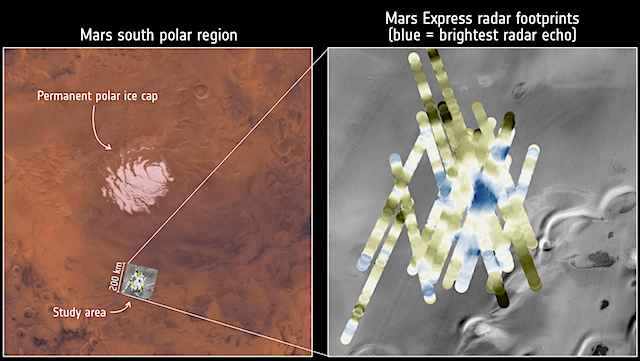
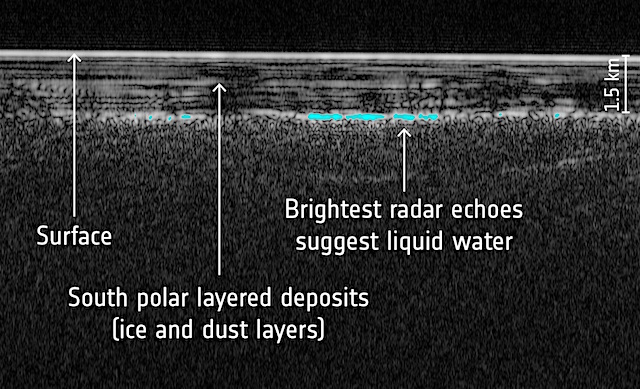
Radar data collected by ESA’s Mars Express point to a pond of liquid water buried under layers of ice and dust in the south polar region of Mars. [The researchers’ paper reporting the discovery was published in Science, July 25; a commentary article in Science accompanies the paper.]

Evidence for the Red Planet’s watery past is prevalent across its surface in the form of vast dried-out river valley networks and gigantic outflow channels clearly imaged by orbiting spacecraft. Orbiters, together with landers and rovers exploring the martian surface, also discovered minerals that can only form in the presence of liquid water.

But the climate has changed significantly over the course of the planet’s 4.6 billion year history and liquid water cannot exist on the surface today, so scientists are looking underground. Early results from the 15-year old Mars Express spacecraft already found that water-ice exists at the planet’s poles and is also buried in layers interspersed with dust.

The presence of liquid water at the base of the polar ice caps has long been suspected; after all, from studies on Earth, it is well known that the melting point of water decreases under the pressure of an overlying glacier. Moreover, the presence of salts on Mars could further reduce the melting point of water and keep the water liquid even at below-freezing temperatures.

But until now evidence from the Mars Advanced Radar for Subsurface and Ionosphere Sounding instrument, MARSIS, the first radar sounder ever to orbit another planet, remained inconclusive.

It has taken the persistence of scientists working with this subsurface-probing instrument to develop new techniques in order to collect as much high-resolution data as possible to confirm their exciting conclusion… [More at links]

marsis-profile

Posted in Reports | Tagged , , , , , , , , | Comments Off

THEMIS: Ares Valles’ long winding channel

Ares Valles' long winding channel through rough terrain (THEMIS_IOTD_20180725)THEMIS Image of the Day, July 25, 2018. Today’s VIS image shows part of Ares Vallis, one of the large channels in Margaritfer Terra that empty into Chryse Planitia.

See more THEMIS Images of the Day by geological subject.

Posted in Reports | Tagged , , , , , , , , , , , | Comments Off

Medusae Fossae Formation: single largest source of dust on Mars

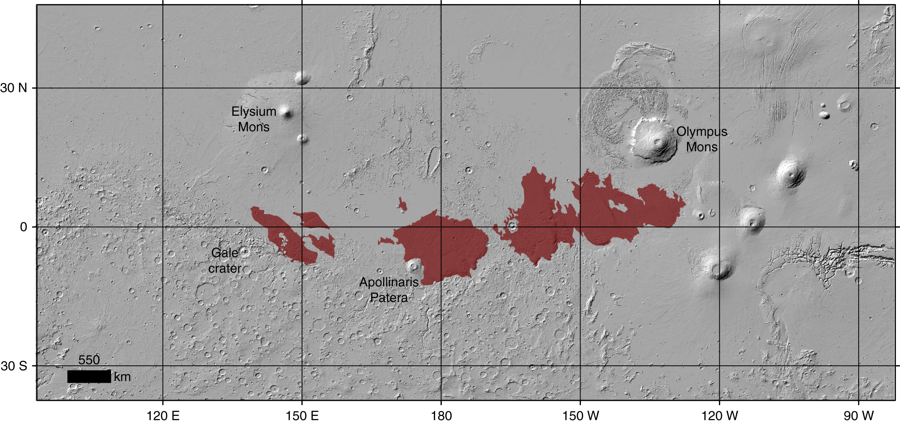
41467_2018_5291_Fig1_HTMLThe dust that coats much of the surface of Mars originates largely from a single thousand-kilometer-long geological formation near the Red Planet’s equator, scientists have found.

A study published in the journal Nature Communications found a chemical match between dust in the Martian atmosphere and the surface feature, called the Medusae Fossae Formation.

“Mars wouldn’t be nearly this dusty if it wasn’t for this one enormous deposit that is gradually eroding over time and polluting the planet, essentially,” said co-author Kevin Lewis, an assistant professor of Earth and planetary science at the Johns Hopkins University. (…)

On Earth, dust is separated from soft rock formations by forces of nature including wind, water, glaciers, volcanoes and meteor impacts. For more than 4 billion years, however, streams of water and moving glaciers have likely made but a small contribution to the global dust reservoir on Mars. While meteor craters are a common feature on the fourth planet from the sun, the fragments created by the impacts typically are bigger than the fine particles that comprise Martian dust.

“How does Mars make so much dust, because none of these processes are active on Mars?” said lead author Lujendra Ojha, a postdoctoral fellow in Lewis’ lab. Although these factors may have played a role in the past, something else is to blame for the large swathes of dust surrounding Mars now, he said… [More at links]

Posted in Reports | Tagged , , | Comments Off