

‘Ghost dune’ pits discovered on Mars

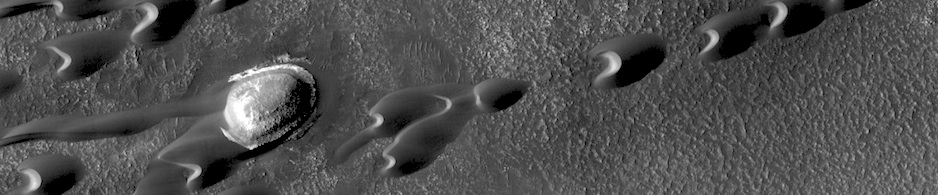
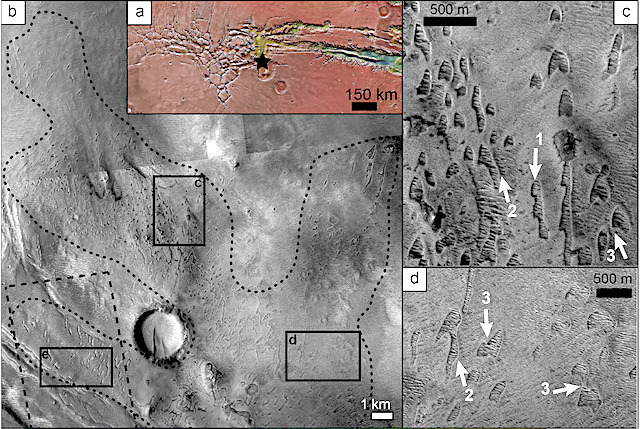
jgre20954-fig-0002-mScientists have discovered hundreds of crescent-shaped pits on Mars where sand dunes the size of the U.S. Capitol stood billions of years ago. The curves of these ancient dune impressions record the direction of prevailing winds on the Red Planet, providing potential clues to Mars’s past climate, and may hold evidence of ancient life, according to a new study detailing the findings in the Journal of Geophysical Research...

Ghost dunes are the negative space left behind by long-vanished sand dunes. Lava or water-borne sediments partially buried the dunes and hardened, preserving the dunes’ contours. Wind subsequently blew sand off the exposed tops and scoured it out from inside, leaving a solid mold in the shape of the lost dune… [More at links]
Posted in Reports | Tagged , , , , , | Comments Off

HiRISE: Fractures on Pavonis Mons

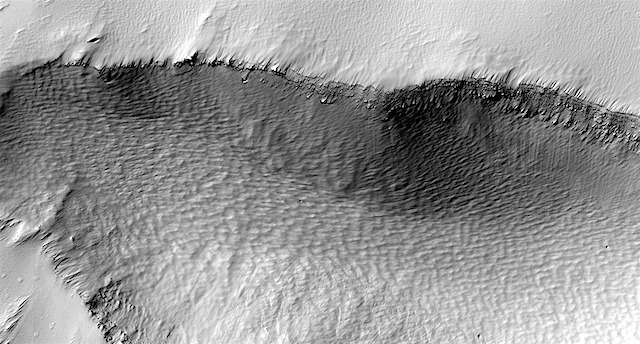
tumblr_pbk6ddZYAH1rlz4gso1_1280Fractures on Pavonis Mons. This observation was suggested by students at the Mars Academy in Brazil. Here is their original rationale: “This “stressed-out” region of the northeastern slopes of Pavonis Mons contains multiple sets of sub-parallel faults, with down-thrown blocks indicating tensional stretching of the crustal layers. We wish to examine a couple of these features in detail using HiRISE images….”

Beautiful Mars series. [More at links]

Posted in Reports | Tagged , , , , , , , , , , | Comments Off

THEMIS: Daedalia Planum’s lava flows

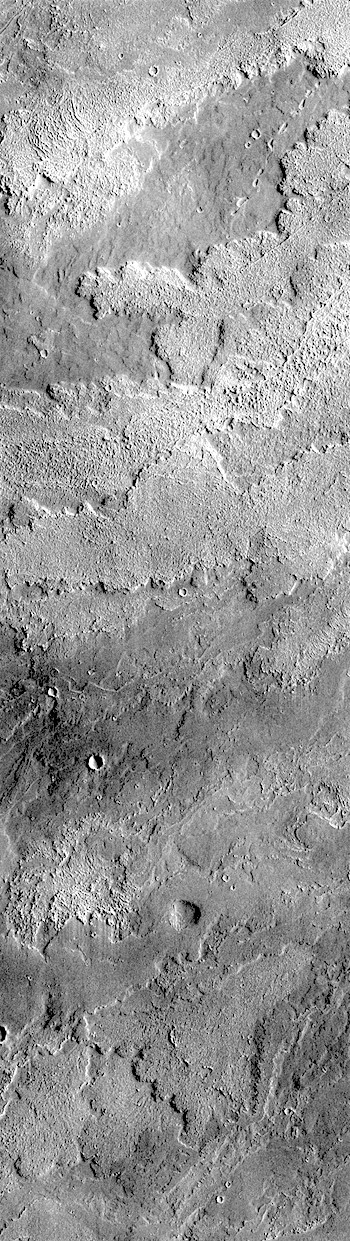
Daedalia Planum lava flows (THEMIS_IOTD_20180711)THEMIS Image of the Day, July 11, 2018. The lava flows in this VIS image originate at Arsia Mons. Arsia Mons in the southermost of the three large Tharsis volcanoes.

More THEMIS Images of the Day by geological topic.

Posted in Reports | Tagged , , , , , , , , , , , | Comments Off

HiRISE: Cliffs and stratified features in central Arabia Terra

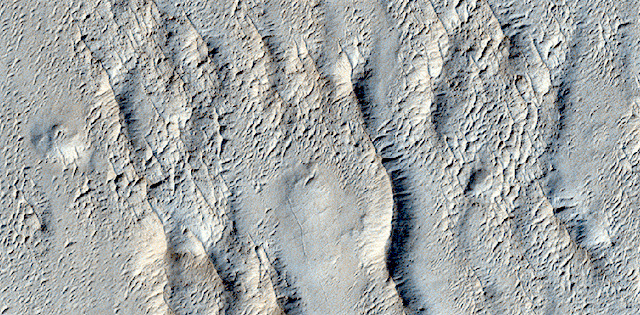
tumblr_pbk5x4f58W1rlz4gso2_1280Cliffs and stratified features in central Arabia Terra. Sedimentary rock? Layered materials looked as if mantled by dust. The goal of this observation is to capture some of the variety of erosional expressions  and stratigraphy.

Beautiful Mars series. [More at links]

Posted in Reports | Tagged , , , , , , , , , | Comments Off

Curiosity update: Heading back to the Great Red Spot

2104ML0112280010802028E01_DXXX-br2Sol 2107, July 9, 2018, update by MSL scientist Roger Wiens: The image above shows the Mastcam view as of Sol 2104, in which the nearby terrain is clearly visible, but nothing beyond the foreground, and the entire scene looks a murky red-brown color due to the dust storm. Unhampered by the storm, Curiosity is heading back toward a site visited on Sol 2005 for what we hope will be the next drill target…. [More at link]

Posted in Reports | Tagged , , , , , , , , , , , , | Comments Off

HiRISE: Figure 8 craters on Mars

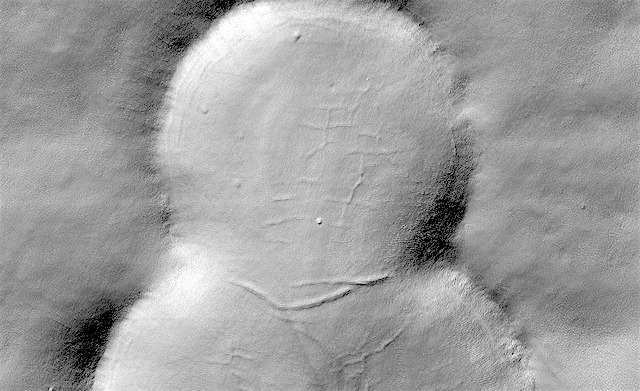
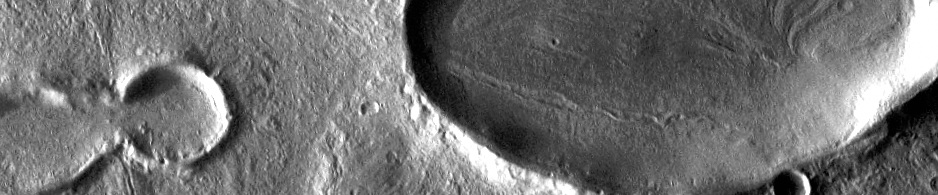
tumblr_pbm55yzBqI1rlz4gso1_1280Impact craters are very common on the surface of Mars as well as any other planetary body lacking a significant atmosphere (e.g., the Moon). In the absence of a thick atmosphere and active geologic processes, and if the surface is very old and has not been altered by something like lava flows, it will retain evidence of so many impacts that older and newer craters appear like circles on top of each other.

When we see a combination of two crater shapes on the ground, the one showing a nearly “full circle” will be the younger crater. In this image, we see the combined shape of two impact craters. However, neither crater displays a continuous circular shape (or rim) in the area connecting them…

Beautiful Mars series. [More at links]

Posted in Reports | Tagged , , , , , , , , | Comments Off

THEMIS: Giant pit crater collapse on Alba Mons

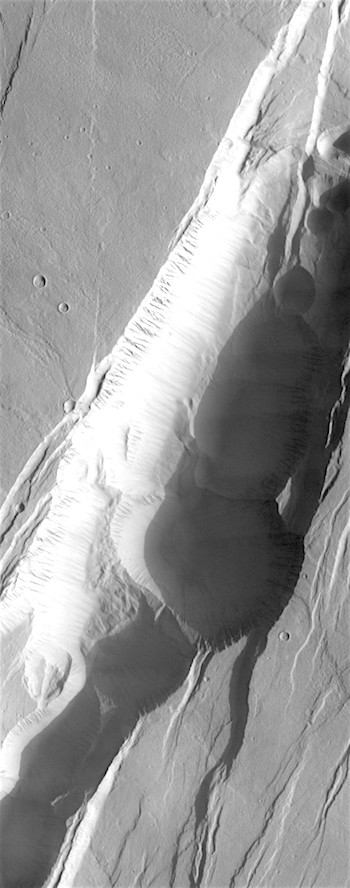
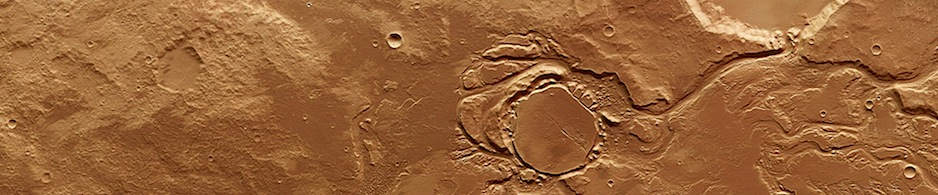
THEMIS Image of the Day, July 10, 2018. This VIS image is located on the eastern flank of Alba Mons. Linear faults and graben surround the volcano aligned north/south, intersecting and deflected around the summit. The large graben is called Phlegethon Catena. The term catena means a string of craters or circular depressions.

The depressions in this image were likely formed by the collapse of the preexisting surface into a subsurface void. Graben are caused by blocks of material that drop down along paired faults.

More THEMIS Images of the Day by geological topic.

Posted in Reports | Tagged , , , , , , , , , , , | Comments Off

Hypanis Valles: More likely a delta than a glacier

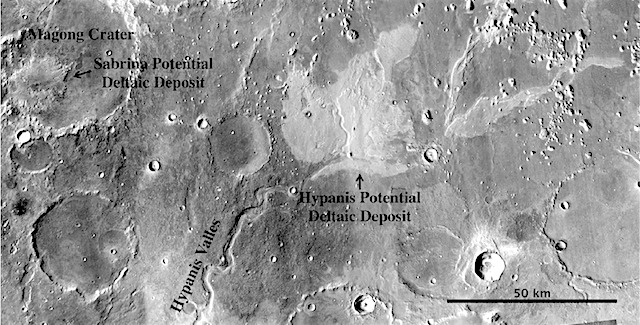
1-s2.0-S0019103518300393-gr1_lrgIs Mars’ Hypanis Valles a glacier? A new study says no.

A recent study [published in Icarus] from a team of scientists led by Jacob Adler of Arizona State University explored a unique area of scientific interest on Mars called Hypanis Valles. Considered a potential landing site for NASA’s Mars 2020 rover and ESA’s ExoMars 2018 rover mission, Hypanis is a large, fan-shaped sedimentary deposit on Mars approximately 150 meters tall and 60 kilometers wide. It has been hypothesized whether a major lobe of Hypanis Vallis could be home to a rock glacier. Adler’s team used satellite images to rule out that option. Instead, they found compelling evidence that these layered, fine-grained deposits were a massive delta.

Because of the lack of high-enough resolution satellite data until recently, scientists were uncertain of which landforms composed Hypanis. For the major lobe of Hypanis, the main candidates were a delta, mudflow, or alluvial fan. For the second, dubbed northern lobe, which the team hypothesized was formed by a different mechanism than the major lobe, one of the main landforms considered was a rock glacier. Interpreting the geomorphology and silt compositions, Adler and his team determined both lobes appear to be of deltaic origin and the largest yet found on Mars…. [More at links]

Posted in Reports | Tagged , , , , , | Comments Off

HiRISE: Fans in east Coprates Montes

tumblr_pbggqp7bHJ1rlz4gso1_1280Dark be the fans in east Coprates Montes. Beautiful Mars series. [More at links]

Posted in Reports | Tagged , , , , , , , , , | Comments Off

Curiosity: Under an orange sky

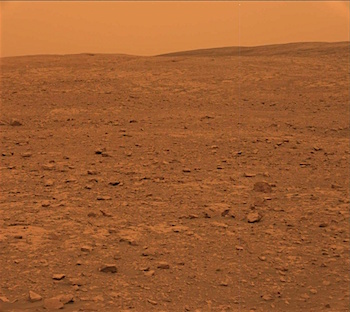
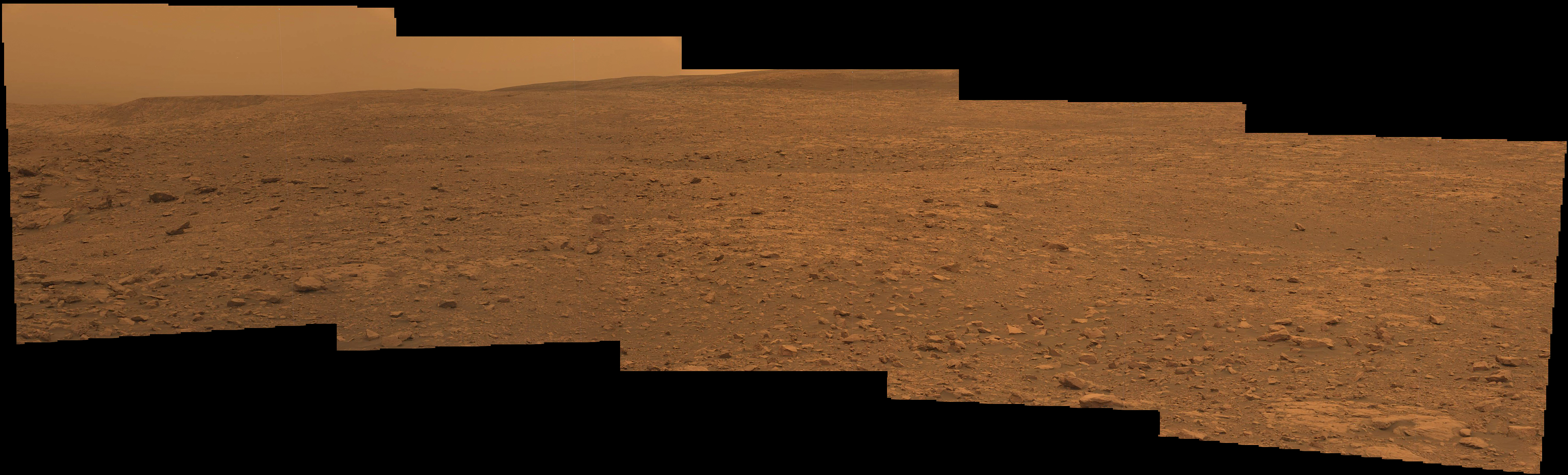
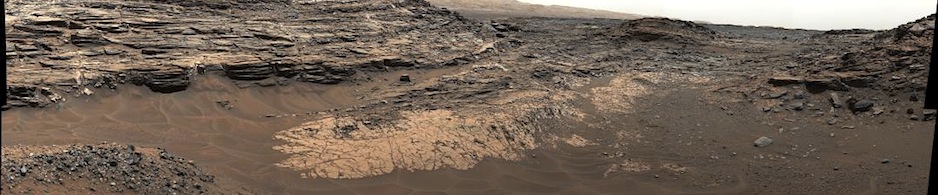
2104-mastcam34-farSol 2104, July 8, 2018. On this day, Curiosity drove about 54 meters (177 feet) to the northeast on the rolling ridge-top. With reddish rocks under a dust-laden atmosphere, the rover’s Mastcam (34 mm) looked out on an orange-tinted world.

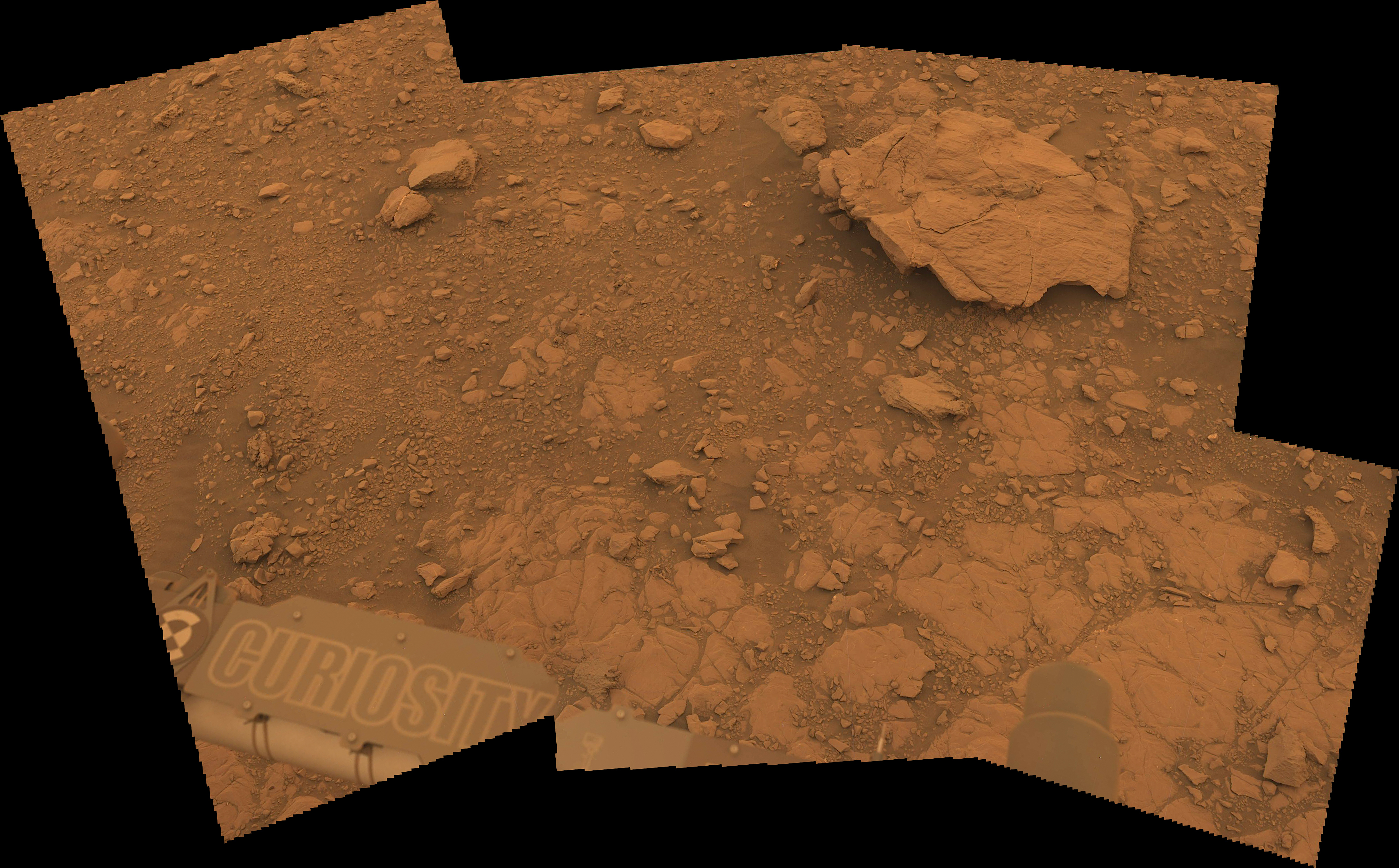
The view below shows a work area in front of Curiosity where it may be commanded to drill. Both images (6 MB each) enlarge when clicked.

Sol 2104 raw images (from all cameras).

2104-mastcam34-ground

Posted in Reports | Tagged , , , , , , , , | Comments Off