




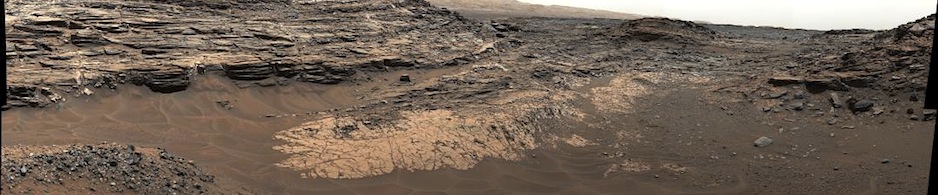
 Of dunes and their stories. So far no seasonal changes have been detected here, making this site unique.
Beautiful Mars series. [More at links]
Of dunes and their stories. So far no seasonal changes have been detected here, making this site unique.
Beautiful Mars series. [More at links]
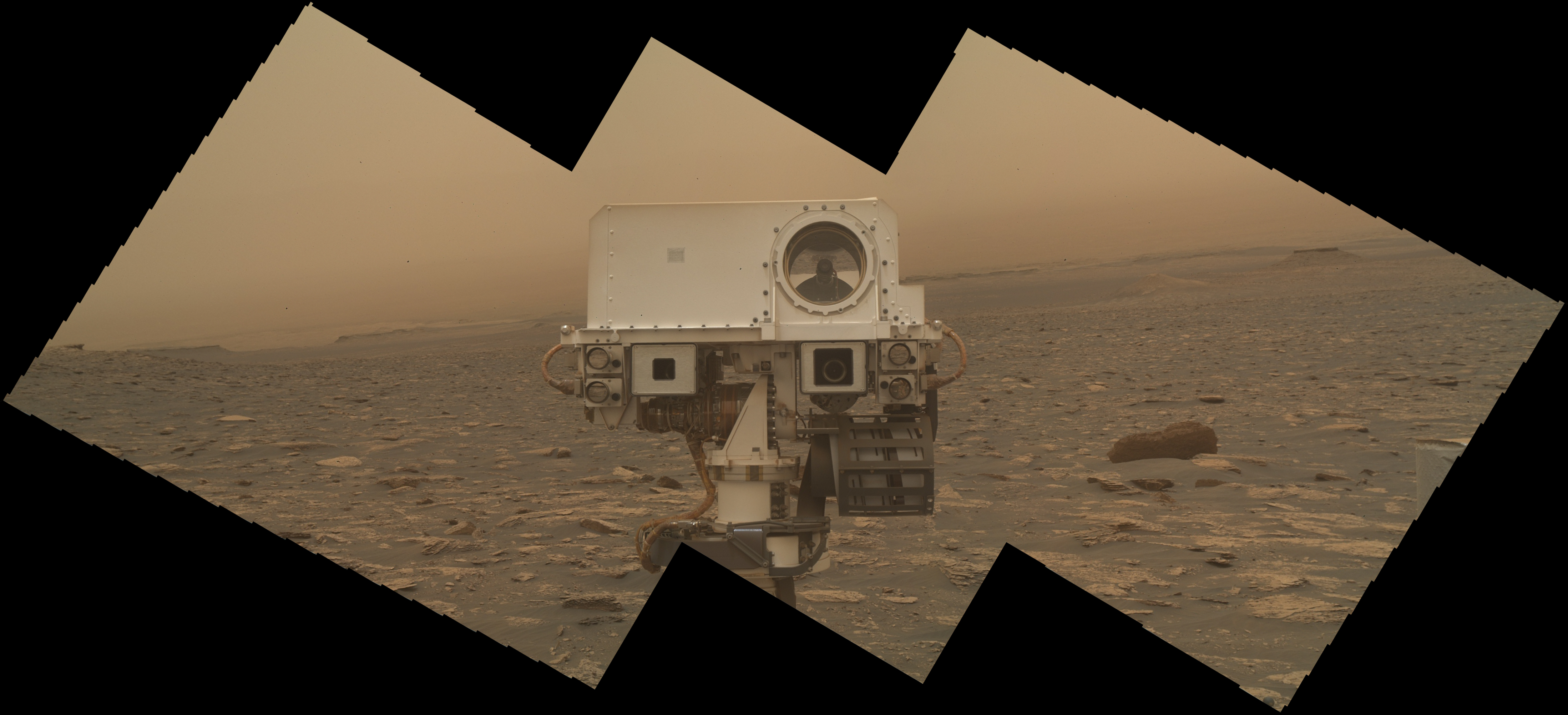 Sol 2082, June 15, 2018. Curiosity has been commanded to shoot a new selfie using the MAHLI (hand lens imager). Above are three frames from the series, showing the effects of the dust storm as seen in Gale Crater, which is on the other side of Mars from Opportunity. The northern rim of Gale lies in the background, but has disappeared from view due to the dust. Click the image to enlarge it.
Sol 2082 raw images (from all cameras), and Curiosity’s latest location.
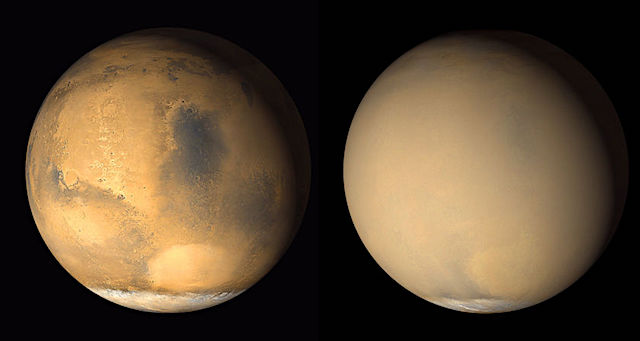 June 15, 2018: Opportunity Pummelled by Massive Dust Storm, Hunkers Down to Sleep: Entrenched in the west rim of Endeavour Crater, veteran robot field geologist Opportunity is hunkered down in Perseverance Valley in a kind of hibernation mode. The rover is sleeping to save what little power she has left in hopes of surviving a dust storm the likes of which the Mars Exploration Rover (MER) mission has never experienced, a dust storm so rare that every NASA asset at the Red Planet will be checking it out.
“I’m not sure what to say other than this is the worst storm Opportunity has ever seen, and we’re doing what we can, crossing our fingers and hoping for the best,” MER Principal Investigator Steve Squyres, of Cornell University, told The MER Update.
During the last two weeks, what began as a regional Martian dust storm expanded into an event, and then, when it moved over Endeavour Crater, it stalled. As it churned, the winds lofted a huge amount of dust into the atmosphere, blotting out the sky, turning day into night and leaving Opportunity blanketed in the powdery rusty-red stuff of Mars.
“The dust here is thicker than anything I have ever encountered, going back to Viking missions,” said MER Deputy Principal Investigator Ray Arvidson of Washington University St. Louis, who served as Science Team Leader for the imaging system on NASA’s Viking Landers from 1977 to 1982. “It’s dark, like the end of twilight dark.” [More at link]
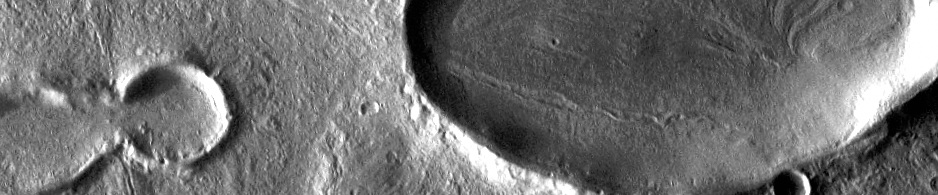
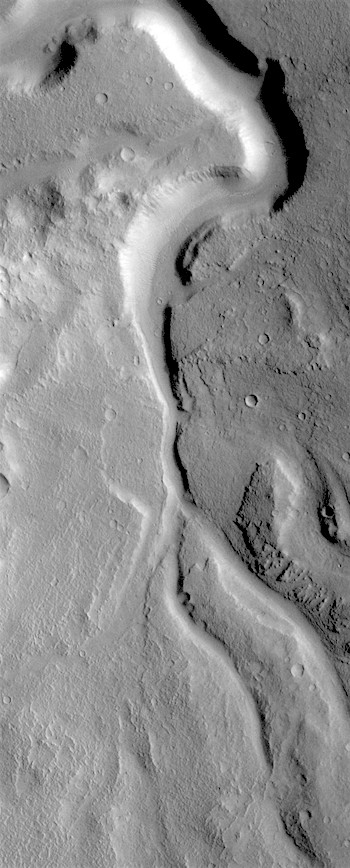 THEMIS Image of the Day, June 18, 2018. Today’s VIS image shows an unnamed channel in Xanthe Terra. The large bend in the channel was created as the flow of liquid from the bottom of the image was deflected by a ridge that extends diagonally from the left center. Note how several channels merge to form the large channel.
More THEMIS Images of the Day by geological topic.

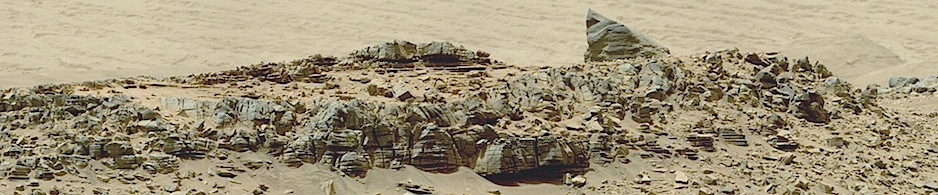
 Sol 2082, June 15, 2018. The Mars Hand Lens Imager (MAHLI) swooped in close to Duluth’s top surface for a good look at its flake-like layers.
Above is a two-frame MAHLI composite image, while at right, the Mastcam shows the overall scene. Click either image to enlarge it.
Sol 2082 raw images (from all cameras), and Curiosity’s latest location.
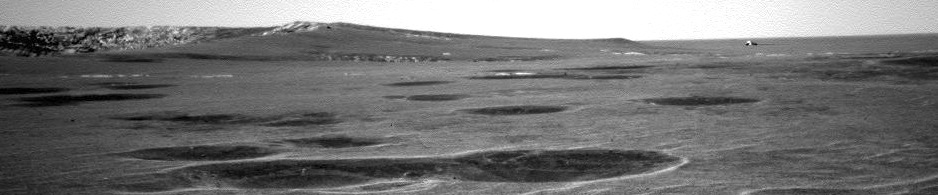
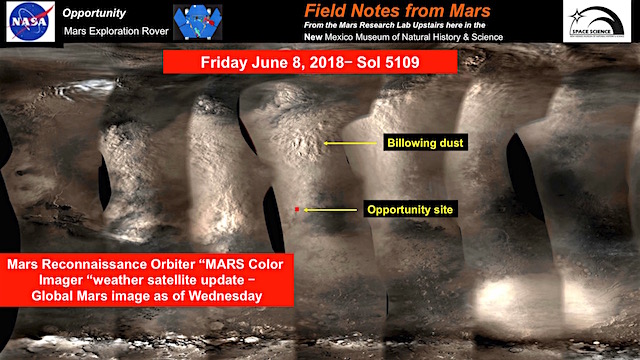 Sol 5114, June 14, 2018: Rover Field Report by Larry Crumpler, MER Science Team & New Mexico Museum of Natural History & Science: Opportunity was continuing to gather data from outcrops in Perseverance Valley up until the end of May and the first week of June. But then a dust storm developed to the northwest and unexpectedly expanded into Merdiani Planum where Opportunity is exploring.
In one sol (Mars day) the power output of the solar panels dropped from nearly 700 W-hrs to 123 W-hrs. By the next day the power had dropped to 22 W-hrs. The optical opacity factor of the atmosphere, which is normally described by numbers like 0.3-0.5, sky rocketed to outrageous numbers. During the previous dust storm back in 2007, the opacity was about 5. The last report on Sunday indicated a factor of 10.8! A new Martian record. (…)
We like to keep the power up to 100 W-hrs even in the worst of winter times as a “margin” just to make certain that internal heaters can be called on if a night is particularly cold. But 22 W-hrs will not even operate basic activities, like communication with the orbital relay satellites. Following a last communication on Sunday, we have not received messages from Opportunity. To conserve what energy it has Opportunity therefore is programmed to disconnect the batteries and go into a deep “sleep”, only running a mission clock to keep track of time… [More at link]

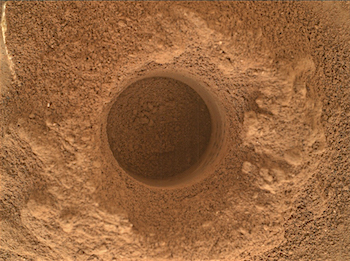 Sol 2082, June 14, 2018, update by MSL scientist Ken Herkenhoff: The investigation of the Duluth drill hole is going well, and is expected to continue on Sol 2082. First, MAHLI will take a picture of the drill tailings to look for an imprint of the APXS contact sensor, then will acquire another rover “selfie.” The major dust storm that caused the solar-powered Opportunity rover, on the other side of Mars, to shut down has somewhat darkened the skies over Gale Crater, but is not expected to seriously affect MSL operations. Still, there is great interest in the environmental effects of the dust storm, so the Sol 2082 plan includes more Navcam and Mastcam… [More at link]
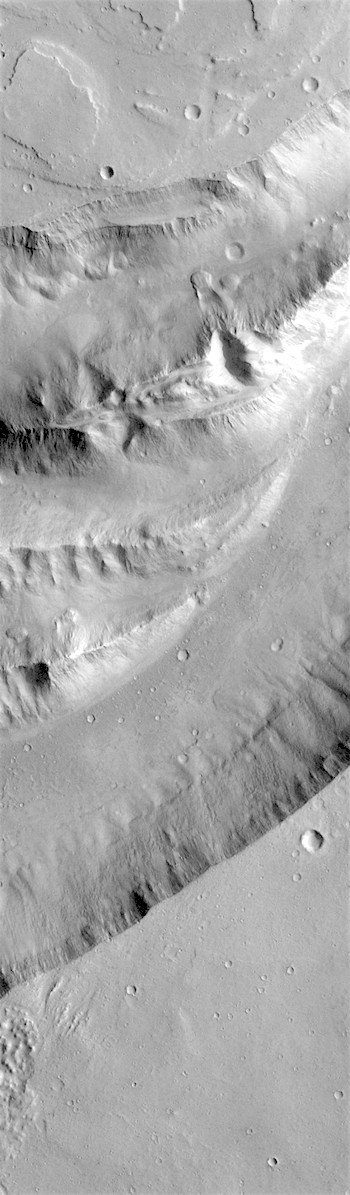 THEMIS Image of the Day, June 15, 2018. This VIS image shows a section of Shalbatana Vallis. Shalbatana Vallis is one of many channels that empty into Chryse Planitia.
More THEMIS Images of the Day by geological topic.
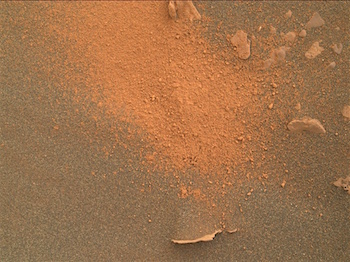 Sol 2081, June 13, 2018, update by MSL scientist Roger Wiens: The final several sols of Curiosity’s drill activities at “Duluth” are devoted mostly to imaging and to analysis of the pile of drill tailings that are dumped on the ground after the delivery to the instruments.
Some people think dirt is uninteresting. Shortly after the Curiosity rover landed in 2012 I was asked to give a special talk to a very distinguished group of people. The slides had to be prepared a couple of weeks in advance and were sent from my director’s office to be reviewed by handlers in the state where I was to give the talk. Those first days of the mission were breathtaking, and my presentation included the video of the landing, taken from the MARDI camera, mounted on belly of the rover, as it descended. In that scene, the dust gets kicked up by the sky crane’s rocket engines as the rover nears the ground, and… [More at link]
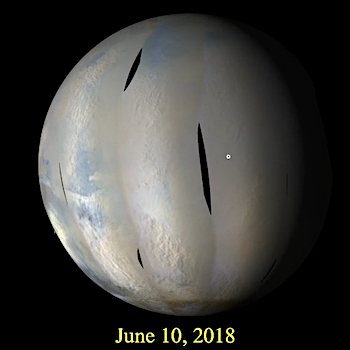 A major regional-scale dust storm continued across Mars this past week. At the start of the week, the dust storm expanded along the northern hemisphere from eastern Tharsis to Elysium. Dust over Arabia was transported north of Syrtis along the polar vortex, where it continued to spread eastward. During that time, the storm proliferated over the southern hemisphere, extending past the edge of the seasonal south polar ice cap, as far as the Mountains of Mitchel. By the end of the week, the storm stretched from Solis in the west to Cimmeria in the east, encompassing an area greater than 30 million square… [More at link, including video]