HiRISE: Once in a blue dune

ESP_053894_2295Sand dunes often accumulate in the floors of craters. In this region of Lyot Crater there is a field of classic barchan dunes.

Just to the south of the group of barchan dunes is one large dune with a more complex structure. This particular dune, appearing like turquoise blue in enhanced color, is made of finer material and/or has a different composition than the surroundings. [More at link]

Posted in Reports | Tagged , , , , , , , , , | Comments Off

Four NASA spacecraft tackle dust-storm science

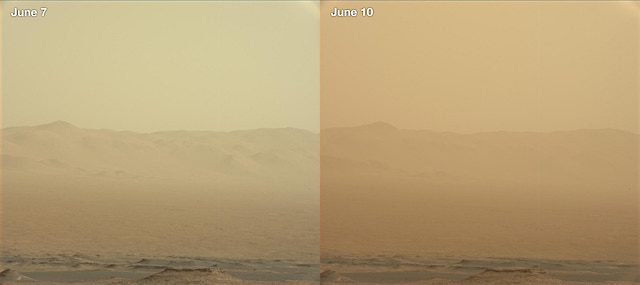
PIA22520_hiresOne of the thickest dust storms ever observed on Mars has been spreading for the past week and a half. The storm has caused NASA’s Opportunity rover to suspend science operations, but also offers a window for four other spacecraft to learn from the swirling dust.

NASA has three orbiters circling the Red Planet, each equipped with special cameras and other atmospheric instruments. Additionally, NASA’s Curiosity rover has begun to see an increase in dust at its location in Gale Crater.

“This is the ideal storm for Mars science,” said Jim Watzin, director of NASA’s Mars Exploration Program at the agency’s headquarters in Washington. “We have a historic number of spacecraft operating at the Red Planet. Each offers a unique look at how dust storms form and behave — knowledge that will be essential for future robotic and human missions.”

Dust storms are a frequent feature on Mars, occurring in all seasons. Occasionally, they can balloon into regional storms in a matter of days, and sometimes even expand until they envelop the planet. These massive, planet-scaled storms are estimated to happen about once every three to four Mars years (six to eight Earth years); the last one was in 2007. They can last weeks, or even months at the longest. (…)

All dust events, regardless of size, help shape the Martian surface. Studying their physics is critical to understanding the ancient and modern Martian climate, said Rich Zurek, chief scientist for the Mars Program Office at NASA’s Jet Propulsion Laboratory in Pasadena, California.

“Each observation of these large storms brings us closer to being able to model these events — and maybe, someday, being able to forecast them,” Zurek said. “That would be like forecasting El Niño events on Earth, or the severity of upcoming hurricane seasons.”  [More at link]

Posted in Reports | Tagged , , , , , , | Comments Off

Exploring planetary plasma environments by laptop

3Dview_Mars_MarsExpress_MAVEN_BField_obs_simu_1280A new database of plasma simulations, combined with observational data and powerful visualisation tools, is providing planetary scientists with an unprecedented way to explore some of the Solar System’s most interesting plasma environments.

This digital space exploration story starts with the Integrated Medium for Planetary Exploration (IMPEx), a collaborative project to create a common data hub for space missions.

While planetary missions are crucial to understand how the solar wind interacts with the magnetospheres of planets and moons in our Solar System, numerical models are, in turn, essential to fully comprehend the measurements and improve our knowledge of planetary plasma environments. (…)

It was in this context that a group led by Ronan Modolo at the Laboratoire Atmosphères, Milieux, Observations Spatiales (LATMOS), in France, started developing a collection of plasma simulations at various planetary bodies. The Latmos Hybrid Simulation (LatHyS) database and its uses are presented in a new study published earlier this year in a special issue of Planetary and Space Science. (…)

“So far, celestial objects modelled by LatHyS simulations include Mars, Mercury and Jupiter’s moon, Ganymede,” explains Modolo. “We are planning to extend this database to other objects like Saturn’s moon Titan and, in the longer term, to other moons of Jupiter, like Europa or Callisto,” he adds…  [More at links]

Posted in Reports | Tagged , , , , , , , , , | Comments Off

THEMIS: Dust avalanches in Lycus Sulci

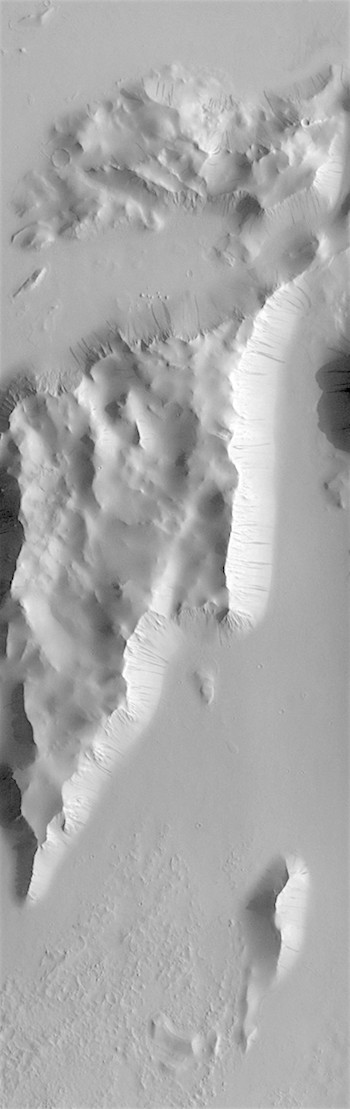
Dark slope streaks in Lycus Sulci (THEMIS_IOTD_20180614)THEMIS Image of the Day, June 14, 2018. Lycus Sulci is a very complex region surrounding the northern and western flanks of Olympus Mons. This VIS image shows some of the tectonic ridges found in Lycus Sulci as well as the dark slope streaks that are common in this region.

Dark slope streaks show where dust avalanches have stripped off the bright dusty coating and exposed darker rocks underneath.

More THEMIS Images of the Day by geological topic.


Posted in Reports | Tagged , , , , , , , , , , | Comments Off

Curiosity update: Communication back to normal

NLA_397681736EDR_F0020000AUT_04096M_-br2[NB: This update involves Curiosity, not Opportunity]

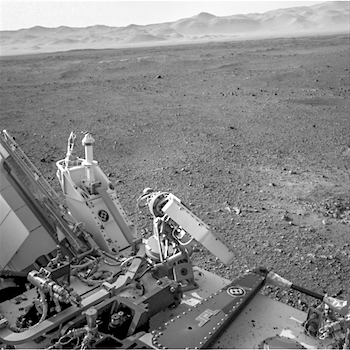
Sol 2080, June 12, 2018, update by MSL scientist Roger Wiens: On Earth we have multiple means of communication – cell phone, text messages, land line, e-mail, and good old snail mail. On Mars the rover basically has three – a UHF antenna that communicates with satellites orbiting Mars, a low-gain antenna (LGA) that does not need to be pointed but only handles a low data flow, and a high-gain antenna (HGA) that requires accurate knowledge of Earth’s position to receive or send commands directly. The two antennae on the left side of the rover are shown in the image above, taken early in the mission. The LGA is the pointy object near the left, and the HGA is the paddle-shaped object near the center of the image. The UHF antenna (not shown) is a can-shaped object on the back right side of the rover. Over the weekend the HGA was left unavailable to receive commands due to an error during a test, so the team had to do the next best thing yestersol, skipping most of the normal… [More at link]

Posted in Reports | Tagged , , , , , , , , , , | Comments Off

Opportunity: Dust storm going global, rover likely in deep-sleep for weeks until skies clear

zurek-1-pia22519-1200

[Ed. note: Video replay of the briefing here, and a new NASA web page, Mars Storm Watch, here.]

NASA scientists reported today that dust in the skies over Opportunity is thicker than ever seen before from the surface, and the storm that is raising the dust is on the verge of becoming global. Moreover, the storm rose over a couple days, unusally quickly for such events. While the baseline of past storms’ behavior is not lengthy, scientists are expecting the storm will last several weeks to perhaps a couple months.

Opportunity has ceased all scientific operations, and according to project manager John Callas (JPL), it has probably dropped into deep-sleep mode. This energy-saving routine is nothing new, he says. The rover has been doing this on mission control’s command every night for the past several thousand days.

While blocking sunlight almost totally over Opportunity, the storm has had a thermal blanketing effect, he says, keeping night temperatures warmer than they would be under clear skies. The scientists stressed that Opportunity can likely survive, even if the storm takes weeks to clear.

Also, unlike a dust storm on Earth, where dust can accumulate thickly enough to hinder vehicles, Mars dust particles are smaller in size and tend to blow off the rover’s solar panels and even the optics. The scientists foresee no mobility problems when the rover returns to operations.

To monitor the storm NASA is using its orbiters and the Curiosity rover. From orbit, the Mars Reconnaissance Orbiter’s Mars Color Imager (MARCI) and Mars Climate Sounder (MCS) are the main contributors, while on Curiosity, the Mastcam and Rover Environmental Monitoring Station (REMS) are its main contributors.

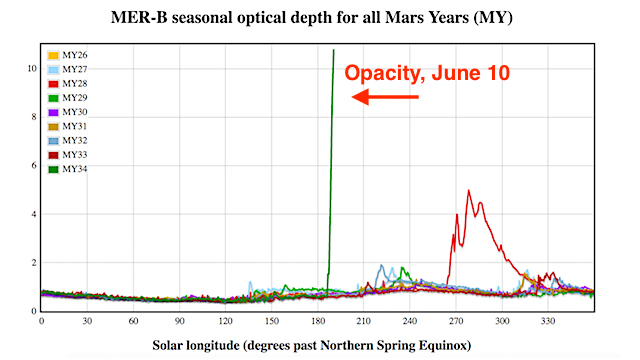
The graph below shows atmospheric opacity throughout the martian year, starting with Mars Year 26 in April 2002. The red trace, for Mars Year 28, shows the 2007 global dust storm at right.
21917_OpacityChart-16

Posted in Reports | Tagged , , , , , , , , , , , , , , , , , , | Comments Off

HiRISE: Dust and frost

ESP_053129_2650Sand dunes in the north polar regions of Mars show light coatings of pale orange dust blown partially across the dark basaltic sand. Around the edges of the dunes, patches of seasonal dry ice remain.

These patches will be gone soon as they sublimate (turn from ice to gas) in the summer sun. Some blocks of ice are visible at the foot of an alcove formed by a sand avalanche down the slipface of the dune. [More at link]

Posted in Reports | Tagged , , , , , , , , , , , | Comments Off

Opportunity dust storm update, June 12

PIA22521_hiresNASA Mars Exploration Rover Status Report
Updated at 6:30 p.m. PDT on June 12, 2018

NASA engineers attempted to contact the Opportunity rover today but did not hear back from the nearly 15-year old rover. The team is now operating under the assumption that the charge in Opportunity’s batteries has dipped below 24 volts and the rover has entered low power fault mode, a condition where all subsystems, except a mission clock, are turned off. The rover’s mission clock is programmed to wake the computer so it can check power levels.

If the rover’s computer determines that its batteries don’t have enough charge, it will again put itself back to sleep. Due to an extreme amount of dust over Perseverance Valley, mission engineers believe it is unlikely the rover has enough sunlight to charge back up for at least the next several days.

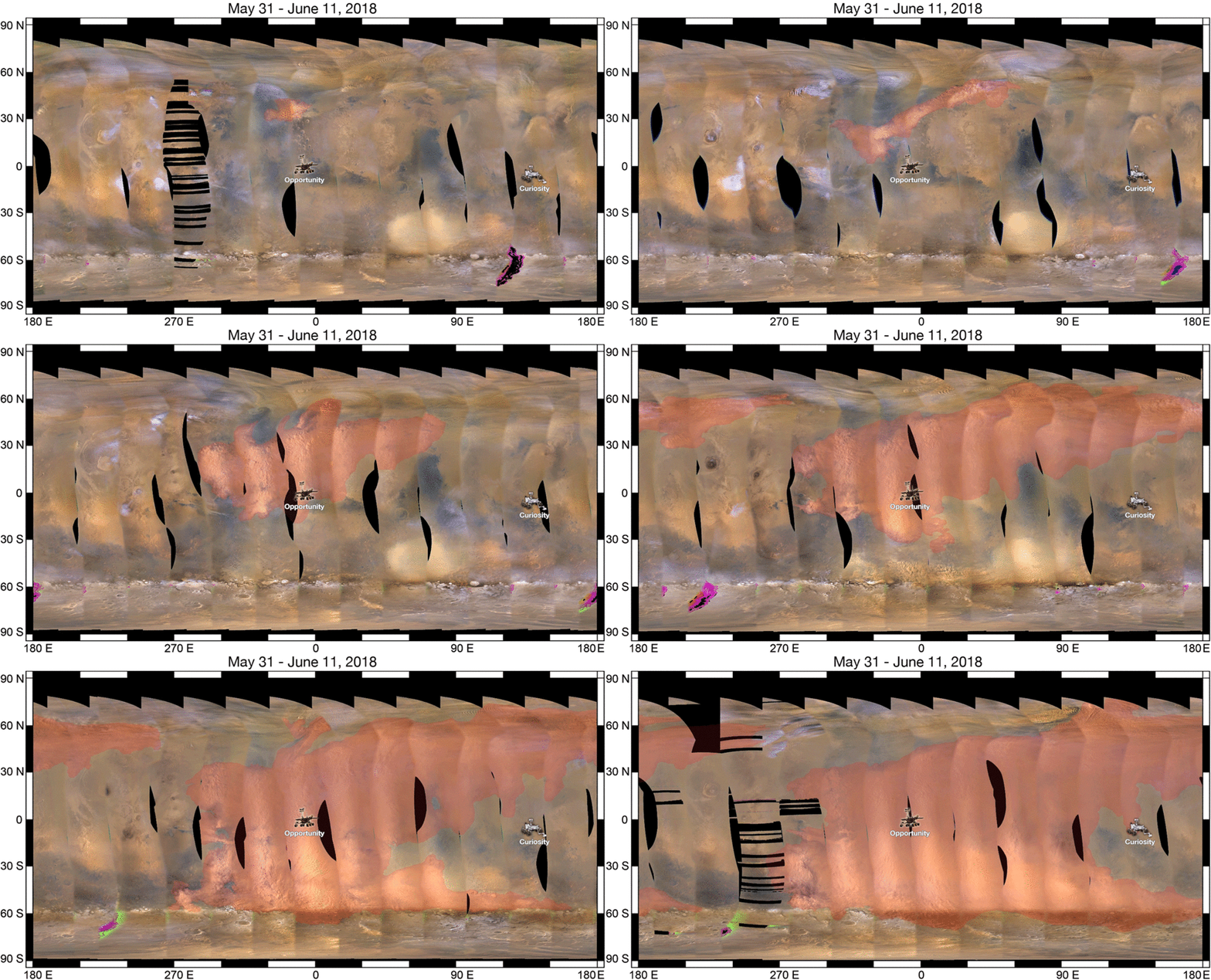
The Martian dust storm that has blotted out the sun above Opportunity has continued to intensify. The storm, which was first detected on May 30, now blankets 14-million square miles (35-million square kilometers) of Martian surface — a quarter of the planet.

NASA is holding a news teleconference on Wednesday, June 13, to discuss the storm and the observations of it by various spacecraft. Details at: https://www.jpl.nasa.gov/news/news.php?feature=7158 [More at links]

Posted in Reports | Tagged , , , , , , , | Comments Off

THEMIS: Hebes Mensa

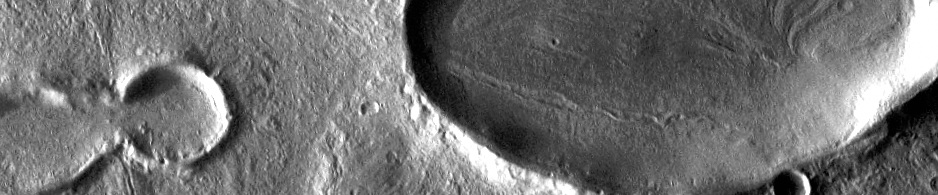
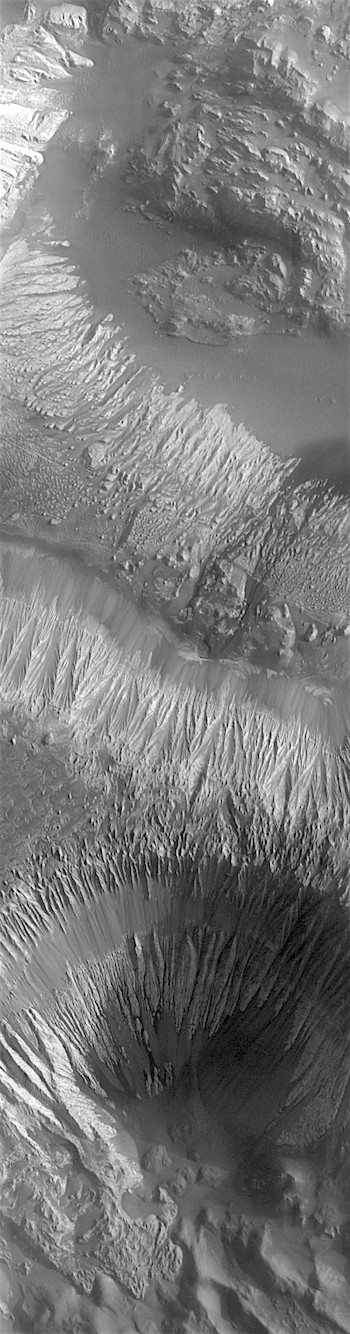
Hebes Mensa (THEMIS_IOTD_20180613)THEMIS Image of the Day, June 13, 2018. Located in the center of Hebes Chasma is a large deposit of layered material called Hebes Mensa. Extensive erosion has created gullies in the mensa and distributed fine sand size materials to create dunes and sand drifts within the chasma.

More THEMIS Images of the Day by geological topic.

Posted in Reports | Tagged , , , , , , , , , , , , , , | Comments Off

NASA briefing on dust storm, Opportunity rover, June 13

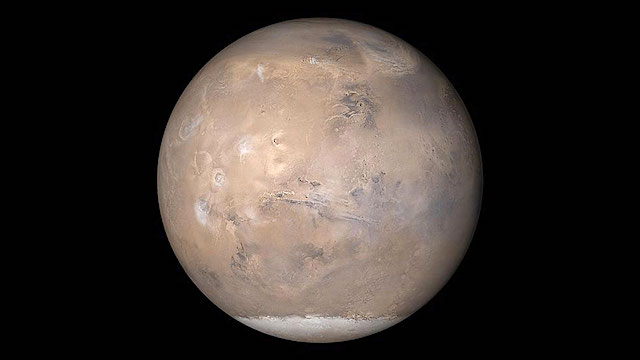
PIA04591-16NASA will host a media teleconference at 10:30 a.m. PDT (1:30 p.m. EDT) Wednesday, June 13, to discuss a massive Martian dust storm affecting operations of the agency’s Opportunity rover and what scientists can learn from the various missions studying this unprecedented event.

The storm is one of the most intense ever observed on the Red Planet. As of June 10, it covered more than 15.8 million square miles (41 million square kilometers) — about the area of North America and Russia combined. It has blocked out so much sunlight, it has effectively turned day into night for Opportunity, which is located near the center of the storm, inside Mars’ Perseverance Valley.

Participants in the teleconference will include:

  • John Callas, Opportunity project manager at NASA’s Jet Propulsion Laboratory, Pasadena, California
  • Rich Zurek, Mars Program Office chief scientist at JPL
  • Jim Watzin, director of the Mars Exploration Program at NASA Headquarters, Washington
  • Dave Lavery, program executive at NASA Headquarters for the Opportunity and Curiosity rovers

Visuals accompanying the teleconference will be posted at the start of the event at:
https://www.nasa.gov/marsduststormtelecon

Audio of the teleconference will be streamed live at:
https://www.nasa.gov/live

The teleconference and visuals will be carried live and archived on:
https://youtube.com/nasajpl/live

[More at links]

Posted in Reports | Tagged , , , , , , , | Comments Off