HiRISE: Bang and whoosh!

ESP_054066_1920This HiRISE image captures a new, dated (within about a decade) impact crater that triggered a slope streak. When the meteoroid hit the surface and exploded to make the crater, it also destabilized the slope and initiated this avalanche.

The crater itself is only 5 meters across, but the streak it started is 1 kilometer long! Slope streaks are created when dry dust avalanches leave behind dark swaths on dusty Martian hills. The faded scar of an old avalanche is also visible to the side of the new dark streak.  [More at link]

Posted in Reports | Tagged , , , , , , , | Comments Off

Curiosity update: Quick change artist

2077ML0110290000801230E01_DXXX-br2Sol 2079, June 11, 2018, update by MSL scientist Michelle Minitti: Over the weekend, an error cropped up during a regular test of the high gain antenna actuators, leaving the antenna unavailable for uplink of today’s plan, but otherwise healthy. The team instead will use Mars Reconnaissance Orbiter (MRO) to uplink a brief suite of activities to the rover, including the commands to recover the high gain antenna for use tomorrow. The MRO uplink window is hours later than our usual HGA uplink window, so with less time in the plan, we had to postpone our drill-related activities until tomorrow’s plan. We did get confirmation that we are ready for the next step of drill-related activities: dumping the “Duluth” sample for analysis by APXS, MAHLI, ChemCam and Mastcam. For today, the… [More at link]

Posted in Reports | Tagged , , , , , , , , , , , | Comments Off

MAVEN observations on dust storms

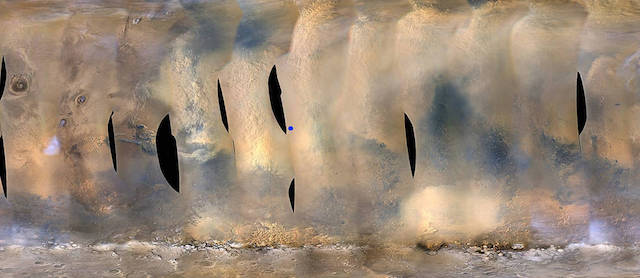
pia22329anno-16The Opportunity rover has proven hardier than expected by operating for nearly 15 years, despite being designed for a 90-day mission. The rover regularly deals with intense dust storms at the surface of the Red Planet and occasionally has to suspend science operations as it waits out such adverse conditions. (…)

It turns out that Opportunity’s loss is — scientifically speaking — MAVEN’s gain.

Previous MAVEN observations of dust increases in the lower Martian atmosphere have revealed dramatic variations in atmospheric composition and density at altitudes from 170 to 220km in Mars’ neutral thermosphere. (See here for additional details.)

The observations reveal that CO₂, N₂, CO, O, and Argon densities all increase up to ~200% compared to typical densities. The density increases are seen throughout this altitude region, and the relative variations are seen to be stronger at higher altitudes.

During increased dust load, MAVEN scientists have observed that the whole Mars atmosphere expands and rises, a phenomenon predicted by general circulation models of how dust increases affect different atmospheric species in the thermosphere… [More at links]

Posted in Reports | Tagged , , , , , , , | Comments Off

THEMIS: Impact blast scars on crater rim

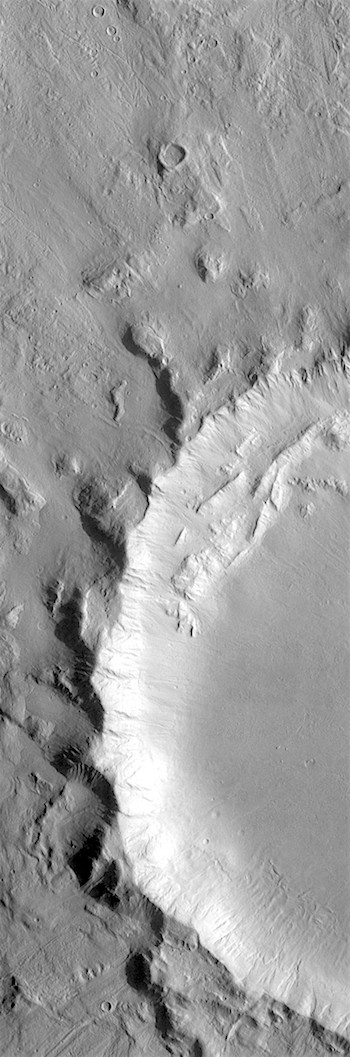
Impact blast scars in crater rim (THEMIS_IOTD_20180612)THEMIS Image of the Day, June 12, 2018. Today’s VIS image shows part of a crater located north of Hecates Tholus. The radial grooves in the ejecta blanket are still visible around the crater rim.

There is also likely blast damage from the base surge produced by the collapsing cloud of debris that rose directly above the crater in the impact. When the column of debris stops rising, it drops straight down, then shoots outward at ground level, scarring the rim and surrounding landscape.

More THEMIS Images of the Day by geological topic.

Posted in Reports | Tagged , , , , , , , , , , , | Comments Off

Medusae Fossae formation is likely a deposit from explosive volcanism

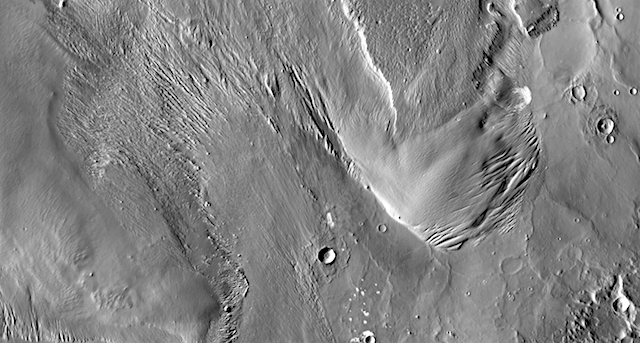
memnoniasulci_dayir[Editor’s note: From a paper by Lujendra Ojha and Kevin Lewis recently published in the Journal of Geophysical Research.]

The Medusae Fossae Formation is one of the largest sedimentary deposits on Mars. Its origin is uncertain, though several processes including volcanic, eolian, and ice-related mechanisms have been proposed in its formation.

Here we localize the gravity and topography signature of the formation and place the first direct constraint on its density. We find that it is a relatively porous unit with a bulk density of 1.765. When combined with previous radar measurements, our density constraint rules out the presence of ice as the cause of unusual radar permittivity.

Rather, we find the joint radar and gravity constraints imply a dry and highly porous rock unit. Based on the relatively low density, lack of ice, and the previously known enrichment of volatile elements associated with volcanic emissions (chlorine and sulfur), we propose that the Medusae Fossae formation was deposited by pyroclastic eruptions.

Using our density estimate, the mass of the formation is found to be two orders of magnitude greater than the largest terrestrial pyroclastic deposit, making it the largest known pyroclastic deposit in the solar system. Outgassing of volatiles such as CO2 and H2O from the formation would have substantially contributed to the Martian atmosphere and hydrosphere. [More at link]
Posted in Reports | Tagged , , , , | Comments Off

HiRISE: East Endeavour Crater dune field monitoring

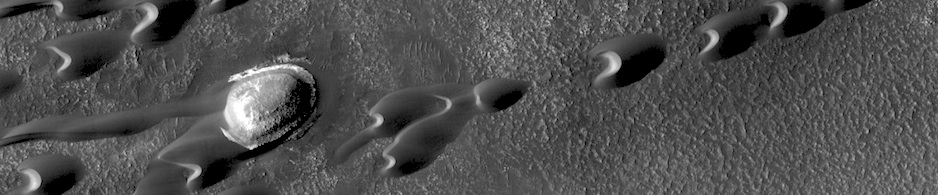
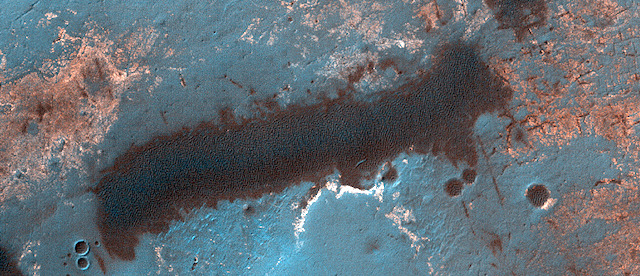
tumblr_p9v4hspsen1rlz4gso2_1280East Endeavour Crater dune field monitoring. We’re monitoring to detect surface change of dunes shown to be active from past HiRISE observations.

Beautiful Mars series. [More at links]

Posted in Reports | Tagged , , , , , , , , , | Comments Off

Opportunity: Update on dust storm

1P581919922EFFD2FCP2682L8M1NASA Mars Exploration Rover Status Report, updated at 4:30 p.m. PDT on June 10, 2018

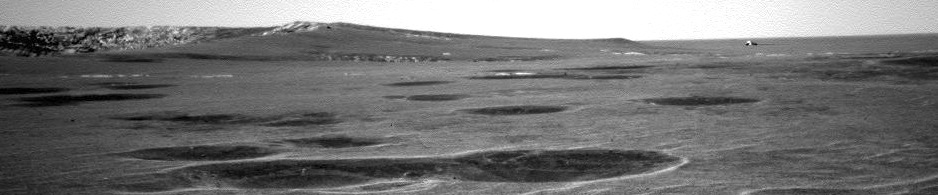
NASA engineers received a transmission from Opportunity on Sunday morning – a positive sign despite the worsening dust storm. Data from the transmission let engineers know the rover still has enough battery charge to communicate with ground controllers at NASA’s Jet Propulsion Laboratory in Pasadena, California. Science operations remain suspended.

Sunday’s transmission was especially good news considering the dust storm has intensified in the past several days. A dark, perpetual night has settled over the rover’s location in Mars’ Perseverance Valley. The storm’s atmospheric opacity – the veil of dust blowing around, which can blot out sunlight — is now much worse than a 2007 storm that Opportunity weathered. The previous storm had an opacity level, or tau, somewhere above 5.5; this new storm had an estimated tau of 10.8 as of Sunday morning… [More at links; atmospheric opacity tracked here]

Posted in Reports | Tagged , , , , , , , | Comments Off

HiRISE: A volcano — of mud or lava?

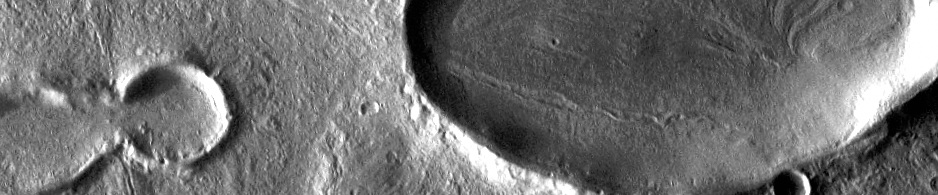
ESP_054649_1665This image shows a hill with a central crater. Such features have been interpreted as both mud volcanoes (really a sedimentary structure) and as actual volcanoes (the erupting lava kind). They occur on the floor of Valles Marineris below a closed topographic contour that could have held a lake, and the compaction of wet sediments may have created mud volcanoes.

The fracture pattern of the bright flow unit surrounding the hill resembles mud cracks. However, there have also been observations from the CRISM instrument interpreted as high-temperature minerals, suggesting actual volcanism, although not necessarily at this location. Fine layers in the hill are consistent with either volcanism or mud flows…. [More at link]

Posted in Reports | Tagged , , , , , , , , , | Comments Off

THEMIS: Wind-eroded Medusae Fossae formation

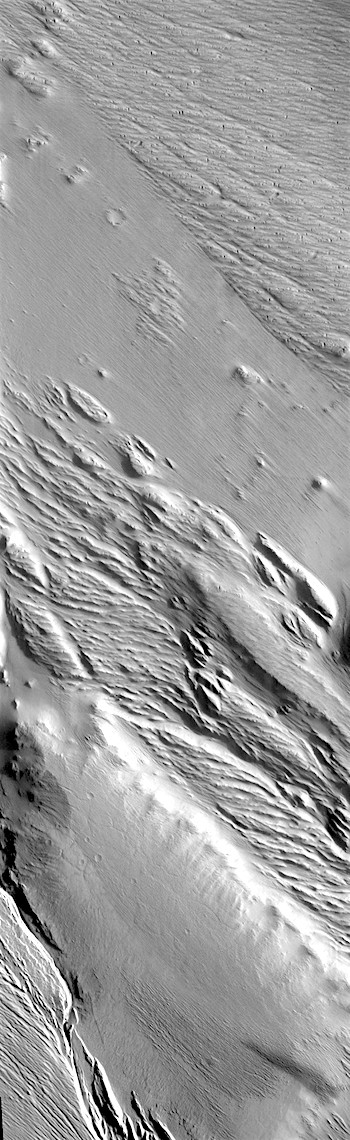
Wind-etched Medusae Fossae formation (THEMIS_IOTD_20180611)THEMIS Image of the Day, June 11, 2018. This VIS image shows part of Medusa Fossae. Winds have eroded materials in this region, creating ridges and valleys aligned with the direction of the wind.

The formation materials appear soft and easily eroded; new research offers evidence that it is a deposit of pyroclastic debris — compacted ash from a volcanic eruption.

More THEMIS Images of the Day by geological topic.

Posted in Reports | Tagged , , , , , , , , , | Comments Off

Curiosity update: Dust on the horizon

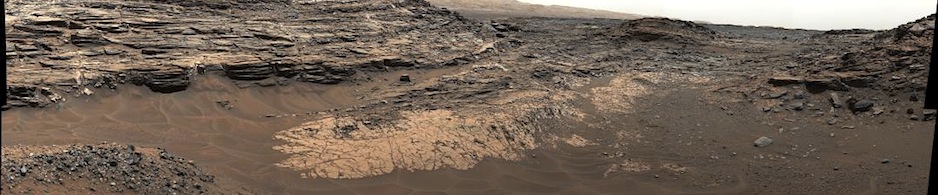
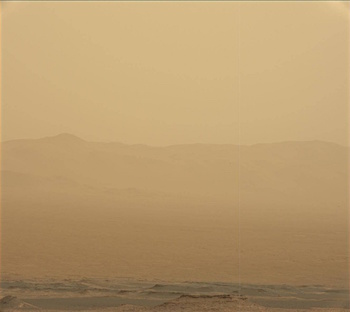
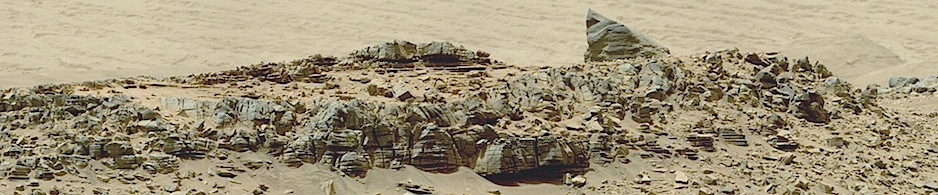
2070ML0109900000801073E01_DXXX-br2Sol 2076-78, June 8, 2018, update by MSL scientist Rachel Kronyak: Today we planned a weekend’s worth of activities for Curiosity. For our weekend plan, we have two main priorities: perform another analysis with CheMin on our Duluth drill sample and continue our campaign of dust storm monitoring.

Earlier in the week, our environmental science theme group (ENV) expert Scott Guzewich gave a nice summary of the dust storm developing on the other side of Mars. In response, the ENV group planned a suite of activities to monitor how the amount of dust in the atmosphere will change over the next few sols. To measure dust in the atmosphere, we’ll first point Mastcam towards the sun and take a tau measurement, which lets us determine the optical depth vertically. Then we’ll take a Mastcam image of the crater rim to determine line-of-sight extinction… [More at link]

Posted in Reports | Tagged , , , , , , , , , , , | Comments Off