

Opportunity hunkers down during dust storm

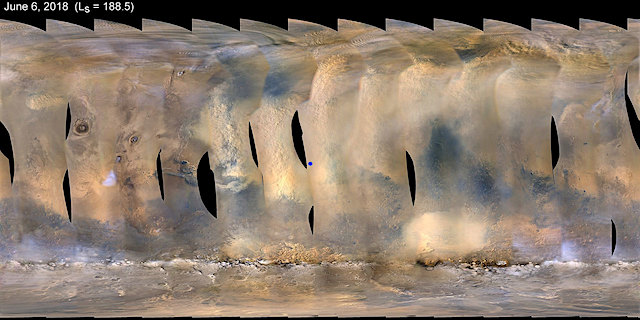
8348_PIA22329_labeled-1280Science operations for NASA’s Opportunity rover have been temporarily suspended as it waits out a growing dust storm on Mars.

NASA’s Mars Reconnaissance Orbiter first detected the storm on Friday, June 1. As soon as the orbiter team saw how close the storm was to Opportunity, they notified the rover’s team to begin preparing contingency plans.

In a matter of days, the storm had ballooned. It now spans more than 7 million square miles (18 million square kilometers) — an area greater than North America — and includes Opportunity’s current location at Perseverance Valley. More importantly, the swirling dust has raised the atmospheric opacity, or “tau,” in the valley in the past few days. This is comparable to an extremely smoggy day that blots out sunlight. The rover uses solar panels to provide power and to recharge its batteries.

Opportunity’s power levels had dropped significantly by Wednesday, June 6, requiring the rover to shift to minimal operations.

This isn’t Opportunity’s first time hunkering down in bad weather: in 2007, a much larger storm covered the planet. That led to two weeks of minimal operations, including several days with no contact from the rover to save power. The project’s management prepared for the possibility that Opportunity couldn’t balance low levels of power with its energy-intensive survival heaters, which protect its batteries from Mars’ extreme cold. It’s not unlike running a car in the winter so that the cold doesn’t sap its battery charge. There is a risk to the rover if the storm persists for too long and Opportunity gets too cold while waiting for the skies to clear… [More at link]

Posted in Reports | Tagged , , , , , , , | Comments Off

Curiosity update: It’s a SAMple party!

CR0_581617793PRC_F0701752CCAM01074L1-br2Sol 2075, June 7, 2018, update by MSL scientist Rachel Kronyak: Today, Sol 2075, was a fairly straightforward day of planning, as most of the plan will be devoted to carrying out a methane experiment with our SAM instrument to analyze an atmospheric sample. On the plus side, we were able to squeeze in about 45 minutes of additional science block time, which was split between our Environmental (ENV) and Geologic (GEO) theme groups. ENV will perform several atmospheric monitoring activities to assess dust opacity with Navcam and Mastcam, including a few line-of-sight images and a tau measurement. ENV will also take a series of images with Navcam to look for dust devils as well as a deck monitoring image with Mastcam… [More at link]

Posted in Reports | Tagged , , , , , , , , , , | Comments Off

HiRISE: Light-toned material in Gorgonum Chaos crater

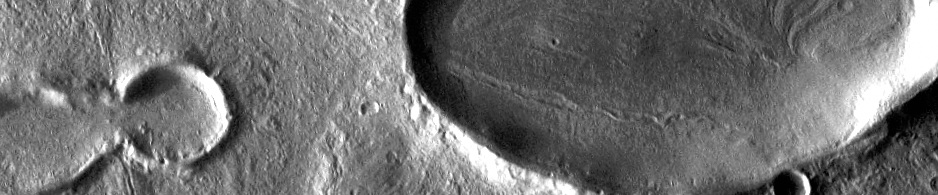
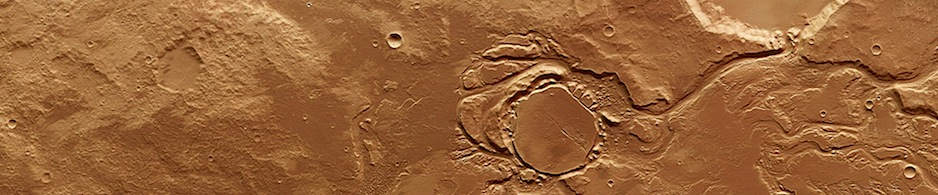
tumblr_p9v3qm71t91rlz4gso2_1280Light-toned material within the center of a crater in Gorgonum Chaos basin. The rocks within the center of this crater are light-toned and appear altered relative to the rocks that define the crater wall.

Beautiful Mars series. [More at links]

Posted in Reports | Tagged , , , , , , , , , , | Comments Off

Mars minerology points to cold, icy ancient climate

ackiss-glacierThe climate throughout Mars’ early history has long been debated – was the Red Planet warm and wet, or cold and icy? New research published in Icarus provides evidence for the latter.

Mars is littered with valley networks, deltas and lake deposits, meaning it must have had freely flowing water at some point, probably around 4 billion years ago. But climate models of the planet’s deep past haven’t been able to produce warm enough conditions to allow liquid water on the surface.

“There are people trying to model Mars’ ancient climate using the same kind of models we use here on Earth, and they’re having a really hard time doing it. It’s difficult to create a warm ancient Mars because the sun was a lot fainter then. The whole solar system was cooler,” said Briony Horgan, an assistant professor of earth, atmospheric and planetary sciences at Purdue University. “While a lot of people are using climate models, we’re coming at this from a unique perspective – what does the volcanic record of Mars tell us?” [More at links]

Posted in Reports | Tagged , , , , , , , , , , , , | Comments Off

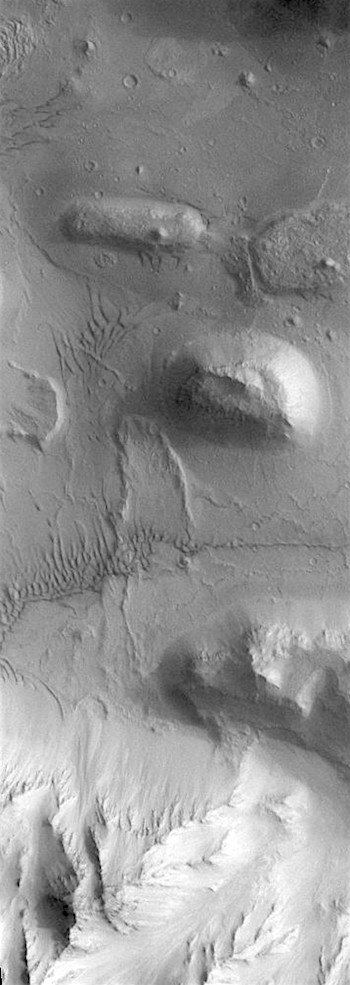
THEMIS: Landslide debris and dunes in Coprates Chasma

Slides and dunes in Coprates Chasma (THEMIS_IOTD_20180608)THEMIS Image of the Day, June 8, 2018. Today’s VIS image shows part of the wall and floor of Coprates Chasma. Several landslide deposits are visible as well as small regions of sand dunes.

More THEMIS Images of the Day by geological topic.

Posted in Reports | Tagged , , , , , , , , , , , , | Comments Off

Curiosity update: And the crowd went wild

2072ML0109950070801090C00_DXXXSol 2074, June 6, 2018, update by MSL scientist Scott Guzewich: Today we received the happy news that the SAM instrument received enough sample to conduct its “evolved gas” analysis of the powdered rock from our “Duluth” drill hole! This will allow the team to study the composition of “Duluth” and search for clues about the habitability of Gale Crater billions of years ago. It also fully validates the new sample drop off routines that were created to work with our new “feed-extended drilling” technique.

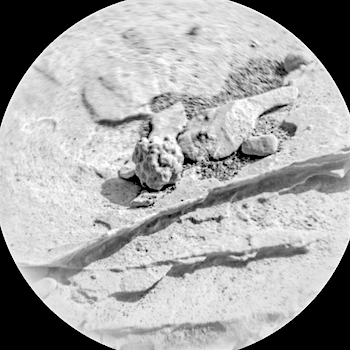
After a busy several sols where Curiosity’s onboard laboratories got back in action, the plan today was relatively quiet with ChemCam LIBS analysis of rock targets “Little Marais” and “Independence”, and some housekeeping activities from SAM following its investigations two sols ago.

The environmental science theme group is monitoring a growing large dust storm on the other side of Mars. To help keep tabs on if and when this storm begins to impact Gale Crater, we added two observations with Mastcam to monitor the amount of dust in the atmosphere and a short Navcam dust… [More at link]

Posted in Reports | Tagged , , , , , , , , , , , | Comments Off

HiRISE: Dark and possibly stationary ripples

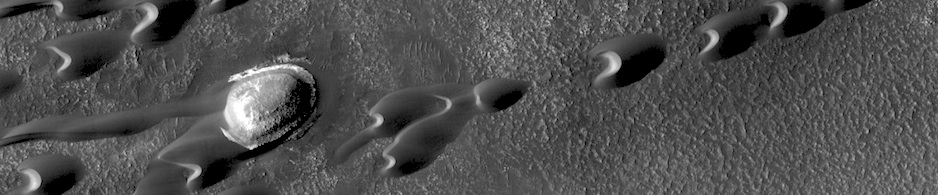
tumblr_p9ta14DKfb1rlz4gso2_1280Dark and possibly stationary ripples in anomalous terrain.  These strange ripples are in some anomalous terrain on the Olympus Mons aureole. These dark ripples have not been imaged in about 8 years, so another shot should show movement…if there IS any movement. If there’s no movement, then it’s a total mystery why they’re so dark.

Beautiful Mars series. [More at links]

Posted in Reports | Tagged , , , , , , , , , | Comments Off

Curiosity finds ancient organic material and seasonally varying methane on Mars

PIA22328_hires

[Editor’s note: press briefing video here.]

NASA’s Curiosity rover has found new evidence preserved in rocks on Mars that suggests the planet could have supported ancient life, as well as new evidence in the Martian atmosphere that relates to the search for current life on the Red Planet. While not necessarily evidence of life itself, these findings are a good sign for future missions exploring the planet’s surface and subsurface.

The new findings — “tough” organic molecules in 3-billion-year-old sedimentary rocks near the surface, as well as seasonal variations in the levels of methane in the atmosphere — appear in the June 8 edition of the journal Science.

Organic molecules contain carbon and hydrogen, and also may include oxygen, nitrogen and other elements. While commonly associated with life, organic molecules also can be created by non-biological processes and are not necessarily indicators of life.

“With these new findings, Mars is telling us to stay the course and keep searching for evidence of life,” said Thomas Zurbuchen, associate administrator for the Science Mission Directorate at NASA Headquarters, in Washington. “I’m confident that our ongoing and planned missions will unlock even more breathtaking discoveries on the Red Planet.”

“Curiosity has not determined the source of the organic molecules,” said Jen Eigenbrode of NASA’s Goddard Space Flight Center in Greenbelt, Maryland, who is lead author of one of the two new Science papers. “Whether it holds a record of ancient life, was food for life, or has existed in the absence of life, organic matter in Martian materials holds chemical clues to planetary conditions and processes.” (…)

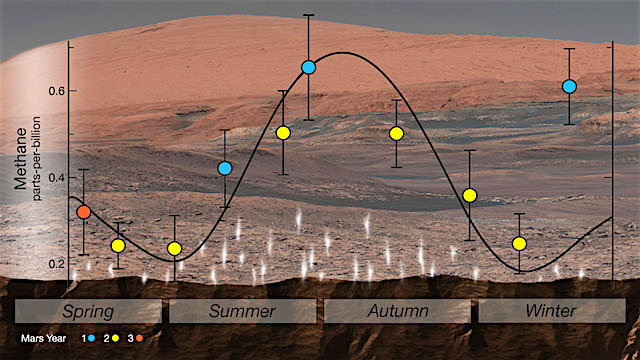
In the second paper, scientists describe the discovery of seasonal variations in methane in the Martian atmosphere over the course of nearly three Mars years, which is almost six Earth years. This variation was detected by Curiosity’s Sample Analysis at Mars (SAM) instrument suite. (…)

“This is the first time we’ve seen something repeatable in the methane story, so it offers us a handle in understanding it,” said Chris Webster of NASA’s Jet Propulsion Laboratory in Pasadena, California, lead author of the second paper. “This is all possible because of Curiosity’s longevity. The long duration has allowed us to see the patterns in this seasonal ‘breathing.’” [More at links]

Posted in Reports | Tagged , , , , , , , , , , | Comments Off

Data-mining offers new picture of Mars minerals

Gale_Crater-Panorama-770x341A team of scientists led by Carnegie’s Shaunna Morrison and including Bob Hazen have revealed the mineralogy of Mars at an unprecedented scale, which will help them understand the planet’s geologic history and habitability. Their findings are published in two American Mineralogist papers [ed. note: each title word is a separate link]. (…)

An instrument on NASA’s Mars Curiosity Rover called the Chemistry and Mineralogy Instrument, or CheMin, is the first tool of its kind ever to operate on another planet. But there are limitations to how much it can tell scientists about the Red Planet’s minerals—how they formed and what they can illuminate about Martian history. (…)

“I scoured the literature, gathering and analyzing thousands of measurements of both mineral compositions and unit cell dimensions and then determined a mathematical connection between them,” Morrison explained. “Once this relationship was established, it could be used to glean much more detail about the minerals in the Martian samples taken by CheMin….”  [More at links]

Posted in Reports | Tagged , , , , , , , , , , | Comments Off

MARCI weather report, May 28-June 3, 2018

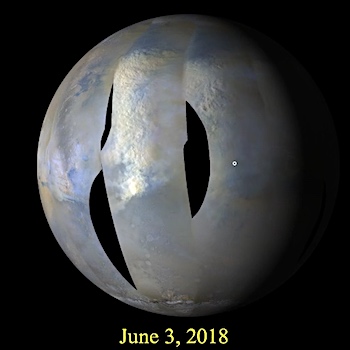
MARCI-June-3-2018The most prominent weather events last week were two large regional dust storms over the northern hemisphere of Mars. The large arcuate-shaped dust storm, reported the previous week, propagated eastward over the northern mid-latitudes of Utopia Planitia before abating. By midweek, a new dust storm had formed over the Ares III landing site featured in the book, ‘The Martian’. The dust storm moved southward along the Acidalia storm-track into Xanthe Terra. By the end of the week, the storm covered an area from eastern…  [More at link, including video]

Posted in Reports | Tagged , , , , , , , , , , , , , | Comments Off