THEMIS: Dry waterfall at edge of Shalbatana Vallis?

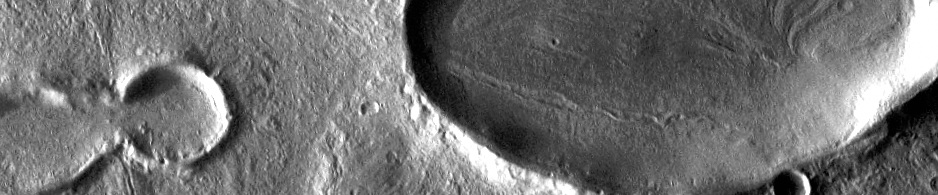
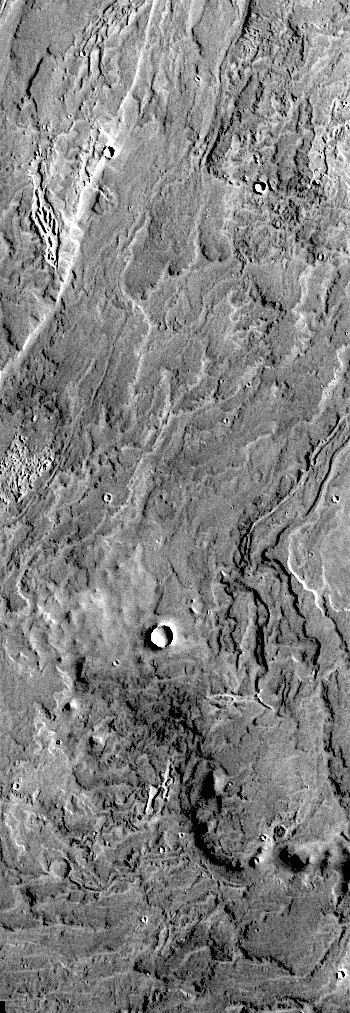
Dry waterfalls in Shalbatana Vallis (THEMIS_IOTD_20180607)THEMIS Image of the Day, June 7, 2018. This VIS image shows a section of Shalbatana Vallis. Shalbatana Vallis is located in Xanthe Terra. Shalbatana is an outflow channel carved by massive floods from escaping groundwater whose source lies far to the south of this image. The cliff-like edge at the top of the image probably saw flood waters pouring over it into the main channel.

More THEMIS Images of the Day by geological topic.

Posted in Reports | Tagged , , , , , , , , , | Comments Off

Curiosity update: Another CheMin analysis

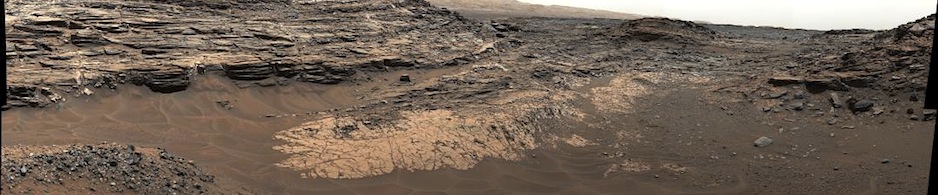
2069MR0109870000903780E02_DXXX-br2Sol 2073, June 5, 2018, update by MSL scientist Ken Herkenhoff: The focus of MSL operations continues to be on the analysis of the Duluth drill sample. The latest SAM EGA was scheduled for the evening of Sol 2072, so the results of that analysis have not been received yet. Both SAM and CheMin analyses require significant power, and can therefore not typically be scheduled on the same day. So today it’s CheMin’s turn to analyze the the Duluth sample again, to improve the statistics of the X-ray diffraction measurements. The uplink team was also able to squeeze in a few daytime observations before the overnight CheMin analysis: Right Mastcam images of Noodle Lake… [More at link]

Posted in Reports | Tagged , , , , , , , , , , | Comments Off

HiRISE: Ever winding

tumblr_p9t9bywebl1rlz4gso1_1280Ever winding. This image (and its partner) was acquired to compare against an earlier stereo pair of the same region several years ago to determine if any changes have occurred.

Beautiful Mars series. [More at links]

Posted in Reports | Tagged , , , , , , , | Comments Off

THEMIS: Rough lava flows on Daedalia Planum

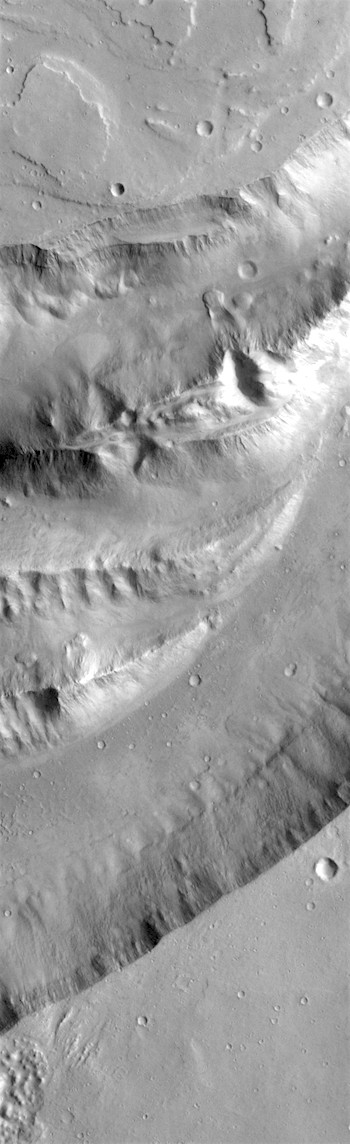
Rough lava terrain in Daedalia Planum (THEMIS_IOTD_20180606)THEMIS image of the Day, June 6, 2018. Today’s VIS image shows a small portion of the lava flows that comprise Daedalia Planum. The flows originated at Arsia Mons, the youngest of the three Tharsis volcanoes. The Tharsis volcanoes are aligned in a northeast trending system. The majority of the Daedalia Planum flows can be traced back to the southern flank of Arsia Mons along the extension of the controlling alignment.

More THEMIS Images of the Day by geological topic.

Posted in Reports | Tagged , , , , , , , , , , , | Comments Off

Opportunity: Giving La Joya the brush-off

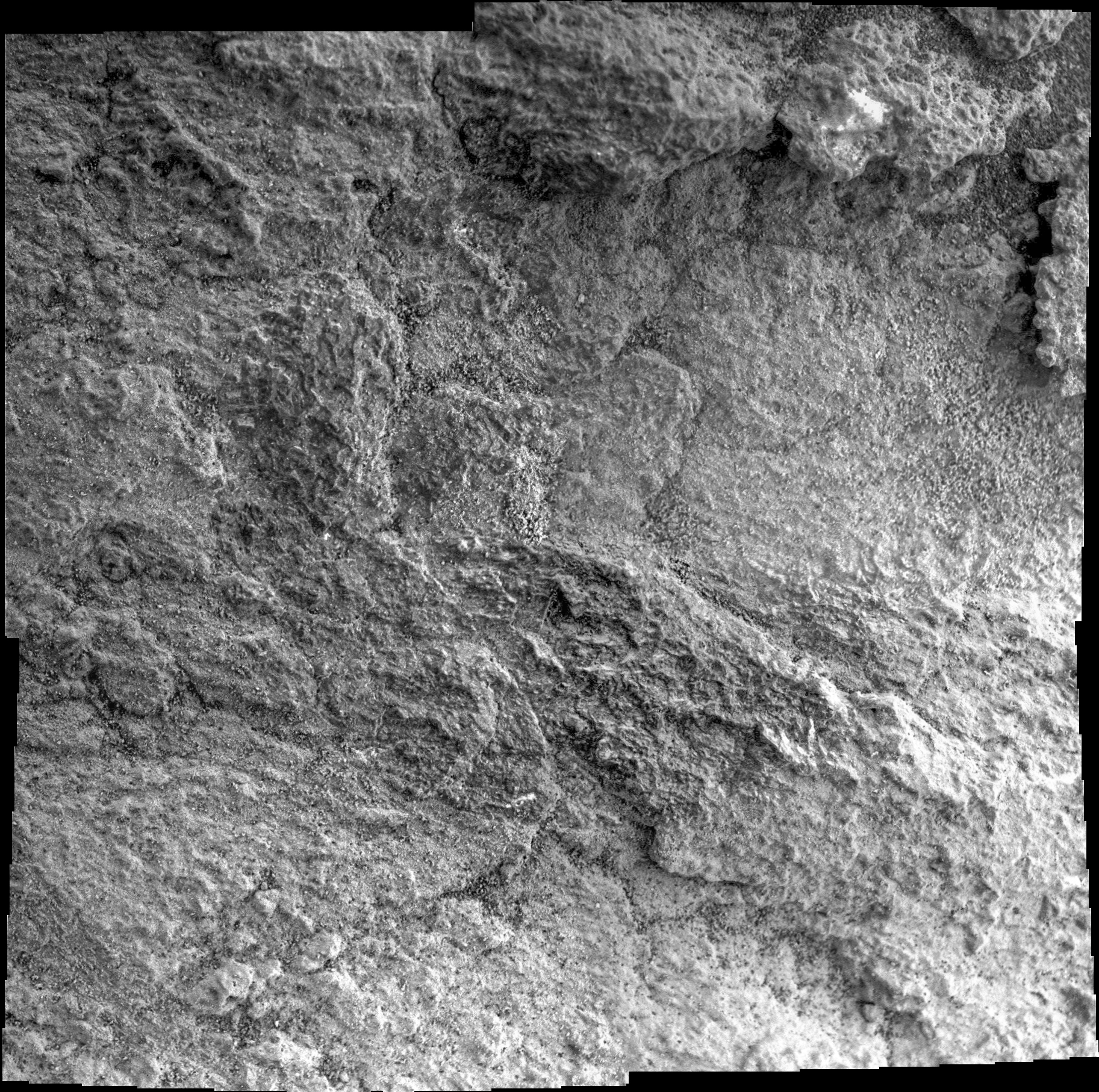
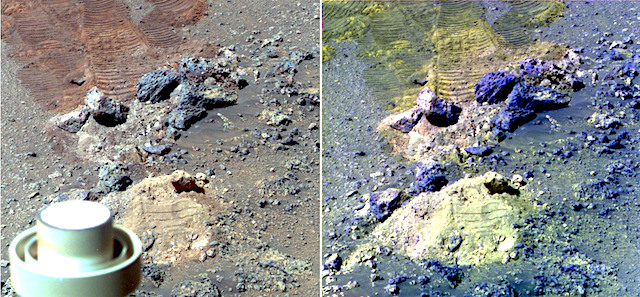
5104-mi1F581290682EFFD2FCP1110R0M1Sol 5104, June 3, 2018. Opportunity’s current close-up target for the Microscopic Imager is a brushed-off part of the La Joya outcrop (above).

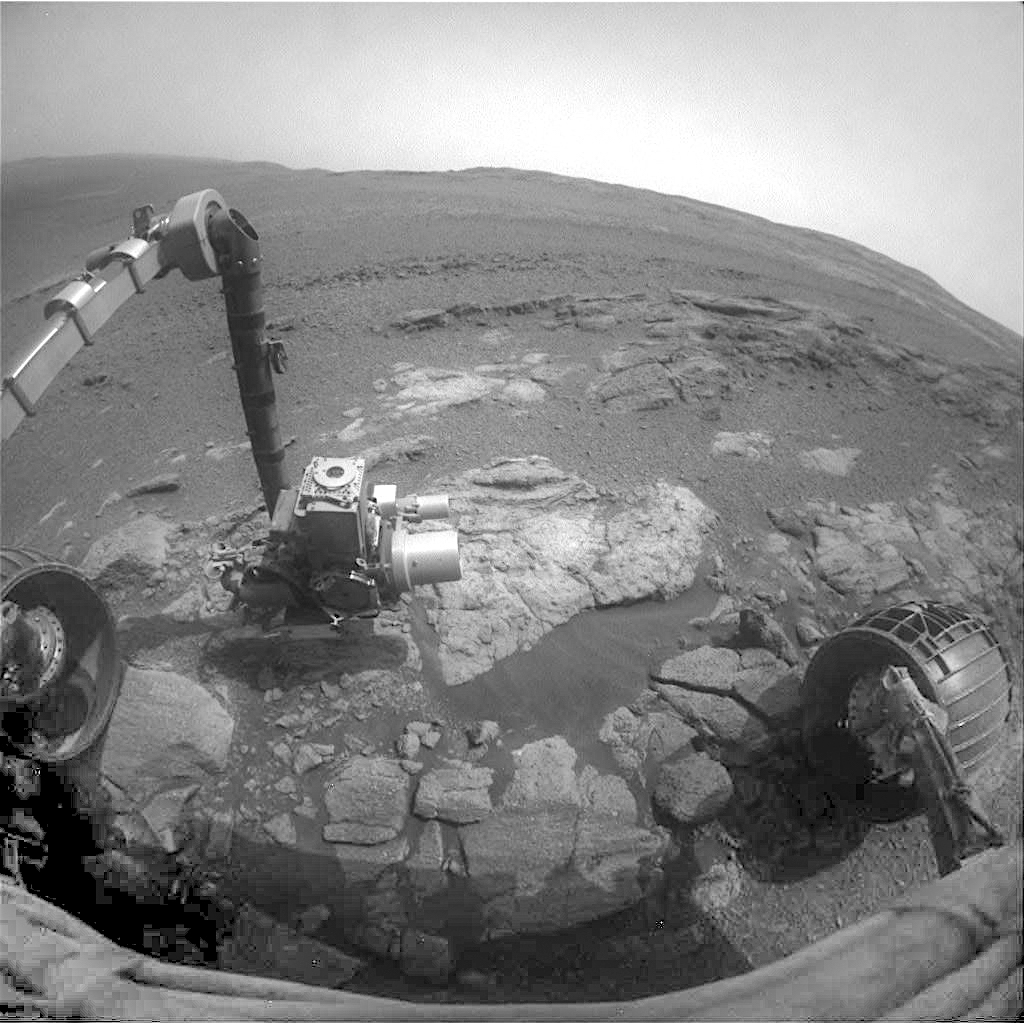
At right, the front Hazcam shows the general scene to the south of the rover. Click either image to enlarge it.

Opportunity raw images, its latest mission status, location map, and atmospheric opacity, known as tau.

Posted in Reports | Tagged , , , , , , , | Comments Off

Curiosity update: The great martian bake-off

2070ML0109900000801073E01_DXXX-br2Sol 2072, June 5, 2018, update by MSL scientist Abigail Fraeman: We received confirmation that the “Duluth” drill sample was delivered to SAM this weekend, so we’re ready to run our evolved gas analysis (EGA) tosol! An EGA basically involves baking the powdered rock sample in a several hundred degree oven, and then measuring the amount and composition of gases that are liberated. Since running the oven requires so much power, we didn’t have the resources to do a whole lot of additional activities in the sol 2072 plan. We did manage to fit in two science blocks that… [More at link]

Posted in Reports | Tagged , , , , , , , , , , | Comments Off

HiRISE: Strangely silent in southwest Arabia Terra

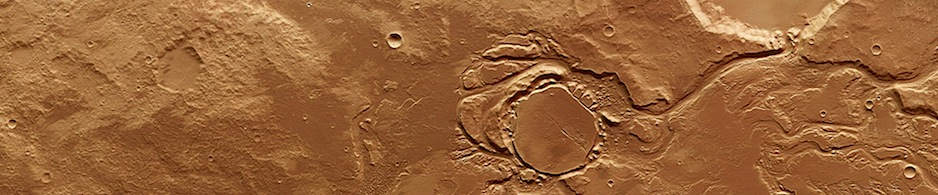
tumblr_p9t8zb5OLm1rlz4gso1_1280Strangely silent in southwest Arabia Terra. Beautiful Mars series. [More at links]

Posted in Reports | Tagged , , , , , , , , | Comments Off

Opportunity report, Sol 5102, by A.J.S. Rayl, The Planetary Society

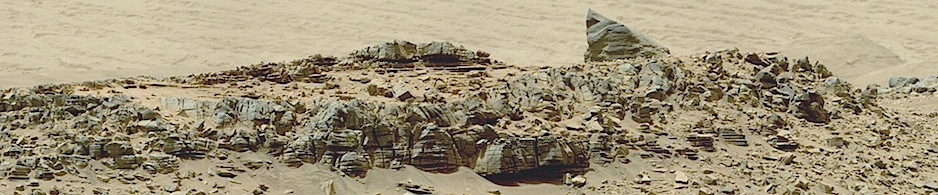
20180603_5-Making-a-scene-Sol-5087June 2, 2018: Opportunity Makes Tracks on Magical Mystery Tour of Different Rocks: Opportunity continued exploring the south trough of Perseverance in May, still looking for evidence that explains just how this one-of-a-kind valley meandering through Endeavour Crater’s rim formed, and, along the way, helped the Mars Exploration Rover (MER) mission chalk up yet another first, linking with three relay orbiters in one Martian day or sol to send a pipeline of data home.

The veteran robot field geologist – the longest-lived robot on Mars, 14.4 years and counting – has been taking a kind of magical mystery tour of the rocks in the south trough for more than two months. “The rocks vary and what’s interesting is these outcrops change in texture and in color as we go from north to south,” said MER Deputy Principal Investigator Ray Arvidson, of Washington University St. Louis (WUSTL).

“We’re trying to look at all the different kinds of rocks in this complicated zone that might be fault-controlled, investigating what’s causing patterns we see in terms of the material properties, and working to understand the nature of each one,” he added.

Opportunity began the merry month on Mars studying a pitted rock, formerly known as vesicular, then roved on, to an outcrop of bright, tan-colored, tabular rocks. “We were intrigued by these pitted rocks and at first called them vesicular,” said Arvidson. “Vesicular rocks are characterized by these little cavities known as vesicles that are formed when you have a magma or lava that degasses and leaves holes. But now the science team is beginning to think that maybe the pits are caused by some kind of chemical corrosion,” he explained. [More at link]
Posted in Reports | Tagged , , , , , , | Comments Off

HiRISE: Within an inverted impact crater

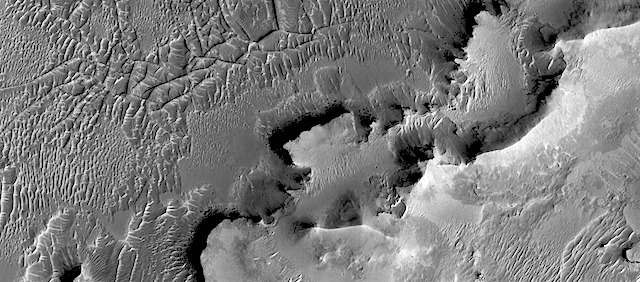
tumblr_p9t8p4pnZR1rlz4gso2_1280Within an inverted impact crater in Vastitas Borealis. This particular crater is characterized by a central deposit of positive relief with a subdued rim as a result of sublimation in the surrounding territory. A comprehensive study of inverted impact craters would be a giant leap towards confirming ancient fluvial processes because their formation is dependent on surface deflation from the loss of ice.

Beautiful Mars series. [More at links]

Posted in Reports | Tagged , , , , , , , , , | Comments Off

NASA briefing on Mars science results, June 7

m18-090The media and public are invited to ask questions during a live discussion at 2 p.m. EDT Thursday, June 7, on new science results from NASA’s Mars Curiosity rover. The results are embargoed by the journal Science until then.

The event will air live on NASA Television and the agency’s website.

Michelle Thaller, assistant director of science for communications, in NASA’s Planetary Science Division will host the chat. Participants include:

  • Paul Mahaffy, director of the Solar System Exploration Division at NASA’s Goddard Space Flight Center in Greenbelt, Maryland
  • Jen Eigenbrode, research scientist at Goddard
  • Chris Webster, senior research fellow, Jet Propulsion Laboratory, Pasadena, California
  • Ashwin Vasavada, Mars Science Laboratory project scientist, JPL

Media who would like to participate by phone must email their name, media affiliation and phone number to Nancy Jones at nancy.n.jones@nasa.gov by 1 p.m. on June 7.

The public can send questions on social media by using #askNASA. The event can also be watched on Facebook Live, Twitch TV, Ustream, YouTube and Twitter/Periscope. [More at link]

Posted in Reports | Tagged , , , , , , , , | Comments Off