





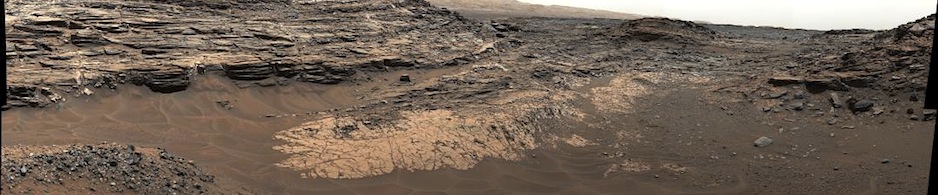

HiRISE: Deposits along Melas Chasma’s north wall

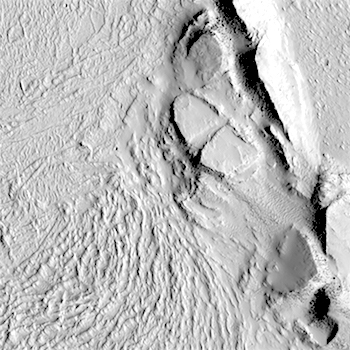
ESP_045960_1705It has been known since the 1970s when the Viking orbiters took pictures of Mars that there are large (i.e., several kilometers-thick) mounds of light-toned deposits within the central portion of Valles Marineris. More recent higher resolution images of Mars, including this image of Melas Chasma, show that the wall rocks of Valles Mariners also contain similar, albeit thinner, light-toned deposits.

Spectral data from the CRISM instrument indicate that the larger mounds are composed of sulfates. Some of the wall rock deposits are also made up of sulfates, but others contain clays or mixtures of several kinds of hydrated materials, suggesting that multiple aqueous processes, perhaps at different times within Valles Marineris, formed the variety of deposits we now observe. [More at link]
Posted in Reports | Tagged , , , , , , , , | Comments Off

NASA is rethinking how it will explore Mars

PIA19929NASA is looking at a new way of studying Mars. Starting in the 2020s, scientists who participate in the agency’s Mars missions might no longer design and build their own highly specialized payloads to explore the red planet. Instead, planetary scientists could find themselves operating much as astronomers who use large telescopes do now: applying for time to use a spacecraft built with a generic suite of scientific instruments.

The proposed change is spurred by NASA’s waning influence at Mars. The agency’s long-running string of spacecraft is winding to a close, and international and commercial interests are on the rise. By the middle of the next decade, European, Chinese, Emirati and SpaceX missions are as likely to be at Mars as NASA is.

Jim Watzin, head of NASA’s Mars exploration programme in Washington DC, suggested the new approach to the red planet on 6 October at a virtual meeting of a Mars advisory group. “The era that we all know and love and embrace is really coming to an end,” he said. “It’s important to recognize that the future is not going to be the same as the past.” [More at link]

Posted in Reports | Tagged | Comments Off

THEMIS: Gusev Crater

Gusev Crater final home of Spirit rover (THEMIS_IOTD_20161007)THEMIS Image of the Day, October 7, 2016. Today’s VIS image shows the part of the floor of Gusev Crater with the Columbia Hills. Numerous dark linear markings were created by dust devil action. The Columbia Hills are where the MER Spirit rover finally fell silent in 2010.

More THEMIS Images of the Day by geological topic.

Posted in Reports | Tagged , , , , , , , , , , , , | Comments Off

HiRISE: Barchan dunes

tumblr_oeas0bFIoK1rlz4gso1_1280Consider the barchan dune. Beautiful Mars series.

Posted in Reports | Tagged , , , , , , , , , | Comments Off

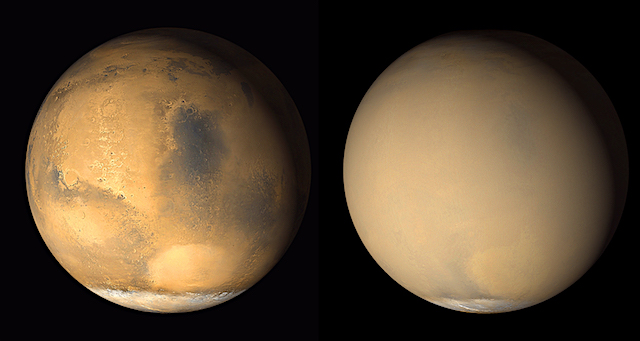
Big global dust storm starting soon?

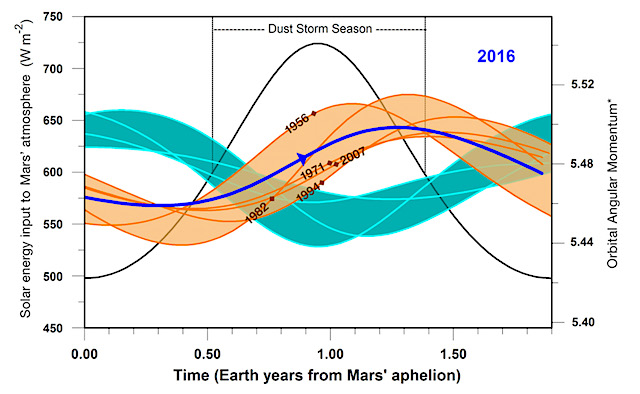
converted PNM fileGlobal dust storms on Mars could soon become more predictable — which would be a boon for future astronauts there — if the next one follows a pattern suggested by those in the past.

A published prediction, based on this pattern, points to Mars experiencing a global dust storm in the next few months. “Mars will reach the midpoint of its current dust storm season on October 29th of this year. Based on the historical pattern we found, we believe it is very likely that a global dust storm will begin within a few weeks or months of this date,” said James Shirley, a planetary scientist at NASA’s Jet Propulsion Laboratory, Pasadena, California. (…)

The most recent Martian global dust storm occurred in 2007, significantly diminishing solar power available to two NASA Mars rovers then active halfway around the planet from each other — Spirit and Opportunity.

“The global dust storm in 2007 was the first major threat to the rovers since landing,” said JPL’s John Callas, project manager for Spirit and Opportunity. “We had to take special measures to enable their survival for several weeks with little sunlight to keep them powered. Each rover powered up only a few minutes each day, enough to warm them up, then shut down to the next day without even communicating with Earth. For many days during the worst of the storm, the rovers were completely on their own.” [More at links]

PIA20855_hires

Posted in Reports | Tagged , , , , | Comments Off

HiRISE: Tilted blocks of layered bedrock

tumblr_oearx4s0gk1rlz4gso2_1280Tilted blocks of layered bedrock. Beautiful Mars series.

Posted in Reports | Tagged , , , , , , , , | Comments Off

Curiosity update: Another touch and go

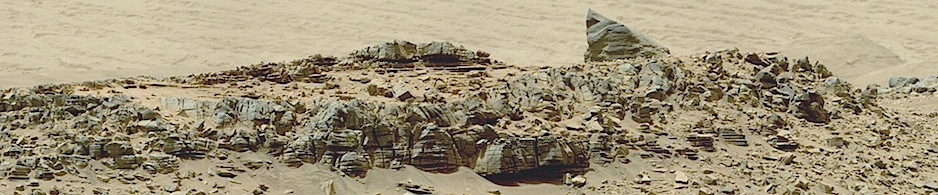
NLB_528892751EDR_F0581248NCAM00346M_Sol 1482-83, October 5, 2016, update by USGS scientist Ken Herkenhoff: MSL drove another 35 meters on Sol 1480, stopping at a location with a layered bedrock exposure right in front of the rover.  So the tactical planning team decided to take advantage of the touch and go option again.  MAHLI will take pictures of the layered target “Cassongue” and of the rover wheels before the arm is stowed in preparation for another drive on Sol 1482.  ChemCam and Mastcam will observe bedrock targets named “Coutada,” “Cuangar,” and “Cacuso,” and the Right Mastcam will acquire mosaics of more distant targets dubbed… [More at link]

Posted in Reports | Tagged , , , , , , , , , , , , , , , | Comments Off

THEMIS: Channels carving into Claritas Fossae

Channels in Claritas Fossae (THEMIS_IOTD_20161006)THEMIS Image of the Day, October 6, 2016. This VIS image shows several channels dissecting the higher elevations of Claritas Fossae. (Sunlight is coming from the right, as the image was taken in local morning, not long after sunrise.)

More THEMIS Images of the Day by geological topic.

Posted in Reports | Tagged , , , , , , , , , | Comments Off

MARCI weather report, Sept 26-Oct 2, 2016

Screen Shot 2016-10-05 at 7.37.25 PMThe large dust storms east of Elysium which were mentioned in the previous report, quickly subsided after coalescing. Shortly thereafter, a subsequent dust storm appeared and moved southward across Amazonis. In the second half of the week, a dust storm developed southwest of Elysium Mons and tracked southward towards Cimmeria. Looking to the southern highlands, local-scale dust storms and hazes were spotted along the edge of the retreating seasonal south polar ice cap throughout the week. Afternoon water-ice clouds were observed over Arsia Mons, Deuteronilus, and in the mesosphere… [More at link, including video]

Posted in Reports | Tagged , , , , , , , , , , , , , | Comments Off

HiRISE: Channels in crater NE of Hellas Planitia

tumblr_oearqpw6Bh1rlz4gso1_1280Channels in crater northeast of Hellas Planitia. Beautiful Mars series.

Posted in Reports | Tagged , , , , , , , , , | Comments Off