





-
Recent Posts
Archives
Links
general
mission instruments
- CRISM: Compact Reconnaissance Imaging Spectrometer for Mars
- CTX: Context Camera
- HiRISE: High Resolution Imaging Science Experiment
- MARSIS: Mars Advanced Radar for Subsurface and Ionosphere Sounding
- SHARAD: Shallow Radar
- THEMIS: Thermal Emission Imaging System
missions
- All Mars missions list
- Curiosity rover
- ExoMars
- Hope (al-Amal) orbiter
- InSight
- Mars Atmosphere and Volatile Evolution Mission (MAVEN)
- Mars Exploration Rovers (MER)
- Mars Express (MEX)
- Mars Odyssey
- Mars Orbiter Mission (MOM) / Mangalyaan
- Mars Reconnaissance Orbiter (MRO)
- Mars Science Laboratory (MSL)
- Perseverance Rover
- Tianwen-1 orbiter/rover
news
Tag Archives: CTX
HiRISE: Formations in context (Or, what is it?)
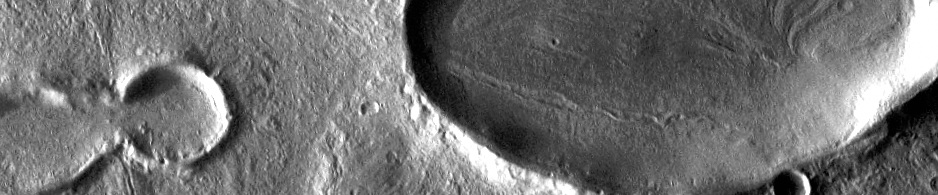
Some HiRISE images show strange-looking formations. Sometimes it helps to look at Context Camera images to understand the circumstances of a scene—like this cutout from CTX 033783_1509—which here shows an impact crater with a central peak, and a collapse depression … Continue reading
Posted in Reports
Tagged central peaks, Context Camera, CTX, High Resolution Imaging Science Experiment, HiRISE, impact craters, Mars Reconnaissance Orbiter, MRO, NASA, University of Arizona
Comments Off
Mars Reconnaissance Orbiter preps aging hardware, instruments for extended operation
NASA’s Mars Reconnaissance Orbiter (MRO) has begun extra stargazing to help the space agency accomplish advances in Mars exploration over the next decade. The spacecraft already has worked more than double its planned mission life since launch in 2005. NASA … Continue reading
Posted in Reports
Tagged Compact Reconnaissance Imaging Spectrometer for Mars, Context Camera, CRISM, CTX, HiRISE, igh Resolution Imaging Science Experiment, Malin Space Science Systems, MARCI, Mars Climate Sounder, Mars Color Imager, Mars Reconnaissance Orbiter, MCS, MRO, MSSS, NASA, Shallow Radar, SHARAD, University of Arizona
Comments Off
MRO completes 50,000 orbits
The most data-productive spacecraft yet at Mars swept past its 50,000th orbit this week, continuing to compile the most sharp-eyed global coverage ever accomplished by a camera at the Red Planet. In addition, the spacecraft — NASA’s Mars Reconnaissance Orbiter … Continue reading
HiRISE: Cluster of recent impacts
The dark spots in this enhanced-color infrared image are the recent impact craters that occurred in the Tharsis region between 2008 and 2014. These impact craters were first discovered by the Mars Context Camera (or CTX, also onboard the Mars … Continue reading
Posted in Reports
Tagged Context Camera, CTX, fresh craters, High Resolution Imaging Science Experiment, HiRISE, Mars Reconnaissance Orbiter, MRO, NASA, University of Arizona
Comments Off
MRO spots Schiaparelli impact scar, parachute
NASA’s Mars Reconnaissance Orbiter has identified new markings on the surface of the Red Planet that are believed to be related to ESA’s ExoMars Schiaparelli entry, descent and landing technology demonstrator module. Schiaparelli entered the martian atmosphere at 14:42 GMT … Continue reading
Posted in Reports
Tagged Context Camera, CTX, ESA, European Space Agency, ExoMars, ExoMars 2016, High Resolution Imaging Science Experiment, HiRISE, Mars Reconnaissance Orbiter, Meridiani Planum, MRO, NASA, Roscosmos, Schiaparelli lander, TGO, Trace Gas Orbiter, University of Arizona
Comments Off
Hunting ice cap ‘spiders’ through citizen science
Ten thousand volunteers viewing images of Martian south polar regions have helped identify targets for closer inspection, yielding new insights about seasonal slabs of frozen carbon dioxide and erosional features known as “spiders.” From the comfort of home, the volunteers … Continue reading
Posted in Reports
Tagged Context Camera, CTX, High Resolution Imaging Science Experiment, HiRISE, Mars Reconnaissance Orbiter, MRO, NASA, south polar ice cap, spiders, University of Arizona
Comments Off
Mars Human Exploration Zone CTX image-maps
We [the US Geological Survey] have created 39 regional semi-controlled CTX mosaics at 5m/pixel for the 2015 proposed Mars Human Exploration zones. They are individually available for download in GeoTiff format from the “Online Linkage” tag below. Cosmetically, mosaics will … Continue reading
Rise and fall of Martian lakes
There is a wealth of evidence, collected over the past few decades, suggesting liquid water was abundant in the early history of Mars. However, the size, evolution, and duration of standing bodies of water such as lakes on Mars’ surface … Continue reading
Posted in Reports
Tagged Atlantis Chaos, Caralis Chaos, Compact Reconnaissance Imaging Spectrometer for Mars, Context Camera, CRISM, CTX, DLR, Eridania Lake, ESA, European Space Agency, FU Berlin, High Resolution Imaging Science Experiment, High Resolution Stereo Camera, HiRISE, HRSC, lakes, Mars Express, Mars Reconnaissance Orbiter, MEX, MRO, NASA, open-basin lakes, Simois Colles, University of Arizona
Comments Off
Help wanted: categorizing south polar features
Science-team members for NASA’s Mars Reconnaissance Orbiter are soliciting help from the public to analyze exotic features near the south pole of Mars. By categorizing features visible in images from the orbiter’s Context Camera (CTX), volunteers are using their own … Continue reading
Posted in Reports
Tagged Context Camera, CTX, High Resolution Imaging Science Experiment, HiRISE, Mars Reconnaissance Orbiter, MRO, NASA, south polar ice cap, south polar region, University of Arizona
Comments Off
Gale Crater’s icy hydrological cycle
Gale Crater was once home to glaciers and other features of an icy hydrological system, says a team of scientists led by Alberto Fairén (Centro de Astrobiología in Spain and Cornell University). They base their work on images captured with the … Continue reading
Posted in Reports
Tagged Aeolis Mons, CTX, Curiosity, Gale Crater, glaciers, groundwater, HiRISE, HRSC, liquid water, Mars Express, Mars Science Laboratory, Mount Sharp, MSL, NASA, water
Comments Off