
-
Recent Posts
Archives
Links
general
mission instruments
- CRISM: Compact Reconnaissance Imaging Spectrometer for Mars
- CTX: Context Camera
- HiRISE: High Resolution Imaging Science Experiment
- MARSIS: Mars Advanced Radar for Subsurface and Ionosphere Sounding
- SHARAD: Shallow Radar
- THEMIS: Thermal Emission Imaging System
missions
- All Mars missions list
- Curiosity rover
- ExoMars
- Hope (al-Amal) orbiter
- InSight
- Mars Atmosphere and Volatile Evolution Mission (MAVEN)
- Mars Exploration Rovers (MER)
- Mars Express (MEX)
- Mars Odyssey
- Mars Orbiter Mission (MOM) / Mangalyaan
- Mars Reconnaissance Orbiter (MRO)
- Mars Science Laboratory (MSL)
- Perseverance Rover
- Tianwen-1 orbiter/rover
news
Tag Archives: ice
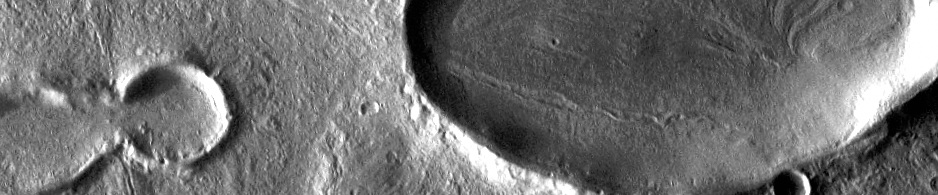
THEMIS: Northern Arabia Terra channel
THEMIS Image of the Day, August 8, 2019. The margin between Arabia Terra and the surrounding lowlands is dissected by numerous named and unnamed channels. Today’s VIS image shows part of an unnamed channel in the region. The channel floor … Continue reading
Posted in Reports
Tagged Arabia Terra, Arizona State University, ASU, channel deposits, glaciers, ice, Mars Odyssey, NASA, periglacial terrain, THEMIS, THEMIS Image of the Day, Thermal Emission Imaging System
Comments Off
HiRISE: Flow, moving
Flow, moving. The objective of this observation is to examine a flow that goes through a crater in Nilosyrtis Mensae. It was probably larger in the past and has since been reduced in volume. HiRISE Picture of the Day archive. … Continue reading
Posted in Reports
Tagged glaciers, High Resolution Imaging Science Experiment, HiPOD, HiRISE, HiRISE Picture of the Day, ice, Mars Reconnaissance Orbiter, mid-latitude glaciers, MRO, NASA, Nilosyrtis Mensae, University of Arizona
Comments Off
HiRISE: Floor and north rim of Dokka Crater
Floor and north rim of Dokka Crater. Dokka Crater is 52-kilometers in diameter and located in the north polar region of Mars. Its interior is presumably a remnant of a former polar cap with larger extension, so it could provide … Continue reading
Posted in Reports
Tagged climate change, climate cycles, Dokka Crater, High Resolution Imaging Science Experiment, HiPOD, HiRISE, HiRISE Picture of the Day, ice, Mars Reconnaissance Orbiter, MRO, NASA, north polar ice cap, University of Arizona
Comments Off
Do ice-squeezed aquifers cause marsquakes?
As the Mars InSight lander begins listening to the interior of Mars, some scientists are already proposing that some marsquakes could be signals of groundwater beneath the frozen surface of the Red Planet. The idea, proposed by Michael Manga, a … Continue reading
Posted in Reports
Tagged aquifers, faulting, faults, ground ice, groundwater, ice, InSight, Interior Exploration Using Seismic Investigations Geodesy and Heat Transport, marsquakes
Comments Off
THEMIS: South polar layers
THEMIS Image of the Day, June 14, 2019. This VIS image shows part of the south polar cap. The numerous layers that comprise the polar cap are readily visible. The cap was built up over millions of years of deposition … Continue reading
Posted in Reports
Tagged Arizona State University, ASU, carbon dioxide ice, dust, ice, Mars Odyssey, NASA, south polar ice cap, south polar layered deposits, THEMIS, THEMIS Image of the Day, Thermal Emission Imaging System
Comments Off
HiRISE: Still life with an impact crater
Still life with an impact crater. Ice fill within a crater in the north polar layered deposits (NPLD) may be a site where accumulation could be observed, helping to settle a long-term problem in Mars polar science: are the NPLD … Continue reading
Posted in Reports
Tagged High Resolution Imaging Science Experiment, HiPOD, HiRISE, HiRISE Picture of the Day, ice, Mars Reconnaissance Orbiter, MRO, NASA, north polar layered deposits, north polar region, University of Arizona
Comments Off
Stagnant ice deposits in Terra Cimmeria
[Editor’s note: From a paper by Solmaz Adeli and five co-authors recently published in the Journal of Geophysical Research.] Geomorphological evidence of localized stagnant ice deposits in Terra Cimmeria, Mars • Small debris‐covered stagnant ice deposits (termed valley fill deposits … Continue reading
Posted in Reports
Tagged ground ice, ice, lineated valley fill, Terra Cimmeria, valley fill deposits, VFD
Comments Off
THEMIS: South polar ice cap layers
THEMIS Image of the Day, March 15, 2019. This VIS image is located on the South Polar cap. The linear features are the steep side of a polar trough. At troughs the extensive layering of the ice is exposed. The … Continue reading
Posted in Reports
Tagged Arizona State University, ASU, climate change, climate cycles, ice, Mars Odyssey, NASA, south polar ice cap, south polar layered deposits, THEMIS, THEMIS Image of the Day, Thermal Emission Imaging System
Comments Off
HiRISE: The slow charm of brain terrain
You are staring at one of the unsolved mysteries on Mars. This surface texture of interconnected ridges and troughs, referred to as “brain terrain” is found throughout the mid-latitude regions of Mars. (This image is in Protonilus Mensae.) This bizarrely … Continue reading
Posted in Reports
Tagged brain terrain, glacial deposits, ground ice, High Resolution Imaging Science Experiment, HiRISE, ice, Mars Reconnaissance Orbiter, MRO, NASA, periglacial processes, periglacial terrain, Protonilus Mensae, University of Arizona
Comments Off
Mars Express: Korolev Crater
This image shows what appears to be a large patch of fresh, untrodden snow – a dream for any lover of the holiday season. However, it’s a little too distant for a last-minute winter getaway: this feature, known as Korolev … Continue reading
Posted in Reports
Tagged DLR, ESA, European Space Agency, FU Berlin, High Resolution Stereo Camera, HRSC, ice, Korolev Crater, Mars Express, MEX
Comments Off