



-
Recent Posts
Archives
Links
general
mission instruments
- CRISM: Compact Reconnaissance Imaging Spectrometer for Mars
- CTX: Context Camera
- HiRISE: High Resolution Imaging Science Experiment
- MARSIS: Mars Advanced Radar for Subsurface and Ionosphere Sounding
- SHARAD: Shallow Radar
- THEMIS: Thermal Emission Imaging System
missions
- All Mars missions list
- Curiosity rover
- ExoMars
- Hope (al-Amal) orbiter
- InSight
- Mars Atmosphere and Volatile Evolution Mission (MAVEN)
- Mars Exploration Rovers (MER)
- Mars Express (MEX)
- Mars Odyssey
- Mars Orbiter Mission (MOM) / Mangalyaan
- Mars Reconnaissance Orbiter (MRO)
- Mars Science Laboratory (MSL)
- Perseverance Rover
- Tianwen-1 orbiter/rover
news
Tag Archives: volcanos
THEMIS: Tharsis Tholus volcano flank
THEMIS Image of the Day, June 28, 2019. This VIS image is located on the flank of Tharsis Tholus. The Tharsis region of Mars is dominated by large volcanoes and extensive lava plains. Explore more THEMIS Images of the Day … Continue reading
Posted in Reports
Tagged Arizona State University, ASU, lava flows, Mars Odyssey, NASA, Tharsis Tholus, THEMIS, THEMIS Image of the Day, Thermal Emission Imaging System, volcanics, volcanos
Comments Off
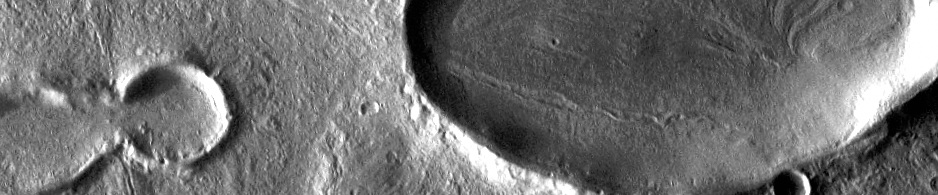
HiRISE: A volcano — of mud or lava?
This image shows a hill with a central crater. Such features have been interpreted as both mud volcanoes (really a sedimentary structure) and as actual volcanoes (the erupting lava kind). They occur on the floor of Valles Marineris below a … Continue reading
Posted in Reports
Tagged High Resolution Imaging Science Experiment, HiRISE, lava, Mars Reconnaissance Orbiter, MRO, mud volcanos, NASA, University of Arizona, Valles Marineris, volcanos
Comments Off
THEMIS: Volcanic vent in Arsia Mons caldera
THEMIS Image of the Day, January 5, 2018. This THEMIS image shows part of the southern margin of the summit caldera. This image contains a variety of features representing the major events related to the formation of the volcano. At … Continue reading
Posted in Reports
Tagged Arizona State University, Arsia Mons, ASU, calderas, collapse features, collapse pits, lava flows, lava tubes, Mars Odyssey, NASA, shield volcanos, Tharsis, THEMIS, THEMIS Image of the Day, Thermal Emission Imaging System, volcanics, volcanos
Comments Off
THEMIS: Chains of pit craters near summit of Arsia Mons volcano
THEMIS Image of the Day, January 4, 2018. The three large aligned Tharsis volcanoes are Arsia Mons, Pavonis Mons and Ascraeus Mons (from south to north). There are collapse features on all three volcanoes, on the southwestern and northeastern flanks. … Continue reading
Posted in Reports
Tagged Arizona State University, Arsia Mons, ASU, calderas, collapse features, collapse pits, lava flows, lava tubes, Mars Odyssey, NASA, shield volcanos, Tharsis, THEMIS, THEMIS Image of the Day, Thermal Emission Imaging System, volcanics, volcanos
Comments Off
THEMIS: Pits at caldera’s edge
THEMIS Image of the Day, January 3, 2018. This THEMIS image shows part of the caldera floor of Arsia Mons. It is not uncommon for calderas to have “flat” floors after the final explosive eruption the empties the subsurface magma … Continue reading
Posted in Reports
Tagged Arizona State University, Arsia Mons, ASU, calderas, collapse features, collapse pits, lava flows, lava tubes, Mars Odyssey, NASA, shield volcanos, Tharsis, THEMIS, THEMIS Image of the Day, Thermal Emission Imaging System, volcanics, volcanos
Comments Off
THEMIS: Flows on the caldera floor of Arsia Mons
THEMIS Image of the Day, January 2, 2018. This THEMIS image shows part of the caldera floor of Arsia Mons. It is not uncommon for calderas to have “flat” floors after the final explosive eruption the empties the subsurface magma … Continue reading
Posted in Reports
Tagged Arizona State University, Arsia Mons, ASU, calderas, lava flows, Mars Odyssey, NASA, shield volcanos, Tharsis, THEMIS, THEMIS Image of the Day, Thermal Emission Imaging System, volcanics, volcanos
Comments Off
THEMIS: Arsia Mons’ collapse pits
THEMIS Image of the Day, January 1, 2018. This VIS image shows part of the northeastern flank of Arsia Mons at the summit caldera. In this region the summit caldera does not have a steep margin most likely due to … Continue reading
Posted in Reports
Tagged Arizona State University, Arsia Mons, ASU, collapse features, collapse pits, lava flows, lava tubes, Mars Odyssey, NASA, shield volcanos, Tharsis, THEMIS, THEMIS Image of the Day, Thermal Emission Imaging System, volcanics, volcanos
Comments Off
THEMIS: Secondary caldera atop Ascraeus Mons
THEMIS Image of the Day, September 8, 2017. This image shows part of the complex caldera at the summit of the volcano. Calderas are found at the tops of volcanoes and are the source region for magma that rises from … Continue reading
Posted in Reports
Tagged Arizona State University, Ascraeus Mons, ASU, calderas, collapse features, faulting, Mars Odyssey, NASA, Tharsis, THEMIS, THEMIS Image of the Day, Thermal Emission Imaging System, volcanics, volcanism, volcanos
Comments Off
THEMIS: Collapse rings in Ascraeus Mons caldera
THEMIS Image of the Day, September 7, 2017. This image shows the eastern part of the complex caldera at the summit of the volcano. Calderas are found at the tops of volcanoes and are the source region for magma that … Continue reading
Posted in Reports
Tagged Arizona State University, Ascraeus Mons, ASU, calderas, collapse features, Mars Odyssey, NASA, Tharsis, THEMIS, THEMIS Image of the Day, Thermal Emission Imaging System, volcanics, volcanism, volcanos
Comments Off
THEMIS: Ring-fault tectonics at Ascraeus Mons caldera
THEMIS Image of the Day, September 6, 2017. This image shows part of the complex caldera at the summit of the volcano. Calderas are found at the tops of volcanoes and are the source region for magma that rises from … Continue reading
Posted in Reports
Tagged Arizona State University, Ascraeus Mons, ASU, calderas, Mars Odyssey, NASA, ring faults, tectonics, Tharsis, THEMIS, THEMIS Image of the Day, Thermal Emission Imaging System, volcanics, volcanism, volcanos
Comments Off