
InSight: Taking Mars’ internal temperature

Ambitious climbers, forget Mt. Everest. Dream about Mars. The Red Planet has some of the tallest mountains in the solar system. They include Olympus Mons, a volcano nearly three times the height of Everest. It borders a region called the Tharsis plateau, where three equally awe-inspiring volcanoes dominate the landscape.

But what geologic processes created these features on the Martian surface? Scientists have long wondered — and may soon know more.

NASA and DLR (German Aerospace Center) plan to take the planet’s temperature for the first time ever, measuring how heat flows out of the planet and drives this inspiring geology. Detecting this escaping heat will be a crucial part of a mission called InSight (Interior Exploration using Seismic Investigations, Geodesy and Heat Transport), managed by NASA’s Jet Propulsion Laboratory in Pasadena, California.

InSight will be the first mission to study Mars’ deep interior, using its Heat Flow and Physical Properties Package (HP3) instrument to measure heat as it is conducted from the interior to the planet’s surface. This energy was in part captured when Mars formed more than 4 billion years ago, preserving a record of its creation. That energy is also due to the decay of radioactive elements in the rocky interior.

The way heat moves through a planet’s mantle and crust determines what surface features it will have, said Sue Smrekar of JPL, the mission’s deputy principal investigator and the deputy lead for HP3.

“Most of the planet’s geology is a result of heat,” Smrekar said. “Volcanic eruptions in the ancient past were driven by the flow of this heat, pushing up and constructing the towering mountains Mars is famous for.” [More at link]

Posted in Reports | Tagged , , , , , , , , | Comments Off

Curiosity update: Look on the sunny side

2152MR0115830010205298E01_DXXX-br2Sol 2154, August 28, 2018, update by MSL scientist Michelle Minitti: If all had gone according to plan over the weekend, we would see a nice pile of drill fines in the above image. Alas, a slight hiccup in the sample dump process meant that the “Stoer” sample was still in the drill and turret. Fortunately, the vast majority of the weekend activities executed unhindered by the sample dumping fault, allowing the team to focus today on recovering the dump-related activities. We had enough power to reattempt the sample dump, the MAHLI imaging on the dump pile, and two APXS integrations on the dump pile. We planned Mastcam and… [More at link]

Posted in Reports | Tagged , , , , , , , , , , , , | Comments Off

THEMIS: Wind streaks in Terra Sirenum

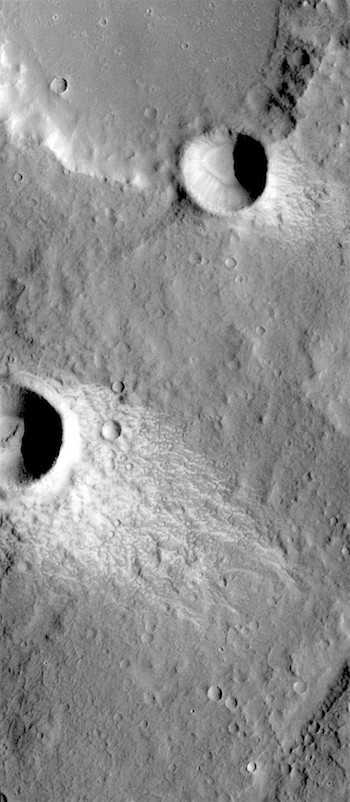
Wind streaks in Terra Sirenum (THEMIS_IOTD_20180828)THEMIS Image of the Day, August 28, 2018. This VIS image shows a small region in Terra Sirenum. The bright material forming “tails” behind the craters were created by surface winds funneled over and around the crater.

The raised rims and bowls of impact craters causes a complex interaction such that the wind vortex in the lee of the crater can both scour away the surface dust and deposit it back in the center of the lee.

The “tail” shows the direction of the wind, in this case blowing from the upper left to the lower right.

See more THEMIS Images of the Day by geological subject.

Posted in Reports | Tagged , , , , , , , , , | Comments Off

HiRISE: Dune swarm!

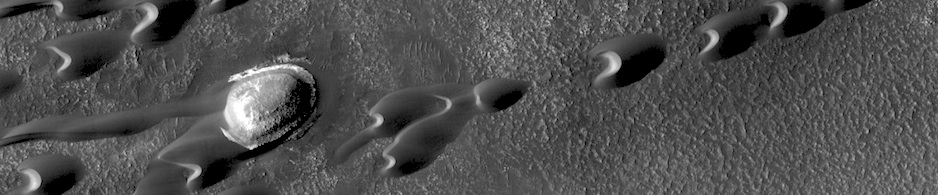
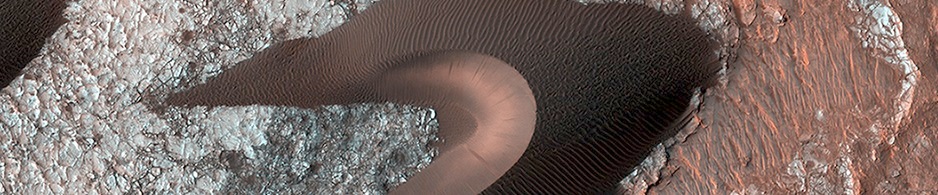
tumblr_pe4v2b8wN61rlz4gso1_1280Dune swarm!  These dunes mean business here in Chasma Boreale.

Beautiful Mars series. [More at links]

Posted in Reports | Tagged , , , , , , , , , , , , , , | Comments Off

THEMIS: Intersecting lava channels & tectonics

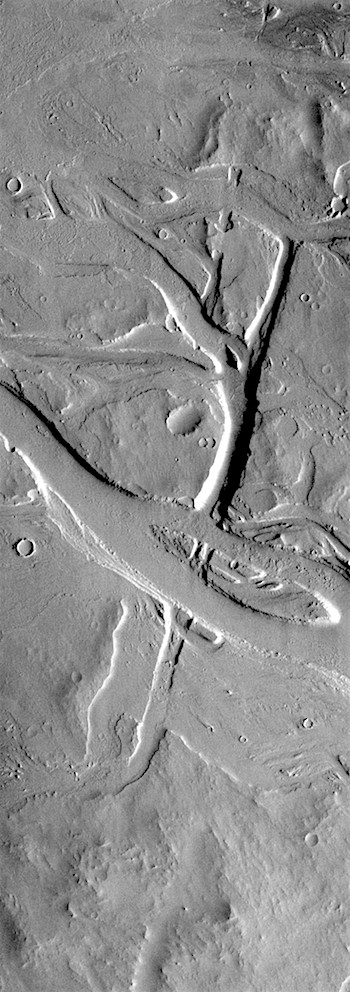
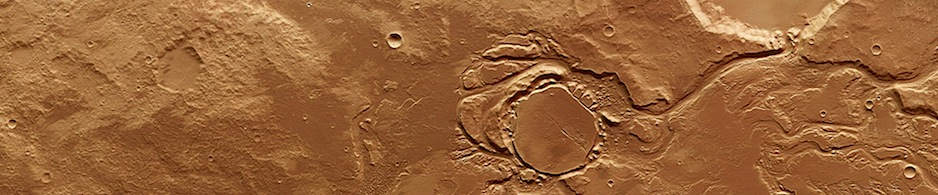
Intersecting lava channels in Tharsis (THEMIS_IOTD_20180827)THEMIS Image of the Day, August 27, 2018. The Tharsis region contains both large volcanoes and extensive lava plains. Most of the channel features in this region were formed by the flow of lava rather than the flow of water.

Tectonic processes are also common and many linear depressions were created due to stresses in the Tharsis area as the surface expanded and lava forced its way to the surface to form volcanoes. This VIS image is located north of Jovis Tholus.

See more THEMIS Images of the Day by geological subject.

Posted in Reports | Tagged , , , , | Comments Off

Curiosity update: Delivering the proper proportions

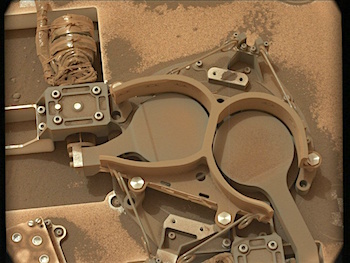
2146ML0115250000803016E01_DXXX-br2Sol 2150, August 24, 2018, update by MSL scientist Roger Wiens: The big question coming into today was whether to re-do the SAM analysis or not. Now that the drill is being operated with the feed immobile in the extended position, the portions (amount of drill tailings) that are delivered to CheMin and SAM are less accurate than before. Duluth was the only previous drill attempt to reach sampling depth with the feed immobile. In that case several attempts were made to deliver proper portions to the in-situ instrument funnels.

The accompanying image [above] shows the positions of the SAM inlets on the rover deck, with the covers closed. The rover team seems to have learned quite quickly how to get the portions to these instruments, and this morning we learned that SAM completed a successful analysis. The other part of the decision was whether to repeat SAM’s analysis with different parameters, but the team decided not to do so at this… [More at link]

Posted in Reports | Tagged , , , , , , , , , , , | Comments Off

THEMIS: Lava channels on Pavonis Mons

Lava channels on Pavonis Mons (THEMIS_IOTD_20180824)THEMIS Image of the Day, August 24, 2018. This VIS image shows part of the southwestern flank of Pavonis Mons. The channel and nearby oval depressions are both related to the flow of lava.

Narrow lava flows can create channels. The cooling of the top of the channel will form a roof over the flow, creating a tube beneath the surface. After the lava stops flowing the tube can empty, leaving a subsurface void. The roof will then collapse into the void forming the oval surface features.

See more THEMIS Images of the Day by geological subject.

Posted in Reports | Tagged , , , , , , , | Comments Off

Tibetan Plateau has analogs for Mars yardangs

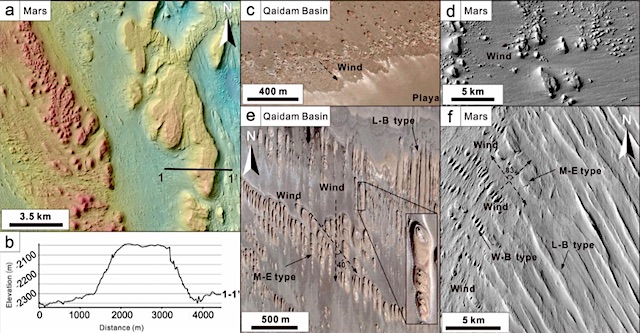
figure-12[Editor’s note: From a paper by Jiang Wang and eight co-authors recently published in the Journal of Geophysical Research.]

Geological Features and Evolution of Yardangs in the Qaidam Basin, Tibetan Plateau (NW China): A Terrestrial Analogue for Mars

• We conduct a comprehensive study of geomorphology and evolution processes of yardangs in the Qaidam Basin and their analogues on Mars.

• These yardangs have similar morphologic and geometric characteristics, and experienced a multi-stage evolution.

• The evolution processes may have been interrupted at some stages due to differences in rocks properties and/or the changes of environment.

The Qaidam Basin is the largest yardang field in China. In this study, we investigate the distributions, morphological types, and sizes of these yardangs. We attempt to explore their origins and explain their evolution processes.

Based on their morphologies and distributions, we have identified 11 different types of yardang and sort them into four main groups. We find both their spatial distribution and orientation are controlled by local topography and prevailing wind direction. Their main orientations are northwest to north‐northeast in the northwestern basin, while approximately West to East in the central eastern basin. Yardangs in the Qaidam Basin are mainly eroded by wind.

We propose a four‐step evolution model to explain their formation processes. Similar yardangs on Mars are also observed, such as those within the Medusae Fossae Formation and Gale Crater. We find that yardangs on Mars show morphologic and geometric characteristics similar to those in the Qaidam Basin, indicating they may have experienced similar evolution processes. [More at link]

Posted in Reports | Tagged , , , | Comments Off

Weather update from Gale Crater

Posted in Reports | Tagged , , , , , , , , | Comments Off

Curiosity update: No golf courses on Mars…yet

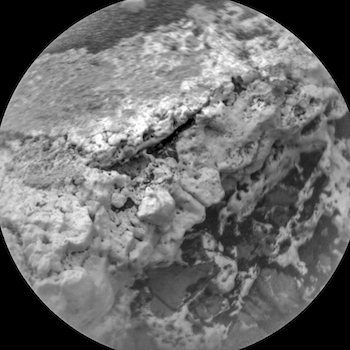
CR0_588014485PRC_F0721316CCAM02145L1-br2Sol 2149, August 22, 2018, update by MSL scientist Roger Wiens: With seventeen sampling holes and several test holes, you might imagine that Curiosity is creating a rather long and erratic golf course in Gale crater. After all, Alan Shepard shot a golf ball on the Moon. The first two martian sampling holes, at Yellowknife Bay, are several kilometers away from the third hole, at Kimberley, which is several kilometers from all the subsequent ones in the Murray formation. The distances between the first several holes might be too long for golf links on Earth, but maybe with reduced gravity and very little wind resistance, a mighty drive of over a kilometer might be possible. Unfortunately, the size of the holes drilled by Curiosity, at ~16 mm diameter, are too small for golf balls, which are > 41 mm diameter, so golf enthusiasts will have to wait a little longer to play on Mars. [More at link]

Posted in Reports | Tagged , , , , , , , , , , , , | Comments Off