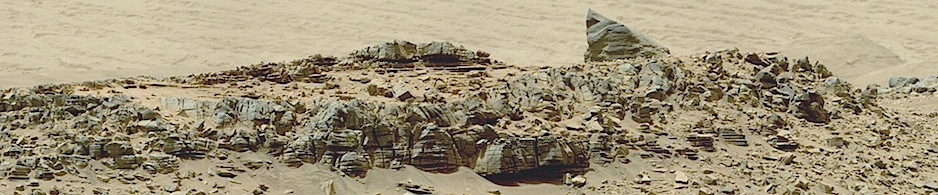





 A mesa in Gale Crater. This is an intriguing delta (?) within Gale Crater, and this is also the first time we’ve imaged it.
Beautiful Mars series. [More at links]
A mesa in Gale Crater. This is an intriguing delta (?) within Gale Crater, and this is also the first time we’ve imaged it.
Beautiful Mars series. [More at links]
What’s the latest news from Mars? A global dust storm is starting to settle, but still obscures the Martian surface; the Curiosity rover turns six and drills a new rock sample; the InSight lander is more than halfway to Mars and has tested its instruments and cameras… [More at link]
 Sols 2145-46, August 20, 2018, update by MSL scientist Christopher Edwards: Unlike normal weekend plans for Curiosity that encompass three martian days, this plan only covers two. This “Soliday Sunday” isn’t really a day off for the rover like it implies, but instead allows the planning schedule on Earth and Mars to get back in sync. On Monday, the team returns to regular planning but there’s still some great science happening this weekend.
CheMin is continuing its analysis of the “Stoer” drill sample but it’s not the only instrument interested in getting a piece of the latest drill target. SAM, Curiosity’s mass spectrometer instrument, is going to receive a sample drop-off from the drill assembly in the weekend plan. However, the Evolved Gas Analysis (EGA) won’t actually be planned until Monday. Evolved Gas Analysis is a powerful technique that allows SAM to reveal… [More at link]
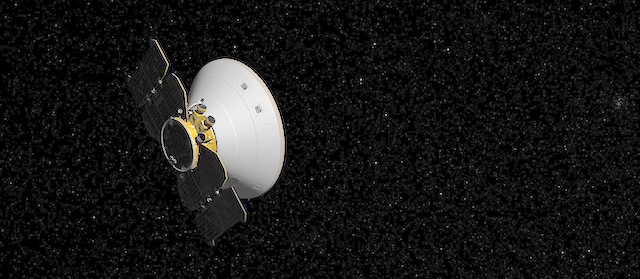 NASA’s InSight spacecraft, en route to a Nov. 26 landing on Mars, passed the halfway mark on Aug. 6. All of its instruments have been tested and are working well.
As of Aug. 20, the spacecraft had covered 172 million miles (277 million kilometers) since its launch 107 days ago. In another 98 days, it will travel another 129 million miles (208 million kilometers) and touch down in Mars’ Elysium Planitia region, where it will be the first mission to study the Red Planet’s deep interior. InSight stands for Interior Exploration using Seismic Investigations, Geodesy and Heat Transport.
The InSight team is using the time before the spacecraft’s arrival at Mars to not only plan and practice for that critical day, but also to activate and check spacecraft subsystems vital to cruise, landing and surface operations, including the highly sensitive science instruments… [More at link]
[Editor’s note: From a paper by Ngai Ham Chan and three co-authors recently published in the Journal of Geophysical Research.]
New Evidence of an Ancient Martian Ocean from the Global Distribution of Valley Networks
• Surface deformation due to True Polar Wander (TPW) events in the Martian history caused sea-level markers to deviate from a present-day equipotential level.
• Previous analyses of possible ancient sea-level markers on the Martian
surface reached opposing conclusions regarding whether TPW is necessary
to explain their topography.
• We revisit this issue by analyzing the elevations of another potential sea-level marker, the fluvial valley networks; our analysis supports the TPW scenario and, by extension, the possible existence of an ancient ocean.
Whether an ancient ocean existed on Mars has long been a controversial subject. On one hand, past conditions predicted by climate simulations suggested that Mars might not have been able to sustain liquid water for long periods of time. On the other hand, there is an abundance of surface features such as shorelines, deltas, sediments, and valley networks that suggest widespread and persistent liquid water on Mars.
While the features believed to trace out ancient shorelines do not lie on the same elevation today, they could have been shifted vertically by the movement of Mars’ rotation pole (which caused a shift in the equatorial bulge) or by the formation of Tharsis ‐ a cluster of large volcanoes.
In this study, we present a new set of possible sea‐level markers: the valley networks that may have drained directly into an ancient northern ocean. We find that the elevations of these valley networks, along what would have been the shore of the northern ocean, are consistent with them being ancient sea‐level markers that had been subsequently shifted vertically by some combination of changes in Mars’ rotation pole and the growing Tharsis volcanic bulge. [More at link]
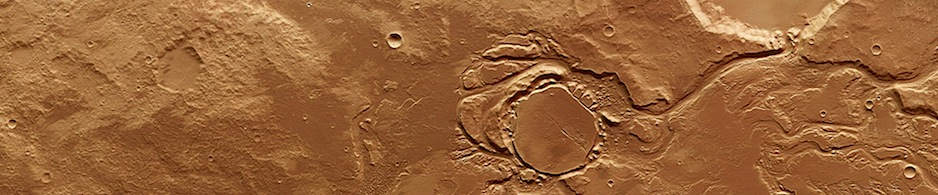
 Candidate landing site for 2020 mission near Jezero Crater. Beautiful Mars series. [More at links]
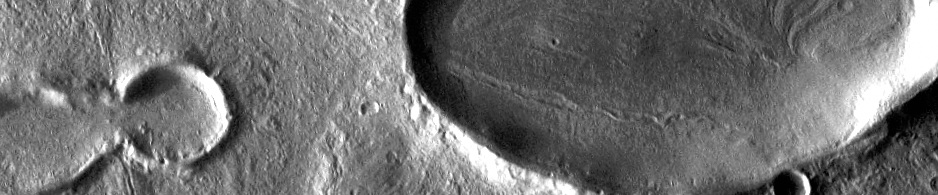
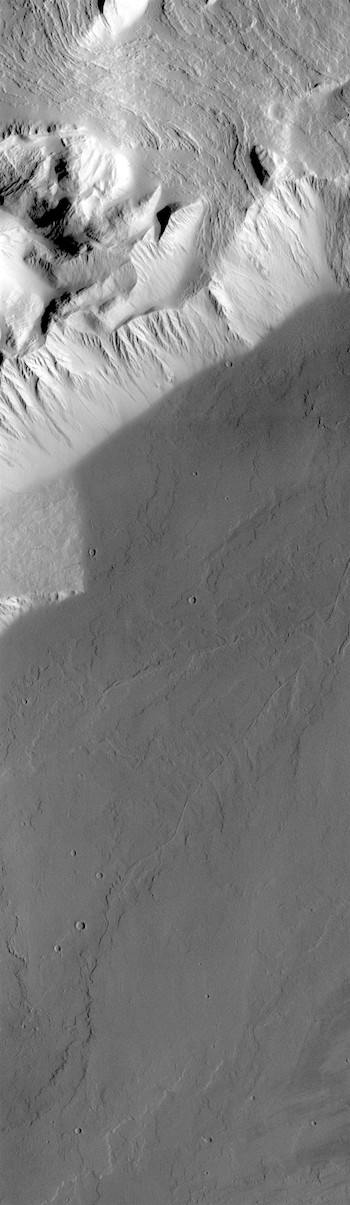 THEMIS Image of the Day, August 20, 2018. Olympus Rupes is the name of the large escarpment surrounding Olympus Mons. The escarpment is a cliff where there is a large elevation change over a short distance.
The elevation change from the lower volcanic plains to the volcano flank is up to 5 miles (26,400 feet), almost the height of Mount Everest.
This VIS image is located along the southeastern margin of Olympus Mons, the largest Martian volcano.
NASA Mars Exploration Rover Status Report, August 14, 2018: The planet-encircling dust storm on Mars continues to decay, although in fits and starts. Atmospheric opacity (tau) over the rover site was estimated down near 2.1, but then popped up to 2.5.
It is expected that Opportunity has experienced a low-power fault, and perhaps even a mission clock fault. Additionally, the up-loss timer has also since expired, adding another fault condition.
The science team is continuing to listen for the rover either during the expected fault communication windows, or listening over a broader range of times using the Deep Space Network Radio Science Receiver. The science team is also sending a command three times a week to elicit a beep if the rover happens to be awake.
The science team does not expect to hear anything from Opportunity until the atmospheric opacity over the rover site clears further. [More at link]
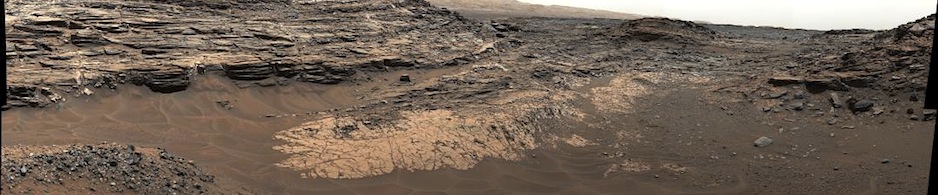
 Possible crater-related deposits near Oudemans Crater. According to the science rationale, this image was requested to help determine the origin of light-toned outcrops and other possible crater-related material.
Beautiful Mars series. [More at links]
Many people have suggested that future Mars colonists may want to thicken the Martian atmosphere and make it breathable for long-term habitation of the Red Planet. In this MAVEN outreach webinar from August 15, 2018, MAVEN Co-Investigator Dr. Robert Lillis of the UC Berkeley Space Sciences Laboratory provides a MAVEN update and discusses the challenges of re-creating a thicker Martian atmosphere.
[Ed. note: See also MAVEN news item here.]