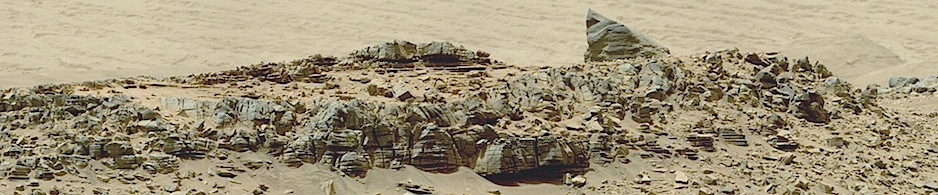






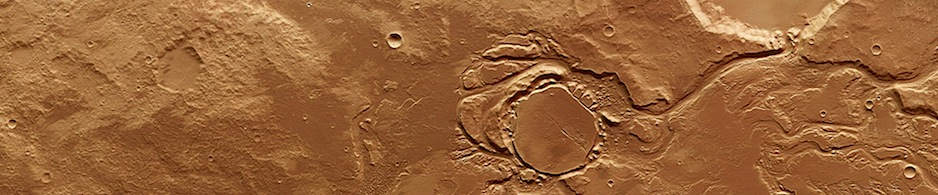
 Glacial tongue. Well, that’s a fine how-do-you-do! This re-image can help to detect for any changes in the ridges and boulder movement.
Beautiful Mars series. [More at links]
Glacial tongue. Well, that’s a fine how-do-you-do! This re-image can help to detect for any changes in the ridges and boulder movement.
Beautiful Mars series. [More at links]
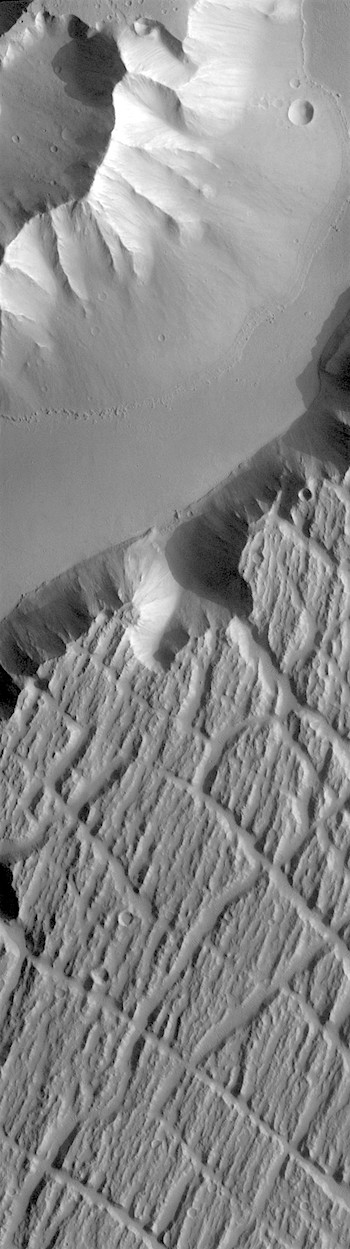 THEMIS Image of the Day, July 9, 2018. Today’s VIS image is located near the beginning of Kasei Valles. At the top of the image is the relative high land of Lunae Planum. The Kasei Valles channel is just below.
The bottom part of the image is an eroded surface that forms an island in the channel. The surface of the island has been modified by the flow of water. The linear features forming right angle intersections were caused by tectonic forces in the region.
More THEMIS Images of the Day by geological topic.
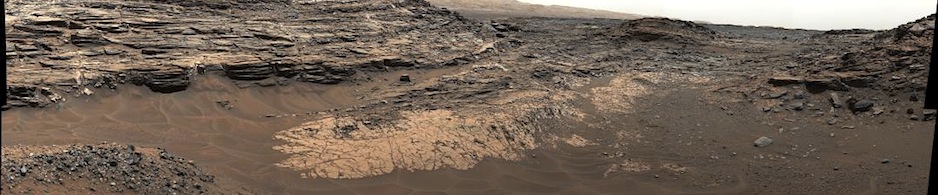
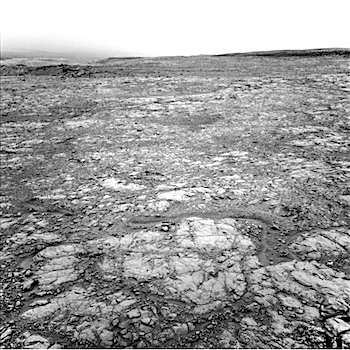 Sols 2104-06, July 6, 2018, update by MSL scientist Scott Guzewich: Our primary goal for today’s planning was to continue to approach our next drill location on the Vera Rubin Ridge by paralleling the north side of the ridge (seen on the left side of this image, right) during this plan’s drive while documenting the geochemistry of the bedrock we’re currently parked on and continuing to study the ongoing planet-encircling dust storm. A warning from ChemCam received early this morning prevented us from employing ChemCam for both of those purposes, but it was cleared up later and will be ready for Monday’s planning. We therefore took advantage of the unexpected availability of science time to include some routine Mastcam calibration activities and additional observations of the dust storm. The amount of dust over Gale Crater has been slowly declining over the last two weeks and it’s possible the dust storm has reached its…. [More at link]
 Korolev Crater layers. With HiRISE resolution, paleoclimate analysis can be done to determine the possible climate record held within ice mounds, like those here.
Beautiful Mars series. [More at links]
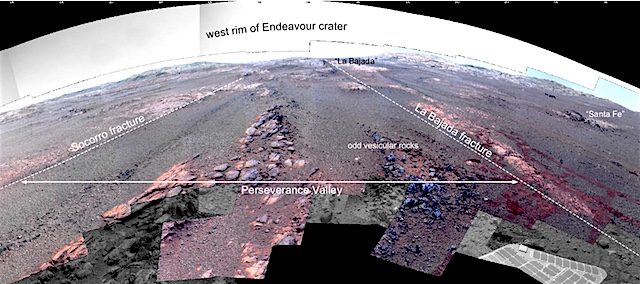
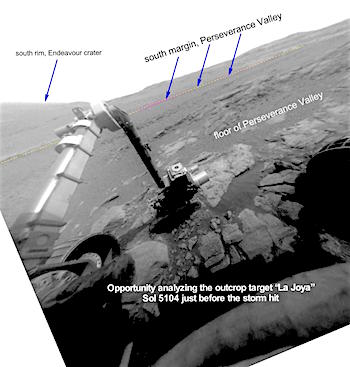 Sol 5135, July 5, 2018: Rover Field Report by Larry Crumpler, MER Science Team & New Mexico Museum of Natural History & Science: Opportunity is hunkered down in the floor of Perseverance Valley here on the inner wall of Endeavour crater waiting out the global dust storm of 2018.
The outcrop currently being investigated, “La Joya”, is exposed sitting in the floor of Perseverance Valley and is an anomalous basaltic and vesicular petrology. Meanwhile the north and south walls of the valley appear to be rather clast-poor impact breccias which we believe may not be from Endeavouur crater, but instead represent a “pre-Endeavour:” lithology. And Perseverance Valley seems to have north and south walls that line up with very noticeable faults (“Socorro” and “La Bajada”) cutting through the crater rim.
Status of Dust Storm:
• MRO/ HiRISE images acquired over the last week are mostly unusable except for the south pole and some high northern latitudes.
• MRO/MARCI reports that dust was still lifting in several locations, so the storm is not abating yet.
• Current assessment of the present storm by the Martian weather experts suggest that this storm is more like the 2001 storm than the 2007 storm. In that storm opacity (tau) did not drop below 2.0 (an acceptable number for Opportunity) until about 80 sols (Mars days) after the storm started… [More at link]
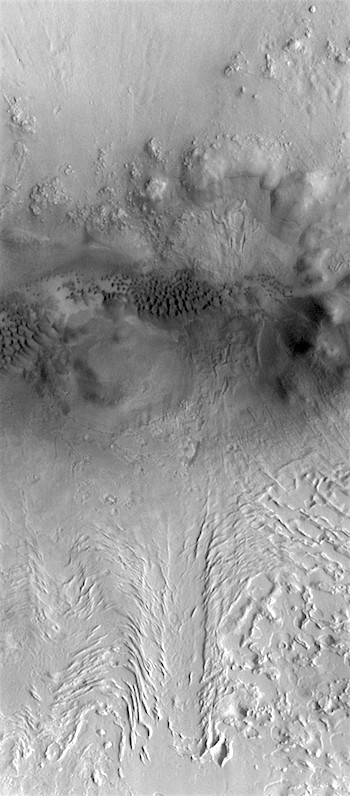 THEMIS Image of the Day, July 6, 2018. This VIS image is located on the floor of an unnamed crater between Terra Sabaea and Utopia Planitia. The center of the image contains several regions of sand dunes. The dunes occupy the lowest elevation of the crater.
Towards the bottom of the image is an unusual texture, most likely created by movement of a volatile rich material down towards the center of the crater. This may have formed in a glacial type material, rich in ice.
More THEMIS Images of the Day by geological topic.
 For the past week on Mars, the planet-encircling dust event persisted across all hemispheres. Though, active dust-lifting was not occurring everywhere across the planet, regional lifting centers in Solis-Sinai, Hellas, and Elysium continued to sustain a planet-encircling dust cloud of varying optical thickness. Near the end of the week, smaller scale active dust-lifting was observed just west of Ascraeus Mons and over Arabia Terra. Looking… [More at link, including video]
 Hills and mesas. Beautiful Mars series. [More at links]
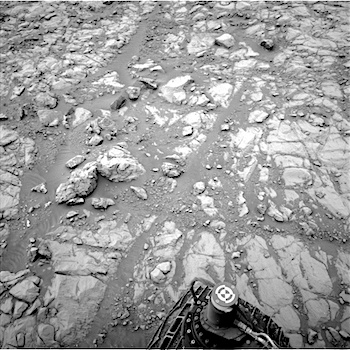 Sols 2102-03, July 4, 2018, update by MSL scientist Mark Salvatore: While the rest of us are enjoying fireworks, BBQs, and spending time with friends and family, Curiosity will remain hard at work over this Fourth of July holiday. On Monday, the science team planned Monday and Tuesday activities on Mars, while today (Tuesday) they planned Wednesday and Thursday activities. This will allow the rover team to take a well- deserved holiday break on Wednesday!
Because of this interesting planning timeline, however, the science team had to make today’s plan before Curiosity executed the plan that was created yesterday. This is no problem though, as we’re in the same location, so we have plenty of activities to do and know which targets… [More at link]