
Curiosity update: Time to feed CheMin

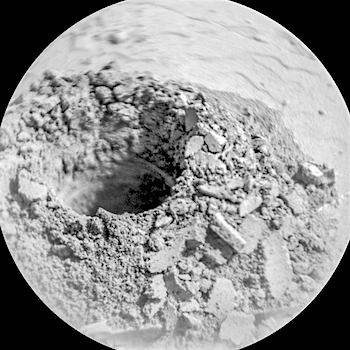
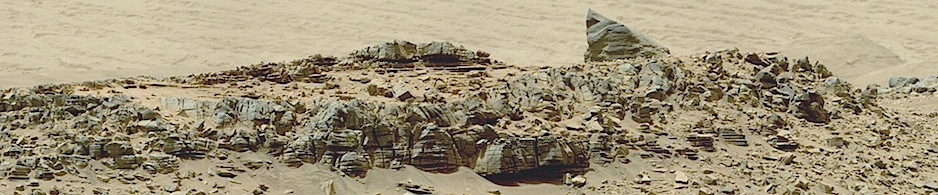
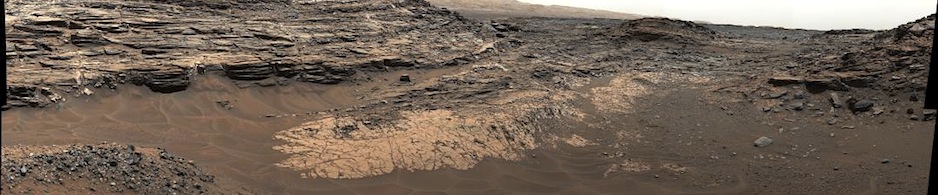
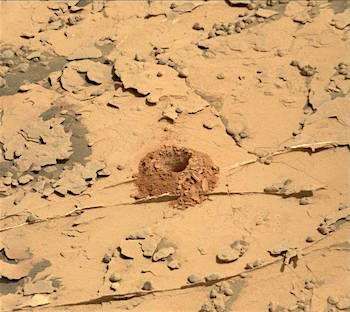
2058MR0109120010903656E02_DXXXSols 2061-62, May 23, 2018, update by MSL scientist Lauren Edgar: After successfully drilling the “Duluth” target on Sol 2057 (as seen in the above Mastcam image), the science team is eager to find out what it’s made of. As SOWG Chair today, it was exciting to plan the drop-off of material to CheMin and overnight CheMin analysis. Hopefully we’ll get some good data about the mineralogy of this sample!

In addition to the CheMin activities, the team planned another ChemCam observation of the “Duluth” drill hole, and nearby bedrock and vein targets named “Prosit” and “Grand Marais.” On Monday we delivered three portions of the drill material to a nearby rock surface, and in today’s plan we’re monitoring those piles to see if any of the fines are moving in the wind. We’ll also check for changes in a sandy ripple… [More at link]

Posted in Reports | Tagged , , , , , , , , , , , , | Comments Off

HiRISE: Of sand, rock, and dust

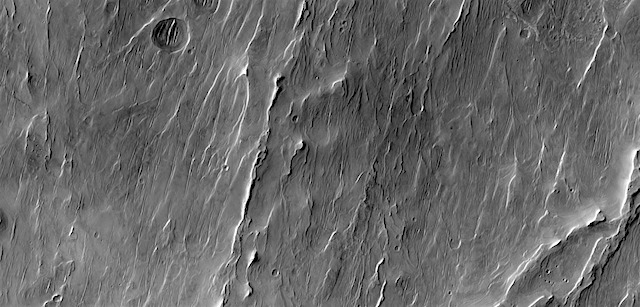
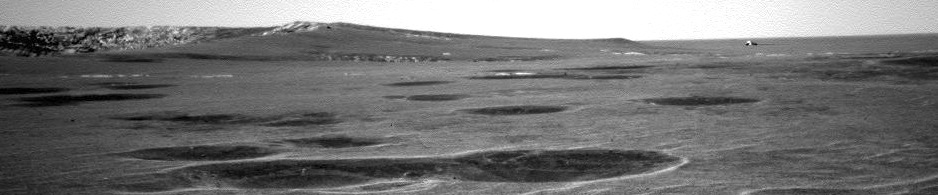
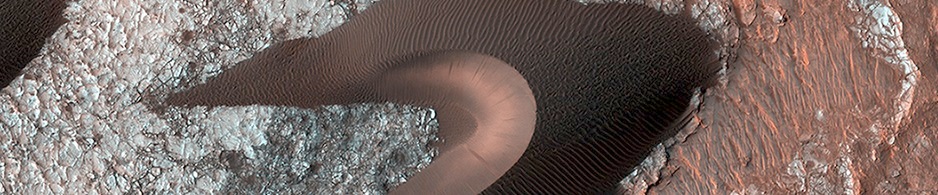
tumblr_p952onuW8x1rlz4gso3_1280Of sand, rock, and dust. There is some wonderful stratigraphy on display here in Meridiani Planum.

Beautiful Mars series. [More at links]

Posted in Reports | Tagged , , , , , , , , , , | Comments Off

THEMIS: Polar dunes and layers of ice and dust

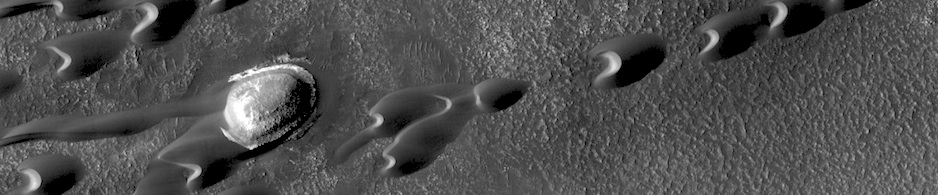
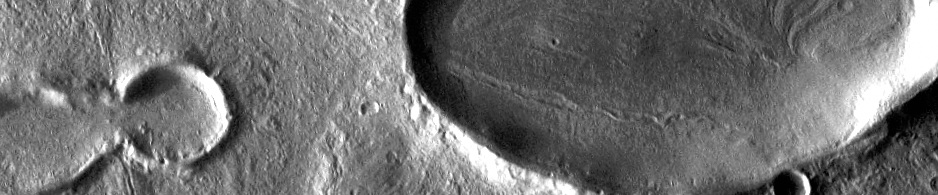
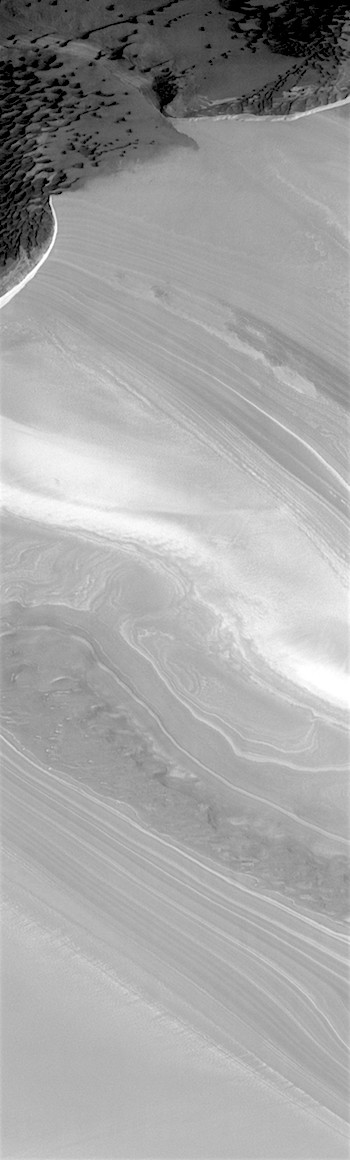
Dunes and ice cap layers (THEMIS_IOTD_20180524)THEMIS Image of the Day, May 24, 2018. This VIS image shows the margin between the polar cap and the surrounding plains. There are dunes on the plains at the top of the image.

In the upper left corner it can be seen that the dunes have been blown onto an extension of the ice. The rest of the image is dominated by the ice of the polar cap.

The polar cap is formed of layers and layers of ice and dust formed over millions of years. The dust allows the layering to be easily visible.

More THEMIS Images of the Day by geological topic.

Posted in Reports | Tagged , , , , , , , , , , | Comments Off

Curiosity starts drilling again

PIA22326_hiresEngineers working with NASA’s Curiosity Mars rover have been hard at work testing a new way for the rover to drill rocks and extract powder from them. This past weekend, that effort produced the first drilled sample on Mars in more than a year.

Curiosity tested percussive drilling this past weekend, penetrating about 2 inches (50 millimeters) into a target called “Duluth.”

NASA’s Jet Propulsion Laboratory in Pasadena, California, has been testing this drilling technique since a mechanical problem took Curiosity’s drill offline in December of 2016. This technique, called Feed Extended Drilling, keeps the drill’s bit extended out past two stabilizer posts that were originally used to steady the drill against Martian rocks. It lets Curiosity drill using the force of its robotic arm, a little more like the way a human would drill into a wall at home.

“The team used tremendous ingenuity to devise a new drilling technique and implement it on another planet,” said Curiosity Deputy Project Manager Steve Lee of JPL. “Those are two vital inches of innovation from 60 million miles away. We’re thrilled that the result was so successful.” [More at link]

Posted in Reports | Tagged , , , , , , , , , | Comments Off

InSight: First course correction successful

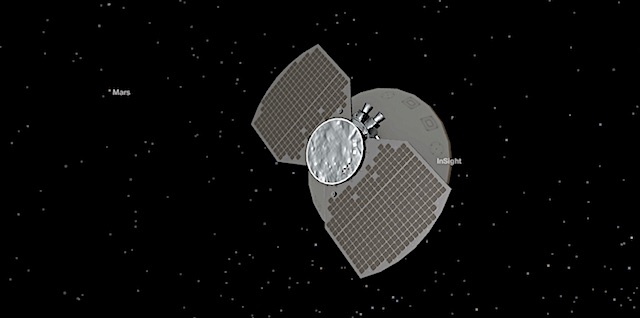
insight-TCM1NASA’s InSight lander has made its first course correction toward Mars. InSight, short for Interior Exploration using Seismic Investigations, Geodesy and Heat Transport, is the first mission dedicated to exploring the deep interior of Mars.

The lander is currently encapsulated in a protective aeroshell, which launched on top of an Atlas V 401 rocket on May 5 from Vandenberg Air Force Base in Central California. Yesterday, the spacecraft fired its thrusters for the first time to change its flight path. This activity, called a trajectory correction maneuver, will happen a maximum of six times to guide the lander to Mars. (…)

Precise calculations are required for InSight to arrive at exactly the right spot in Mars’ atmosphere at exactly the right time, resulting in a landing on Nov. 26. Every step of the way, a team of navigators estimates the position and velocity of the spacecraft. Then they design maneuvers to deliver it to an entry point at Mars. That navigation team is based at NASA’s Jet Propulsion Laboratory in Pasadena, California, which leads the InSight mission.

“This first maneuver is the largest we’ll conduct,” said Fernando Abilleira of JPL, InSight’s Deputy Mission Design and Navigation Manager. “The thrusters will fire for about 40 seconds to impart a velocity change of 3.8 meters per second [8.5 mph] to the spacecraft. That will put us in the right ballpark as we aim for Mars.” [More at link]

Posted in Reports | Tagged , , , , | Comments Off

MARCI weather report, May 14-20, 2018

MARCI-May-18-2018Last week on Mars, weather patterns were fairly typical for this time of martian year. A large dust storm was observed over Cimmeria and Sirenum at the beginning of the week. In the following sols, the dust lifting quickly abated but a residual dust haze was observed spreading eastward over Aonia. Looking to the northern plains, a number of dust storm and water-ice clouds were spotted propagating east from Arcadia to Utopia. Dust lifting along the equatorial latitudes was rather uneventful apart from a tiny spiral storm near the caldera of Pavonis Mons at the start of the week. For most… [More at link, including video]

Posted in Reports | Tagged , , , , , , , , , , , , , | Comments Off

Opportunity: La Joya, take 2

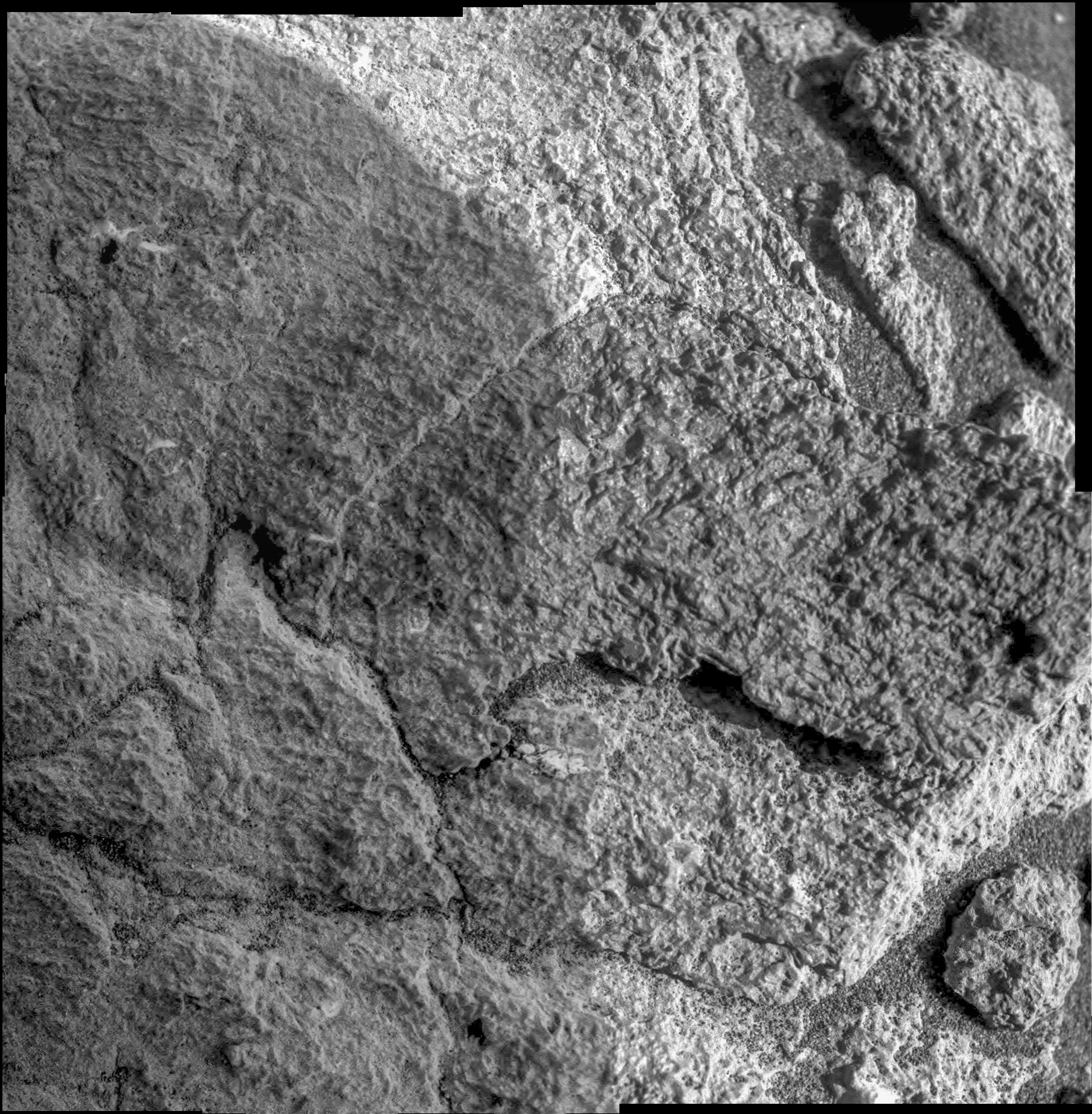
5093-miSol 5093, May 23, 2018. After taking one close-up on the La Joya target rock, the Microscopic Imager shifted position for another close-up of the rock (above), which partly overlaps with the first. (Click the image to enlarge it.)

A composite that includes both images (4.9 MB) is here.

Opportunity raw images, its latest mission status, location map, and atmospheric opacity, known as tau.

Posted in Reports | Tagged , , , , , , , , | Comments Off

Curiosity update: Characterizing a successful drill!

CR0_580106913PRC_F0701752CCAM05056L1-br2Sols 2059-60, May 23, 2018, update by MSL scientist Mark Salvatore: This past weekend, Curiosity successfully drilled into the “Duluth” rock target, generating a beautiful pile of drill tailings! This is a very exciting time for us on the rover team, who have been waiting for quite a while to successfully drill into a target and to ingest samples into the rover’s analytical instruments.

Before we are able to use all of our instruments, however, we must first characterize the nature of the materials that were collected during the drill activities. So, on Monday, the science team planned for the characterization of three small portions of the collected sample that were to be dropped onto the surface in front of us so that we could image these materials at high resolution. While these efforts were not primarily driven by science (the rover engineers were more interested in the nature of the sample and whether there would be any difficulties in delivering the sample to Curiosity’s instruments), the science team didn’t dare miss an opportunity to make some cool measurements of the new materials… [More at link]

Posted in Reports | Tagged , , , , , , , , , , | Comments Off

HiRISE: Alluvial fan in Murray Crater

tumblr_p952dyC7c51rlz4gso1_1280Alluvial fan in Murray Crater. Alluvial fans are among the strongest lines of evidence that liquid water once flowed on the surface of Mars.

Beautiful Mars series. [More at links]

Posted in Reports | Tagged , , , , , , , , | Comments Off

THEMIS: Twisting channels in Hebrus Valles

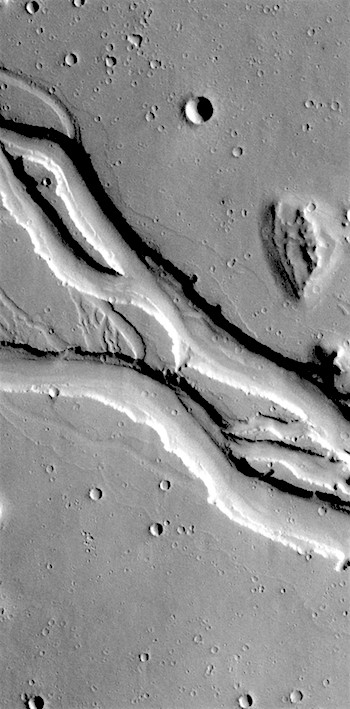
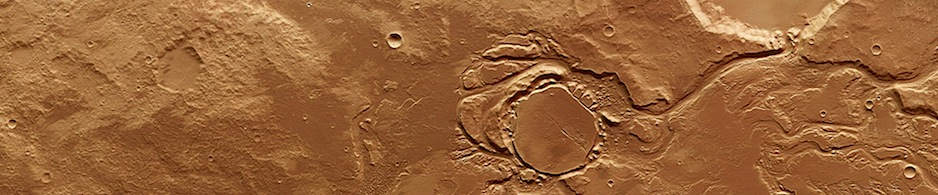
Channels in Hebrus Valles (THEMIS_IOTD_20180523)THEMIS Image of the Day, May 23, 2018. Located west of the Elysium Volcanic complex, Hebrus Valles is a complex channel system that flowed to the north. In this VIS image the channel features have the appearance of a channel formed by liquid flow.

In other portions of the valles, there are pits and collapse features which appear to have formed by material falling into subsurface voids. This is a common feature in regions of volcanic activity where lava tubes run below the surface. Both water and lava probably contributed to the formation of Hebrus Valles.

More THEMIS Images of the Day by geological topic.

Posted in Reports | Tagged , , , , , , , , , , , | Comments Off