Curiosity: Edge of the ridge and outcrops

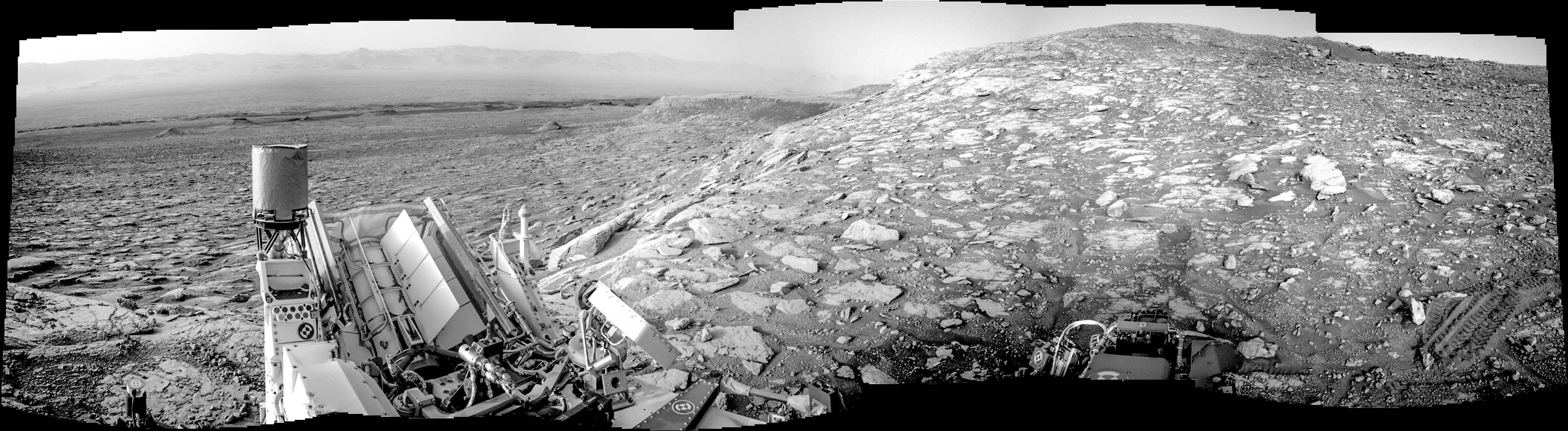
2036-navcamSol 2036, April 29, 2018. Curiosity drove about 28 meters (92 feet) to the northwest along the ridge. In the center distance of this Navcam end-of-drive composite stand outcrop faces, targets for this week if all goes as planned. Click the image to enlarge it.

Sol 2036 raw images (from all cameras), and Curiosity’s latest location.

Posted in Reports | Tagged , , , , , , , , , | Comments Off

HiRISE: Channeled southern highlands

ESP_054669_1690This enhanced color image shows the heavily channeled and ancient southern highlands of Mars. The elongated and jagged features are windblown dunes, perhaps hardened and eroded. [More at link]

Posted in Reports | Tagged , , , , , , , , | Comments Off

Opportunity: Aiming at Allende

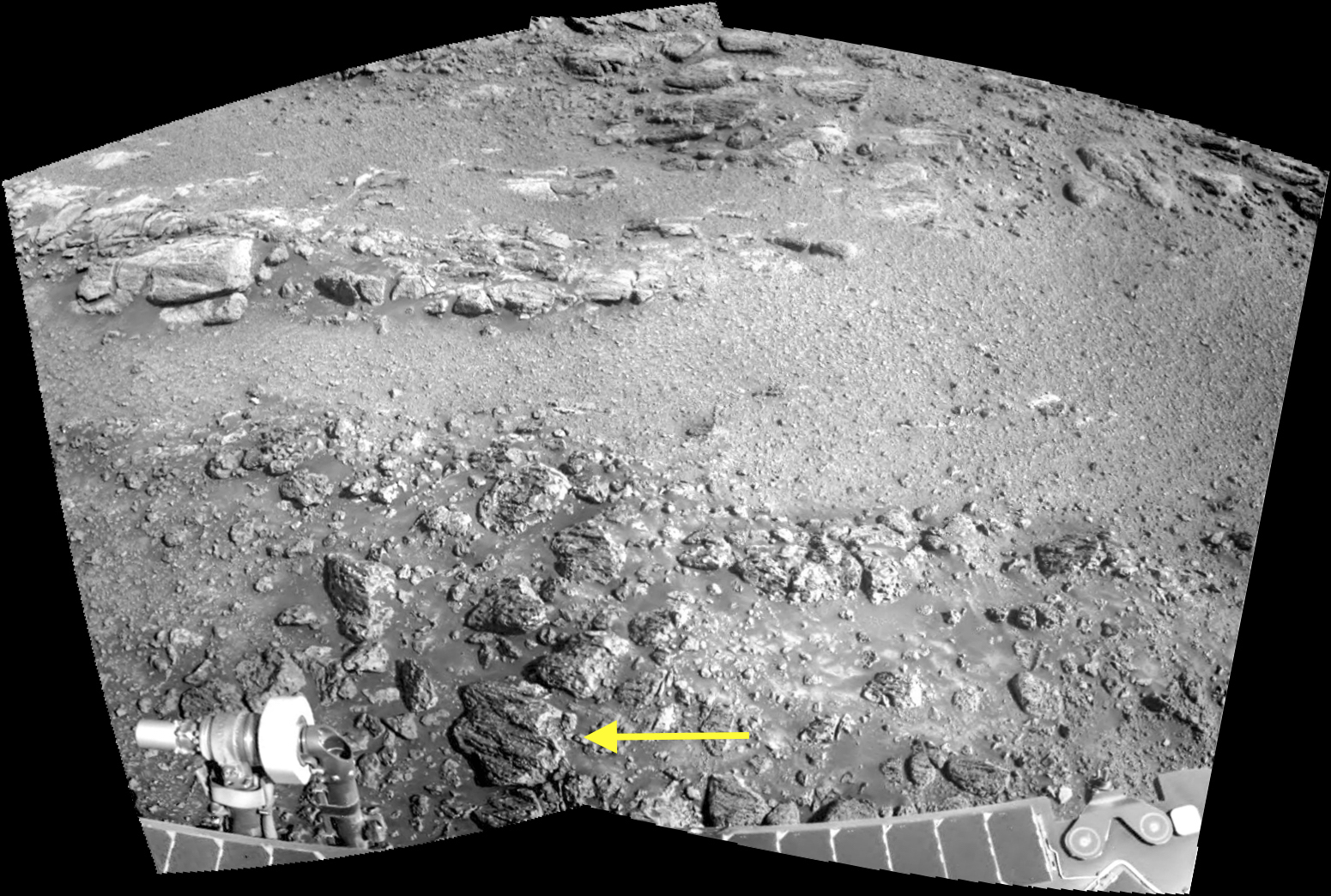
5070-navcam1P578275462ESFD2DNP2509L5M1_L2L5L5L7L7Sol 5070, April 29, 2018. On the weekend, Opportunity turned to square up to its next target, a rock dubbed Allende (arrow), seen in the Navcam view above.

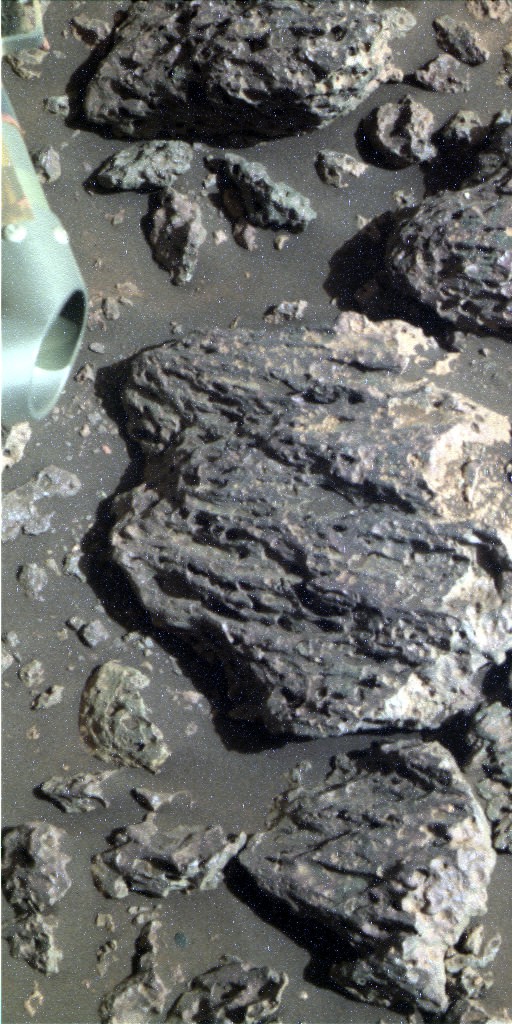
At right is a false-color (Holger Isenberg) Pancam view showing Allende in the rover’s workplane. Click either image to enlarge it.

Opportunity raw images, its latest mission status, location map, and atmospheric opacity, known as tau.

Posted in Reports | Tagged , , , , , , , , | Comments Off

HiRISE: Tracking dune-alcove changes within Chasma Boreale dunes

tumblr_p7egniX9Ec1rlz4gso1_1280Tracking dune-alcove changes within Chasma Boreale dunes. Beautiful Mars series. [More at links]

Posted in Reports | Tagged , , , , , , , , , , | Comments Off

THEMIS: Winding channel in Arabia Terra

Arabia Terra channel (THEMIS_IOTD_20180430)THEMIS Image of the Day, April 30, 2018. This VIS image shows one of the numerous unnamed channels located in northern Arabia Terra.

More THEMIS Images of the Day by geological topic.

Posted in Reports | Tagged , , , , , , , , | Comments Off

InSight launch set for May 5

insight20180329b-16NASA’s next mission to Mars, Interior Exploration using Seismic Investigations, Geodesy and Heat Transport (InSight), is scheduled to launch Saturday, May 5, on a first-ever mission to study the heart of the Red Planet. Coverage of prelaunch and launch activities begins Thursday, May 3, on NASA Television and the agency’s website.

InSight, the first planetary mission to take off from the West Coast, is targeted to launch at 4:05 a.m. PDT (7:05 a.m. EDT) from Space Launch Complex-3 at Vandenberg Air Force Base in California aboard a United Launch Alliance (ULA) Atlas V rocket.

Launching on the same rocket is a separate NASA technology experiment known as Mars Cube One (MarCO). MarCO consists of two mini-spacecraft and will be the first test of CubeSat technology in deep space. They are designed to test new communications and navigation capabilities for future missions and may aid InSight communications. [More at link]

Posted in Reports | Tagged , , , , , , | Comments Off

Curiosity update: Down the ridge she comes

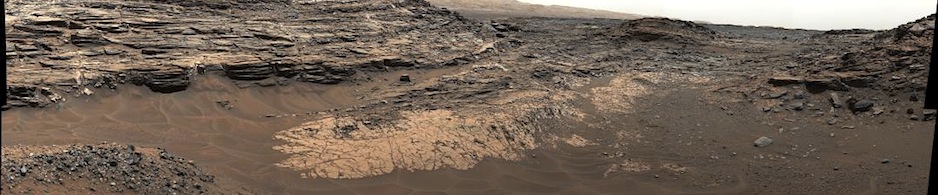
NLB_578070184EDR_F0700000NCAM00294M_-br2Sols 2036-37, April 27, 2018, update by MSL scientist Michelle Minitti: Curiosity continues to pick her way downhill off the “Vera Rubin Ridge” and onto the Murray formation rocks below. This weekend’s plan only covers two sols, to give Earth planning time and Mars time a chance to realign so that the science team is not up in the middle of the night commanding the rover. The two sols, however, are still chock full of activities. The rover is positioned on a rock-strewn sandy slope, and the science team thought the scattered rocks of the workspace would be better interrogated with Mastcam and ChemCam than MAHLI and APXS. ChemCam targeted “Virginia,” a tan bedrock slab with small nodules, “Shannon Lake,” a red bedrock slab, and “Eveleth,” a block with distinctive layers. One of the advantages of driving backward is that rocks the rover has driven over end up in view of the remote sensing instruments. Mastcam acquired multispectral data from a rock broken by the rover wheels, the target “Britt,” and an expanse of crossbedded ! outcrop, “Aurora,” to the left of the rover. Mastcam… [More at link]

Posted in Reports | Tagged , , , , , , , , , , , , , , , | Comments Off

MAVEN: Deep-dip campaign #9 begins

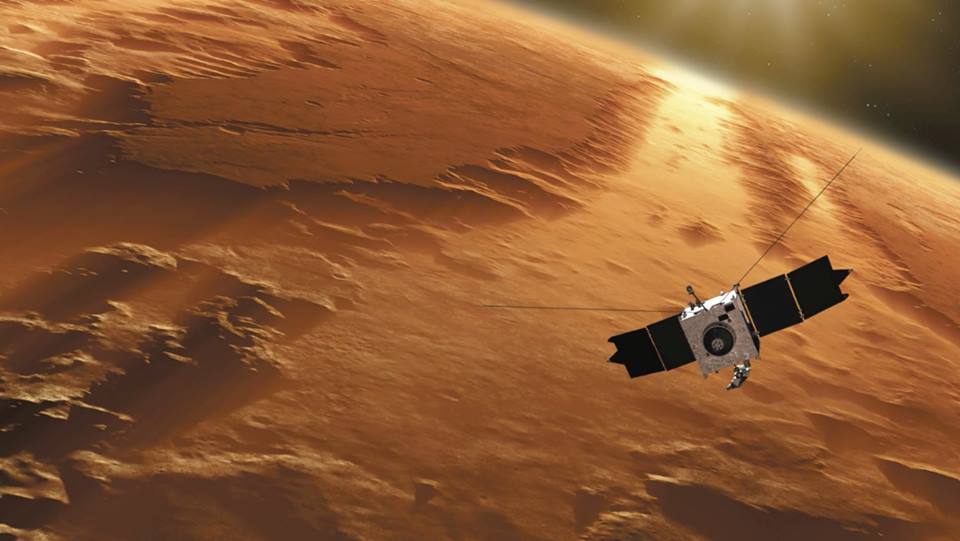
Maven deep-dippingMAVEN has begun its ninth deep dip campaign by performing two entry maneuvers to place the spacecraft into a corridor where Mars’ atmospheric density is between 2.0 – 3.5 kg/km³.

The two deep dip entry maneuvers consisted of a 4.5 m/s ∆V (change in velocity) maneuver to lower periapsis (the lowest altitude of the spacecraft) by 28 km (on April 23) and a 0.6 m/s ∆V maneuver to lower periapsis another 4 km (on April 24).

The periapsis latitude during deep dip #9 is 51° S and the orbital period of the spacecraft is 4 hours 26 minutes.

Each MAVEN deep dip campaign is intended to not only lower the altitude of the spacecraft down into the well-mixed portion of the atmosphere, but to do so in a location where MAVEN’s orbit is such that it can observe a variety of solar conditions and their effects on Mars’ atmosphere over time. [More at link]

Posted in Reports | Tagged , , , | Comments Off

Opportunity: Moving into place

5068-navcamSol 5068, April 27, 2018. Mission controllers have been driving Opportunity to where the rover can examine both the vesicular rocks and the tabular ones with comparative ease. So they drove the rover uphill, then turned, and went to the southeast, making a circuitous path to avoid areas where the driving could prove difficult.

The Navcam pair above looks downhill with the vesicular rocks at the left edge and tabular rocks on the right. Click the image to enlarge it.

Opportunity raw images, its latest mission status, location map, and atmospheric opacity, known as tau.

Posted in Reports | Tagged , , , , , , , , | Comments Off

Mars 2020 rover: Heat shield cracked in testing

PIA14835-16A post-test inspection of the composite structure for a heat shield to be used on the Mars 2020 mission revealed that a fracture occurred during structural testing. The mission team is working to build a replacement heat shield structure. The situation will not affect the mission’s launch readiness date of July 17, 2020.

Project management at NASA’s Jet Propulsion Laboratory in Pasadena, California, is working with contractor Lockheed Martin Space, Denver, to understand the cause of the fracture and determine whether any design changes need to be incorporated into a replacement.

The fracture, which occurred near the shield’s outer edge and spans the circumference of the component, was discovered on April 12, after the shield completed a week-long test at the Lockheed Martin Space facility. The test was designed to subject the heat shield to forces up to 20 percent greater than those expected during entry into the Martian atmosphere. While the fracture was unexpected, it represents why spaceflight hardware is tested in advance so that design changes or fixes can be implemented prior to launch. [More at link]

Posted in Reports | Tagged , , , | Comments Off