



HiRISE: Better preserved on Mars than on Earth

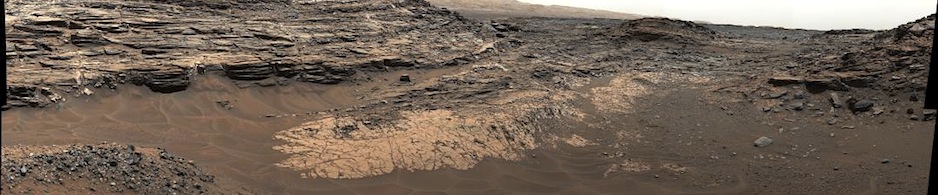
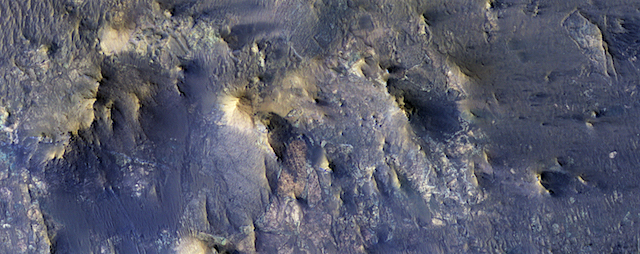
ESP_014096_1975In many ways, Mars bears remarkable similarities to Earth, but in some ways it is drastically different. Scientists often use Earth as an example, or analog, to help us to understand the geologic history of the Red Planet.

As we continue to study Mars, it is vitally important to remember in what ways it differs from Earth. One very apparent way, readily observed from orbit, has to do with its preservation of numerous craters of all sizes, which are densest in its Southern hemisphere. Earth has comparatively little preserved craters—about 1,000 to 1,500 times fewer—due to very active geologic processes, especially involving water. When it comes to impact craters, there are some things that can no longer be observed on Earth, but can be observed on Mars.
Posted in Reports | Tagged , , , , , , , , | Comments Off

Opportunity field report, February 10, 2017

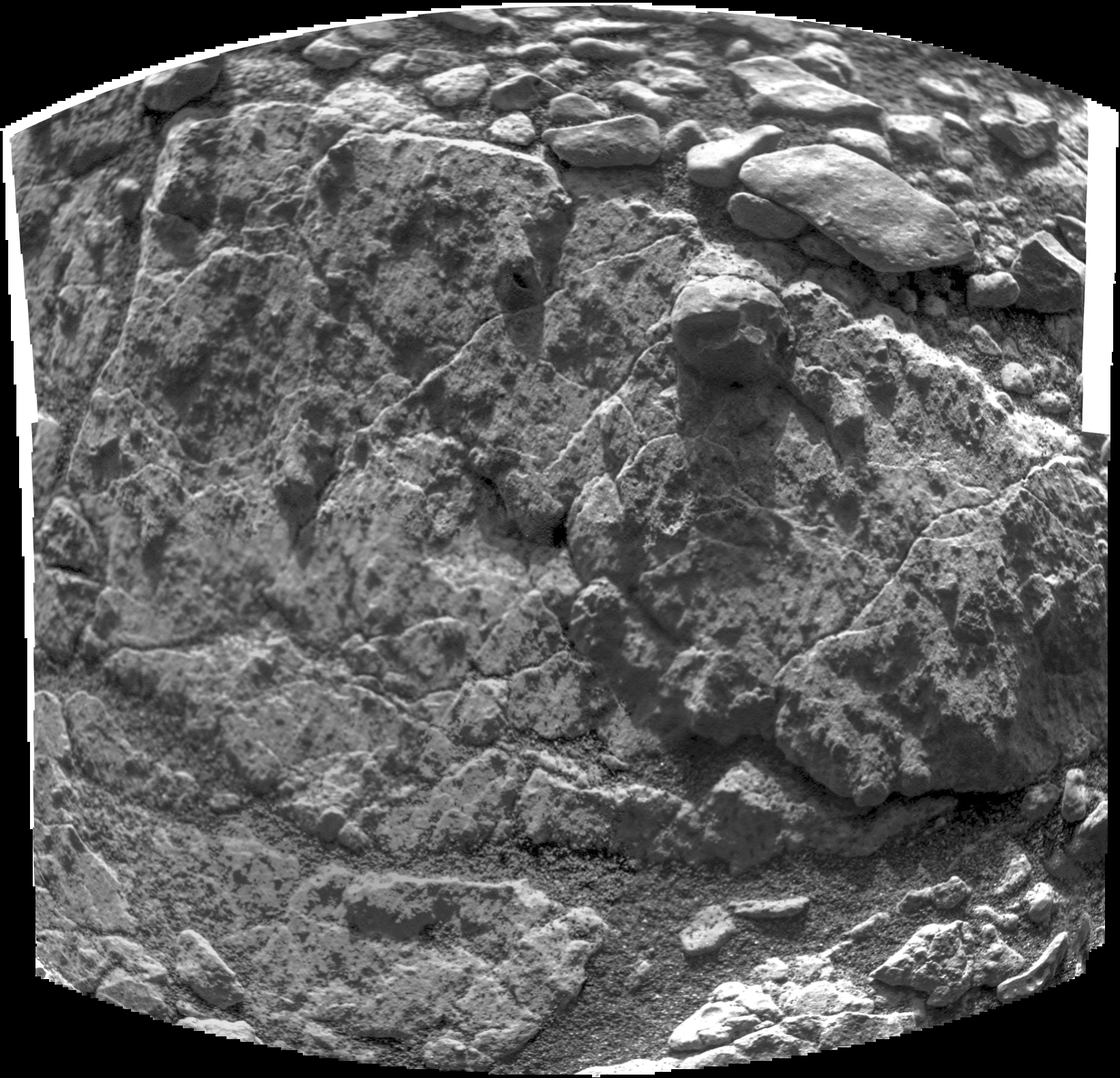
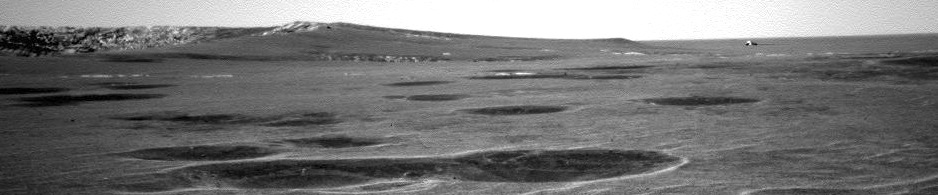
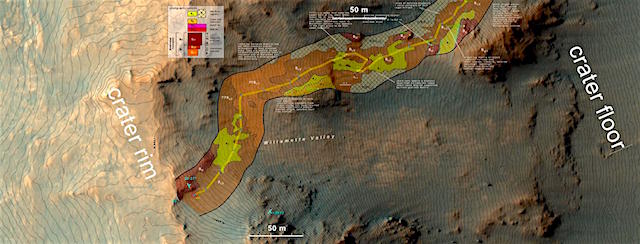
1_rimSol 4639, February 10, 2017; Rover Field Report by Larry Crumpler, MER Science Team & New Mexico Museum of Natural History & Science: Opportunity has successfully clawed its way to within a few meters of the crater rim after spending the last few months climbing and the last two years inside the crater. There will be a short stop just inside the rim for one more look and then if all goes well a drive out onto the world of horizontality. This will commence the adventure of driving south over the next few months to the mission goal of a water-cut in the crater rim.

This is the 14th year of surface operations on Mars. Odometry is currently at 27 miles (over 44 km). [More at link]

Posted in Reports | Tagged , , , , , , | Comments Off

Mars 2020 rover landing site short list: Columbia Hills, Jezero Crater, Northeast Syrtis Major

mars2020-20170211-16Participants in a landing site workshop for NASA’s upcoming Mars 2020 mission have recommended three locations on the Red Planet for further evaluation. The three potential landing sites for NASA’s next Mars rover include Northeast Syrtis (a very ancient portion of Mars’ surface), Jezero crater, (once home to an ancient Martian lake), and Columbia Hills (potentially home to an ancient hot spring, explored by NASA’s Spirit rover).

More information on the landing sites can be found at:

http://mars.nasa.gov/mars2020/mission/timeline/prelaunch/landing-site-selection
http://marsnext.jpl.nasa.gov/index.cfm

Mars 2020 is targeted for launch in July 2020 aboard an Atlas V 541 rocket from Space Launch Complex 41 at Cape Canaveral Air Force Station in Florida. The rover will conduct geological assessments of its landing site on Mars, determine the habitability of the environment, search for signs of ancient Martian life, and assess natural resources and hazards for future human explorers. It will also prepare a collection of samples for possible return to Earth by a future mission. [More at links]

Posted in Reports | Tagged , , , , , , | Comments Off

THEMIS: Hellas Planitia in false color

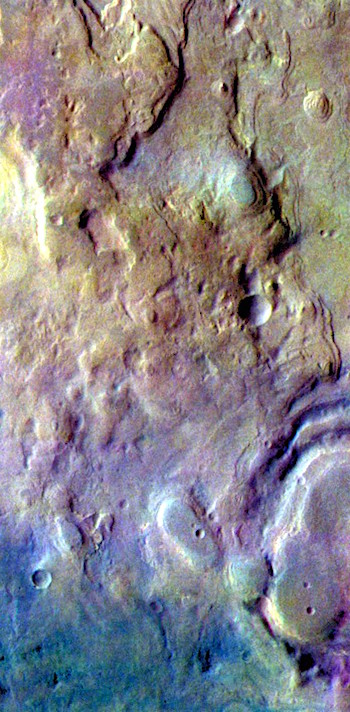
Big basin tangled geology in Hellas Planitia (themis_iotd_20170213)THEMIS Image of the Day, February 13, 2017. Today’s false color image shows plains in the northern part of Hellas Planitia.

The THEMIS VIS camera contains 5 filters. The data from different filters can be combined in multiple ways to create a false color image. These false color images may reveal subtle variations of the surface not easily identified in a single band image.

More THEMIS Images of the Day by geological topic.

Posted in Reports | Tagged , , , , , , , , | Comments Off

HiRISE: Dragonfly-shaped crater

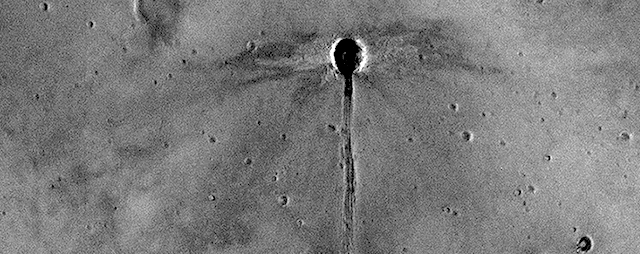
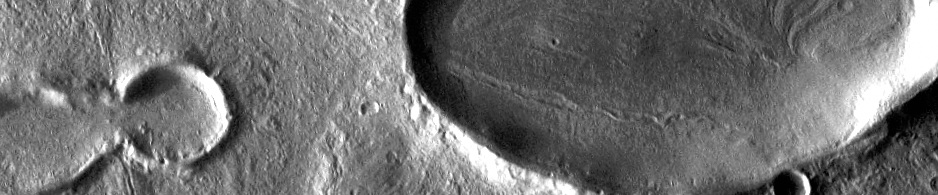
ESP_048462_1585The broader scene for this image is the fluidized ejecta from Bakhuysen Crater to the southwest, but there’s something very interesting going on here on a much smaller scale.

A small impact crater, about 25 meters in diameter, with a gouged-out trench extends to the south. The ejecta (rocky material ejected from the crater) mostly extends to the east and west of the crater. This “butterfly” ejecta is very common for craters formed at low impact angles. Taken together, these observations suggest that the crater-forming impactor came in at a low angle from the north, hit the ground and ejected material to the sides. [More at link]

Posted in Reports | Tagged , , , , , , , , , | Comments Off

Curiosity update: Studying Ireson Hill

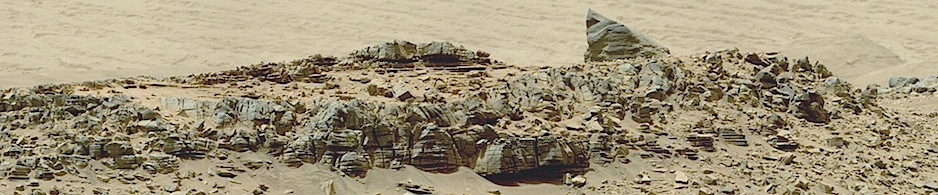
1605MH0006780010602139C00_DXXX-br2Sol 1606-08, February 10, 2017, update by USGS scientist Ryan Anderson: Our drive on Sol 1605 was successful, putting us in a good position for weekend science on the northeast side of Ireson Hill. The sol 1606 plan starts off with ChemCam observations of “Quimby,” which appears to be a piece of cap rock that has tumbled down from the top of the hill, and a bedrock target “Quoddy”. Mastcam will take an image to document the ChemCam data that was automatically collected at the end of the Sol 1605 drive, as well as a mosaic of an area called “Castine”. APXS will then do an overnight analysis on “Quoddy” and “Pogy”. [More at link]

Posted in Reports | Tagged , , , , , , , , , , , , , , , , | Comments Off

Curiosity update: Toward Ireson Hill

NLB_539893082EDR_F0610000NCAM00261M_-br2Sol 1604-05, February 10, 2017, update by USGS scientist Ryan Anderson: On Sol 1604 we wrapped up at the first stop of this second phase of the Bagnold Dune campaign. The plan started off, as usual for the dune campaign, with a pair of Mastcam images that were then repeated throughout the day to look for changes. ChemCam had an RMI of the target “Mapleton” and then Mastcam had a whole series of images of nearby sand formations. Once that was taken care of, we decided to drive back toward Ireson Hill so that we can take a closer look at some of the geology there. The drive was about 55 meters, followed by… [More at link]

Posted in Reports | Tagged , , , , , , , , , , , , , | Comments Off

Opportunity: Eyeing the exit

4638-pancam4638-mi-allSol 4638, February 9, 2017. As Opportunity approaches the upper end of the valley leading to the rim crest, the Pancam is scouting ahead to the exit route. Once the crest is reached, a vista should open toward the west. (False-color Pancam images by Holger Isenberg.)

At right, later in the afternoon, the rover’s Microscopic Imager examined a target on the ground named Rulo. (Click images to enlarge them.)

Opportunity raw images, its latest mission status, a location map, and atmospheric opacity, known as tau.

Posted in Reports | Tagged , , , , , , , | Comments Off

HiRISE: Unlocking an impact crater’s clues

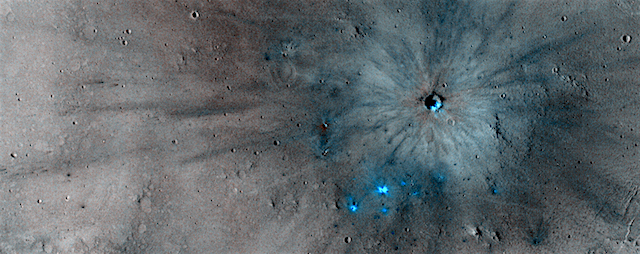
ESP_048456_1640Mars is a dynamic planet. HiRISE has witnessed many surface changes over the past ten years, including hundreds of new craters formed by ongoing impacts. Most of these impacts are likely caused by asteroids that have strayed into collision courses with Mars. The planet’s much thinner atmosphere compared to Earth makes small asteroids less likely to burn up prior to hitting the Martian surface.

This new crater, which formed explosively at the point of impact, has a diameter of roughly 8 meters (about 25 feet), but its surrounding blast zone and ejecta extend over a kilometer (about one mile) beyond the crater itself. The materials exposed nearest the crater have distinctive yellowish and lighter grey appearances, while more distant ejected materials range from dark brown to bright bluish in an enhanced-color view. These varied materials may have originated from different layers penetrated by the impact. [More at link]

Posted in Reports | Tagged , , , , , , , , | Comments Off

THEMIS: Faulting in Margaritifer Terra

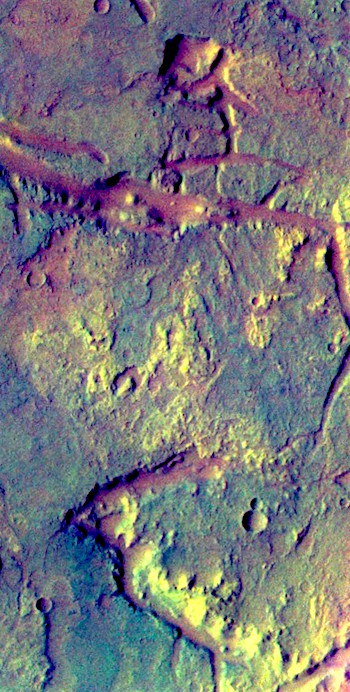
Broken plains of Margaritifer Terra (THEMIS_IOTD_20170210)THEMIS image of the Day, February 10, 2017. Today’s false color image shows some of the plains of Margaritifer Terra, which have been cracked by faulting. The faults may have released groundwater that enlarged the channels.

The THEMIS VIS camera contains 5 filters. The data from different filters can be combined in multiple ways to create a false color image. These false color images may reveal subtle variations of the surface not easily identified in a single band image.

More THEMIS Images of the Day by geological topic.

Posted in Reports | Tagged , , , , , , , , , | Comments Off