Curiosity update: Drilling Precipice

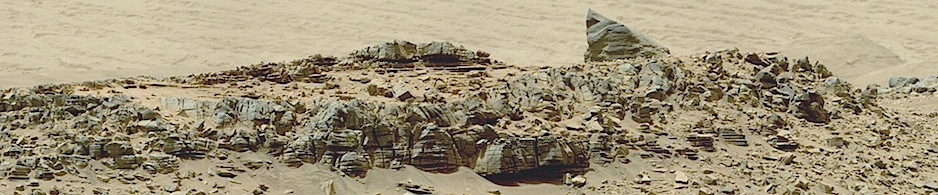
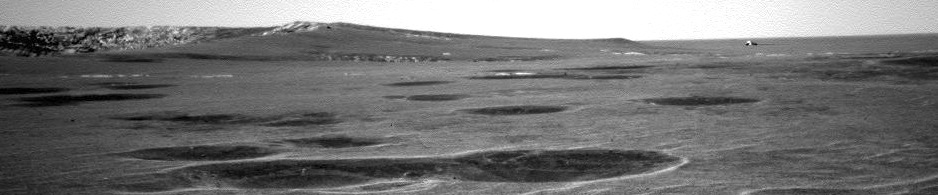
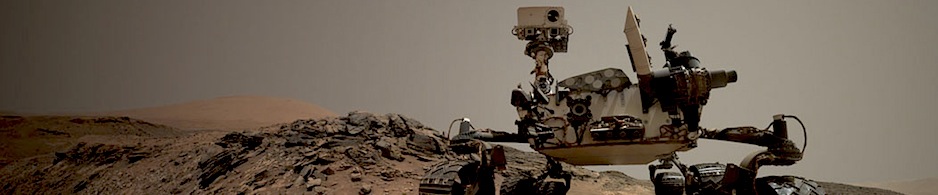
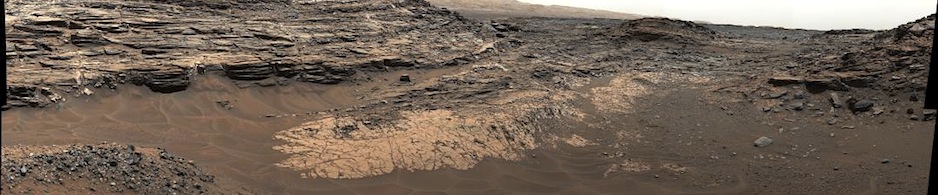
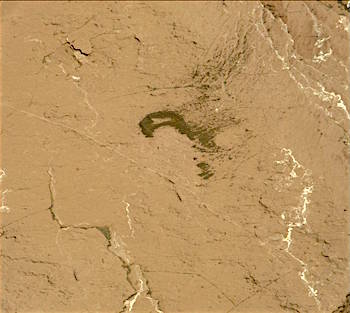
1532MR0078090010204906E01_DXXXSol 1536, November 30, 2016, update by USGS scientist Ken Herkenhoff: The The cross-contamination experiment and cleaning of CHIMRA went well, so we are ready to drill into the Precipice target!  Past drilling activities have made use of both rotation and percussion, but percussion has caused intermittent short circuits occasionally since Sol 911, so on Sol 1536 we will test the ability of the drill to acquire a sample using rotation only, without percussion.  We expect that the Precipice target is soft enough that the experiment will go well, but of course… [More at link]

Posted in Reports | Tagged , , , , , , , , , | Comments Off

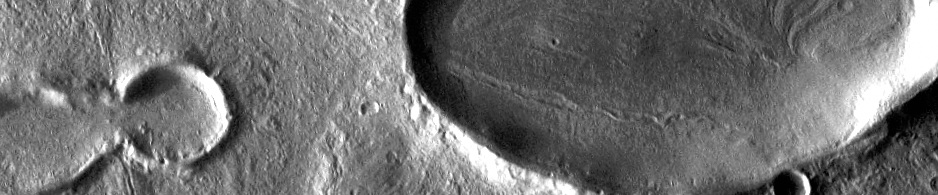
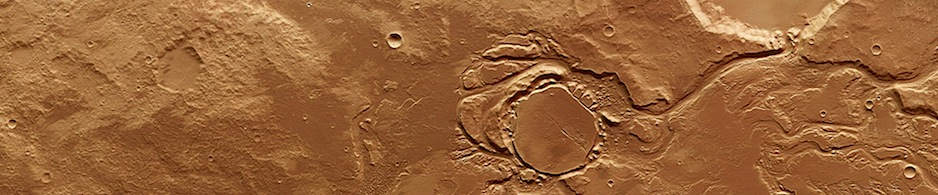
HiRISE: Inter-plate trough in Cerberus Palus

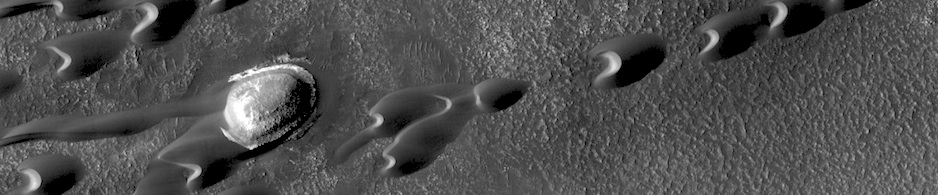
tumblr_ohdgcy2HTG1rlz4gso2_1280Inter-plate trough in Cerberus Palus. Beautiful Mars series.

Posted in Reports | Tagged , , , , , , , , , , , , | Comments Off

Geomorphology of potential tsunami deposits

image_3Planetary Geomorphology Image of the Month, December 1, 2016: Alexis Rodriguez (Planetary Science Institute). The Martian northern lowlands are thought to currently be extensively covered by an ice-rich deposit, interpreted by some researchers to be the residue of an ancient ocean that existed ~3.4 Ga (Kreslavsky and Head., 2002). However, evidence for this ocean has remained a subject of intense dispute and scientific scrutiny since it was first proposed (Parker et al., 1989, 1993) several decades [ago].

The controversy has largely stemmed in the fact that the proposed Martian paleo-shoreline features exhibit significant elevation ranges (Head et al., 1999), a lack of wave-cut paleoshoreline features (Malin and Edgett, 1999), and the presence of lobate margins (Tanaka et al., 1997, 2005).

The discovery of potential tsunami deposits as discussed in a recent article by Rodriguez et al. (2016) brings in a new perspective in which coastal margins shaped by enormous tsunami waves likely characterized early Mars oceans (Fig. 1)…

The features that Rodriguez et al. (2016) interpreted as tsunami deposits consist of lobate deposits reaching several hundred kilometers in lengths over a few hundred meters of relief gains (Figs. 2 and 3). [More at link and at an earlier RPR item]

Posted in Reports | Tagged , , | Comments Off

THEMIS: Channels winding through Noachis Terra

Channels in Noachis Terra (THEMIS_IOTD_20161201)THEMIS Image of the Day, December 1, 2016. Numerous channels dissect the higher elevation material at the top of this image. This image is located in Noachis Terra.

More THEMIS Images of the Day by geological topic.

Posted in Reports | Tagged , , , , , , , , | Comments Off

MARCI weather report, November 21-27, 2016

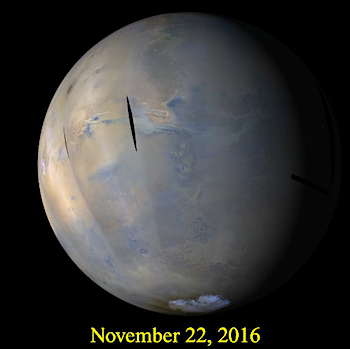
marci-nov22-2016Afternoon dust storm activity was sparse across most of Mars during the past week. Exceptions were a local-scale dust storm observed over northern Amazonis Planitia, as well as, a dust haze that continued over Aonia and latitudes south of 60°S latitude. Equatorward, condensate clouds were observed northeast of Hellas, south of Solis Planum, and near Valles Marineris. Orographic condensate (water-ice) clouds… [More at link, including video]

Posted in Reports | Tagged , , , , , , , , , , , , , | Comments Off

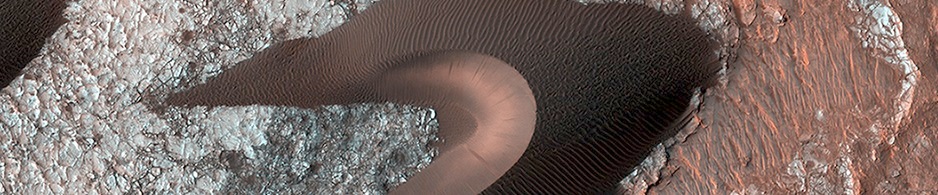
HiRISE: Knobs with lobate flows

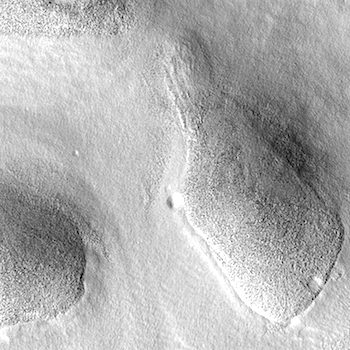
tumblr_ohdgn83RJg1rlz4gso1_1280Knobs with lobate flows around their margins. Beautiful Mars series.

Posted in Reports | Tagged , , , , , , , , , | Comments Off

Curiosity: Long view to a small hill

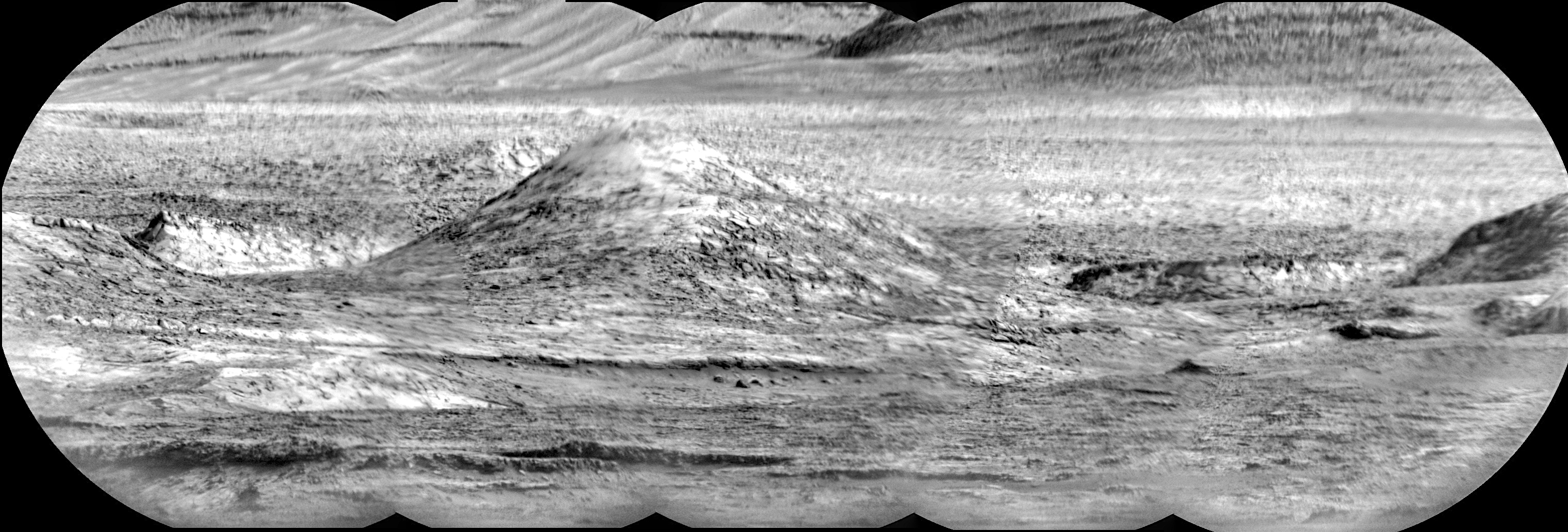
1534-rmiSol 1534, November 29, 2016. Five Remote Micro-Imager (RMI) frames shot a composite image of a small hill far off to the southeast of Curiosity’s position. Click to enlarge it.

Sol 1534 raw images (from all cameras), and Curiosity’s latest location.

Posted in Reports | Tagged , , , , , , , , , , | Comments Off

Curiosity update: Cross-contamination experiment

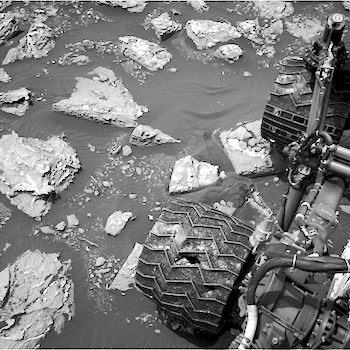
NLB_532962849EDR_F0592830NCAM00654M_Sol 1535, November 29, 2016, update by USGS scientist Ken Herkenhoff: The current drill campaign continues to go smoothly, and the Sol 1535 plan is dominated by an experiment to see if any Sebina sample material is left inside the drill bit chamber from the previous drilling.  This is motivated by the fact that we only used vibration to transfer that sample from the drill bit assembly into CHIMRA, rather than also using percussion.  So it’s a “cross-contamination experiment” designed to see if the vibration didn’t do a complete job back when we first drilled Sebina.  Lots of images of the sieve and other parts of CHIMRA will be… [More at link]

Posted in Reports | Tagged , , , , , , , , , , , , | Comments Off

THEMIS: Snow & ice fill crater in martian Arctic

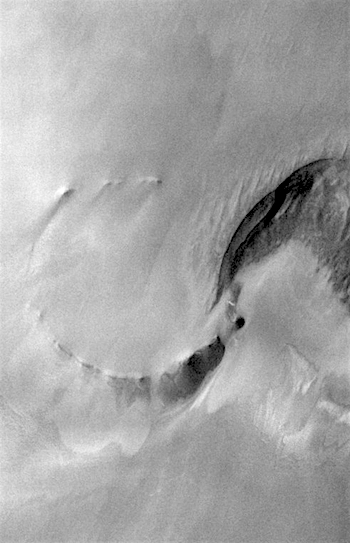
North polar cap ice-filled crater (THEMIS_IOTD_20161130)THEMIS Image of the Day, November 30, 2016. This VIS image shows part of the north polar cap. This image is along the cap margin. The buried remnants of an impact crater are visible in the bottom half of the frame.

More THEMIS Images of the Day by geological topic.

Posted in Reports | Tagged , , , , , , , , , | Comments Off

NASA radio on Trace Gas Orbiter aces relay test

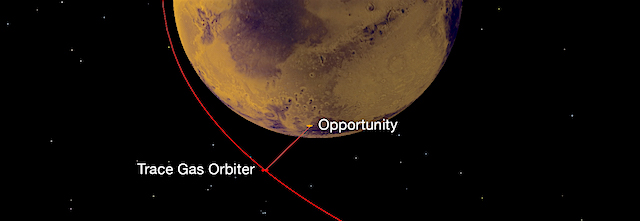
PIA21139_hiresData from each of the two rovers active on Mars reached Earth last week in the successful first relay test of a NASA radio aboard Europe’s new Trace Gas Orbiter (TGO).

The transmissions from NASA rovers Opportunity and Curiosity, received by one of the twin Electra radios on the orbiter on Nov. 22, mark a strengthening of the international telecommunications network supporting Mars exploration. The orbiter’s main radio for communications with Earth subsequently relayed onward to Earth the data received by Electra. (…)

Frequent use of TGO’s relay capability to support Mars rover operations is planned to begin more than a year from now. That’s after the orbiter finishes adjusting its orbit to a near-circular path about 250 miles (400 kilometers) above Mars’ surface. Meanwhile, four other active Mars orbiters also carry radios that can provide relay service for missions on the surface of Mars. The two active rovers routinely send data homeward via NASA orbiters Mars Odyssey and Mars Reconnaissance Orbiter (MRO).

“The arrival of ESA’s Trace Gas Orbiter at Mars, with its NASA-provided Electra relay payload on board, represents a significant step forward in our Mars relay capabilities,” said Chad Edwards, manager of the Mars Relay Network Office within the Mars Exploration Program at NASA’s Jet Propulsion Laboratory, Pasadena, California. “In concert with our three existing NASA orbiters and ESA’s earlier Mars Express orbiter, we now have a truly international Mars relay network that will greatly increase the amount of data that future Mars landers and rovers can return from the surface of the Red Planet.” [More at link]

Posted in Reports | Tagged , , , , , , , , , , , , , , | Comments Off