Opportunity: Crimson Tide at Birmingham rock

1F467225619EFFCH0UP1110L0M1Sol 3819, October 21, 2014. Exploring in the Ulysses Crater ejecta field on Wdowiak Ridge, the rover team is currently studying a roundish rock dubbed Birmingham and a target area on it named Crimson Tide. Birmingham, about half a meter wide, appears to be igneous with layering or planes within the rock. (Planetary scientist Tom Wdowiak, for whom the ridge is named, was at the University of Alabama.)

1P467040912ESFCH0UP2508L5M1_L2L5L5L7L7At right a closeup on the Crimson Tide target area on Birmingham, in a false-color image by Holger Isenberg using filtered Pancam frames.

Opportunity raw images, its latest mission status, and a location map.

Posted in Reports | Tagged , , , , , , , , , | Comments Off

THEMIS: Crater dunes

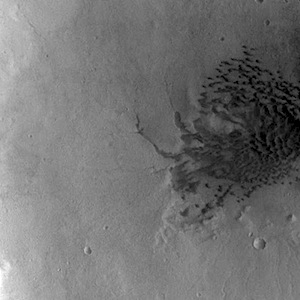
Dune field in crater (THEMIS_IOTD_20141022)THEMIS Image of the Day, October 22, 2014. A field of sand dunes is located on the floor of this unnamed crater in Terra Cimmeria. Several gullies dissect the northern rim of the crater.

More THEMIS Images of the Day by geological topic.

Posted in Reports | Tagged , , , , , , , , , , | Comments Off

Curiosity update: ‘Comet Siding Spring’

0780ML0034040010400300E01_DXXX-br2Sol 785-786, October 20, 2014, update from USGS Scientist Lauren Edgar: “Over the weekend, a number of Mars spacecraft observed a rare encounter with Comet Siding Spring. Curiosity successfully observed the comet with Mastcam, Navcam and ChemCam RMI.  Today we’re planning two sols during which Curiosity will drive closer to the rock outcrop “Book Cliffs,” and perform some remote sensing… [More at link]

Posted in Reports | Tagged , , , , , , , , | Comments Off

HiRISE: Comet nucleus smaller than 500 meters

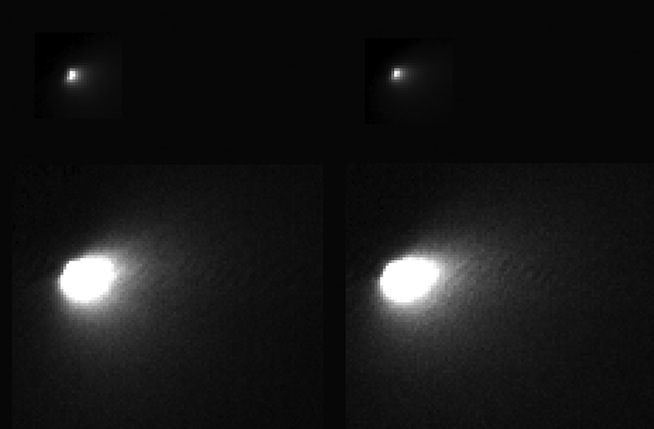
PIA18618_ipThese images were taken of comet C/2013 A1 Siding Spring by NASA’s Mars Reconnaissance Orbiter on Oct. 19, 2014, during the comet’s close flyby of Mars and the spacecraft. Comet Siding Spring is on its first trip this close to the Sun from the Oort Cloud at the outer fringe of the solar system. This is the first resolved imaging of the nucleus of a long-period comet.

The High Resolution Imaging Science Experiment (HiRISE) camera on Mars Reconnaissance Orbiter acquired images of this comet from a minimum distance of about 86,000 miles (138,000 kilometers), yielding a scale of about 150 yards (138 meters) per pixel. Telescopic observers had modeled the size of the nucleus as about half a mile, or one kilometer, wide. However, the best HiRISE images show only two to three pixels across the brightest feature, probably the nucleus, suggesting a size less than half that estimate. [More at link]

Posted in Reports | Tagged , , , , , , , | Comments Off

Opportunity: Comet Siding Spring at dawn

PIA18591_fig1Sol 3817, October 19, 2014. The comet (indicated) stands in the eastern sky before dawn in this 50-second Pancam exposure. Background stars and image artifacts are noted in the key image below.


PIA18591_ipShortcut to Sol 3817 Opportunity Pancam images here.


Posted in Reports | Tagged , , , , , , , , | Comments Off

THEMIS: Sirenum Fossae

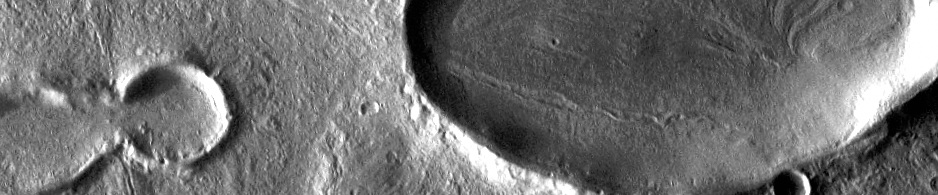
Graben in Sirenum Fossae (THEMIS_IOTD-20141021)THEMIS Image of the Day, October 21, 2014. The linear depression in the center of this VIS image is a graben — a fault-bounded block of material. The graben crosses the crater and ejecta in the middle of the image, indicating that the graben formed after the impact that created the crater.

More THEMIS Images of the Day by geological topic.

Posted in Reports | Tagged , , , , , , , , , | Comments Off

THEMIS: Faults and flows

Faults and flows in Mangala Fossa (THEMIS_IOTD_20141020)THEMIS Image of the Day, October 20, 2014. Lava flows of Daedalia Planum can be seen at the top and bottom portions of this VIS image. The ridge and linear depression in the central part of the image are part of Mangala Fossa, a fault bounded graben.

More THEMIS Images of the Day by geological topic.

Posted in Reports | Tagged , , , , , , , , , , | Comments Off

HRSC: Flight over chaotic terrain

ESA-hydraotes-flyoverAmong the most interesting landforms on Mars are features referred to as ‘chaotic terrain’. Dozens or even hundreds of isolated mountains up to 2,000 m high are scattered in these extensive regions. Seen from orbit, they form a bizarre, chaotic pattern. Such terrains are found over a large area to both the west and east of Valles Marineris, the largest canyon in the Solar System. Hydraotes Chaos, showcased in this video, is a typical example of this type of landscape. The data used to generate these images and the simulated flyover were acquired with the High Resolution Stereo Camera on ESA’s Mars Express orbiter… [More at link, including 2D video and anaglyph 3D video]

Posted in Reports | Tagged , , , , , , , , , | Comments Off

Mars Odyssey, MRO, MAVEN: healthy after flyby

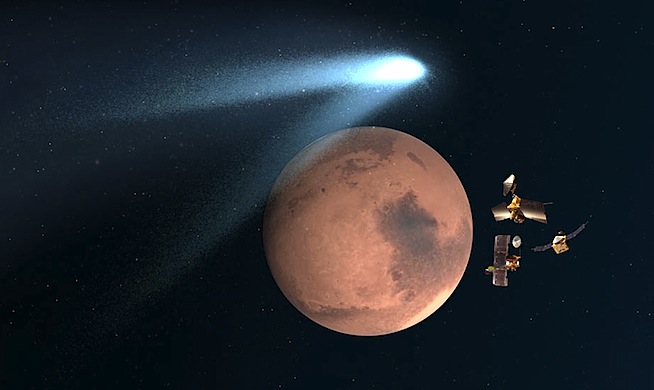
comet-16-9Mars Odyssey: “The telemetry received from Odyssey this afternoon confirms not only that the spacecraft is in fine health but also that it conducted the planned observations of comet Siding Spring within hours of the comet’s closest approach to Mars,” said Odyssey Mission Manager Chris Potts of NASA’s Jet Propulsion Laboratory, Pasadena, Calif., speaking from mission operations center at Lockheed Martin Space Systems, Denver… [More at link]

Mars Reconnaissance Orbiter: The orbiter continues operating in good health after sheltering behind Mars during the half hour when high-velocity dust particles from comet C/2013 A1 Siding Spring had the most chance of reaching the paths of Mars orbiters. It maintained radio communications with Earth throughout the comet’s closest approach, at 11:27 a.m. PDT (2:27 p.m. EDT), and the peak dust-risk period centered about 100 minutes later. “The spacecraft performed flawlessly throughout the comet flyby,” said Mars Reconnaissance Orbiter Project Manager Dan Johnston of NASA’s Jet Propulsion Laboratory, Pasadena, California. “It maneuvered for the planned observations of the comet and emerged unscathed…” [More at link]

MAVEN: The MAVEN spacecraft — full name Mars Atmosphere and Volatile Evolution — reported back to Earth in good health after about three hours of precautions against a possible collision with high-velocity dust particles released by comet C/2013 A1 Siding Spring. “We’re glad the spacecraft came through, we’re excited to complete our observations of how the comet affects Mars, and we’re eager to get to our primary science phase,” said MAVEN Principal Investigator Bruce Jakosky of the University of Colorado, Boulder… [More at link]

Posted in Reports | Tagged , , , , , , | Comments Off

Comet links roundup

At Emily Lakdawalla’s blog at The Planetary Society, there is a roundup of links to information and webcasts about the encounter between Mars and Comet Siding Spring. As she notes, it’ll take several days to download the data from Mars, calibrate it, and turn it into usable observations.

Posted in Reports | Tagged , | Comments Off