THEMIS: South polar textures

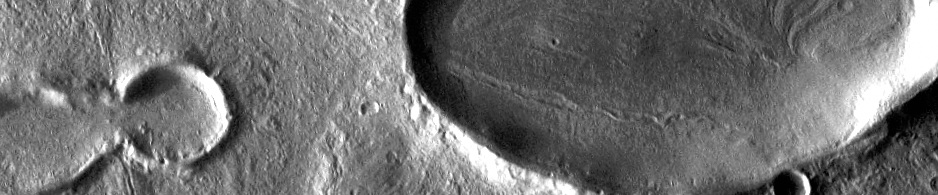
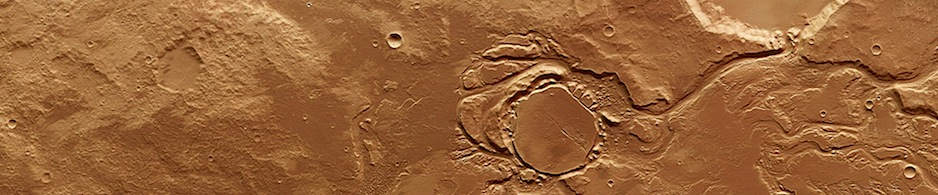
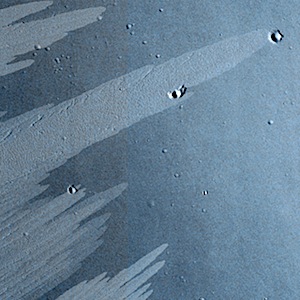
Linear south polar textures (THEMIS_IOTD_20141007)THEMIS Image of the Day, October 7, 2014. While yesterday’s VIS image showed a texture of oval depressions (Swiss cheese), today’s VIS image shows a linear surface texture of the south polar cap. This texture is described as looking like a thumbprint.

More THEMIS Images of the Day by geological topic.

Posted in Reports | Tagged , , , , , , , , , | Comments Off

Curiosity: ChemCam Pahrump texture album

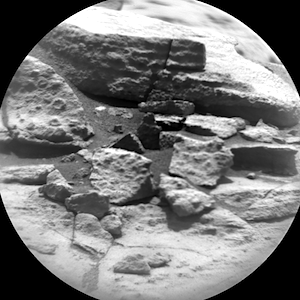
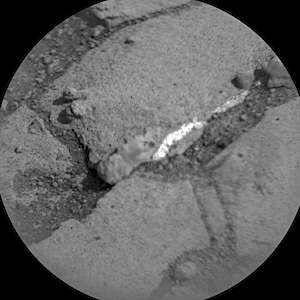
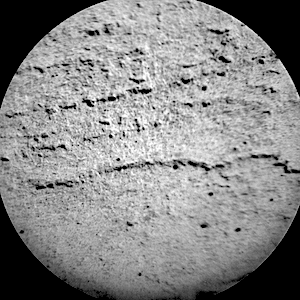
CR0_465931790PRC_F0421020CCAM01771L1Sol 771, October 7, 2014. The ChemCam’s Remote Micro-Imager explores a variety of textures in rocks at the Pahrump Hills outcrop. Note the round, hollow “nodules” at left in top image, the bright vein in the center image, and the thin laminations with a cross-cutting vein (?) in the bottom image.

Sol 771 raw images (from all cameras), and Curiosity’s latest location map.


CR0_465940084PRC_F0421020CCAM03771L1


CR0_465940249PRC_F0421020CCAM04771L1


Posted in Reports | Tagged , , , , , , , , , | Comments Off

HiRISE: Dome & barchan dunes in Newton Crater

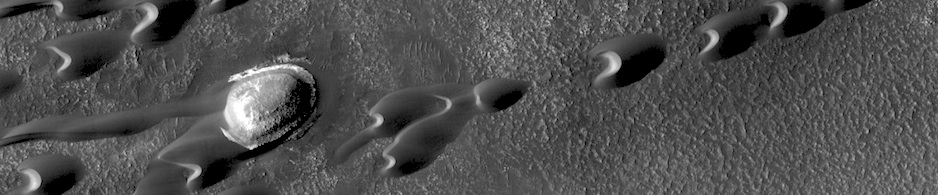
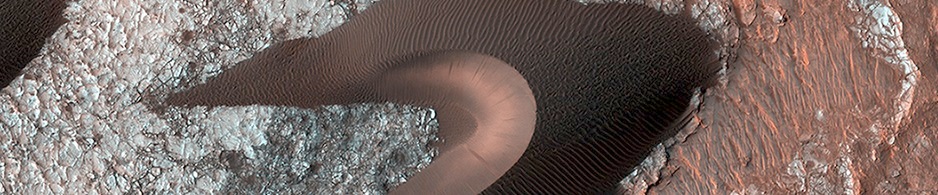
ESP_038117_1385This observation shows a small sand dune field on the floor of Newton Crater, an approximately 300 kilometer (130 mile) wide crater in the southern hemisphere of Mars. The image shows both dome and barchan dunes. Both these types of dunes are also found on Earth. Barchan dunes in particular are common on Earth, and are generally crescent-shaped with a steep slip face bordered by horns oriented in the downwind direction…. [More at link]

Posted in Reports | Tagged , , , , , , , , , | Comments Off

Opportunity: Rock ejecta with sharp edges

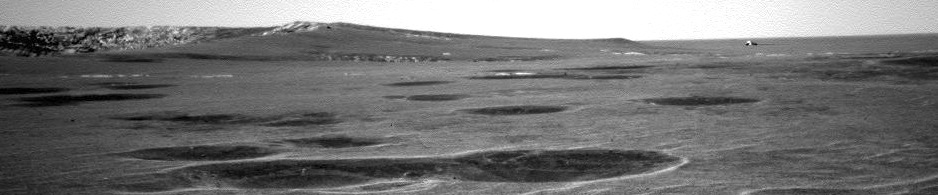
1P465800562ESFCHXWP2597L5M1_L2L5L5L7L7Sol 3803, October 5, 2014. Lipscomb rock, a piece of ejected debris from the Ulysses Crater impact, displays a sharp-featured, lightly weathered appearance. False-color image by Holger Isenberg using filtered Pancam frames.

Opportunity raw images, its latest mission status, and a location map.

Posted in Reports | Tagged , , , , , , , , , | Comments Off

Curiosity update: ‘Arm recovery’

FLB_465841934EDR_F0421020FHAZ00323M_Sol 771, October 6, 2014, update from USGS Scientist Ken Herkenhoff: “During the nighttime MAHLI imaging on Sol 768, there was a problem with arm positioning that prevented the subsequent arm activities from completing.  The problem is understood, and the arm is in a safe configuration.  So the Sol 771 plan includes arm recovery activities…” [More at link]

Posted in Reports | Tagged , , , , , , , | Comments Off

NASA briefing on Comet Siding Spring plans, Oct. 9

mars_comet-full_0NASA will host a media briefing at 2 p.m. EDT (11 a.m. PDT) Thursday, Oct. 9, to outline the space and Earth-based assets that will have extraordinary opportunities to image and study a comet from relatively close range to Mars on Sunday, Oct. 19. The briefing will be held in NASA Headquarters’ auditorium, 300 E Street SW in Washington, and broadcast live on NASA Television and the agency’s website.

Panelists include:

Jim Green, director, Planetary Science Division, NASA Headquarters, Washington
Kelly Fast, program scientist, Planetary Science Division
Carey Lisse, senior astrophysicist, Johns Hopkins University Applied Physics Laboratory, Laurel, Maryland
Padma Yanamandra-Fisher, senior research scientist, Space Science Institute, Rancho Cucamonga Branch, California

Comet C/2013 A1 Siding Spring will miss Mars by only about 88,000 miles (139,500 kilometers). That is less than half the distance between Earth and its Moon and less than one-tenth the distance of any known comet flyby of Earth. The comet’s nucleus will come closest to Mars at about 2:27 p.m. EDT (11:27 a.m. PDT), hurtling at about 126,000 mph (56 kilometers per second), relative to Mars… [More about the comet here, and more about the briefing here.]
Posted in Reports | Tagged , , | Comments Off

HiRISE: Bright slope streaks in Arabia Terra

ESP_038044_1965This observation shows bright and dark slope streaks in craters in the Arabia Terra region. Slope streak formation is among the few known processes currently active on Mars. The cause of slope streaks is still debated, and both dry and wet processes have been proposed to explain their formation. They are most commonly believed to form by gravity-driven movement of extremely dry sand or very fine-grained… [More at link]

Posted in Reports | Tagged , , , , , , , , , | Comments Off

Curiosity: Looking closely at Pahrump

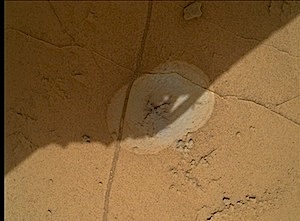
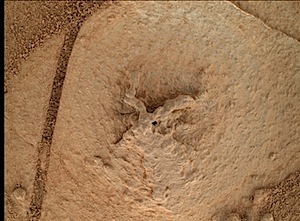
0767MH0001900010300135C00_DXXXSol 767, October 3, 2014. The MAHLI (hand lens imager) sees an area that has been brushed to clear away dust and reveal a deposit on the surface of the Pahrump Hills bedrock.  Then the camera moves in closer for a clearer look. [Edit: target is called Morrison]


0767MH0003630010300137C00_DXXXSol 767 raw images (from all cameras), and Curiosity’s latest location map.

Posted in Reports | Tagged , , , , , , , , | Comments Off

MAVEN: Status update, September 30, 2014

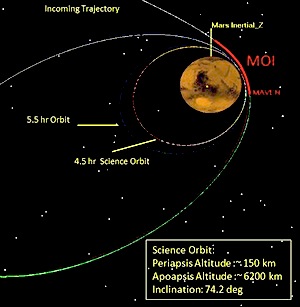
MAVEN_science_orbitEverything is going well on the mission as MAVEN orbits Mars! All systems are performing nominally. Following Mars Orbit Insertion on Sept. 21 the spacecraft successfully completed two engine burns which brings MAVEN closer to its planned science orbit. We have lowered MAVEN from the 35 hour capture orbit into its current 5.5 hour orbit period. In the weeks to come we’ll perform additional engine burns to get MAVEN into a 4.5 hour orbit period and the required atmospheric density corridor… [More at link]

Posted in Reports | Tagged , , , | Comments Off

Opportunity report by A.J.S. Rayl, The Planetary Society

20141004_4-CRISM-detections-EndeavourOctober 4, 2014: Opportunity Gets Extension, Returns Killer Panoramas, and Roves onto Mystery Rocks. While the winds of Martian spring blew through Meridiani Planum in September, Mars Exploration Rover (MER) Opportunity reformatted its Flash memory then continued exploring Wdowiak Ridge on the western rim of Endeavour Crater. Even though the Flash-related issues soon returned, the robot field geologist hardly seemed to notice as it sent home two spectacular panoramas, presented the scientists with a rocky Martian mystery, and delivered yet another September to remember for the mission. And that’s not all… The best news of the month broke right on September 4th when NASA announced that it is granting MER its ninth mission extension… “We have a healthy rover, good weather, the funding we need, and terrific science ahead of us,” Steve Squyres, MER principal investigator, of Cornell University, said during an interview at September’s end. “It’s continued good times for Opportunity.” [More at link]

Posted in Reports | Tagged , , , , , , , , | Comments Off