
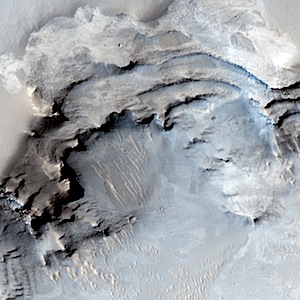
HiRISE: Outcrops & strata near Meridiani Planum

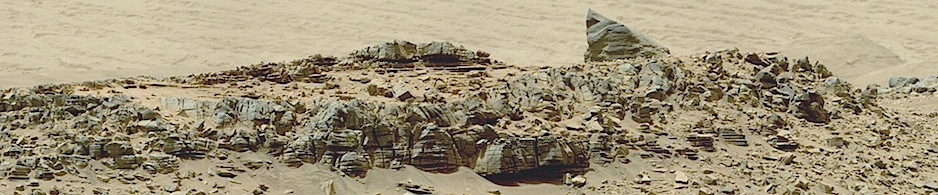
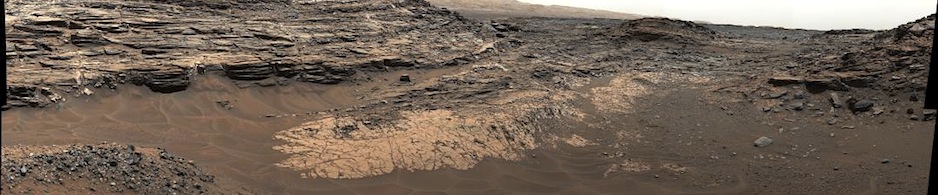
tumblr_navr7yPt3H1rlz4gso2_1280Outcrops and strata near Meridiani Planum. Beautiful Mars series.
Posted in Reports | Tagged , , , , , , , , | Comments Off

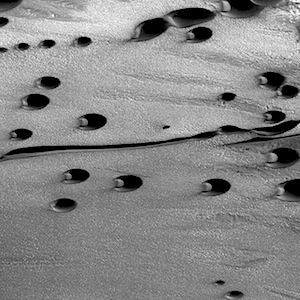
HiRISE: Defrosting spots on Chasma Boreale dunes

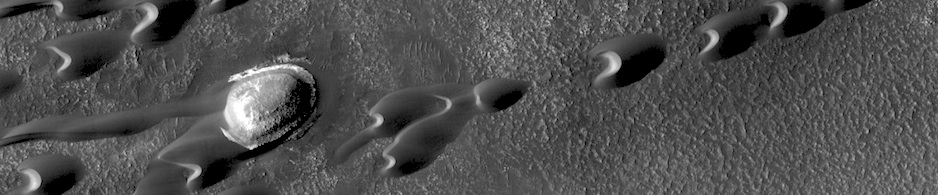
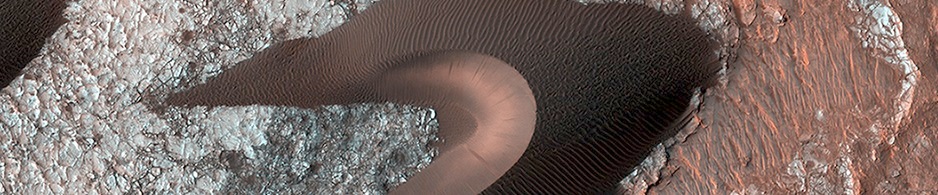
tumblr_navrehyfZr1rlz4gso3_1280Defrosting spots on Chasma Boreale dunes in Chasma Boreale. Beautiful Mars series.

Posted in Reports | Tagged , , , , , , , , , | Comments Off

CRISM: Mesospheric cloud above the Argyre Basin

CRISM_FeaturedImage_LMB2CAE_CompressedThis image shows a limb (meaning a view of the horizon) of the planet where the surface can be seen at the bottom with an orange tint, a cloud can be seen in the atmosphere, and space is seen above in black. In order to make these observations, the MRO spacecraft must pitch onto its side so CRISM no longer looks down at the surface, but instead out onto the horizon of the planet. This particular observation shows a carbon dioxide (CO2) ice cloud in the mesosphere (middle layer) of Mars’s very minimal atmosphere. Clouds start to form when the temperature becomes so cold that the CO2 is able to freeze from a gas to a solid. This cloud is between 50-90 km from the surface of the planet… [More at link]

Posted in Reports | Tagged , , , , , , | Comments Off

THEMIS: Dark slope streaks

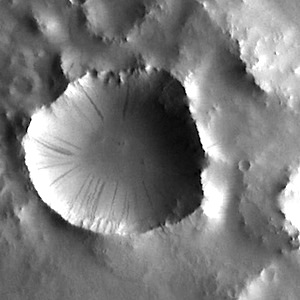
Dark slope streaks in Terra Sabaea (THEMIS_IOTD_20140829)THEMIS Image of the Day, August 29, 2014. Today’s VIS image shows dark slope streaks in an unnamed crater in Terra Sabaea. These features are believed to be formed by material moving downslope, removing the dust cover and revealing darker material.

More THEMIS Images of the Day by geological topic.


Posted in Reports | Tagged , , , , , , , , , , | Comments Off

Curiosity update: ‘Multi-sol planning’

Sols 732-734, August 28, 2014, update from USGS Scientist Ken Herkenhoff: “Yesterday we did not receive as much data as expected, so could not drive as originally planned.  Therefore, the Sol 732 plan was dominated by targeted… [More at link]

Posted in Reports | Tagged , , | Comments Off

HiRISE: Flow in mesa valley in Protonilus Mensae

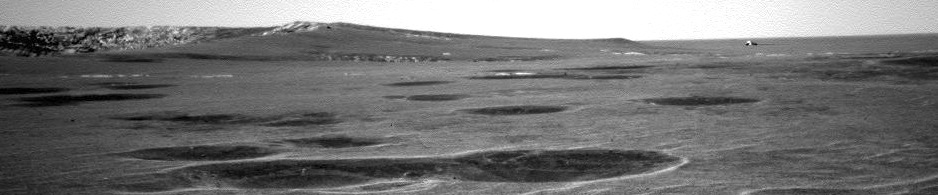
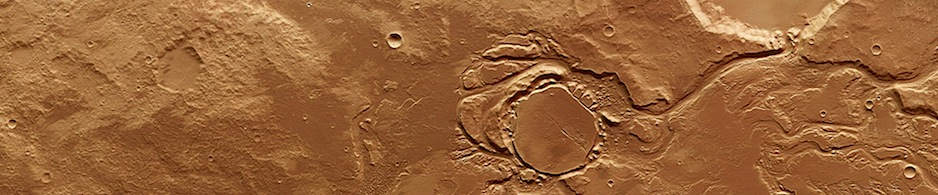
tumblr_navfe9rMRL1rlz4gso1_1280Flow leaving a mesa valley in Protonilus Mensae. Beautiful Mars series.

Posted in Reports | Tagged , , , , , , , , , | Comments Off

HiRISE: Mantled terrain in southern mid-latitudes

ESP_037474_1380The mid-latitudes of Mars (about 30 to 60 degrees, north and south) are covered in ice-rich mantling deposits in varying states of degradation. This mantle is thought to be deposited as snow during periods when the angle of the tilt of Mars’ rotational axis — called obliquity — is much higher, which last happened around 10 million years ago…. [More at link]

Posted in Reports | Tagged , , , , , , , , | Comments Off

‘Black Beauty’ zircons record ancient Mars climate

140827131553-largeWas Mars — now a cold, dry place — once a warm, wet planet that sustained life? And if so, how long has it been cold and dry? … By analyzing the chemical clues locked inside an ancient Martian meteorite known as Black Beauty, Florida State University Professor Munir Humayun and an international research team are revealing the story of Mars’ ancient, and sometimes startling, climate history. The team’s most recent finding of a dramatic climate change appeared in Nature Geoscience[More at links]

Posted in Reports | Tagged , , , , , | Comments Off

HiRISE: New crater near InSight landing site

ESP_037328_1845InSight (Interior Exploration using Seismic Investigations, Geodesy and Heat Transport) is a NASA Discovery Program mission that will place a single geophysical lander on Mars in September 2016 to study its deep interior. InSight needs seismic signals, and one sure way to get them is from the impact of bolides onto Mars. InSight can detect large impacts that are far from the lander and smaller impacts that… [More at link]

Posted in Reports | Tagged , , , , , , , , , | Comments Off

HiRISE: Weird crater

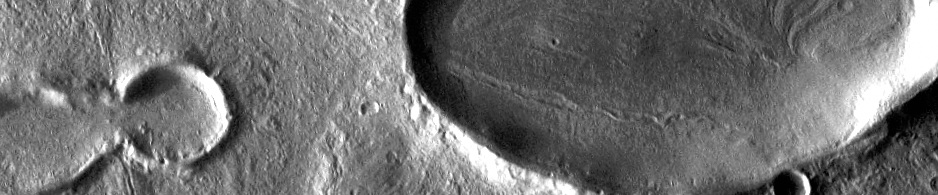
ESP_037237_1435This feature has a strange appearance, as if the crater has feet with toes sticking out of two sides. Let’s try to explain this. First, there was a highly oblique impact event, with the bolide (or meteorite) striking the ground while flying almost horizontally over the surface. Such oblique impacts tend to send ejecta in two directions to the sides of the bolide trajectory, rather than in all directions around the crater. However, there was ice near the surface… [More at link]

Posted in Reports | Tagged , , , , , , , , | Comments Off