
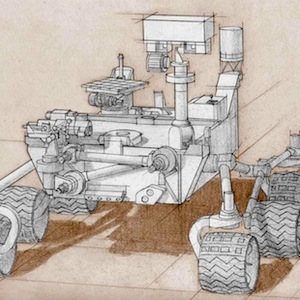
Mars 2020 rover payload selected

M2020-300The next rover NASA will send to Mars in 2020 will carry seven carefully-selected instruments to conduct unprecedented science and exploration technology investigations on the Red Planet… [These will] conduct geological assessments of the rover’s landing site, determine the potential habitability of the environment, and directly search for signs of ancient Martian life…

The selected instruments are:

Mastcam-Z, an advanced camera system with panoramic and stereoscopic imaging capability with the ability to zoom. The instrument also will determine mineralogy of the Martian surface and assist with rover operations. The principal investigator is James Bell, Arizona State University in Phoenix.

SuperCam, an instrument that can provide imaging, chemical composition analysis, and mineralogy. The instrument will also be able to detect the presence of organic compounds in rocks and regolith from a distance. The principal investigator is Roger Wiens, Los Alamos National Laboratory, Los Alamos, New Mexico. This instrument also has a significant contribution from the Centre National d’Etudes Spatiales,Institut de Recherche en Astrophysique et Plane’tologie (CNES/IRAP) France.

Planetary Instrument for X-ray Lithochemistry (PIXL), an X-ray fluorescence spectrometer that will also contain an imager with high resolution to determine the fine scale elemental composition of Martian surface materials. PIXL will provide capabilities that permit more detailed detection and analysis of chemical elements than ever before. The principal investigator is Abigail Allwood, NASA’s Jet Propulsion Laboratory (JPL) in Pasadena, California.

Scanning Habitable Environments with Raman & Luminescence for Organics and Chemicals (SHERLOC), a spectrometer that will provide fine-scale imaging and uses an ultraviolet (UV) laser to determine fine-scale mineralogy and detect organic compounds. SHERLOC will be the first UV Raman spectrometer to fly to the surface of Mars and will provide complementary measurements with other instruments in the payload. The principal investigator is Luther Beegle, JPL.

• The Mars Oxygen ISRU Experiment (MOXIE), an exploration technology investigation that will produce oxygen from Martian atmospheric carbon dioxide. The principal investigator is Michael Hecht, Massachusetts Institute of Technology, Cambridge, Massachusetts.

Mars Environmental Dynamics Analyzer (MEDA), a set of sensors that will provide measurements of temperature, wind speed and direction, pressure, relative humidity and dust size and shape. The principal investigator is Jose Rodriguez-Manfredi, Centro de Astrobiologia, Instituto Nacional de Tecnica Aeroespacial, Spain.

Radar Imager for Mars’ Subsurface Exploration (RIMFAX), a ground-penetrating radar that will provide centimeter-scale resolution of the geologic structure of the subsurface. The principal investigator is Svein-Erik Hamran, Forsvarets Forskning Institute, Norway.

[More at link]

Posted in Reports | Tagged , , | Comments Off

HiRISE: Preserving ice from a vanished terrain

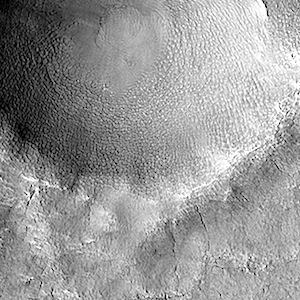
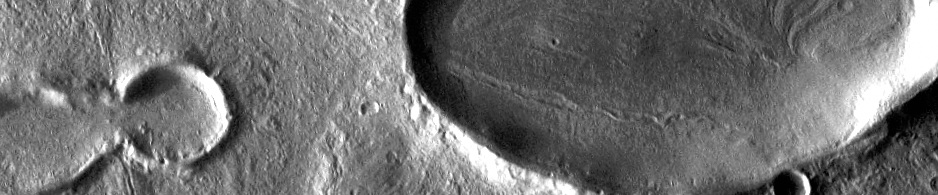
ESP_036815_2330This HiRISE image shows what is termed a pedestal crater, so-called because the level of the surface adjacent to the crater is elevated relative to the surface of the surrounding terrain. The raised surface has patterns and a general outline resembling what ejecta would look like after being thrown out from the crater by the impact. This impact probably occurred… [More at link]

Posted in Reports | Tagged , , , , , , , , | Comments Off

THEMIS: Cyane Fossae

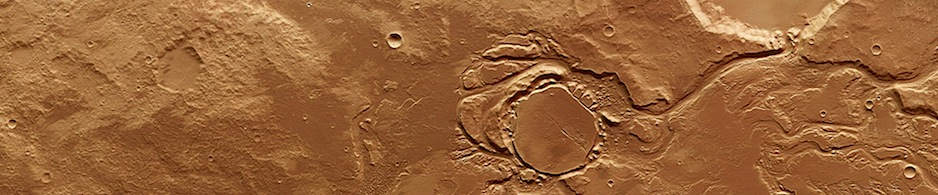
Pit craters in Cyane Fossae (THEMIS_IOTD_20140731)THEMIS Image of the Day, July 31, 2014. The linear feature in this image is part of Cyane Fossae. The circular collapse features are bounded by linear faults.

More THEMIS Images of the Day by geological topic.

Posted in Reports | Tagged , , , , , , , , , , | Comments Off

HiRISE: Frosty gullies

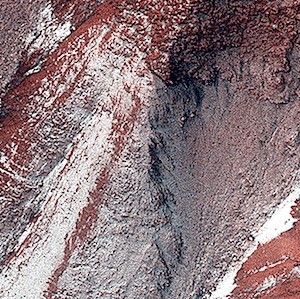
ESP_037137_1360HiRISE monitoring has shown that gully formation on Mars occurs in winter and early spring in times and places with frost on the ground. This image was acquired in late winter, and the frost or ice (visible as white areas) persists only on the south-facing slopes that have received little direct sunlight to this date…. [More at link]

Posted in Reports | Tagged , , , , , , , , | Comments Off

HiRISE: Water-bearing rocks in Noctis Labyrinthus

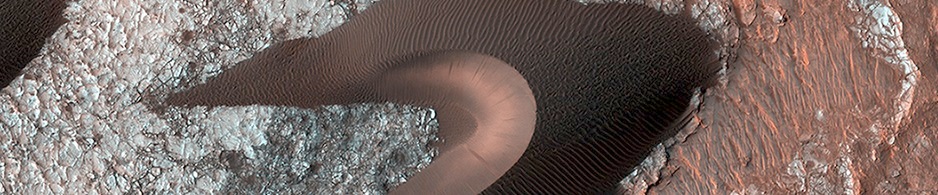
ESP_036598_1735The bright rocks in this image have minerals that contain water. These water-bearing minerals are found using the companion instrument on the MRO spacecraft called CRISM. By combining the spectral data from the CRISM instrument with the high resolution visible images taken by HiRISE, scientists are able to speculate how water deposited and/or altered these rocks… [More at link]

Posted in Reports | Tagged , , , , , , , , , | Comments Off

MARCI weather report: July 21-27, 2014

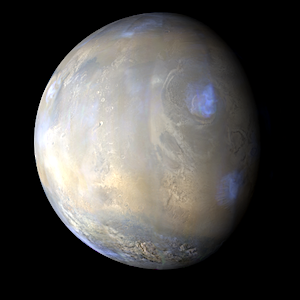
releaseimg_140721_140727Regional scale dust lifting was observed in both hemispheres this week. In the north, storms continued to occur at mid- to polar latitudes for much of the week with occasional frontal storms observed north of Tempe. In the south persistent and widespread dust lifting occurred in… [More at link, including video]

Posted in Reports | Tagged , , , , , , , , , , | Comments Off

Curiosity: Sol 703, July 29, 2014

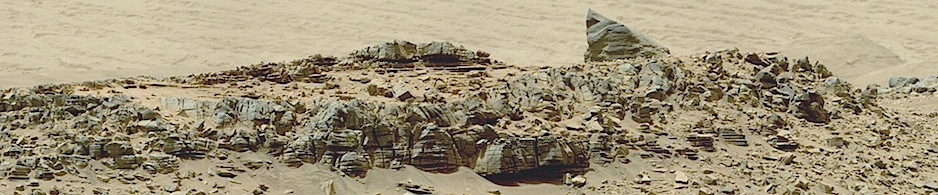
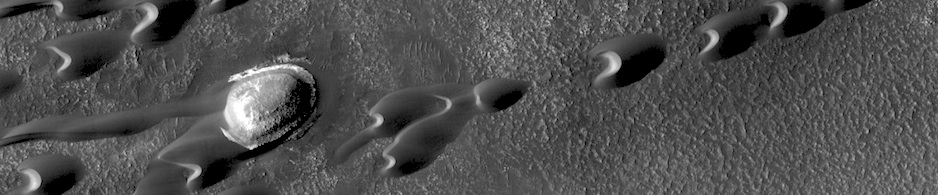
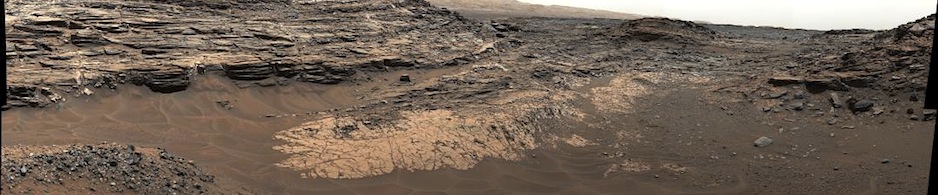
Valley viewMastcam’s wide-angle imager looks down into Hidden Valley, examining sand ripples in a five-frame composite. In the distance at center, the valley branches left and right. HiRISE imagery from orbit shows the left branch leads down to a large field of dunes, possibly active. The right branch provides a tortuous (though likely more driveable) route onward toward Mount Sharp through connecting shallow valleys.

Sol 703 raw images (from all cameras), and Curiosity’s latest location map.

Posted in Reports | Tagged , , , , , , , , , | Comments Off

Curiosity update: ‘Off-planet driving record’

Sol 704, July 29, 2014, update on Curiosity from USGS Scientist Ken Herkenhoff: “I should have mentioned yesterday that the Opportunity rover recently broke the off-planet driving record…. But Curiosity made almost 30 meters…. [More at link]

Posted in Reports | Tagged , , , , | Comments Off

Curiosity: Sol 704, July 30, 2014

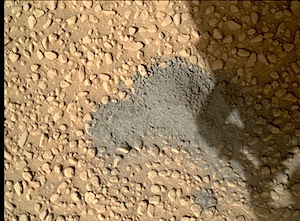
0704MH0001900010204151C00_DXXXUsed sample dump: MAHLI records a sample dropped by the Collection and Handling for In-Situ Martian Rock Analysis (CHIMRA) device.

NASA description: NASA’s Mars rover Curiosity acquired this image using its Mars Hand Lens Imager (MAHLI), located on the turret at the end of the rover’s robotic arm, on July 30, 2014, Sol 704 of the Mars Science Laboratory Mission, at 12:23:06 UTC.

Sol 704 raw images (from all cameras), and Curiosity’s latest location map.

Posted in Reports | Tagged , , , , | Comments Off

HiRISE: Like a river

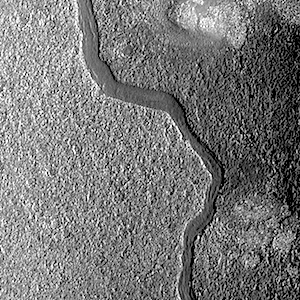
tumblr_n9hkhqKfyg1rlz4gso2_1280Like a river. Beautiful Mars series.

Posted in Reports | Tagged , , , , , , , , , | Comments Off