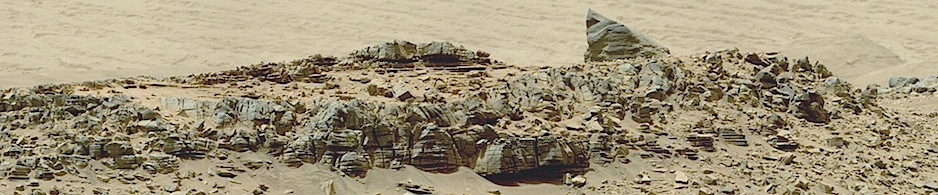




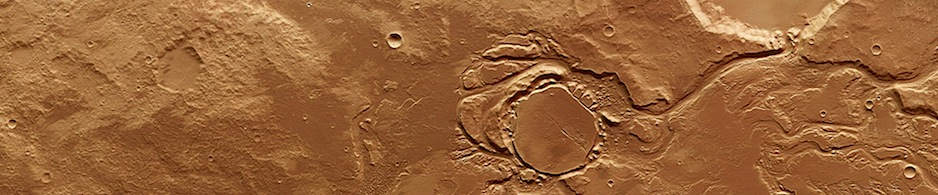
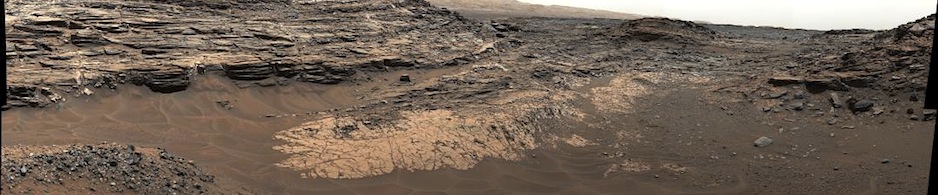
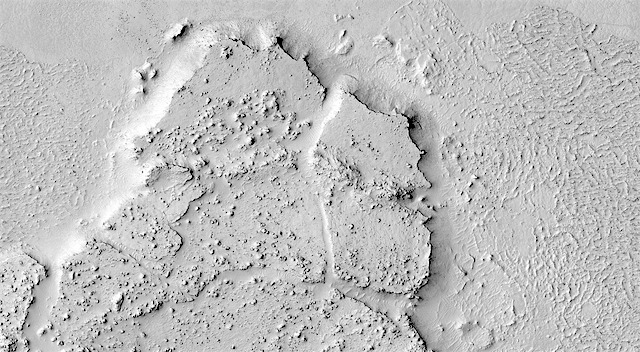
 Athabasca Valles lava. It’s quite the jumbled mess down here. The northern toe of this mesa appears to contact and possibly overlie a rift in the lava crust, giving the impression that the mesa is younger.
Beautiful Mars series. [More at links]
Athabasca Valles lava. It’s quite the jumbled mess down here. The northern toe of this mesa appears to contact and possibly overlie a rift in the lava crust, giving the impression that the mesa is younger.
Beautiful Mars series. [More at links]
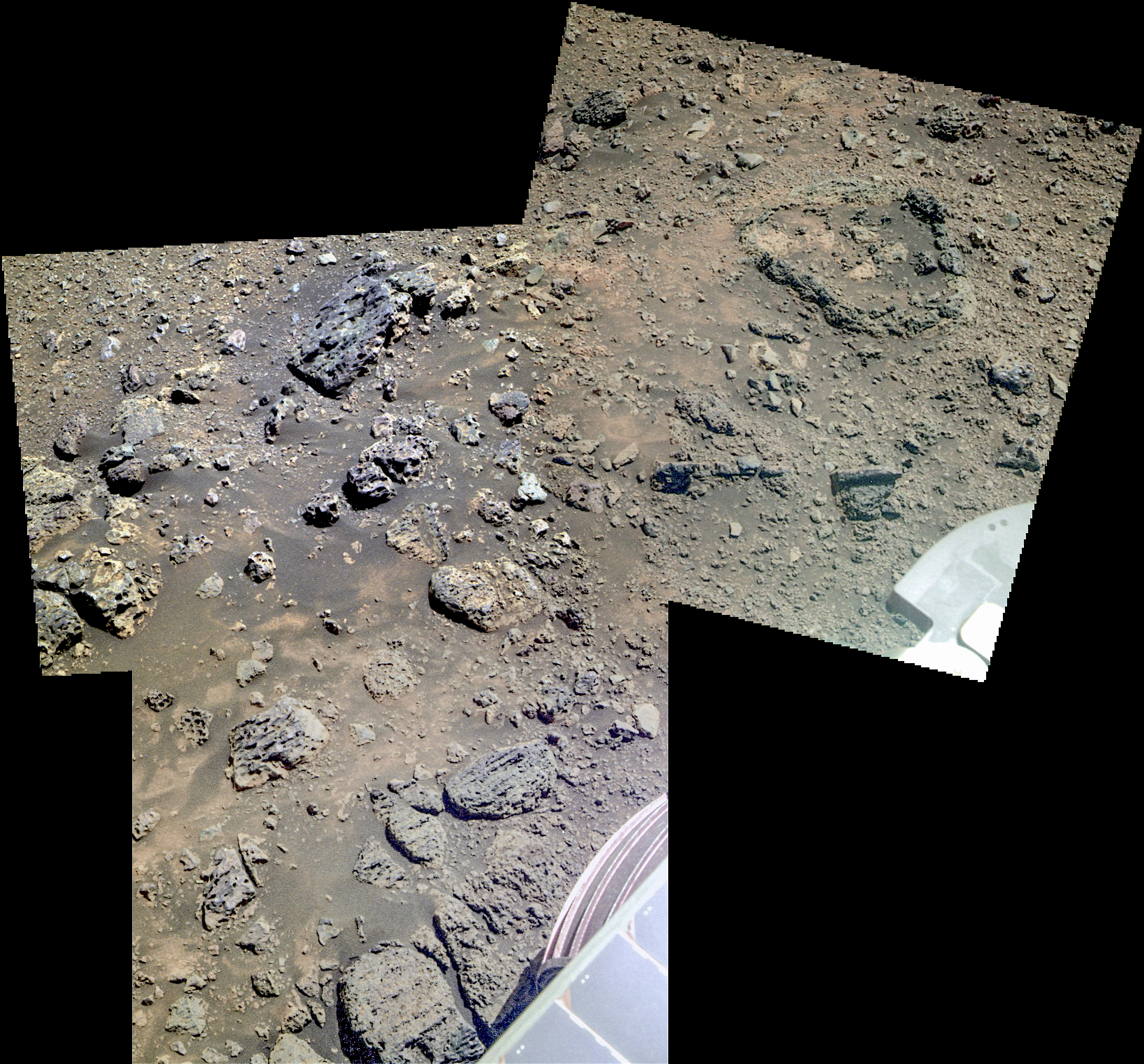 Sol 5073, May 2, 2018. With Opportunity parked at La Salinera, mission scientists used the Pancam to shoot a multi-filtered set of images of the pitted rocks next to the rover. (Holger Isenberg reconstructions; false colors vary across the composite image.) Click the image to enlarge it.
Opportunity raw images, its latest mission status, location map, and atmospheric opacity, known as tau.
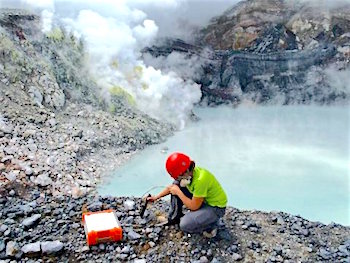 Researchers at CU Boulder have discovered microbes living in a toxic volcanic lake that may rank as one of the harshest environments on Earth. Their findings, published recently online [in Astrobiology], could guide scientists looking for signs of ancient life on Mars.
The team, led by CU Boulder Associate Professor Brian Hynek, braved second-degree burns, sulfuric acid fumes and the threat of eruptions to collect samples of water from the aptly-named Laguna Caliente. Nestled in Costa Rica’s Poás Volcano, this body of water is 10 million times more acidic than tap water and can reach near boiling temperatures. It also resembles the ancient hot springs that dotted the surface of early Mars, Hynek said.
The Costa Rican lake supports living organisms—but only one. Hynek and his colleagues found microbes belonging to just a single species of bacteria in the lake water, a rock-bottom level of diversity.
“Even in an extremely harsh environment, there can still be life,” said Hynek of the Laboratory for Atmospheric and Space Physics and Department of Geological Sciences. “But then there’s very little life. Mars was just as extreme in its early history, so we should probably not expect to find evidence of large-scale biodiversity there.”
Hynek, who is also the director of CU Boulder’s Center for Astrobiology, has spent much of his career searching for places on Earth today that look like Mars did nearly four billion years ago. At that time, liquid water was plentiful on the surface. His goal is to better understand the environments where life may have evolved on the Red Planet.
It’s a hard task: Rampant volcanism during that period created volatile and mineral-rich pools of water, giving rise to “Yellowstones all over Mars,” Hynek said. [More at links]
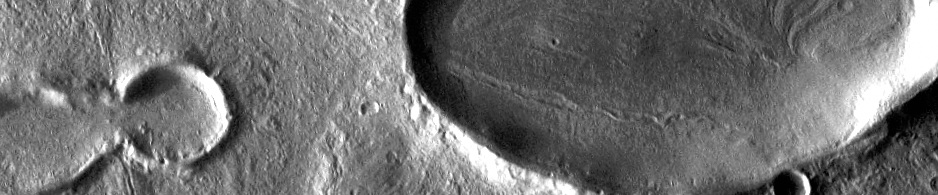
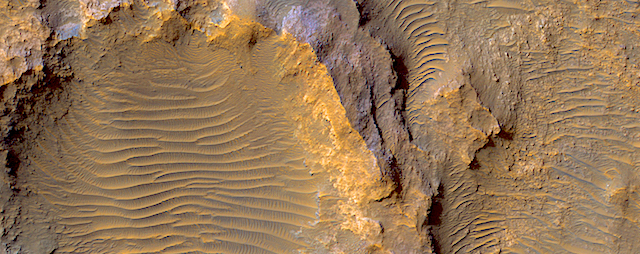 This enhanced color image shows eroded bedrock on the floor of a large ancient crater. [More at link]
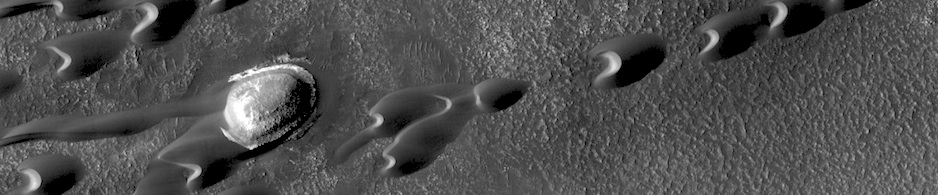
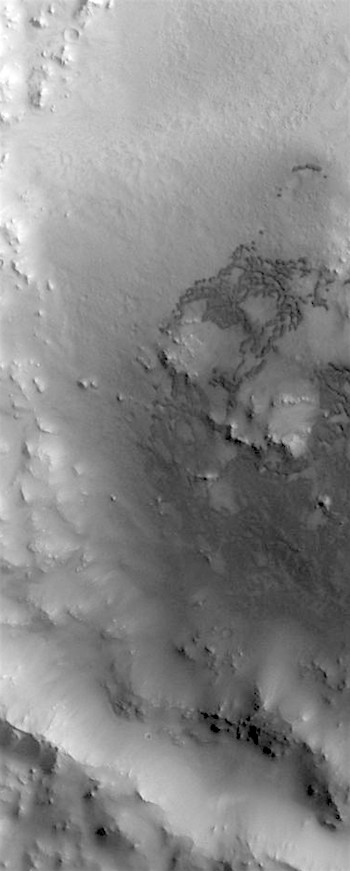 THEMIS Image of the Day, May 3, 2018. A group of dunes is visible on the floor of this unnamed crater in Arabia Terra. The dunes contain basaltic sand, which is darker than the dust covered materials of the rest of the crater.
More THEMIS Images of the Day by geological topic.
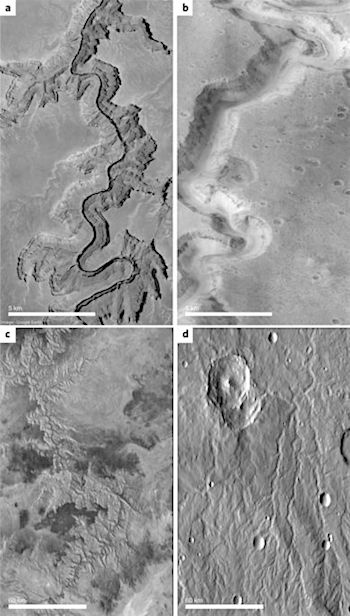 The climate of early Mars is a subject of debate. While it has been thought that Mars had a warm and wet climate, like Earth, other researchers suggested early Mars might have been largely glaciated.
A recent study by Ramses Ramirez from the Earth-Life Science Institute (Tokyo Institute of Technology, Japan) and Robert Craddock from the National Air and Space Museum’s Center for Earth and Planetary Studies (Smithsonian Institution, USA) suggests that the early Martian surface may not have been dominated by ice, but instead it may have been modestly warm and prone to rain, with only small patches of ice. (…)
However, this idea has challenges. First, the amount of solar energy entering the atmosphere at the time was considered to be too low to support a warm and wet climate. Secondly, recent climate studies have argued that Mars’ ancient fluvial features can be accounted for with an icy climate, where widespread surfaces of ice promoted cooling by reflecting solar radiation. Occasional warming events would have triggered large amounts of ice-melt, and fluvial activity as a result. (…)
Recently, the authors’ study, published in Nature Geoscience, argues that volcanic activity on a relatively unglaciated planet could explain Mars’ fluvial features. Volcanic eruptions releasing CO2, H2, and CH4 may have contributed to the greenhouse effect, which in turn may have promoted warming, precipitation (including rain), and the flow of water that carved out the valleys and fluvial features… [More at links]
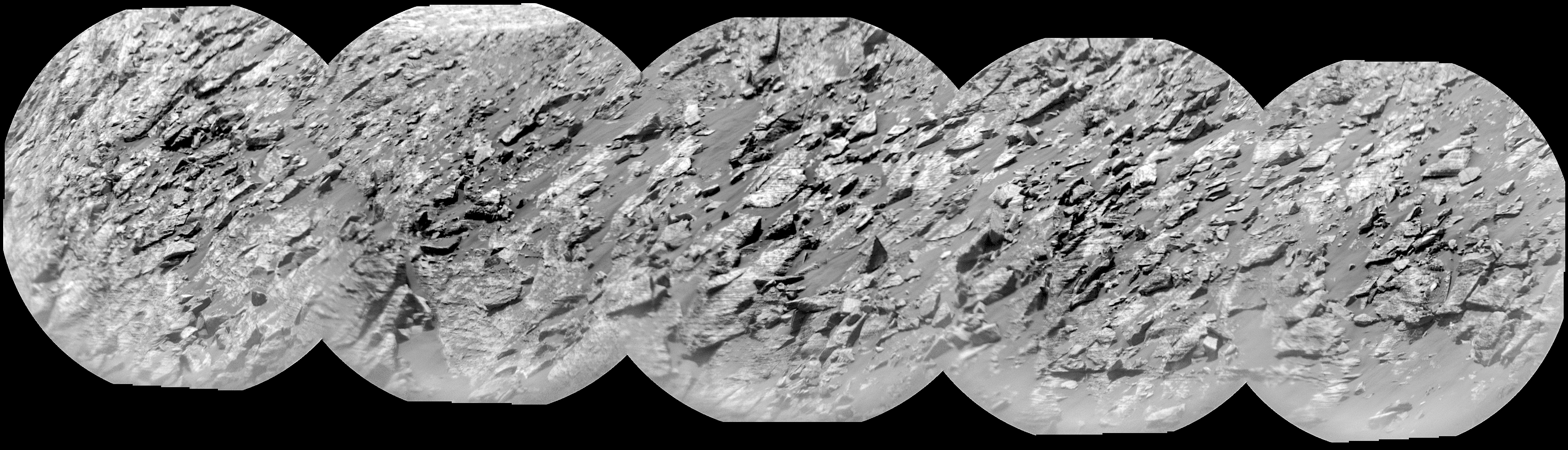
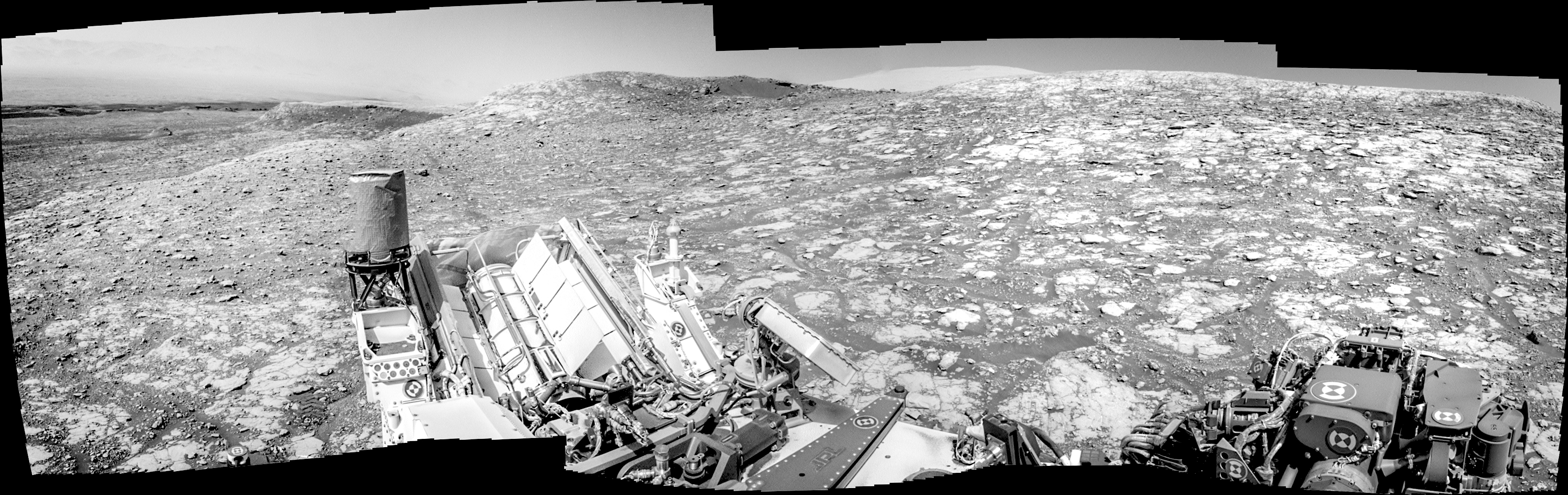 Sol 2039, May 2, 2018. After shooting another Remote Micro-Imager composite of Red Cliff (below), Curiosity drove 43 meters (140 feet) to the southwest, away from the overlook which offered the view to the cliff. In the Navcam composite above Red Cliff lies in the distance on the left beyond the cylindrical low-gain antenna, and Curiosity’s wheel tracks are visible stretching behind the rover. The summit of Mt. Sharp can be seen above the ridgetop.
In the new RMI composite below, much rubble and sand litters the cliff slope, yet thin, basically horizontal layers are visible in many of the bedrock outcrops within the image. Click either image to enlarge it.
Sol 2039 raw images (from all cameras), and Curiosity’s latest location.
 Weather patterns this past week were very similar to those reported the previous week. A new regional dust storm kicked up in the southern mid-to-low latitudes of Promethei-Cimmeria. It extended northeast over Gusev Crater, the final resting place of the Mars Exploration Rover-Spirit and the location of one of three remaining candidate landing sites for the Mars 2020 Rover mission. Storm had begun to dissipate by week’s end. Additional local storm activity was observed over the northern plains and along the edge of the perennial north polar cap. Afternoon condensate ice clouds continued to be observed over… [More at link]
 The Opportunity rover has spent 13 years exploring a small region of Meridiani Planum which has a rather ordinary appearance.
Other portions of Meridiani are much more interesting, with well-exposed layered bedrock eroded into strange patterns. [More at link]
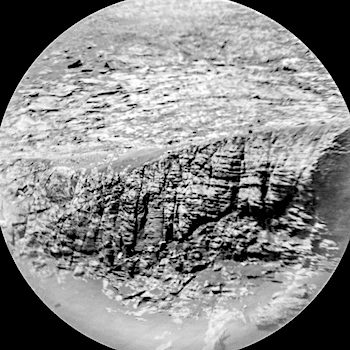 Sol 2039, May 1, 2018, update by MSL scientist Rachel Kronyak: Following some fantastic preliminary imaging from yestersol, today’s plan (Sol 2039) is dedicated to additional imaging of “Red Cliff” before continuing to drive toward a location where we think we are likely to drill. We have a short science block to start the day, during which we’ll use Mastcam to take some context imaging of our surroundings and upcoming terrain. We’ll then use the ChemCam RMI to extend our coverage of Red Cliff, similar to the black and white image above. These RMI images give us a really great opportunity to study small-scale stratigraphic details in rocks that are pretty far away from the rover. Following our science block, we’ll perform a drive and take our standard sequence of post-drive images to set us up for… [More at link]