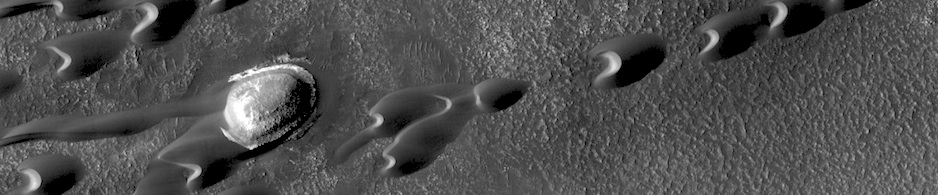

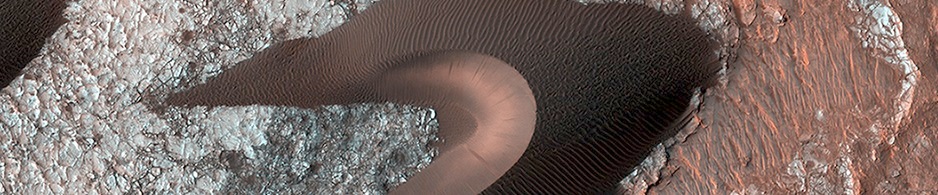
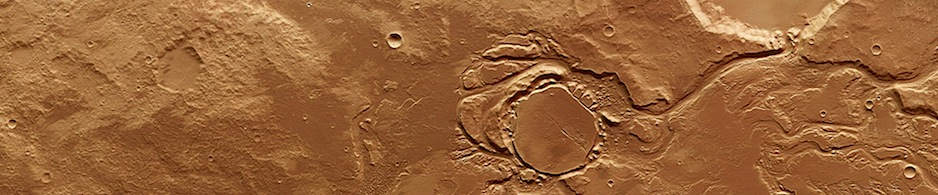
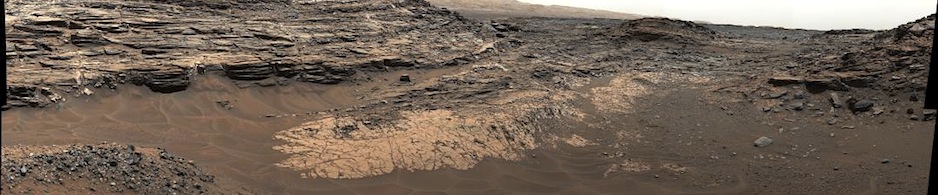
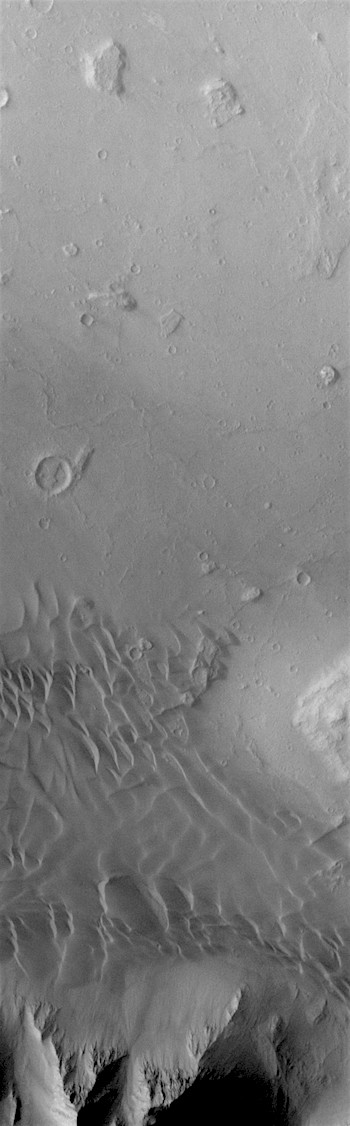
THEMIS: Swirled dunes at foot of Coprates canyon wall

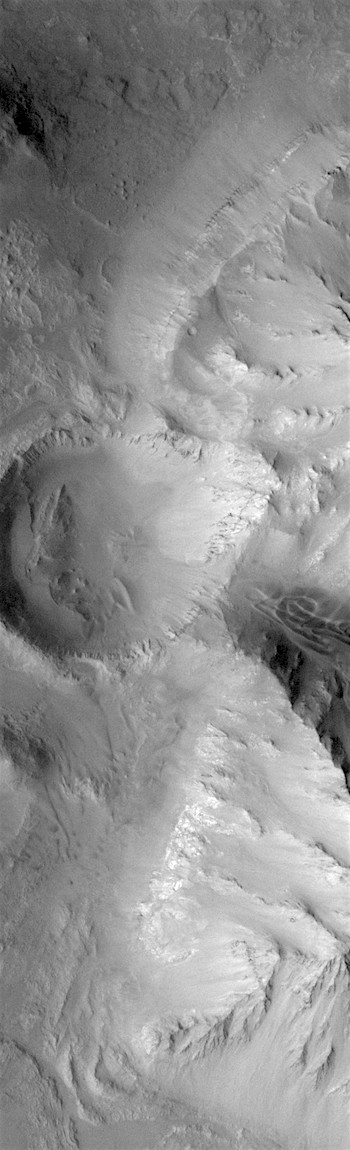
Coprates Chasma dunes (THEMIS_IOTD_20170928)THEMIS Image of the Day, September 28, 2017. This image is located in eastern Coprates Chasma. The image shows a relatively smooth floor, with a group of sand dune forms located against the wall of the chasma (bottom of image).

Coprates Chasma is one of the numerous canyons that make up Valles Marineris. The chasma stretches for 960 km (600 miles) from Melas Chasma to the west and Capri Chasma to the east. Landslide deposits, layered materials and sand dunes cover a large portion of the chasma floor.

NASA’s Mars Odyssey spacecraft has spent over 15 years in orbit around Mars, circling the planet more than 69,000 times. It holds the record for longest working spacecraft at Mars. THEMIS, the IR/VIS camera system, has collected data for the entire mission and provides images covering all seasons and lighting conditions.

Over the years many features of interest have received repeated imaging, building up a suite of images covering the entire feature. From the deepest chasma to the tallest volcano, individual dunes inside craters and dune fields that encircle the north pole, channels carved by water and lava, and a variety of other feature, THEMIS has imaged them all.

For the next several months the Image of the Day will focus on the Tharsis volcanoes, the various chasmata of Valles Marineris, and the major dunes fields. We hope you enjoy these images!

More THEMIS Images of the Day by geological topic.
Posted in Reports | Tagged , , , , , , , , , , , , , | Comments Off

Curiosity update: Bye, bye, Bar Harbor

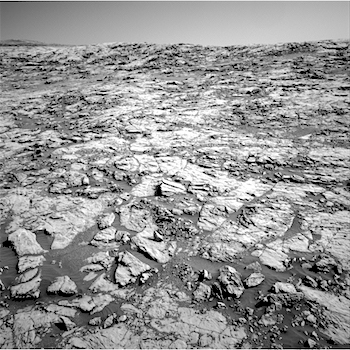
NRB_559691641EDR_F0660450NCAM00265M_-br2Sol 1828, September 27, 2017, update by MSL scientist Michelle Minitti: Before landing, Curiosity’s landing ellipse and the foothills of Mt. Sharp were divided up into quadrangles – squares ~1.5 km on a side – to give science team members reasonable amounts of terrain to work with during pre-landing geological mapping, and provide the source of the target names within that quadrangle. Quadrangles get their names from towns that are nearby and share names with notable regions of geological interest on Earth, and since Sol 1500, Curiosity has been traversing the “Bar Harbor” quadrangle. If today’s drive goes as planned, we will leave the Bar Harbor quadrangle behind, so today’s blog will honor the Maine heritage of our long-time home.

Curiosity spent her last sol in the Bar Harbor quadrangle “going right out straight” (working very hard). With ChemCam, she zapped “Hawk Mountain,” a rock with “savage” (great) layering, and a “whole ‘notha” (another) target, “Bonney Woods,” moving from a white vein into the surrounding bedrock. Mastcam acquired a small stereo mosaic over an area where the bedding geometry appeared particularly… [More at link]

Posted in Reports | Tagged , , , , , , , , , , , , , | Comments Off

Radar gives new info on Mars climate change, polar cap ages

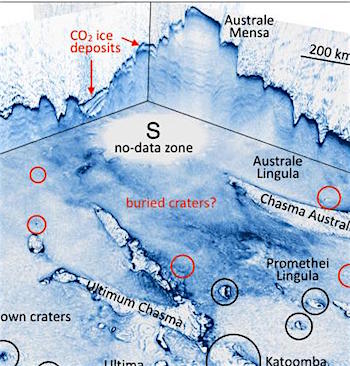
fp_image fig. 3Three-dimensional (3-D) subsurface radar volumes generated from thousands of 2-D radar profiles are revealing new information about the polar regions of Mars, including more accurate mapping of CO2 and water ices, the discovery of buried impact craters, and new elevation data. PSI Senior Scientist Nathaniel E. Putzig is the lead author of the new Icarus paper “Three-dimensional radar imaging of structures and craters in the Martian polar caps.”

This information will help scientists better understand Martian climate changes and may allow them to determine the age of the polar caps without using climate models. The 3-D data volumes were assembled from observations by the Shallow Radar (SHARAD) sounder onboard NASA’s Mars Reconnaissance Orbiter (MRO) during more than 2,000 passes over each Martian pole.

“An example is the more accurate mapping of the CO2 ice deposits in the south that allows us to provide a new, larger estimate of their volume. Sublimation of that CO2 ice into the atmosphere – which is thought to have occurred at various times in Martian history – would more than double the current atmospheric pressure,” said Putzig. “That in turn would allow liquid water to be stable at the surface in many more locations than it is today.”

One type of feature in the polar caps that was never detected or mapped with single-orbit radar profiles is buried impact craters. “In the 3D radar volumes, we can identify and map bowl-shaped features that appear to be buried impact craters, many of them at the base of the icy layers,” Putzig said. “To estimate the age of planetary surfaces, scientists combine information about the number, size, and distribution of craters and knowledge of cratering rates over time within the Solar System.

“Our analysis of the apparent craters at the base of the northern cap yields an age of about 3.5 billion years, which is consistent with the previously estimated age for the surrounding plains from surface cratering statistics,” Putzig said. “This overall agreement gives us greater confidence in identifying buried craters as we continue to search for them within the ices and beneath the southern cap.” [More at links]

Posted in Reports | Tagged , , , , , , , | Comments Off

Radar shows thick, porous sediments & no ground ice under Meridiani Planum

Mars-sandsNew findings reveal deposits on Mars that could be interpreted to be ice-rich may contain little or no ice at all, based on an analysis of radar sounder data for Meridiani Planum — an area on the planet’s equator being explored by the Opportunity rover.

This new insight into Meridiani Planum may help identify areas with and without accessible water ice, a resource critical to future human exploration and possible colonization of Mars. A new paper detailing the findings is published in Geophysical Research Letters, a journal of the American Geophysical Union.

In the new study, researchers present new compaction models for materials on Mars that suggest the electrical properties of the deposits of Meridiani Planum, derived from data collected by the Mars Advanced Radar for Subsurface and Ionospheric Sounding (MARSIS) instrument, can be explained without the need for pore-filling ice.  [More at links]

Posted in Reports | Tagged , , , , , | Comments Off

HiRISE: Tiny spiders off south polar layered deposits

tumblr_owuwwqkcbz1rlz4gso1_1280Tiny spiders off south polar layered deposits. Beautiful Mars series.

Posted in Reports | Tagged , , , , , , , , | Comments Off

MARCI weather report, September 18-24, 2017

MARCI-September-19-2017Dust-lifting activity was sparse this past week on Mars. In the first half of the week, small dust storm fronts and hazes were spotted over northern Acidalia — near the seasonal north polar ice cap edge. Looking further south, equatorial water-ice clouds continued to mask major shield volcanoes and the plateaus near Valles Marineris. The floors of Valles Marineris and Hellas were largely unobscured most afternoons. Throughout… [More at link, including video]

Posted in Reports | Tagged , , , , , , , , , , , , , | Comments Off

THEMIS: Rough floor in Coprates Chasma

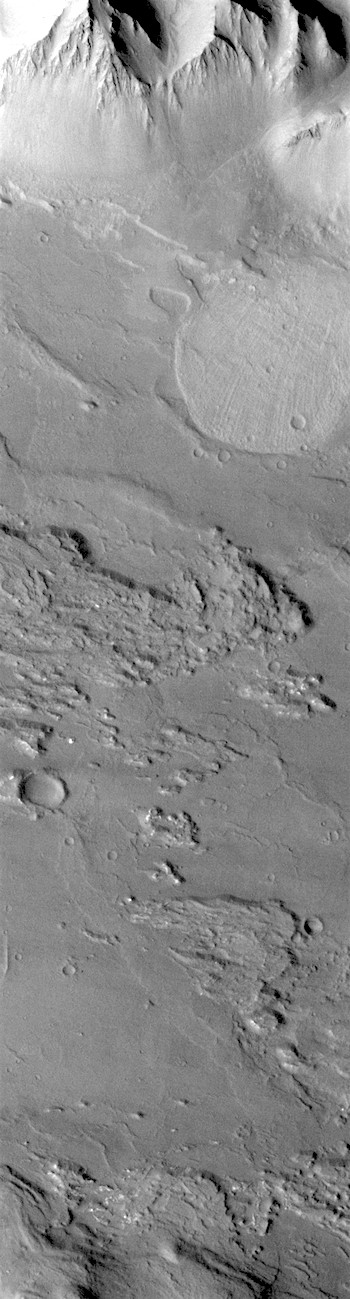
Rough canyon floor in Coprates Chasma (THEMIS_IOTD_20170927)THEMIS Image of the Day, September 27, 2017. This image is located in central Coprates Chasma. The image shows multiple landslide features, which form the bright lobed shaped deposits at the bottom of the canyon cliff face (top of image). The linear grooves on the top of the large landslide deposit were formed as the material came to rest on the canyon floor. The other features on the chasma floor are layered materials that have been weathered.

Coprates Chasma is one of the numerous canyons that make up Valles Marineris. The chasma stretches for 960 km (600 miles) from Melas Chasma to the west and Capri Chasma to the east. Landslide deposits, layered materials and sand dunes cover a large portion of the chasma floor.

NASA’s Mars Odyssey spacecraft has spent over 15 years in orbit around Mars, circling the planet more than 69,000 times. It holds the record for longest working spacecraft at Mars. THEMIS, the IR/VIS camera system, has collected data for the entire mission and provides images covering all seasons and lighting conditions.

Over the years many features of interest have received repeated imaging, building up a suite of images covering the entire feature. From the deepest chasma to the tallest volcano, individual dunes inside craters and dune fields that encircle the north pole, channels carved by water and lava, and a variety of other feature, THEMIS has imaged them all.

For the next several months the Image of the Day will focus on the Tharsis volcanoes, the various chasmata of Valles Marineris, and the major dunes fields. We hope you enjoy these images!

More THEMIS Images of the Day by geological topic.
Posted in Reports | Tagged , , , , , , , , , , , , , | Comments Off

Opportunity: Head of the valley in false color

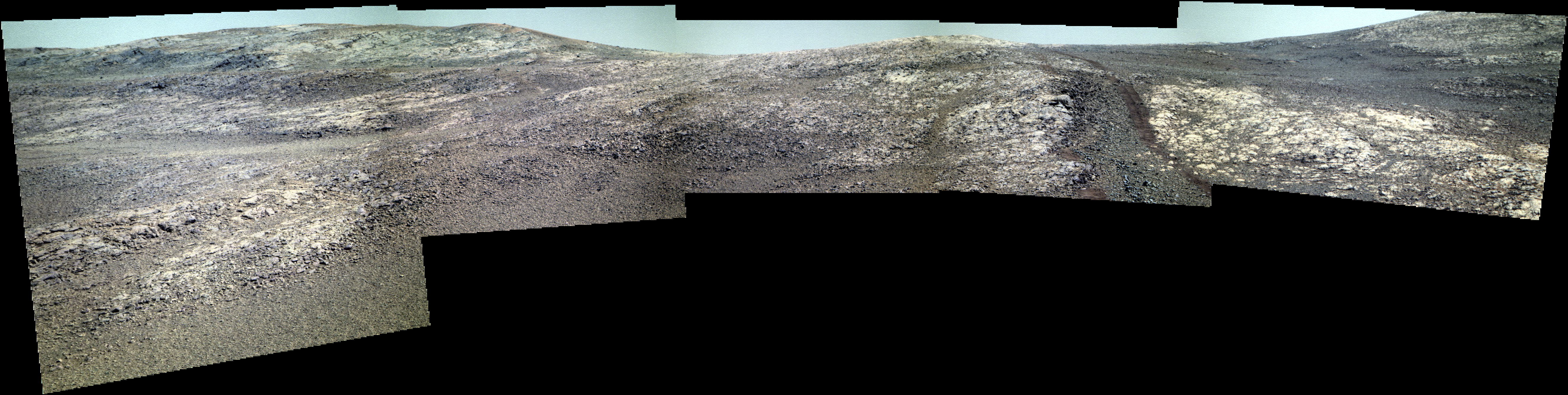
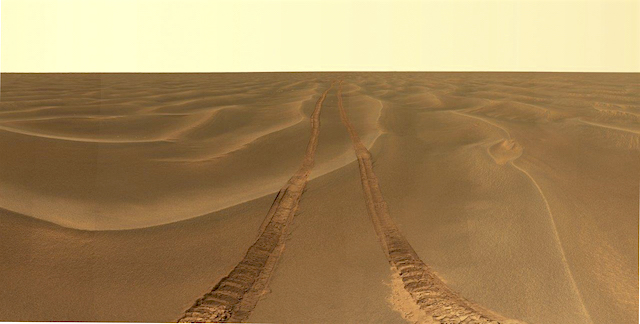
4859-pancamFCSol 4859, September 24, 2017. Five Pancam frames in false color (Holger Isenberg) profile the head of Perseverance Valley, looking upslope from the rover’s perch on a Sun-favored “lily pad.” Opportunity’s tracks into the valley are visible in the disturbed soil at right center. Click image to enlarge it.

Opportunity raw images, its latest mission status, location map, and atmospheric opacity, known as tau.

Posted in Reports | Tagged , , , , , , | Comments Off

THEMIS: Badlands in Coprates Chasma

THEMIS Image of the DayBadlands in Coprates Chasma (THEMIS_IOTD_20170926), September 26, 2017. This image is located on the eastern side of Coprates Chasma, near Capri Chasma. The image shows multiple landslide features, which form lobed shaped deposits at the bottom of the canyon cliff face. Sand dunes are visible both on the landslide deposit and other parts of the canyon floor.

Coprates Chasma is one of the numerous canyons that make up Valles Marineris. The chasma stretches for 960 km (600 miles) from Melas Chasma to the west and Capri Chasma to the east. Landslide deposits, layered materials and sand dunes cover a large portion of the chasma floor.

NASA’s Mars Odyssey spacecraft has spent over 15 years in orbit around Mars, circling the planet more than 69,000 times. It holds the record for longest working spacecraft at Mars. THEMIS, the IR/VIS camera system, has collected data for the entire mission and provides images covering all seasons and lighting conditions.

Over the years many features of interest have received repeated imaging, building up a suite of images covering the entire feature. From the deepest chasma to the tallest volcano, individual dunes inside craters and dune fields that encircle the north pole, channels carved by water and lava, and a variety of other feature, THEMIS has imaged them all.

For the next several months the Image of the Day will focus on the Tharsis volcanoes, the various chasmata of Valles Marineris, and the major dunes fields. We hope you enjoy these images!

More THEMIS Images of the Day by geological topic.
Posted in Reports | Tagged , , , , , , , , , , , , | Comments Off

Curiosity update: It’s deja vu all over again

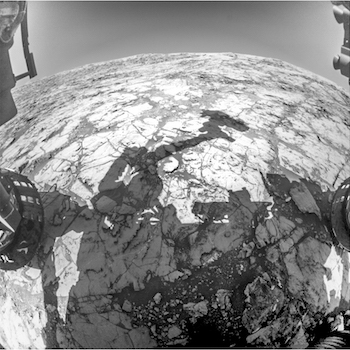
FLB_559588699EDR_F0660384FHAZ00302M_-br2Sol 1827, September 25, 2017, update by MSL scientist Scott Guzewich: Just when we thought we were going to leave this spot on Mars, we found ourselves stuck here for yet another sol. This time, a fault during one of our arm activities caused us to lose our plans for the past two sols (which would have included a drive to our next waypoint in the Vera Rubin Ridge science campaign) and we were in recovery mode again today. This picture of the arm’s shadow on the ground was taken just before the fault. So today, we make our third attempt to complete our science activities at this stop, including ChemCam and Mastcam targets of nearby bedrock: “Sherwood Forest”, “Tableland”, and “Troll Valley”. We were also able to plan a Mastcam image of a target named “Elf Woods” that was originally… [More at link]

Posted in Reports | Tagged , , , , , , , , , , , , | Comments Off