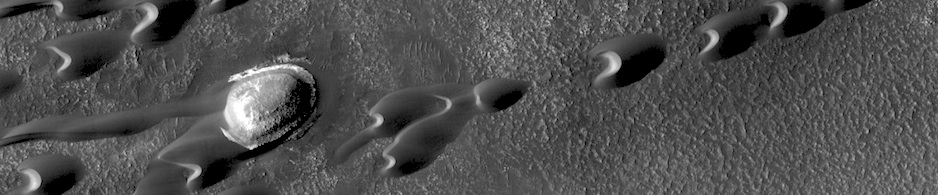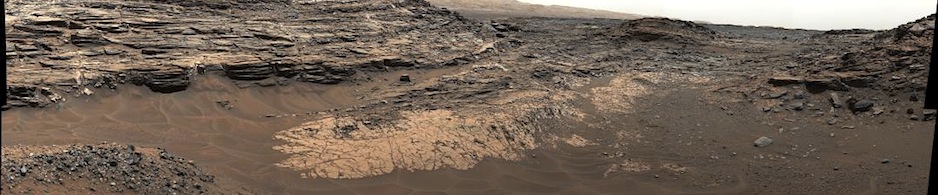
HiRISE: Candidate ExoMars landing site near Aram Dorsum

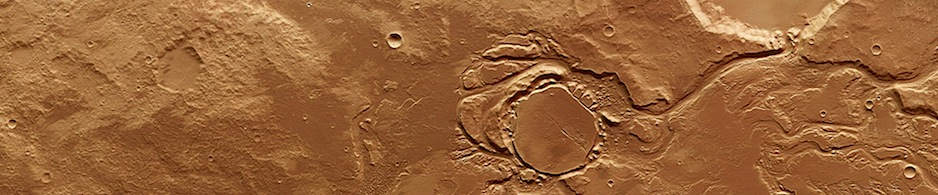
tumblr_owuwt3K76v1rlz4gso2_1280Candidate ExoMars landing site near Aram Dorsum. Beautiful Mars series.

Posted in Reports | Tagged , , , , , , , , , , , | Comments Off

Opportunity field report, September 22, 2017

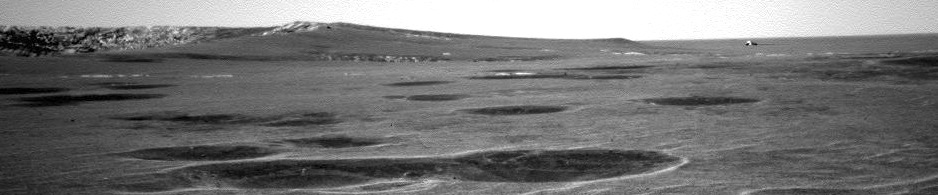
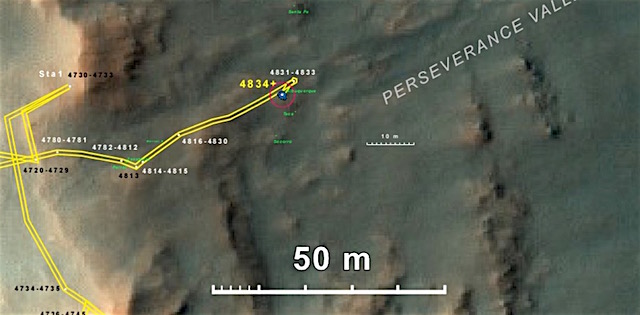
Slide28Sol 4857, September 22, 2017: Rover Field Report by Larry Crumpler, MER Science Team & New Mexico Museum of Natural History & Science: Opportunity is continuing its drive down Persevereance Valley, a channel that was cut in the inner wall of the 22 km-diameter Endeavour impact crater in ancient Mars (Noachian) time. This is the second stop of a series of stops as Opportunity drives down the valley. The goal is to collect field data that will help assess the origin of the valley. While the valley looks like a water-cut valley, we cannot be sure whether other processes like wind or drive flow have cut the valley. But that is why we are taking our time and collecting data as we drive. [More at link]

Posted in Reports | Tagged , , , , , , | Comments Off

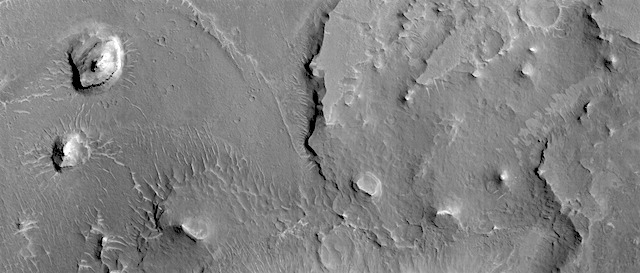
HiRISE: The Big Valley (Mars edition)

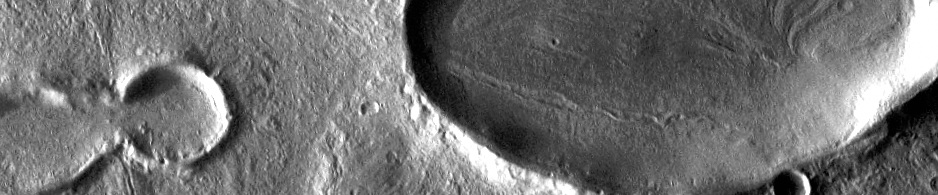
tumblr_ou48k5KWjJ1rlz4gso1_1280The Big Valley (Mars edition) — Libya Montes. Beautiful Mars series.

Posted in Reports | Tagged , , , , , , , | Comments Off

Opportunity: MI closeup on Bernalillo

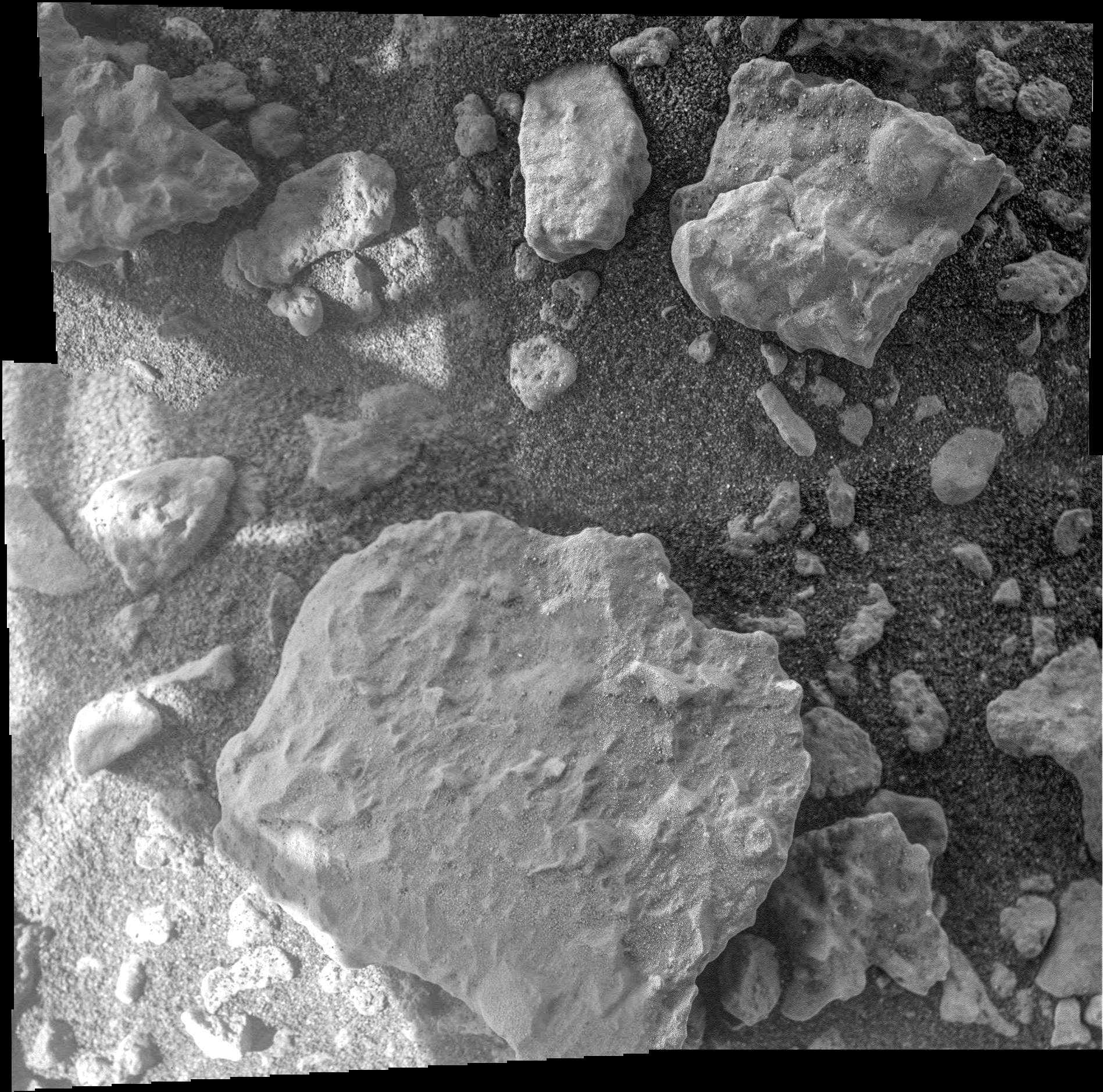
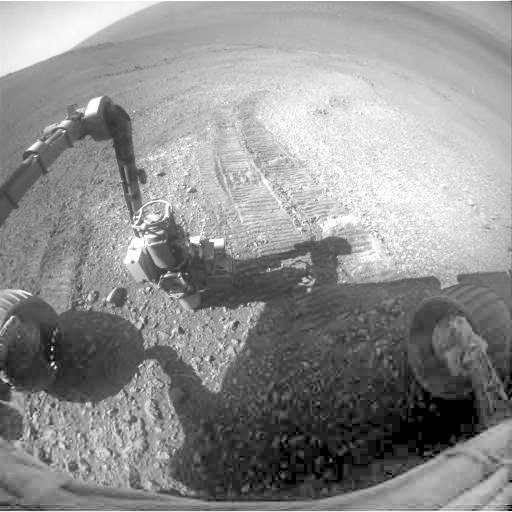
4857-mi1F559370548EDND0AKP1121R0M1Sol 4857, September 22, 2017. Sunlight and shadow play on a patch of ground, as seen by the Microscopic Imager (above). The large pebble is dubbed Bernalillo. (The present target naming system honors places along the Camino Real de Tierra Adentro, the 16th-century Spanish royal road between Mexico City and Taos, New Mexico.)

At right is a Hazcam view showing the overall scene. Click either image to enlarge it.

Opportunity raw images, its latest mission status, location map, and atmospheric opacity, known as tau.

Posted in Reports | Tagged , , , , , , | Comments Off

THEMIS: Landslides and dunes in Coprates Chasma

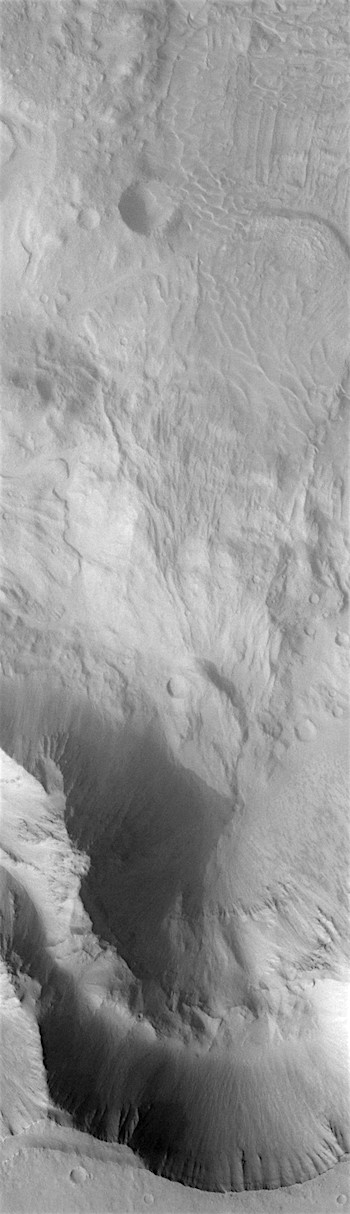
Landslides and dunes in Coprates Chasma (THEMIS_IOTD_20170925)THEMIS Image of the Day, September 25, 2017. This image is located on the eastern side of Coprates Chasma, near Capri Chasma. The image shows multiple landslide features, which form lobed shaped deposits at the bottom of the canyon cliff face. Sand dunes are visible both on the landslide deposit and other parts of the canyon floor.

Coprates Chasma is one of the numerous canyons that make up Valles Marineris. The chasma stretches for 960 km (600 miles) from Melas Chasma to the west and Capri Chasma to the east. Landslide deposits, layered materials and sand dunes cover a large portion of the chasma floor.

NASA’s Mars Odyssey spacecraft has spent over 15 years in orbit around Mars, circling the planet more than 69,000 times. It holds the record for longest working spacecraft at Mars. THEMIS, the IR/VIS camera system, has collected data for the entire mission and provides images covering all seasons and lighting conditions.

Over the years many features of interest have received repeated imaging, building up a suite of images covering the entire feature. From the deepest chasma to the tallest volcano, individual dunes inside craters and dune fields that encircle the north pole, channels carved by water and lava, and a variety of other feature, THEMIS has imaged them all.

For the next several months the Image of the Day will focus on the Tharsis volcanoes, the various chasmata of Valles Marineris, and the major dunes fields. We hope you enjoy these images!

More THEMIS Images of the Day by geological topic.
Posted in Reports | Tagged , , , , , , , , , , , , | Comments Off

Curiosity update: Reality and fantasy collide

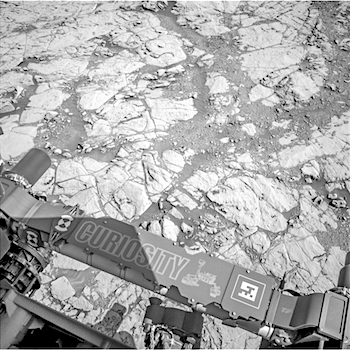
NLB_559245410EDR_F0660384NCAM00375M_-br2Sol 1824-26, September 22, 2017, update by MSL scientist Scott Guzewich: At times, it seems like fantasy that we have a nuclear-powered car exploring Mars and that I get to help that exploration, including today as the Science Operations Working Group Chair. But at other times, mundane reality creeps in to throw cold water on that. Such as happened yesterday when a network communications problem here on Earth resulted in yesterday’s Sol 1823 plan not being uplinked to Curiosity. That resulted in Curiosity performing a “runout” sol when only basic activities are performed.

But we picked up right where we left off yesterday and created a packed list of science activities to keep Curiosity busy over the weekend. We recovered the lost science on targets “Sherwood_Forest” and “Tableland” (both of which are just above the first letters in “Curiosity” in this image [above]), which includes ChemCam and Mastcam examinations of both and contact science on “Sherwood_Forest”. We added another fantasy-themed named target in “Troll_Valley” (just past the sandy spot above the Curiosity logo in that previous picture), which also will be examined by contact… [More at link]

Posted in Reports | Tagged , , , , , , , , , , | Comments Off

Vanadium: key element in search for Mars biosignatures?

mars rover rendering 800The search for biology on neighbor planet Mars won’t play out like a Hollywood movie starring little green men. Rather, many scientists agree if there was life on the Red Planet, it probably will present itself as fossilized bacteria. To find it, astrobiologists likely will need to decode the chemical analysis of rock samples performed by a rover (like the one NASA plans to send to Mars in 2020). Only then might humankind know conclusively that life exists beyond Earth.

A new paper in the journal Astrobiology suggests NASA and others hunting for proof of Martian biology in the form of “microfossils” could use the element vanadium in combination with Raman spectroscopy on organic material as biosignatures to confirm traces of extraterrestrial life.

“You’ve got your work cut out if you’re looking at ancient sedimentary rock for microfossils here on Earth —  and even more so on Mars,” said Craig Marshall, the paper’s lead author and an associate professor of geology at the University of Kansas. “On Earth, the rocks have been here for 3.5 billion years, and tectonic collisions and realignments have put a lot of stress and pressure on rocks. Also, these rocks can get buried, and temperature increases with depth.” [More at links]

Posted in Reports | Tagged , , , , , , | Comments Off

Curiosity update: “Will you come with me, sweet Reader?”

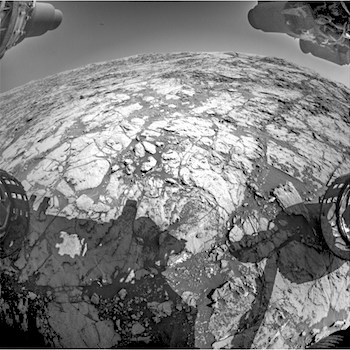
FRB_559245347EDR_F0660384FHAZ00302M_-br2Sol 1822, September 21, 2017, update by MSL scientist Mark Salvatore: Curiosity continues her traverse across the lowermost portions of Vera Rubin Ridge, where she continues to investigate the interesting rock textures and colors ahead. Our current location is quite dusty, which motivated the science team to focus on a relatively quick characterization of the surrounding bedrock, which will allow the rover to drive away and continue making progress towards some of the other interesting locations within Vera Rubin Ridge. The upcoming plan involves a quick “touch-and-go” using the APXS and MAHLI instruments for the chemical and morphological investigation (respectively) of a flat piece of bedrock named “Sherwood Forest.” After stowing her arm, Curiosity will then use Mastcam and ChemCam to analyze both “Sherwood Forest” and a dark-toned target named “Tableland.” These targets are located just to the left of center in this front Hazcam image.

Before driving away, Curiosity will also create a high-resolution Mastcam mosaic of a region to the southwest of her current location. This region was identified from orbit as a potential region of interest, as it shows a relatively steep slope with some potentially interesting bedrock exposures. Ever since ascending onto Vera Rubin Ridge, Curiosity has been making progress towards this location to determine whether it is worth investigating from close-range. As it turns out, the region doesn’t appear all that different from the parts of the ridge that Curiosity has already been exploring. [More at link]

Posted in Reports | Tagged , , , , , , , , , , | Comments Off

THEMIS: Shore of the sand sea

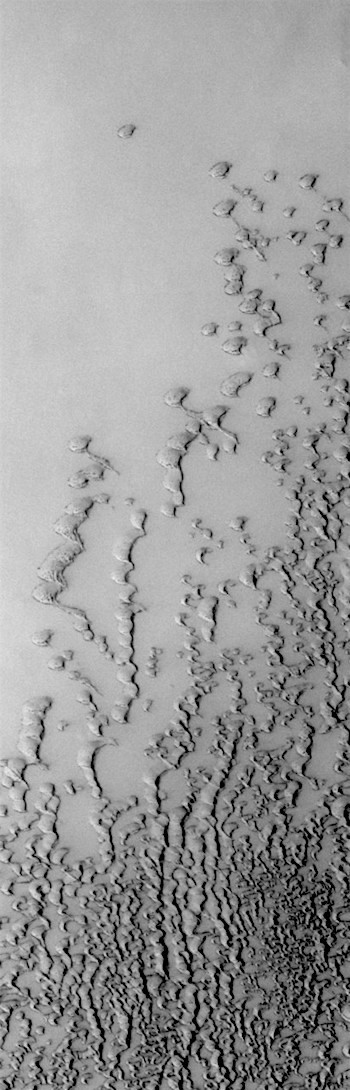
Edge of the sand sea in Siton Undae (THEMIS_IOTD_20170922)THEMIS Image of the Day, September 22, 2017. Siton Undae is a large dune field located in the northern plains near Escorial Crater. Siton Undae is west of the crater and is one of three dune fields near the crater. The nearby north polar cap is dissected by Chasma Boreale, which exposes an ice free surface. This image crosses the center of the dune field and was collected in early spring.

NASA’s Mars Odyssey spacecraft has spent over 15 years in orbit around Mars, circling the planet more than 69,000 times. It holds the record for longest working spacecraft at Mars. THEMIS, the IR/VIS camera system, has collected data for the entire mission and provides images covering all seasons and lighting conditions.

Over the years many features of interest have received repeated imaging, building up a suite of images covering the entire feature. From the deepest chasma to the tallest volcano, individual dunes inside craters and dune fields that encircle the north pole, channels carved by water and lava, and a variety of other feature, THEMIS has imaged them all.

For the next several months the Image of the Day will focus on the Tharsis volcanoes, the various chasmata of Valles Marineris, and the major dunes fields. We hope you enjoy these images!

More THEMIS Images of the Day by geological topic.

Posted in Reports | Tagged , , , , , , , , , , , , , , | Comments Off

Mars Express: Rover craters

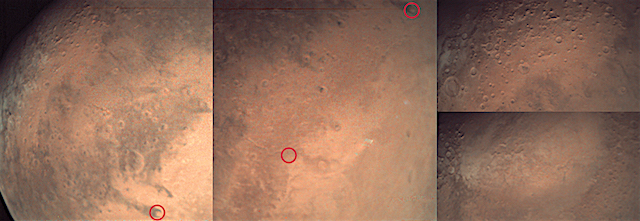
Rover_cratersIn the week of 18 September 2017, the low-resolution webcam on ESA’s Mars Express captured some impressive images from between 3000 km to 5000 km altitude.

The image series is being used to calibrate the camera now that it has been promoted to a ‘full’ science instrument (Mars webcam goes pro).

This week, the images provided reasonably good definition for many craters on the surface, including several that are occupied by NASA rovers.

In the composite image above, moving from lower left to upper right, three craters are circled.

The first shows Gale crater, which is occupied by NASA’s Curiosity rover. The second circle, to the right in the middle, shows Gusev Crater, home of the retired Spirit rover. The last circle, at top right of the middle image, also indicates the location of Gale crater and Curiosity…. [More at link]

Posted in Reports | Tagged , , , , , , , , , , | Comments Off