





HRSC: Remnants of a mega-flood

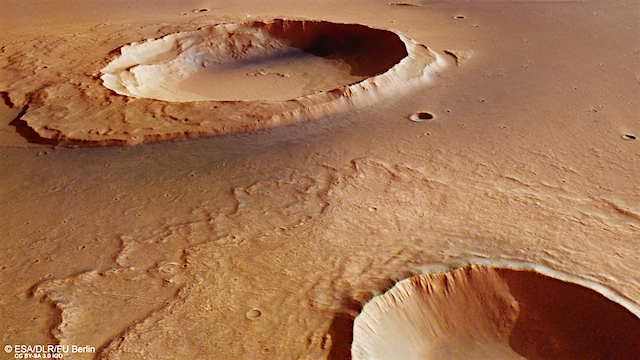
Perspective_view_towards_Worcester_craterESA’s Mars Express has captured images of one of the largest outflow channel networks on the Red Planet.

The Kasei Valles channel system extends around 3000 km from its source region in Echus Chasma – which lies east of the bulging volcanic region Tharsis and just north of the Valles Marineris canyon system – to its sink in the vast plains of Chryse Planitia.

A combination of volcanism, tectonics, collapse and subsidence in the Tharsis region led to several massive groundwater releases from Echus Chasma, which subsequently flooded the Kasei Valles region around 3.6–3.4 billion years ago. These ancient mega-floods have left their mark on the features seen today.

Sections of Kasei Valles have already been imaged by Mars Express during its 14 years at the Red Planet, but this new image, taken on 25 May 2016, captures a portion right at its mouth.

A 25 km-wide impact crater – Worcester Crater – just left to the centre of the main colour image, has done its best to stand up to the erosive forces of the mega-floods.

While much of the blanket of material surrounding the crater – which was originally thrown out from inside the crater during the impact – has been eroded, the section downstream of the flood has survived. Over time this has led to the overall appearance of a streamlined island, with its stepped topography downstream perhaps suggesting variations in water levels or different flood episodes. [More at link]

Posted in Reports | Tagged , , , , , , , , , , , | Comments Off

Can methanogens survive on Mars?

170302092128_1_540x360Researchers at the University of Arkansas recently took a step toward answering a question for the ages: Is there life on Mars? Answer: they can’t rule it out.

Two recent publications suggest that life, in the form of ancient, simple organisms called methanogens, could survive the harsh conditions found near the surface of Mars, and deep in its soils. Using methanogens to test for survivability is particularly relevant because scientists have detected their byproduct, methane, in the Martian atmosphere. On Earth, methane is strongly associated with organic matter, though there are non-organic sources of the gas, including volcanic eruptions. (…)

“We consider methanogens ideal candidates for possible life on Mars because they are anaerobic, and non-photosynthetic, meaning that they could exist in the subsurface,” said Rebecca Mickol, a Ph.D. candidate at the Arkansas Center for Space and Planetary Science.“Just a few millimeters of Martian regolith is enough to protect the organisms from the dangerous UV and cosmic radiation that hits the surface. Additionally, methane has been detected in the Martian atmosphere, via multiple space-based and ground-based sources, including the Martian rover, Curiosity. Although these findings are still controversial, the presence of methane on Mars is particularly exciting because most methane on Earth is biological in origin.”

Mickol is the lead author on a study titled “Low Pressure Tolerance by Methanogens in an Aqueous Environment: Implications for Subsurface Life on Mars,” published in September in the journal Origins of Life and Evolution of Biospheres. (…)

Pradeep Kumar, an assistant professor in the Physics Department, is looking at the implications for life deeper on Mars: as far down as 30 kilometers — more than 18 miles — under the planet’s surface. (…) On Earth, methanogens that survive in hydrothermal environments do so despite a wide range of pressures, pH levels and temperatures. (…)

The results, published in February the journal Planetary and Space Science, show that the methanogen M. wolfeii, one [of] the species Mickol experimented with, survived all pressure and pH levels. In acidic conditions, its growth rate increased with higher pressures. In neutral and alkaline conditions, the growth rate increased initially, then decreased with higher pressures.

“Given the discovery of methane in Martian atmosphere, our study raises an exciting possibility of methanogenic archaea to be a viable organism that can survive and possibly thrive in the subsurface conditions of Mars,” Kumar said. [More at links]

Posted in Reports | Tagged , , | Comments Off

MAVEN fires rocket engine to dodge Phobos

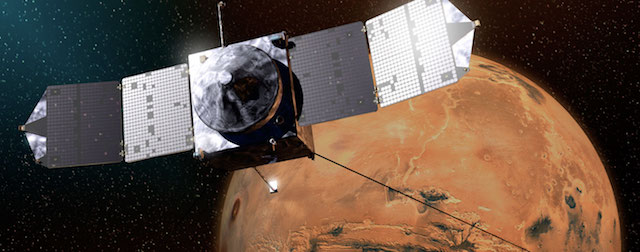
maven20170302-16NASA’s MAVEN spacecraft performed a previously unscheduled maneuver this week to avoid a collision in the near future with Mars’ moon Phobos. (…)

On Tuesday, Feb. 28, the spacecraft carried out a rocket motor burn that boosted its velocity by 0.4 meters per second (less than 1 mile per hour). Although a small correction, it was enough that — projected to one week later when the collision would otherwise have occurred — MAVEN would miss the lumpy, crater-filled moon by about 2.5 minutes.

This is the first collision avoidance maneuver that the MAVEN spacecraft has performed at Mars to steer clear of Phobos. The orbits of both MAVEN and Phobos are known well enough that this timing difference ensures that they will not collide. (…)

Said MAVEN Principal Investigator Bruce Jakosky of the University of Colorado in Boulder, “Kudos to the JPL navigation and tracking teams for watching out for possible collisions every day of the year, and to the MAVEN spacecraft team for carrying out the maneuver flawlessly.” [More at link]

Posted in Reports | Tagged , , , , | Comments Off

HiRISE: Isidis Basin ejecta

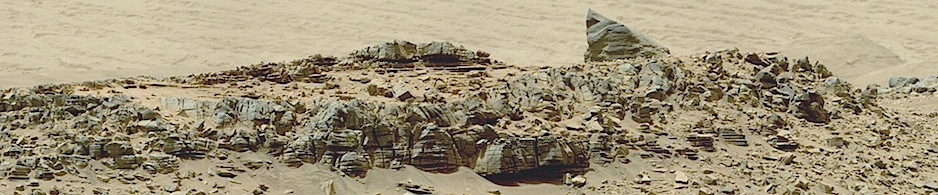
ESP_011261_1960This scene is a jumbled mess! There are blocks and smears of many different rocks types that appear to have been dumped into a pile.

That’s probably about what happened, as ejecta from the Isidis impact basin to the east. This pile of old rocks is an island surrounded by younger lava flows from Syrtis Major. [More at link]

Posted in Reports | Tagged , , , , , , , | Comments Off

THEMIS: Channels of Nirgal Vallis

Branching channels of Nirgal Vallis (THEMIS_IOTD_20170302)THEMIS Image of the Day, March 2, 2017. This VIS image shows a portion of Nirgal Vallis. A tributary of the channel is seen on the left side of the image, with the main channel crossing the image from left to right.

More THEMIS Images of the Day by geological topic.

Posted in Reports | Tagged , , , , , , , , | Comments Off

Curiosity update: Change detection & additional remote sensing

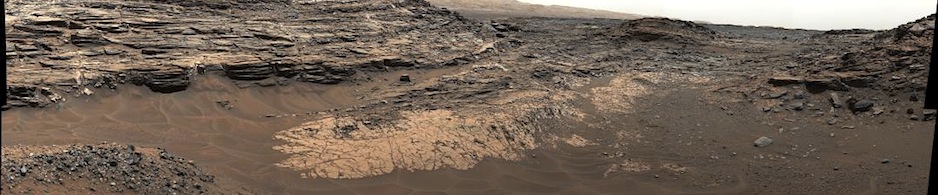
1621MR0083150000801213E01_DXXXSol 1625-26, March 1, 2017, update by USGS scientist Lauren Edgar: We’re still at the second stop of the Bagnold Dune campaign, running a few more MAHLI diagnostics and focusing on targeted remote sensing.  I was the GSTL today and it was still a pretty busy day for the GEO theme group.  The first sol includes a ChemCam observation of a ripple crest (similar to the observation from Sol 1621 shown in the above Mastcam image) and a long distance RMI to look for changes on the slope of Mt. Sharp.  We’ll also use Navcam to search for dust devils, and Mastcam will survey the color and opacity of the atmosphere.  The second sol includes ChemCam observations of “Allagash” and “Hersey” to… [More at link]

Posted in Reports | Tagged , , , , , , , , , , | Comments Off

HiRISE: Martian meanders and scroll-bars

ESP_020673_1750This is a portion of an inverted fluvial channel in the region of Aeolis / Zephyria Plana, at the Martian equator.

Channels become inverted when the sediments filling them become more resistant to erosion than the surrounding material. Here, the most likely process leading to hardening of the channel material is chemical cementation by precipitation of minerals. Once the surrounding material erodes, the channel is left standing as a ridge. The series of curvilinear lineations are ancient scroll-bars, which are features typical of river meanders (bends) in terrestrial fluvial channels.

Scroll-bars are series of ridges that result from the continuous lateral migration of a meander. On Earth, they are more common in mature rivers. The presence of scroll bars suggests that the water flow in this channel may have been sustained for a relatively long time. [More at link]

Posted in Reports | Tagged , , , , , , , , , , , , , , | Comments Off

HiRISE: Floor of Ius Chasma

tumblr_olh8esdTim1rlz4gso1_1280Floor of Ius Chasma. Beautiful Mars series.

Posted in Reports | Tagged , , , , , , , , | Comments Off

MARCI weather report, February 20-26, 2017

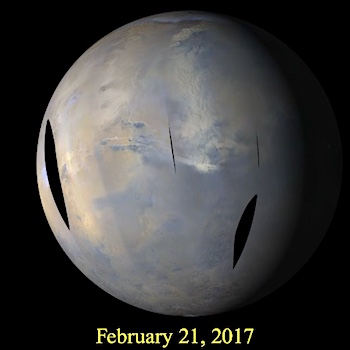
feb-21-2017A major dust storm system traveled down the Acidalia storm-track this past week on Mars. Two dust storms observed at the beginning of the week, quickly merged, forming a regional dust storm. The regional dust storm was further fed by subsequent dust lifting over Acidalia. At the middle of the week, the storm swept east and west affecting Lunae Planum and western Arabia. By the following sol, a regional scale dust storm also cropped up over the Solis-Sinai region. Furthermore, this storm merged with the major storm and propagated southwest over Aonia and eastern Daedalia. The eastern extents of the major storm stretched over Argyre and western Noachis as well.  [More at link, including video]

Posted in Reports | Tagged , , , , , , , , , , , , , | Comments Off

THEMIS: Tapestry of once-molten rock

Layers of lava on Daedalia Planum (THEMIS_IOTD_20170301)THEMIS Image of the Day, March 1, 2017. This VIS image shows a portion of Daedalia Planum, an extensive volcanic plain comprised of flows from Arsia Mons. Different flow surface textures help delineate different flows. (This image was taken shortly after local sunrise, so the light is coming from the right. Use the small crater at center right to orient you.)

More THEMIS Images of the Day by geological topic.

Posted in Reports | Tagged , , , , , , , , , , | Comments Off