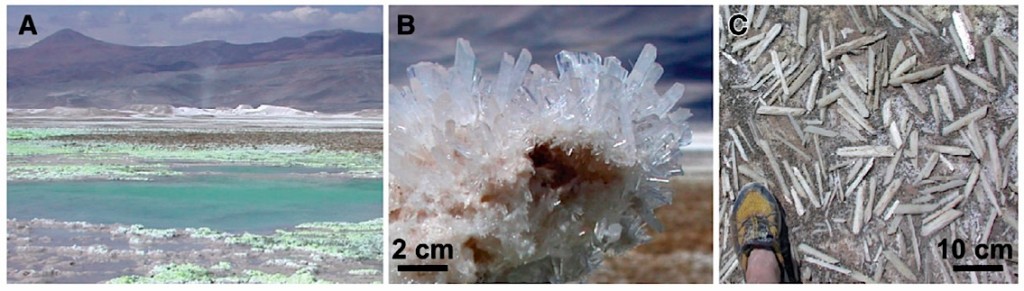
ACID SALTY LAKES. Terrestrial lakes in Mars-like environments high in the Andes Mountains show that naturally occuring sulfate minerals can preserve both fossils of ancient microbes and harbor communities of living microorganisms. (Image taken from Figure 1 in the paper.)
Sulfate minerals, such as calcium sulfates (gypsum), are common in areas on Mars, having been documented with data from satellites, landers, and rovers. Could these minerals also preserve the remains of ancient life, ask Kathleen Counter Benison and Francis Karmanocky III (West Virginia University) in a recent paper in the journal Geology.
“Despite the abundance of gypsum on Mars and the search for signs of life on Mars,” they note, “few studies have been conducted about the fossilization potential of gypsum on either Earth or Mars.”
The scientists examined a pair of shallow acidic saline lakes (Salar Gorbea and Salar Ignorado), both lying at high altitude (about 4,000 meters or 13,000 feet) in the Andes Mountains of northern Chile.
Microbiological analyses of surface waters at Salar Gorbea identified diatoms, green algae, and several classes of bacteria, showing that microbial life exists in the acid saline waters. The waters precipitate a suite of minerals besides gypsum, including halite, sulfur, jarosite, alunite, hematite, and clay minerals. The lakes lie on the flanks of active composite volcanoes and the host sediment is volcanic sand and gravel.
“Salars Gorbea and Ignorado are extreme terrestrial environments in several ways,” the scientists explain. “The setting is high in elevation and extremely arid, with very high winds, large daily and seasonal temperature ranges, and little macroscopic life.” The water chemistry is also extreme, with a pH is as low as 1.8 and salinity as high as 28%.
“We propose that Salars Gorbea and Ignorado are among the best-known terrestrial analogs for Mars because they are similar in geochemistry, mineral composition, and sedimentary processes and products.”
To identify microbes encapsulated in the gypsum, the team collected crystals, split them along cleavage planes, and examined their interiors with a microscope. They found that fluid inclusions in the crystals acted as host environments.
“Could microfossils and/or viable microorganisms be trapped in gypsum on Mars as they are in gypsum on Earth?” they ask.
“We suggest that gypsum on Mars would have entrapped, as solid inclusions and within fluid inclusions, any microorganisms and/or organic compounds that were present in its parent waters,” they note. “Therefore, fluid inclusions and solid inclusions hosted by salt minerals may be the best place to continue the search for life on Mars.”
Looking ahead, they propose that future lander and rover missions to Mars should be equipped with cleaving and optical imaging capabilities with magnifications up to 2000x. These tools would allow for Martian gypsum and other salt minerals to be optically examined in place for microfossils. This would help scientists target specific samples for more advanced methods, leading to chemical and biological identification of organic materials.
They also conclude that their findings “leave open the possibility that there may be a living microbiological community on Mars today.”




 NASA is taking steps to protect its Mars orbiters, while preserving opportunities to gather valuable scientific data, as Comet C/2013 A1 Siding Spring heads toward a close flyby of Mars on Oct. 19. The comet’s nucleus will miss Mars by about 82,000 miles (132,000 kilometers), shedding material hurtling at about 35 miles (56 kilometers) per second, relative to Mars and Mars-orbiting spacecraft. At that velocity, even the smallest particle…could cause significant damage to a spacecraft… [More at link]



 In late afternoon