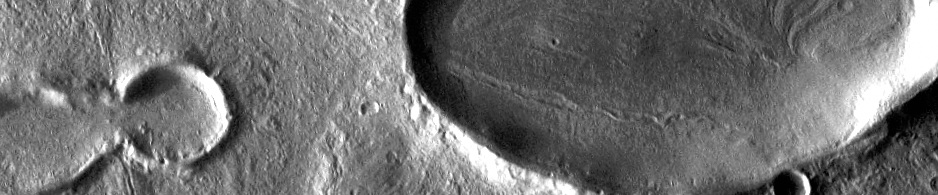
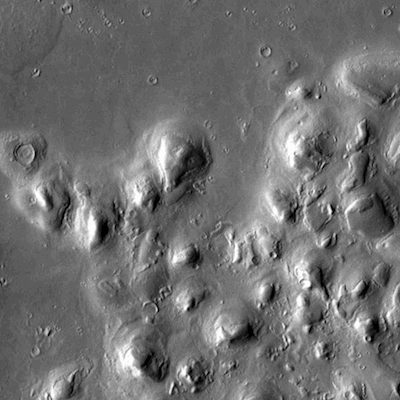
HiRISE image: Fissure near Cerberus Fossae with tectonic morphologies

The linearity of the volcanic vent shown in this HiRISE image, in conjunction with evidence of lava flow from the vent, suggests control by combined volcano-tectonic processes…. [More at link]
Posted in Reports | Tagged , , , , , , | Comments Off

THEMIS image: Galaxias Colles

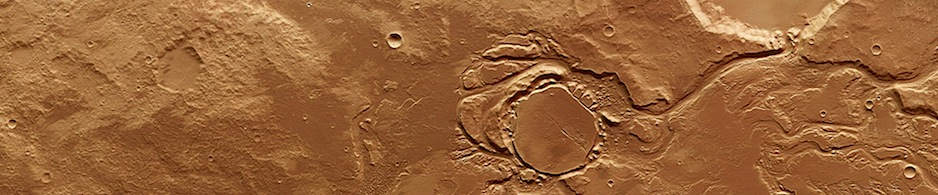
THEMIS Image of the Day, January 22, 2014. The hills in this VIS image appear mantled with material that is probably ice-rich. They are part of a large region of hills located north of Hecates Tholus.

Posted in Reports | Tagged , , | Comments Off

Recurring slope lineae discovered deep in Valles Marineris

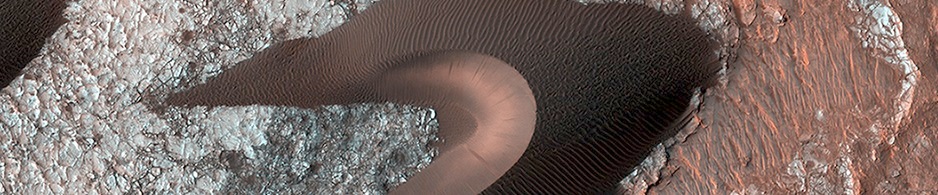
Discovered in 2011, recurring slope lineae (RSL for short) are narrow, dark lines on steep slopes. They appear and grow longer during the warmest time of year, then fade and disappear over winter. They recur in the same places the following Mars year, and appear to emerge from bedrock layers. Continue reading

Posted in Reports | Tagged , , , , , , , , , , , , | Comments Off

Impact debris from Mars lies everywhere on Phobos

On Earth there are meteorites that arrived naturally from the Moon and also ones from Mars that arrived the same way. Both are fragments that were ejected into space at escape velocity in the aftermath of big meteorite impacts. Continue reading

Posted in Reports | Tagged , , | Comments Off

Debris aprons and valley fill hold ancient ice several hundred million years old

Along the edge of the crustal dichotomy, where the southern highlands step down onto the northern plains, lies a landscape of mesas, buttes, and valleys. Valleys appear choked with linear streams of debris, and on the flanks of many mesas are gently sloping aprons of debris that make each resemble a half-melted ice cream sandwich. Continue reading

Posted in Reports | Tagged , , , , , , | Comments Off

Pressure-release melting put rocky floors into early Mars craters

Martian craters in the highlands that are wider than 10 kilometers (6 miles) often have flat, smooth, shallow floors. This fact has been noted since the first spacecraft images of Mars were taken by NASA’s Mariner 4 in 1965. Over the years, scientists have suggested variously that the cause could be windblown sediments, lakebed sediments, impact melt, or volcanism. Continue reading

Posted in Reports | Tagged , , , , | Comments Off

Hematite ridge: site for Curiosity rover to explore ancient habitability?

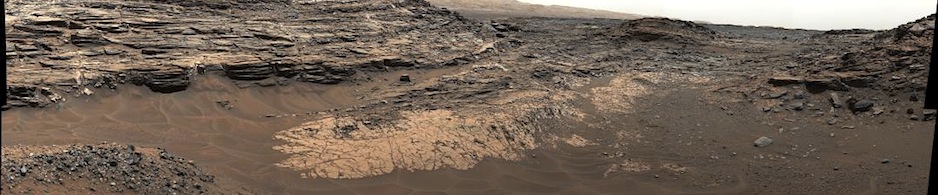
A low ridge running along the foot of Mt. Sharp will likely become a prime target for Curiosity, the Mars Science Laboratory rover as it approaches the mound. The reason, outlined in a recent paper in Geology by Abigail Fraeman (Washington University, St. Louis) and a team of coauthors, is that the ridge appears capped with a substantial deposit of hematite. Continue reading

Posted in Reports | Tagged , , , , , , , | 2 Comments

Spiral troughs in Mars polar caps are born in ‘cyclic steps’

Both Martian polar caps have deep spiral troughs that slice into them for dozens or hundreds of kilometers, but their origin and development has been much debated by scientists. New work by a team of researchers led by Isaac Smith (University of Texas) combines theoretical insights with data from the Shallow Radar (SHARAD) instrument on NASA’s Mars Reconnaissance Orbiter to suggest an origin for the features. Continue reading

Posted in Reports | Tagged , , , , , , , , , , , , , , , | Comments Off

Mars dust devils travel much faster than surface winds blow

Extending earlier work, a team of Mars scientists led by Dennis Reiss (Westfälische Wilhelms-Universität, Germany) has made simultaneous (or near-) observations of dust devil speeds using cameras on NASA’s Mars Reconnaissance Orbiter. The cameras include CRISM, CTX, and HiRISE. The data run from 2008 to 2011, and the results are published in Icarus. Continue reading

Posted in Reports | Tagged , , , , , , , , , | Comments Off

Supervolcanos in Arabia on Mars: Update

The idea of giant volcanos erupting in Arabia was proposed by Joseph Michalski (Planetary Science Institute) in a talk at the Lunar and Planetary Science Conference in March 2013. Michalski and coauthor Jacob Bleacher (NASA Goddard Space Flight Center) have now published a more detailed report on their work in Nature. Continue reading

Posted in Reports | Tagged , , , , , , , , , , , , , | Comments Off