Dry ice slabs carve linear grooves down Mars dunes

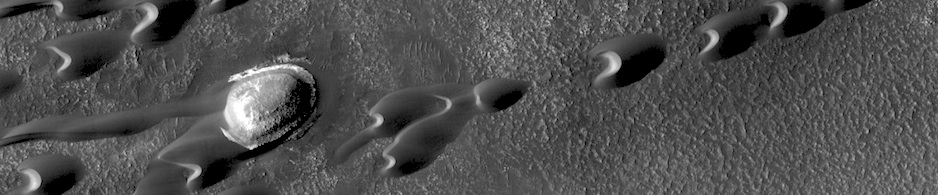
The “megadune” in Russell Crater features linear grooves or gullies a few meters wide, a meter or two deep, and roughly a kilometer or two long. Continue reading

Posted in Reports | Tagged , , , , , , , | Comments Off

Was nitrogen in the early Mars atmosphere a key to ancient habitability?

Scientists have long suspected that ancient Mars had a thicker atmosphere and temperatures warmer and far more habitable than at present. But modelers have difficulties making the numbers come out right, Continue reading

Posted in Reports | Tagged , , , , , , , , , , | Comments Off

Well-rounded pebbles in Gale Crater’s rocks point to longtime stream flow

Mars Science Laboratory rover Curiosity landed in Gale Crater at a feature called Bradbury Rise, which lies near the far end of the Peace Vallis alluvial fan. The fan is a broad, flat deposit of sand, gravel, and pebbles washed down from Gale’s northern rim that sprawls on the crater floor. Continue reading

Posted in Reports | Tagged , , , , , , , , , , , , , , , , , , | 1 Comment

Aeolis Serpens, Mars’ longest sinuous ridge, is an ancient riverbed

A linear ridge that winds for more than 200 kilometers (120 miles) through part of South Australia was a river channel roughly 10 million years ago. After the paleoriver stopped flowing, silica-rich groundwater seeped into the riverbed, cementing its sediments. Continue reading

Posted in Reports | Tagged , , , , , , , , , , | Comments Off

Most deltas on Mars created by short, catastrophic floods

Rivers that run into lakes and other standing bodies of water drop sediment where the flow slackens as it enters the body of water. Over time, the accumulating material builds a delta — a wedge of sediment whose form can tell scientists about both the river’s activity and that of the body of water. Continue reading

Posted in Reports | Tagged , , , , , , , | Comments Off

Are brines actually needed to make recurring slope lineae flow?

Recurring slope lineae (RSL) are finger-like dark lines on steep slopes that appear and grow longer during the warmest time of year, then fade and disappear over winter. They repeat the following Mars year in the same places. While scientists have not pinpointed the fluid responsible for the flows, the betting runs heavily on brines: water full of salts that lower the freezing point.

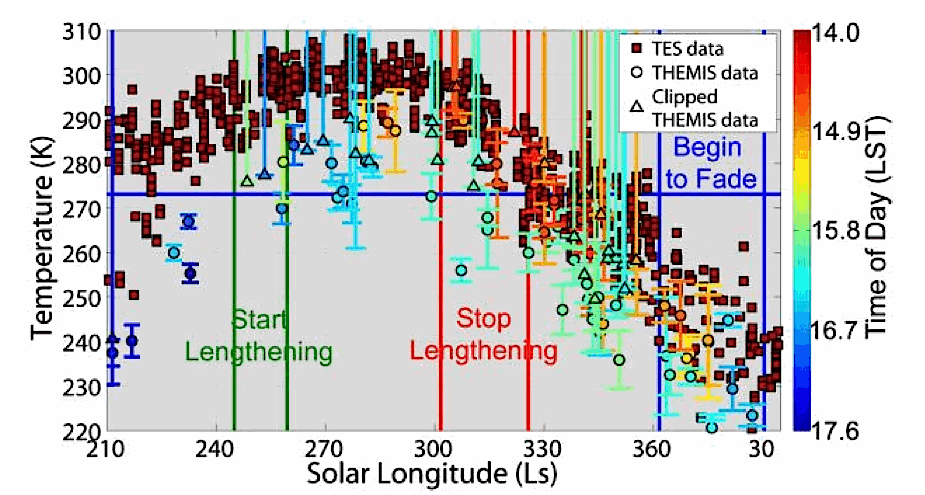
BASKING IN WARMTH. Recurrent slope lineae (RSL) lengthen only at times of year when ground temperatures rise above freezing (blue horizontal line). This suggests that RSL flows do not require salt-laden brines and that fresh water alone is sufficient. (Image taken from the online abstract.)

Brines may be involved, says David Stillman (Southwest Research Institute, Boulder), but fresh water can do the job on its own. Reporting (PDF) on the work of a team of scientists, Stillman spoke at the 44th Lunar and Planetary Science Conference in The Woodlands, Texas.

The team used images from the HiRISE and Context (CTX) cameras, and derived ground temperatures using data from the Thermal Emission Spectrometer (TES), Mars Climate Sounder (MCS), and Thermal Emission Imaging System (THEMIS). The survey revealed the stages the RSL typically go through each Mars year.

“RSL start lengthening when near-maximum (roughly 2 p.m.) temperatures reach 296 Kelvin (73° F),” the scientists note, “and they stop lengthening at 289 K (61° F).” THEMIS mid-afternoon surface temperatures indicate that RSL lengthen only when the temperature is above 273 K, or the freezing point of pure water. Water-saturated soil can be expected to be above freezing to a depth of about 10 centimeters (4 inches) for several hours a day, the team says.

Mid-latitude RSL appear to be associated with surface features suggesting buried ice (for example, ice-rich latitude-dependent mantled units, pedestal craters, concentric crater fill, etc.). The team notes, “This ice is more than 400,000 years old and would likely maintain a saturated subsurface atmosphere.”

Stillman’s group says, “We suggest that the reason RSL emanate from bedrock outcrops is because bedrock has a thermal conductivity about 40 times greater than regolith (dry soil) does.” This allows the wave of annual heat to penetrate in bedrock to a depth of several meters (yards).

During winter, the subsurface temperature of outcropping bedrock will fall below the frost point of the subsurface atmosphere. Consequently, water vapor will condense into the bedrock unit throughout the winter. In spring, subsurface temperatures begin to rise, ultimately melting the ice in the bedrock, allowing it to flow.

Finally, the team concludes, “RSL lengthen when surface temperatures rise above 273 K [32° F]. This suggests high concentrations of brine are not necessary to generate the RSL. Our proposed flow mechanism explains the repeatability of RSL and allows vapor-deposited ice to recharge bedrock, even at topographic highs such as crater central peaks.”
Posted in Reports | Tagged , , , , , , , , , , , , , , , , | Comments Off

‘Faint young Sun paradox’ a problem for Mars (and Earth, too)

Astronomers say that billions of years ago when the Sun was young, it shone with only 70 percent its current brightness, notes Robert Craddock (Smithsonian Institution). If that were true of today’s Sun, Continue reading

Posted in Reports | Tagged , , , , , , , , , | Comments Off

Gale’s winds sculpted the Mt. Sharp mound as they built it

The major reason for sending the Mars Science Laboratory rover Curiosity to Gale Crater is the five-kilometer (three-mile) high layered mound, dubbed Mt. Sharp, that looms at the crater’s center. The lowest layers have been altered by water Continue reading

Posted in Reports | Tagged , , , , , , , , , , , , | Comments Off

Dust drifts: new windblown feature on Mars?

Mars has ample loose material blowing around on its surface, a fact which has been known and studied for decades and more. However scientists have paid little attention to sedimentary deposits of dust. Continue reading

Posted in Reports | Tagged , , , , , , , , | Comments Off

Icy jets erupt from north polar dunes in spring

Jets of gas erupting in the springtime from beneath slabs of carbon dioxide ice at the Martian south pole was a dramatic finding in 2006. It explained the mysterious “spiders” which came and went each year. Continue reading

Posted in Reports | Tagged , , , , , , | Comments Off