Gale Crater’s Lake District

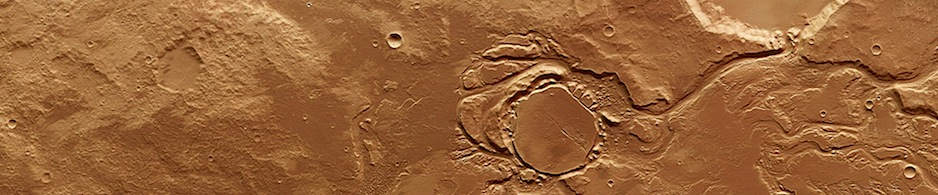
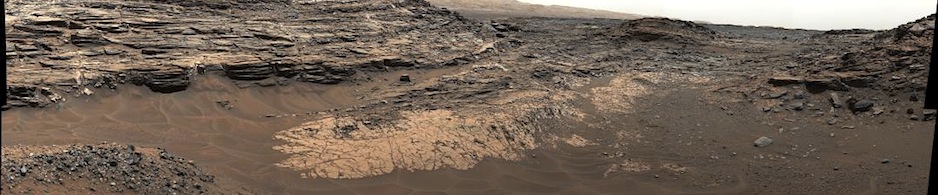
Mars rover Curiosity landed on, or just beyond, the far end of an alluvial fan — rocks, gravel, and sand washed down by the Peace River from the north rim of Gale Crater. The rover has driven for 200 sols (Mars days) across a landscape that was shaped and mineralogically altered by water, and which lies near the lowest part of Gale Crater’s floor. Continue reading

Posted in Reports | Tagged , , , , , , , , , | Comments Off

Does Arabia show a new style of Martian volcanism?

Arabia is one of the largest and oldest regions of Mars. Among its varied rocks are widespread deposits of soft and easily eroded ones which may have a volcanic origin. However, Arabia has no obvious volcanic vents or sources. Continue reading

Posted in Reports | Tagged , , , , , , , , , , , | Comments Off

Developing a stratigraphic column for Gale Crater’s floor

After more than 100 sols (Martian days) in Gale Crater, NASA’s Curiosity rover has driven some 500 meters (1,600 feet), traversing several rock units. A sketch of the crater floor’s geological history is emerging.

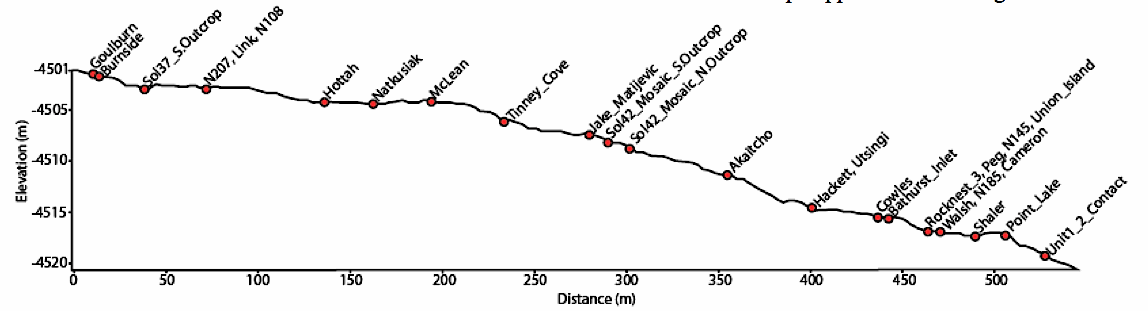
HIGHER IS YOUNGER and lower is older: Curiosity descended in elevation and time as it drove eastward from Bradbury Landing. (Image from abstract.)

On its half-kilometer drive from its landing site on Bradbury Rise eastward toward Yellowknife Bay, Curiosity descended about 15 m (50 ft) in elevation. While much of the drive was across loose sand and gravel sediments, Curiosity also passed several outcrops of bedrock. These gave scientists a look at the rock units making up part of the Gale Crater floor.

A team of researchers led by Kathryn Stack (Caltech) reported (PDF) on the first drafts for a stratigraphic column for Gale’s floor at the 44th Lunar and Planetary Science Conference in The Woodlands, Texas.

“This study presents an inventory of outcrops targeted by Curiosity, grouped by lithological properties observed in Mastcam and Navcam imagery,” the researchers say. The team identified potential outcrop locations in color Mastcam and Navcam images using thickness, orientation, and similarity to nearby rock fragments so as to distinguish outcrops from “float,” rocks separated from their original location.

They then sorted and classified the outcrops by tone and color, presence of bedding, grain-size, and weathering style into several types. These types included conglomerates, fine-grain beds, and thickly bedded and fractured ones.

“Creating stratigraphic columns from a 2D rover traverse cross-section requires several assumptions,” the team cautions. These were that the outcrops represent layers located where they formed, that they were deposited horizontally and are still horizontal so that outcrop elevations reflect their stratigraphic position, and finally, that younger units lie above older ones.

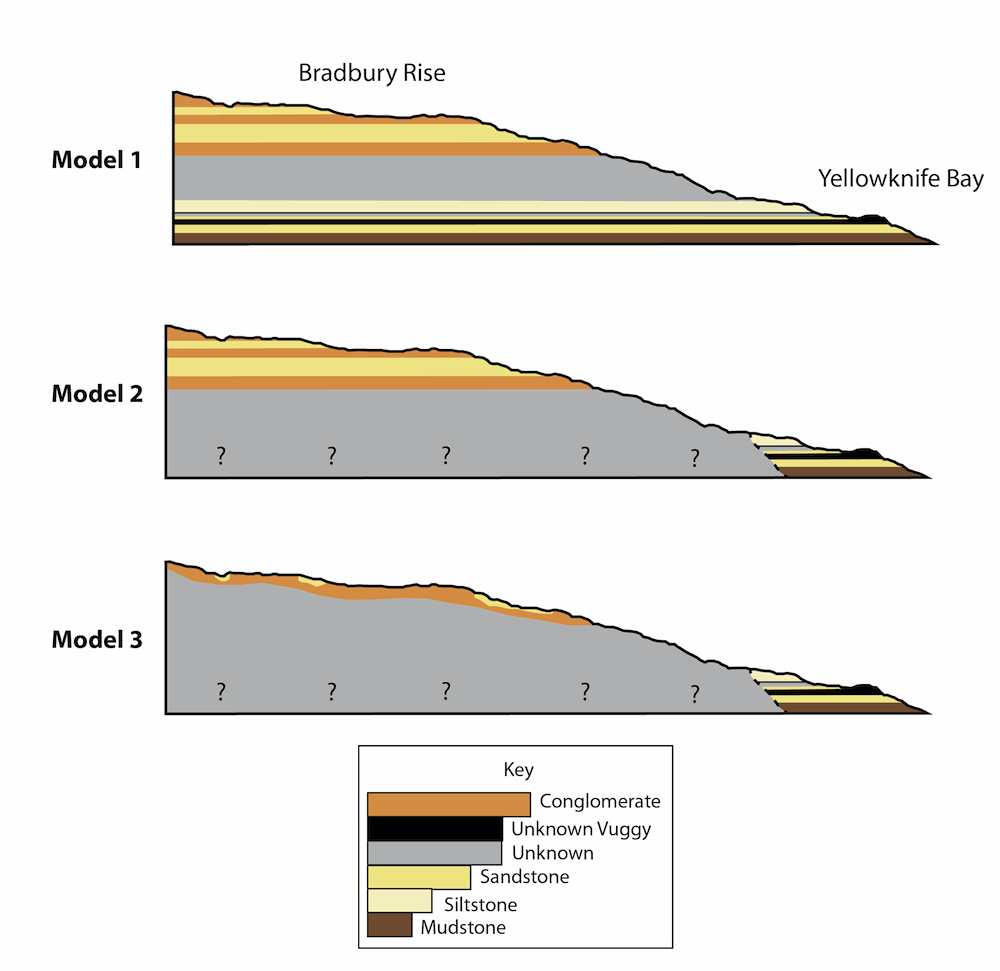
THREE MODELS for the local geology at the Curiosity landing site. In each, coarse outcrops of gravel and pebbles ("conglomerates") lie on top. These represent sediments deposited by ancient stream flow. Thickly bedded mudstones on the bottom reflect fine-grain sediments, perhaps deposited in at the far end of an alluvial fan. (Image from K. Stack.)

Model 1 assumes a “layer-cake” stratigraphy where fine-grained cross-stratified sandstones are interbedded with the Bradbury gravels. In this model, the rock units of Yellowknife Bay are older than those exposed on Bradbury Rise.

In Model 2, the Yellowknife Bay units represent a distinct sequence of rocks from those deposited on Bradbury Rise. In this scenario the rocks at Yellowknife Bay are in on-lap relationship with those of Bradbury Rise meaning that the Yellowknife Bay sequence may be younger or equivalent in age to the rocks of Bradbury Rise.

Model 3 considers the Bradbury conglomerates to be the youngest unit in the sequence, deposited unconformably  as a thin surficial deposit on Bradbury Rise.

“It may not be possible to distinguish between the three stratigraphic models at this point in the mission,” the team acknowledges. But they note that stratigraphic frameworks such as these can help guide the selection of targets for camera observations, drilling, and detailed geochemical analysis.

Posted in Reports | Tagged , , , , , , , | Comments Off

Subsurface radar profiles Marte Vallis outflow channel in 3D

Ground-penetrating radar on NASA’s Mars Reconnaissance Orbiter (MRO) reveals buried channels that show floods of water from Cerberus Fossae eroded Marte Vallis in two distinct stages, and they did so to a much greater extent than is visible today.

Marte Vallis channels seen by radar

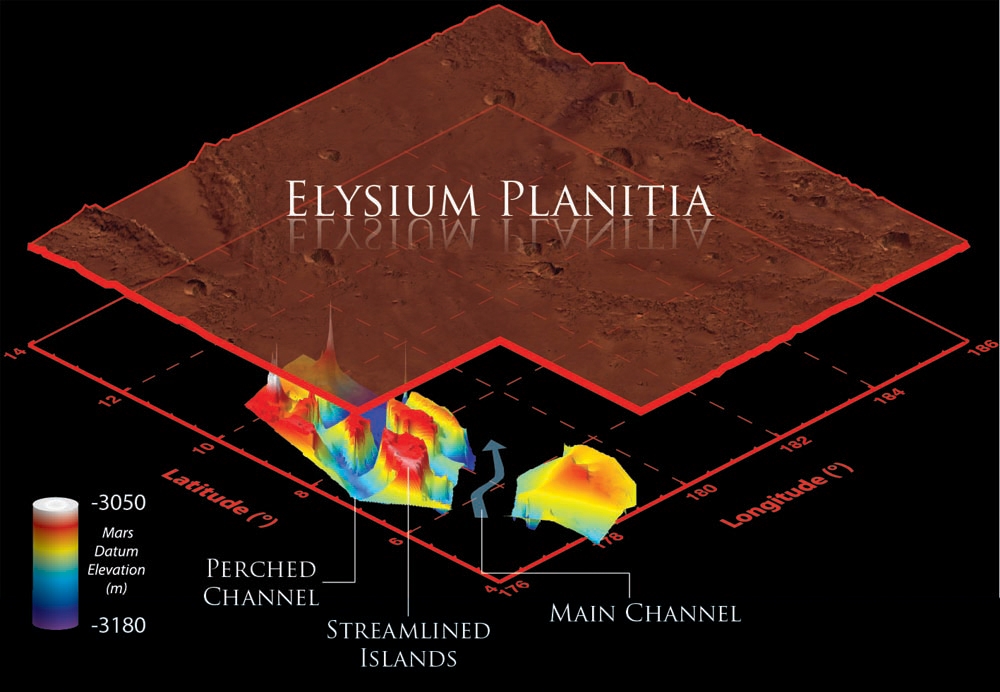
DEEP SCOURING. Ground-penetrating radar shows the channel bed of Marte Vallis is about twice as deep as previously thought. Also details of the channel show that it was eroded in two major episodes of flooding. (Image: NASA/JPL-Caltech/Sapienza University of Rome/Smithsonian Institution/USGS)

The Shallow Radar (SHARAD) instrument on MRO detects radar-reflecting surfaces underground. These may be due to changes in rock types or the presence of water or ice, or other geological differences.

A team of scientists led by Gareth Morgan (Center for Earth and Planetary Studies, Smithsonian Institution) used 58 SHARAD data tracks to probe the subsurface of Marte Vallis, a young outflow channel in Elysium Planitia. Marte is about 1,000 kilometers (620 miles) long and 100 km (62 mi) wide and slopes down to the northeast into Amazonis. The team report appears in Science.

SHARAD data let the team make a 3D reconstruction of Marte’s buried channel beds. The results show that the upper end of the valley connects to a now-buried portion of the Cerberus Fossae fracture zone. Previously, scientists had been unable to tell whether the valley’s source was at Cerberus or Athabasca, farther to the west.

“The channel alignment at the source matches the orientation of the Cerberus Fossae graben system,” the scientists write. They add that they found that the Cerberus fractures extend at least 180 km (112 mi) east of their present apparent end, thus reaching Marte and supporting the hypothesis that Cerberus was the source of the Marte Vallis floods.

Looking at the subsurface shape of the channel bed using the radar, the researchers identified two probable stages of the valley’s erosion. The first flowed around several islands in the channel, leaving them streamlined. Then as the flow continued, a main channel developed which cut deeper and left a ledge or shoulder around high-standing islands. Geologists call such features perched or hanging valleys.

In regard to the main channel, the radar data led the team to estimate its depth as 69 to 113 m (170 to 290 ft). “This is comparable with the depth of incision of the largest known megaflood on Earth, the Missoula floods, responsible for carving the Channeled Scabland of the northwestern United States,” they explain. The scientists add that these channel depths are at least double the previous maximum estimates for Marte Vallis (40 meters). “The scale of these floods has been underestimated.”

Some researchers have argued that Marte could have been eroded by lava flows. The Morgan team disagrees. “While they are filled with later lavas, our tomographic models show that the Marte Vallis channels are morphologically similar to the circum-Chryse outflow channels, and thus could reasonably have been carved entirely by water.”

Posted in Reports | Tagged , , , , , , , , , | Comments Off

Megaflood carved a valley in a week

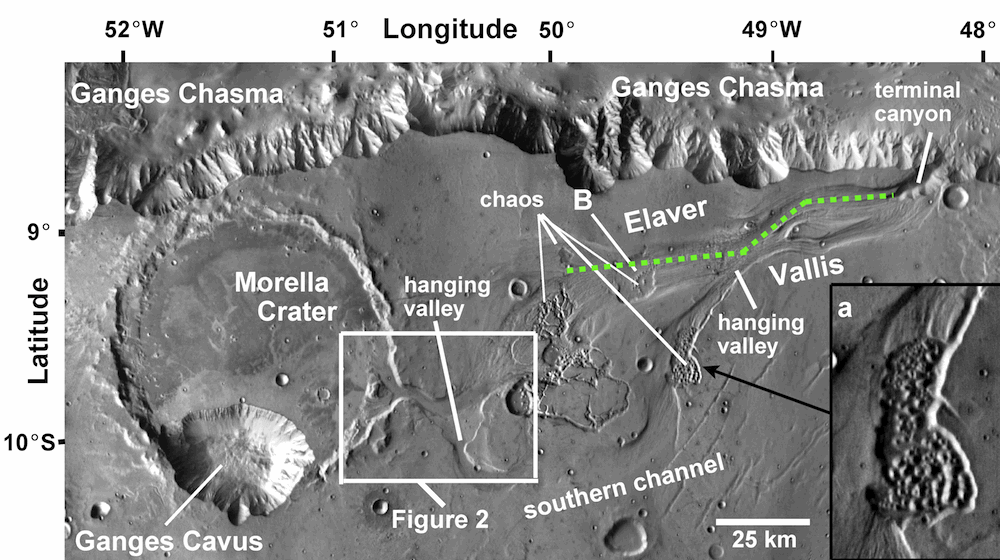
Morella Crater is an ancient impact scar 78 kilometers (49 miles) across that sits barely 5 km (3 mi) away from the southern edge of the large canyon, Ganges Chasma. Roughly 3 billion years ago,  groundwater filled Morella Crater with as much water as Glacial Lake Missoula on Earth held (or about as much as Lakes Ontario and Erie combined). Finally, the water overtopped the crater’s rim and spilled out.

GUSHER. Pressurized groundwater filled Morella Crater until the water overtopped the crater rim, rapidly eroded a breach, and scoured Elaver Vallis in a megaflood. (Image is taken from Figure 1 in the paper.)

In less than a day, the spill became a flood as the pent-up water chopped a 5 kilometer (3 mile) wide breach through the crater rim. Racing eastward across the plateau, the water carved Elaver Vallis, a channel system that today extends for about 150 km (90 mi).

As Neil Coleman (University of Pittsburgh at Johnstown) reports in the Journal of Geophysical Research, the floodwaters eroded Elaver in about a week. How far the valley originally extended is unknown, he says, because Elaver Vallis abruptly ends at the rim of Ganges Chasma.

“After the flood, the Elaver channel was truncated by the southward expansion of Ganges Chasma,” Coleman explains.

The newly published work builds on previous studies by Coleman and others, and provides a detailed hydrologic analysis of the crater lake, the breach in its rim, and the resulting flood channels and their features.

The groundwater to fill the lake came from what is now Ganges Cavus, a depression in the floor of Morella Crater, although the cavus may not have been fully formed at the time.

“Groundwater was the only plausible source of the water that filled Morella Crater,” says Coleman, “because Elaver Vallis exits Morella at a single outlet and no inflow channels exist.” (In this it’s unlike Gusev Crater, which has both an outlet and an inflow channel.)

The subsurface water was pressurized enough to rise (“like water in a standpipe,” Coleman says) to cover Morella’s floor at an elevation of about 1,100 meters – and keep rising until it found a low spot in the rim at an elevation of about 1,800 meters. The filling could have taken several decades. The lake was certain to be ice-covered, though the ice was probably less than 20 meters (66 feet) thick, according to the paper’s estimates.

The breach, when it came, likely took less than a day to reach full size. This is because the volume of water impounded was much more than what could flow through the breach, Coleman says. “In such cases the breach fully forms before significant drawdown of the lake occurs.”

Running the numbers, Coleman calculates, “Approximately 95 percent of the drainable lake volume discharged in 6.4 to 7.5 days.” The rate of discharge from Morella was about two times greater than the peak for the Spokane (or Missoula) Flood during the last Ice Age on Earth.

Elaver Vallis shows features common to megaflood channels on both Earth and Mars. These include longitudinal ridges, streamlined buttes, cataracts, hanging valleys, and channels that divide and merge.

Coleman developed hydrographs to show how the flood discharge varied over time and compared them to flow calculations using traditional open channel methods. Results show that the northern Elaver Vallis channel we see today never flowed bank-full because the flows would have exceeded the peak breach discharges.

Close to the rim breach, the flood swept a scabland about 75 km (47 mi) wide. This then narrowed and divided into two channels around an elevated highland. The channels merged again into a single channel about 30 km (20 mi) wide. The channel then vanishes at the lip of Ganges Chasma.

Says Coleman, “The Elaver flood occurred before the formation of Ganges Chasma as we see it today. The chasma margin continued to grow southward after the fluvial episode.” Evidence, he says, lies in the abrupt truncations of ridges in the channel which sharply end at the canyon’s edge as the ground falls away.

Another piece of evidence for the flood predating today’s Ganges Chasma lies in the source of the groundwater. If the edge of Ganges Chasma were as close to Morella Crater at the time of the flood as it is now, Coleman explains the same pressure that pushed the groundwater up inside the crater would instead have burst out into the canyon itself.

He says, “High groundwater pressures would have been relieved by breakouts from the walls or floor of this chasma, rather than by groundwater discharges high on the plateau” inside Morella Crater.
Posted in Reports | Tagged , , , , , , , , , | Comments Off

What Earth’s saltiest pond says about Mars

An Antarctic pond that’s the saltiest natural body of water on Earth stays wet in part by pulling moisture out of the air, scientists have discovered. And that has implications for possible brine seeps and reservoirs on Mars.

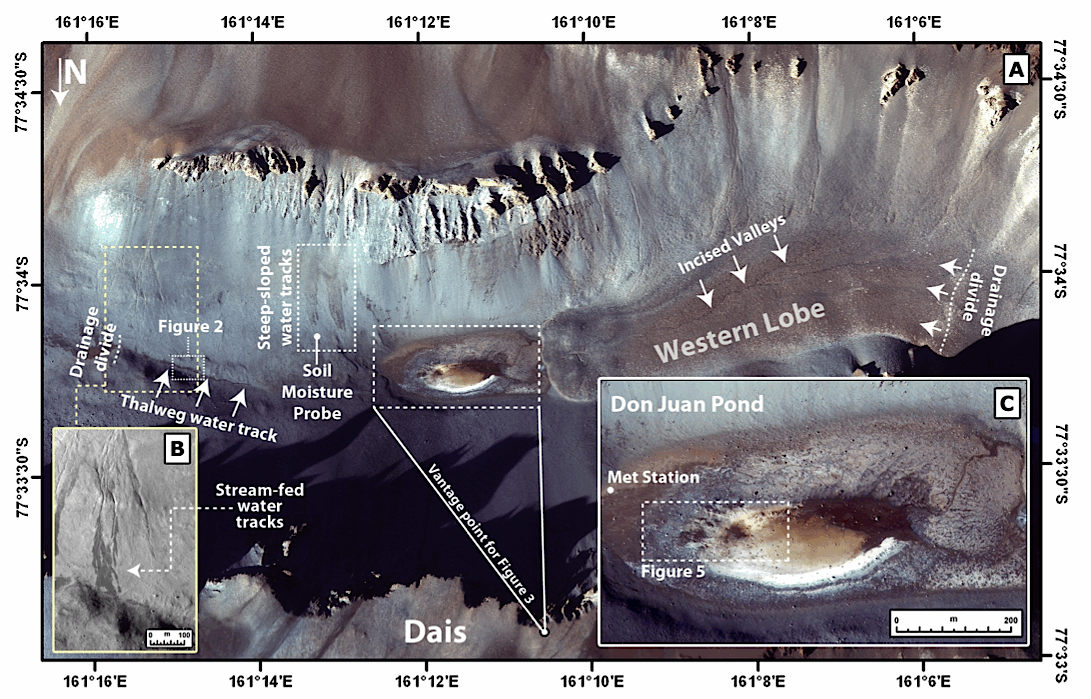
DRIP, DRIP, DRIP. Water from snowmelt does most of the job keeping Antarctica's Don Juan Pond full of water. But some additional water comes from humidity in the air, thanks to a nearby source of calcium chloride salts. (South is up in the image, which is taken from Figure 1 in the paper.)

Don Juan Pond lies in Antarctica’s McMurdo Dry Valleys, one of the best terrestrial analogs for Mars. The pond has a salinity of 40 percent (the Dead Sea is “only” 34 percent). This allows it to remain almost always liquid, despite local temperatures dropping to -50°C (-58°F) during southern winter.

A paper published in Nature‘s open-access science journal Scientific Reports by a group of geologists reports on studies that identified where the pond’s moisture comes from. The team, led by James Dickson (Brown University), also sought to identify the source for the pond’s salt, which is 90 percent calcium chloride, an unusual chemical composition for natural saline ponds.

To determine the pond’s water cycle, the scientists used time-lapse photos (video link) taken over two months during austral summer. These revealed the appearance of dark “water tracks” running down local slopes as temperatures warmed. The pond’s water level also rose in step with the daily temperatures, suggesting that meltwater from snow was feeding the pond.

But the source for the high salt content was harder to pinpoint. It turned out that loose sediment rich in calcium chloride salt lay to the west of the pond. As the humidity in the air rose, the salt in the soil absorbed the moisture (video link) in a kind of inverse-evaporation called deliquescence. As it turned liquid, the salty water trickled down through the soil until it hit the impenetrable permanently frozen layer below. Then, whenever snowmelt flowed, it washed the salty water down into Don Juan Pond.

The link to Mars lies in regard to the “recurring slope lineae” (RSL). These are dark streaks that flow down canyon and crater walls in local springtime. Scientists have hypothesized that the lineae may be caused by seeps of brine or salty water. Deliquescence working with salts and traces of moisture in the Martian atmosphere might possibly create brief flows of brine.

“Broadly speaking,” says lead author Dickson, “all the ingredients are there for a Don Juan Pond-type hydrology on Mars.” While Mars appears too cold and dry today to have such ponds, they could have been abundant in the Martian past.

“Don Juan Pond is a closed basin pond and we just documented a couple hundred closed basins on Mars,” says co-author James Head. “So what we found in Antarctica may be a key to how lakes worked on early Mars and also how moisture may flow on the surface today.”

Posted in Reports | Tagged , , , , , , , , , , , , | Comments Off

Blowing sand and moving dunes in Gale Crater

Curiosity, NASA’s Mars Science Laboratory rover, is exploring the floor of Gale Crater. Its main science target, however, is the giant stack of water-altered sediments that make up Mount Sharp, Gale Crater’s central mound. But to reach the mound, the rover needs to drive through a field of dark dunes that marches in a line for 35 kilometers (22 miles) along the foot of Mt. Sharp.

ON THE MOVE. Ripples slither across a dune in Gale Crater, as seen in 2006, 2008, and 2011. Click the image to enlarge and animate. (NASA/JPL-Caltech/University of Arizona)

Simone Silvestro (SETI Institute) led a group of researchers who report on the dune field in Geology. Using overlapping images from the HiRISE camera, the scientists traced movements of both ripples on the dunes’ surface and of the dunes themselves over a five-year period (2006 to 2011).

The dunes are basaltic sand and lie about 150 to 200 meters (500 to 650 feet) apart. Dune crests can stretch for 2 km (1.2 mi) and rise about 10 meters (33 ft).

The scientists saw evidence of winds from two directions. While some come from the northwest, the strongest blow from the east-northeast, pushing sand ripples southwest. (This is agrees with a model for Mars atmospheric circulation.) The team suggests this wind comes from regional winds interacting with Mt. Sharp.

The average distance that sand dunes moved was 2 meters (7 feet) over the five Earth years, although some individual dunes moved 3 to 4 meters (10 to 13 ft) in that time. This doesn’t sound like much, yet Curiosity’s mission control team will pay close attention in making driving plans.

In any case, the researchers note, “Roving between the dunes represents a unique opportunity to validate the accuracy of wind predictions and to make the first ground observations of a known active environment on Mars.”

Posted in Reports | Tagged , , , , , , , , | Comments Off

Grooving on Phobos

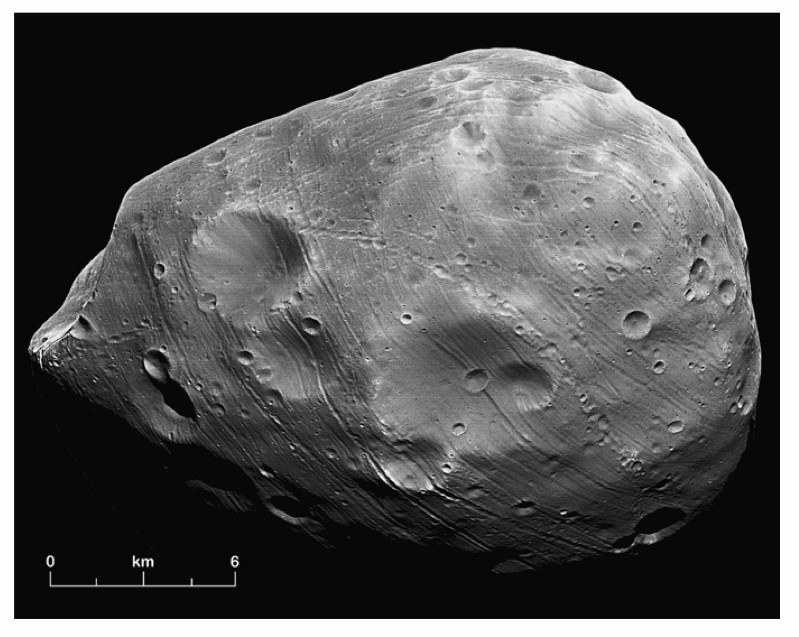
Phobos, the larger moon of Mars, has a surface covered in craters, dust, boulders – and a great many semi-parallel and intersecting grooves. One theory for the grooves’ origin, proposed in 2011, holds that they are impact scars from chains of debris thrown into space by big meteorite impacts on Mars itself.

NOT MARS EJECTA. Calculations find that the grooves on the Martian moon Phobos did not come from chains of debris ejected by impacts on Mars itself. The fact that about 12 "families" of grooves lie parallel, semi-parallel, and intersecting suggests that more than one groove-making episode occurred. (Mars Express image taken from Figure 4 in the paper.)

Writing in Planetary and Space Science, Kenneth Ramsley and James Head (Brown University) say “nix” on this idea. The core of their finding is that the Phobos grooves are too perfectly shaped — too neat and clean — to be the result of ejecta from Martian impacts.

“We strongly suggest that no impact event on Mars produces enough focused material to form grooves as impact chains on Phobos,” the team says. “At the altitude of Phobos, Martian impact debris disperses to a huge volume in the space above Mars. By the time it reaches the altitude of Phobos, the debris is far too thinly distributed to produce more than a few stray impacts on Phobos, if any at all.”

To reach this conclusion, they undertook extensive computer simulations to see how much debris would be ejected from Mars and big the pieces would likely be, how far ejected pieces would travel, how much they would disperse as they flew, and where they would go within the Mars-Phobos system.

“On the basis of our analysis,” they write, “we find that six major predictions of the hypothesis are not consistent with a wide range of Mars ejecta emplacement models and observations.”

These failed predictions include:
• The largest family of grooves can’t be emplaced by any valid trajectory from Mars in its present-day or ancient orbit.
• To make families of parallel grooves over most of Phobos (as is seen), fragments must have nearly identical diameters and be ejected in grid patterns with virtually no dispersion.
• Due to Phobos’ rough and uneven surface, grid patterns of incoming debris would strike the ground more unevenly than is seen, disrupting the grooves’ linearity.
• Grooves are found on the trailing end of Phobos in places where no trajectory from Mars to Phobos is possible.

The researchers also compared the Phobos grooves with chains of known secondary craters on Mercury and the Moon. They found that most Mercurian and lunar secondary craters are as large as the bigger (non-groove) craters on Phobos and far larger than the pits seen in the groove networks.

They also observe that blasting chains of craters across Phobos would also throw secondary plumes into orbit around Mars. Such debris will resettle back onto Phobos over roughly 10,000 years.

As Ramsley and Head explain, “This would substantially add to the effects of space weathering and potentially bury most evidence of the initial groove-forming impacts.

Posted in Reports | Tagged , , | Comments Off

Hardened arteries in Nili and Nilo

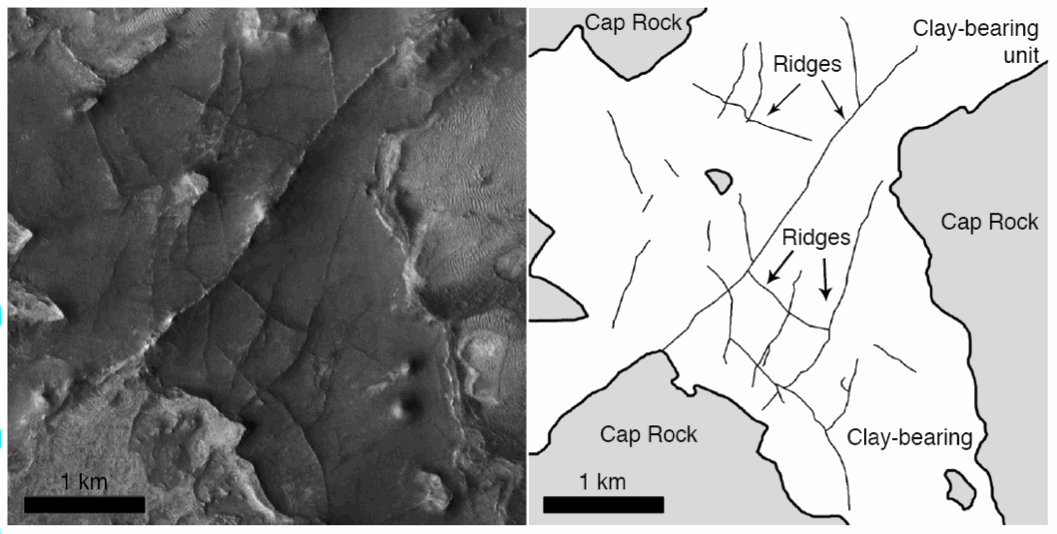
Water seeping through conduits and cracks in the deep subsurface rocks of Nilosyrtis and Nili Fossae left behind minerals, like hard-water deposits that collect in the plumbing of your house. (Or cholesterol in your arteries.) Then as the softer rocks around them eroded over millions of years, the mineralized seams emerged as ridges.

PROMINENT VEINS. Ridges in Nili Fossae stand out as ridges because groundwater containing minerals flowed into cracks and left hard deposits. As surrounding rocks weathered away, the mineralized veins emerged as ridges. (Image taken from Figure 2 in the paper.)

The ridges had been noted before by scientists, but their origin was unexplained, largely because sufficiently sharp images didn’t exist. Lee Saper and Jack Mustard (both Brown University) used new, more detailed imagery to explore the ridges and their surroundings. Their work is described in a Geophysical Research Letters paper which lays out the evidence for a mineralizing flow of subsurface water in early times.

Such a flow would strengthen the argument that ancient Mars had an active underground hydrology, possibly including habitats for life.

The new imagery came from the Context Camera (CTX) and the High-Resolution Imaging Science Experiment (HiRISE) on NASA’s Mars Reconnaissance Orbiter. In all, the scientists mapped more than 4,000 ridge segments in the two areas.

Mineral veins are not unknown on Mars. The researchers note in particular that Mars Exploration Rover Opportunity discovered a vein of water-precipitated gypsum cutting through ancient shattered rocks on the rim of Endeavour Crater. They also noted that Nili Fossae lies near the rim of the Isidis impact basin. The ridges in Nili, the scientists found, have orientations that suggest influence by the basin-making impact, either the original shock or subsequent faulting and collapse on its margins.

“This suggests that fracture formation resulted from the energy of localized impact events,” says Saper. In the case of Nilosyrtis, which lies farther from Isidis, the ridged unit lies in the floors of large impact craters, again suggesting a shock-related origin.

Another piece of evidence pointing to water being abundantly present in ancient times is that in the areas studied, the ridges occur only among rocks that contain iron-magnesium clays, typically produced when water is present.

“The association with these hydrated materials suggests there was a water source available,” explains Saper. “That water would have flowed along the path of least resistance, which in this case would have been these fracture conduits.”

To judge from the density of the ridge network, Saper says, “there was enough fracturing and fluid flow in the crust to sustain at least a regional subsurface hydrology.” Given the importance of water to the search for life on Mars, he says, “if in fact these fractures that turned into ridges were flowing with hydrothermal fluid, they could have been a viable biosphere.”

Nili Fossae was once a candidate landing site for Curiosity, the Mars Exploration Rover. In the end NASA chose Gale Crater instead. But Saper notes that something similar could well turn up in Gale.

“In Gale Crater, we think there are mineralized fractures that Curiosity will go up and touch,” Saper says. “These are very small and may not be exactly the same kind of feature we studied in Nili and Nilosyrtis. But we’ll have the opportunity to crush them up and do chemical analysis on them. That could either bolster this hypothesis – or tell us we need to explore other possibilities.”

Posted in Reports | Tagged , , , , , , , , , , , , , , , , | Comments Off

Ancient Mars biosphere: deep underground?

Something like half of Earth’s entire biomass lies underground in the form of microorganisms living off geothermal heat and chemicals in the crustal rocks. Could the same hold true for Mars, now or in bygone times? If so, it’s hard to tell because rocks affected by a deep subsurface biosphere remain well out of reach.

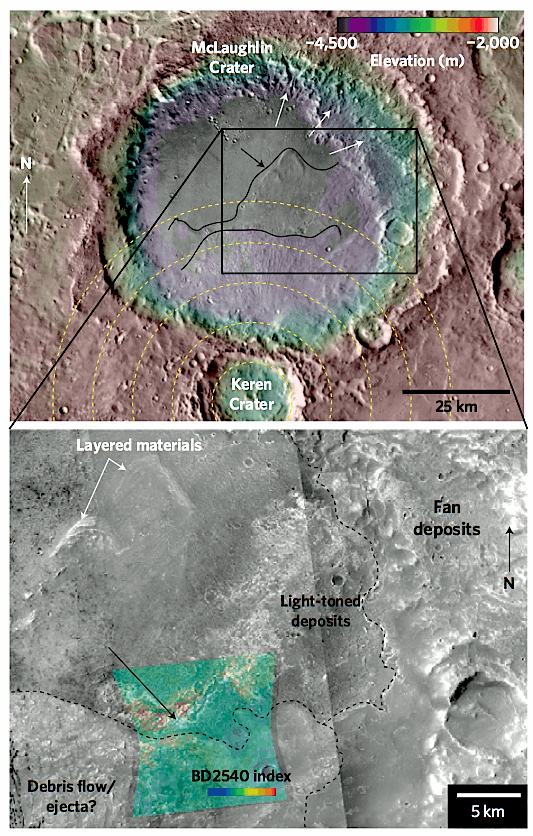
WET BASEMENT: GOOD NEWS. In the depths of McLaughlin Crater lie deposits of clays and carbonates that likely formed in the deep subsurface by the action of groundwater. According to new work, these might harbor evidence of a deep subsurface biosphere. (Image taken from Figure 4 in the paper.)

Or do they? Take McLaughlin Crater in northwestern Arabia. It lies on the boundary between the highlands and lowlands, and its floor is well below Martian “sealevel.” The crater has no fluvial channels leading in or out, yet it contains iron- and magnesium-bearing clays and carbonate minerals that resulted from water’s action on the rocks.

A new paper in Nature from a group of scientists led by Joseph Michalski (Planetary Science Institute) proposes that deposits such as those in McLaughlin Crater could preserve evidence of a deep Martian biosphere. They base their argument on what they see as four roughly horizontal zones in the Martian crust. Each is progressively deeper and older, and each has different physical and chemical conditions, which reflect differing environmental histories.

Zone 1 lies at the surface and contains sulfates and layered clays, plus loose sediments and snow, ice, and dust. This zone may make up the top few hundred to thousands of meters in many regions. Zone 2 lies below that, and likely contains brines and chloride deposits. Zone 3 lies 2 to 5 km (1.2 to 3 mi) deep and is likely heavily broken up from ancient giant impacts. Waters in this zone would be neutral to alkaline. Zone 4 lies deeper still and would be rich in hydrothermal activity. But these waters rarely emerge at the surface.

Zones 3 and 4, the team says, offer the best places to look for any subsurface Martian microorganisms. “In the deepest zone,” they note, “the viability of a microbial community is perhaps greater than at similar depths on Earth because a lower gravity implies less compaction of the very limited pore space, and a lower heat flow reduces the temperature constraints.”

McLaughlin Crater is 92 km (57 mi) wide and 2.2 km (1.4 mi) deep relative to its surroundings. As these already lie about 2 km below the planet’s mean radius, the floor of McLaughlin approaches a depth appropriate for Zone 4. “The facts that the crater is deep and situated at a major decline in regional topography suggest that this basin is an excellent candidate in which to search for groundwater activity.”

Data collected by the CRISM spectrometer on the Mars Reconnaissance Orbiter, plus that from the TES instrument on Mars Global Surveyor and THEMIS on Mars Odyssey, have identified deposits of clays and carbonates inside the crater. The team points out that these minerals formed in an environment sharply different from the acidic, water-limited conditions making the sulfate deposits found at much higher elevations in Arabia and elsewhere, including Meridiani Planum.

Inside McLaughlin Crater, channels from the eastern inside wall of the crater end about 500 meters (1,600 feet) above the crater floor. This may indicate a former lake surface, the team writes. Also, the channels end at a broad platform probably made by sediments washing down into standing water. The crater floor contains layered, flat-lying clay-carbonate-bearing rocks, which the scientists interpret as lakebed deposits. These in turn are overlain by lobate flow materials, which suggest the crater floor sediments were buried rapidly.

The team says, “We propose that the materials represent a combination of wet gravity flows and fluidized ejecta emplaced rapidly on the crater floor.” On Earth, they explain, such geometries occur in underwater landslides. “The deposits in McLaughlin Crater could have very high preservation potential for organic materials, in much the same manner as turbidites do on Earth.”

Looking toward the search for Martian life, the scientists argue that the highest priority astrobiological targets on Mars should be portions of deep crust exhumed by impact and erosion. These could preserve evidence of organic chemicals from an era that’s not preserved in Earth’s geologic record.

The team concludes, “Lacustrine clay minerals and carbonates in McLaughlin Crater might be the best evidence for groundwater upwelling activity on Mars, and therefore should be considered a high-priority target for future exploration.”

Posted in Reports | Tagged , , , , , , , , , , , , , | Comments Off