



Mars’ ancient climate had a “wet-pass” filter

Volcanic eruptions — and the rocks they produce — dominate the surface of the Red Planet. Mars also shows evidence for activity by liquid water — sediments, channels, and valley networks — through much of its history. While volcanos can erupt under any climate regime, liquid water requires a narrower range of temperatures.
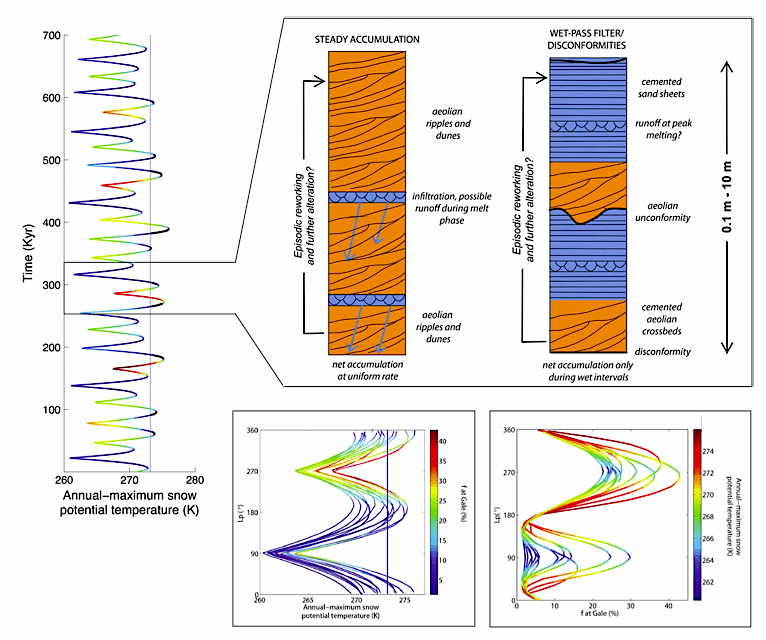
DEEP FREEZE AND THAW. Cyclical changes in Mars' orbit can warm the surface periodically to produce snowmelt. The scale at left shows predicted temperature swings over 700,000 years. The outtake centered on 300,000 years shows hypothetical changes in the sediments in Mount Sharp, the Gale Crater mound that's a target for NASA's Curiosity rover. Orange layers are dry episodes, blue ones are affected strongly by snowmelt. The left column shows a steady accumulation, on the right is the pattern made when accumulation occurs during wet intervals. (Image taken from Figure 17 in the paper.)

A team of scientists led by Edwin Kite (Caltech) developed a computer model to look at a particular subset of the geologic evidence — sedimentary rocks — and they concluded that these could be explained by infrequent, orbitally-controlled seasonal melting. Their work is published in Icarus.

“The pattern of sedimentary rocks on Mars,” the team writes, “is most consistent with a model Mars paleoclimate that only rarely produced enough meltwater to precipitate aqueous cements and indurate sediment.” Moreover, sedimentary rocks on Mars are not widely distributed across the planet, but rather narrowly concentrated into equatorial latitudes and low elevations.

The scientists explain that this implies long spells of globally dry climate with brief wet intervals. The result, they note, is “unfavorable for past life on Mars.”

In the team’s model, the factor that controls the rate of sediment formation is the supply of liquid water coming from seasonal melting of snow or ice.  The model assumes conditions that the researchers believe are reasonable estimates for early Mars. These include an atmosphere of pure carbon dioxide about 10 times thicker than today’s, dusty snow, and a solar luminosity reduced by 23 percent.

“Under these conditions,” the team explains, “snow melts only near the equator, when obliquity and eccentricity are high, and when perihelion occurs near the equinox.” Such situations occur relatively rarely, only about 20 percent of the time at most.

The team says, “This fraction of time is small, yet consistent with the geologic record of meta-stable surface liquid water acting as a ‘wet-pass filter’ for Martian climate history.”

In essence, they say, the sediments record only those orbital conditions that allow liquid water to exist at the surface.

When the researchers ran the model they found that viewed globally, snowmelt reached a maximum in Valles Marineris and Meridiani Planum. A third “wet spot” location is Gale Crater, where the rover Curiosity is currently exploring.

Rover scientists reported January 15, 2013, that outcrops on the Gale Crater floor which they are preparing to drill into appear to have been saturated with water. Water-related minerals have precipitated in cracks, while nearby cross-bedded dunes of coarse sand suggest shallow but flowing water.

In regard to Mt. Sharp, the giant mound in Gale Crater, the Kite team predicts that Curiosity will find, as it climbs the mound, a succession of layers, each with generally homogenous chemical changes. Curiosity should also find evidence of wet/dry orbital cycles, with wet events occurring only during optimal conditions.

Early Mars, the team suggests, was not very warm and not very wet. “The climates considered in this paper are extremely cold,” they write. “Meltwater production is comparable to the coast of Antarctica.”

They add, however, that the computer model is still incomplete: “Our model runs can’t explain big valley networks, so an angle to explore in future work would be to try slightly warmer climates, comparable to the coast of Greenland, and see if this produces enough melting and runoff.”

Looking at the big picture, the scientists conclude, “Seasonal melting on Mars is the product of tides of light and tides of ice, which move around the planet on time scales driven by orbital changes. The peaks of these tides infrequently intersect, and melting can occur when they do.”

Posted in Reports | Tagged , , , , , , , , , , | 1 Comment

Explosive eruptions in dense ancient atmospheres

Explosive volcanic eruptions on an earlier Mars with a thicker atmosphere would have scattered fine ash (pyroclastic debris) mainly east or west of the volcano, a new study finds. Also, a denser ancient atmosphere supports the addition of Arsia and Pavonis Montes to possible source volcanos for the puzzling Medusae Fossae formation, which scientists think may be made of thick deposits of volcanic ash.

TO THE WINDS. Volcanic ash erupted into Martian atmospheres thicker than that of today tends to drift mainly east and west. And as atmospheres become thicker (left to right) the plume of ash is less prone to drift north and south. For the purposes of the modeling, each eruption was set to last one Martian year. (Image taken from Figure 3 in the paper.)

These results appear in a paper published in Icarus by a team of scientists led by Laura Kerber (Laboratoire de Météorologie Dynamique, CNRS, France). The researchers used a global atmospheric circulation model developed at the Laboratoire de Météorologie Dynamique.

Earlier work using this same computer model, which assumed a 0.006 bar (6 millibar) atmospheric pressure like that of today, pointed to Apollinaris Mons as the source of the Medusae Fossae formation. The new results come from modeling with thicker Martian atmospheres of 0.05 bar (50 mb), 0.5 bar (500 mb), 1 bar (1,000 mb), and 2 bars (2,000 mb). (Earth’s atmospheric pressure is 1 bar.)

Higher atmospheric pressures altered the way Martian volcanic ash plumes behave, the researchers found. The initial eruption blast is more muted, but the plume may rise higher as the denser atmosphere becomes entrained and heated. In today’s Martian atmosphere, an erupting plume would be limited to about 20 kilometers’ (12 miles) altitude; with a 1 bar atmosphere that height could rise to 30 km (20 mi) or more.

The team also found that with thicker atmospheres, an explosive plume of ash is more closely confined to the latitude of the source vent and it tends to drift mostly east or west rather than north or south. With thin-atmosphere models, ash tends to drift more significantly in latitude as well as in longitude.

The researchers note, “Using these results it was possible to determine that some of the friable layered deposits (such as those in the basin of Argyre or those in Arabia Terra) would have been difficult or impossible to emplace from known Martian volcanoes, whereas others (such as the Medusae Fossae Formation) showed good matches under a variety of atmospheric and volcanic scenarios.”

While the giant Tharsis volcanos Arsia Mons and Pavonis Mons have been eyed as potential sources for the Medusae Fossae formation, scientists have thought that this could occur only when Mars’ axis was tipped at a greater angle to its orbit than today.

“But these recent simulations demonstrate that higher atmospheric pressures at the time of eruption could also increase the likelihood that these two volcanoes contributed material to this deposit,” the team concludes.

Nonetheless, they say, “The source most favorably located to produce the Medusae Fossae formation under the widest variety of conditions remains Apollinaris Mons.”

Posted in Reports | Tagged , , , , , , , | Comments Off

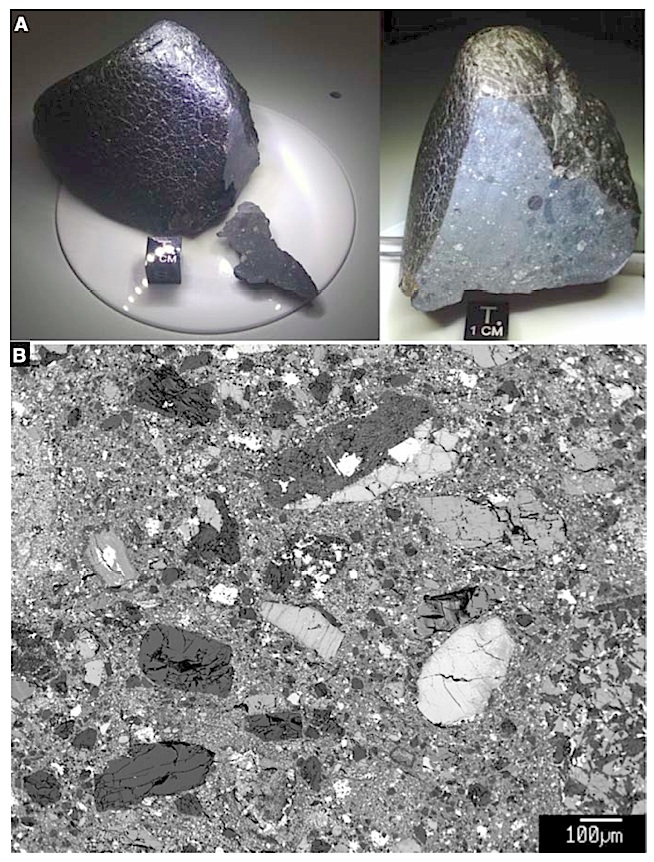
“Black Beauty” Mars meteorite unique

It’s young, it has been shattered and naturally recemented, and it’s about ten times richer in water than any other Mars meteorite. And if the scientists who studied it are right, it’s the also first meteorite to come from the Martian crust.

BLACK BEAUTY. Northwest Africa 7034 would fit comfortably in your hand. It achieves several Mars meteorite landmarks: it’s the first basalt breccia, it contains about 10 times the water of any other Mars meteorite, it’s 2.1 billion years old, and it appears to be a piece of Martian crust. (Image taken from Figure 1 in the paper.)

Northwest Africa (NWA) 7034 is a fist-size chunk of basaltic breccia found in the Sahara Desert and bought from a Moroccan meteorite dealer in 2011. It bears the nickname “Black Beauty.”

When it fell to Earth is unknown, but it last crystallized 2.1 billion years ago. This places it in the early Amazonian epoch of Martian geologic history, says Carl Agee (University of New Mexico), who led a group of scientists publishing their findings in Science.

Agee notes, “The basaltic rock in this meteorite is consistent with the crust or upper mantle of Mars, based on findings from recent Martian rovers and orbiters.” He adds that the team’s analysis of the oxygen isotopes shows that NWA 7034 is unlike any other meteorites or planetary samples. “The chemistry is consistent with a surface origin and an interaction with the Martian atmosphere,” Agee says.

Co-author Andrew Steele (Carnegie Institution) adds, “The texture of the NWA meteorite is not like any of the SNC meteorites. It is made of cemented fragments of basalt, rock that forms from rapidly cooled lava, dominated with feldspar and pyroxene, most likely from volcanic activity.”

SNC meteorites, with 110 known examples, dominate the Mars meteorites. (There’s one additional non-SNC meteorite, the famous Alan Hills ALH84001.) The name SNC (pronounced “snick”) comes from the first three such meteorites identified: Shergotty, Nakhla, and Chassigny. NWA 7034 brings the total to 112.

The team notes, “NWA 7034 is strikingly similar to recent orbital and lander data collected at the Martian surface, allowing for a direct link between a Martian meteorite and orbital and lander spacecraft data from Mars.”

Posted in Reports | Tagged , , , , , , , , , | Comments Off

Lava flows resurfaced crater lakes after water was gone

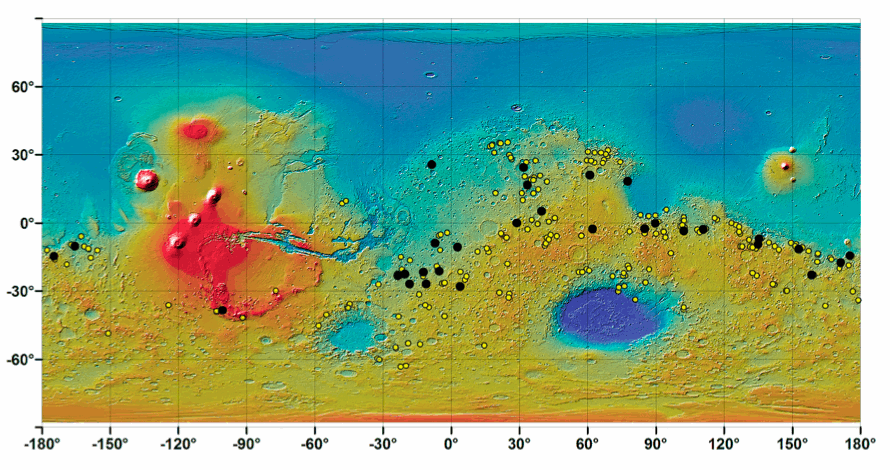
Fire and water didn’t mix when it came to resurfacing basins that lie along Martian fluvial valley networks. A study of some 30 open-basin lakes (paleolakes) with floors covered by lava flows has concluded that at least these basins were dry by the time lava flowed into them and buried their lakebeds. The implication is that water activity in their associated valleys had shut down before lava flows covered the basin floors.

DRY HOLES. Black circles indicate 30 open-basin paleolakes whose floors have been resurfaced by lava flows with no sign of interaction between the molten lava and water. (Image taken from Figure 1 in the paper.)

The work was done by a team of scientists led by Timothy Goudge (Brown University); their report was published in the Journal of Geophysical Research. The researchers were studying the history of open-basin lakes and the Martian water cycle during a period when Mars scientists have thought that fluvial activity and volcanic resurfacing partly overlapped in time.

Open-basin lakes are usually large impact craters with both a water-eroded valley coming in and one leading out. At some point in their history, such basins would have held lakes (paleolakes). The 30 paleolake basins studied were selected from more than 200 because they were both volcanically resurfaced and large enough for dating using crater-counts.

About half of the 30 basins fall along the highland-lowland boundary, and Gusev Crater, where Mars Exploration Rover Spirit landed, was among the basins examined.

The scientists’ approach was to identify paleolakes whose floors showed volcanic landforms (or materials), then look for signs of lava interacting with water, and finally use counts of craters to determine an age for the lava resurfacing.

The team used orbital data and images (TES, THEMIS, CTX, HiRISE, HRSC) to identify lava flows, surface properties, and other volcanic details, as well as counts of craters (CTX, HRSC, and THEMIS). Remote-sensing instruments (CRISM, OMEGA) indicated mineral compositions.

When lava meets water, the team explains, certain identifiable geological features occur. These include lava deltas at shorelines, explosively formed cones along shorelines, rootless cones that form on wet sediments, tuyas (eruptions under glacier ice), and maar craters (formed when magma meets groundwater which explodes into steam).

None were seen. Says the team, “All of these features should have been resolvable with the resolution of images used, suggesting that they never formed in these locations, or if so, were buried by later lava flooding.”

As for ages, they report, “From the analysis of crater counts for the 30 basins…the resurfacing of the open-basin lakes occurred over a wide range in Martian history.”

Resurfacing began approximately 3.8 billion years ago, the team says, when the Noachian era changed to the Hesperian, and continued until around 2.9 billion years ago (Early Amazonian time). The majority of basins appear to have been resurfaced during the Hesperian, a period when volcanic flows resurfaced about 30 percent of Mars.

Although the date for the end of valley network activity appears to have overlapped with lava activity, the team concludes that “the volcanic resurfacing of these specific paleolake basins was not contemporaneous with the fluvial activity that carved the inlet and outlet valley networks and filled the basins with water.”

They add, “There must have been some period of desiccation at these sites subsequent to the end of valley network activity but prior to volcanic resurfacing.”

Posted in Reports | Tagged , , , , , , , , , , , , | Comments Off

Mars’ explosive childhood

Mars is widely understood to be a volcanic planet — its surface shows abundant evidence of volcanic activity, both ancient and more recent. Spacecraft detect lava flows in many locations, and spectroscopic evidence of volcanic rocks lies almost everywhere.

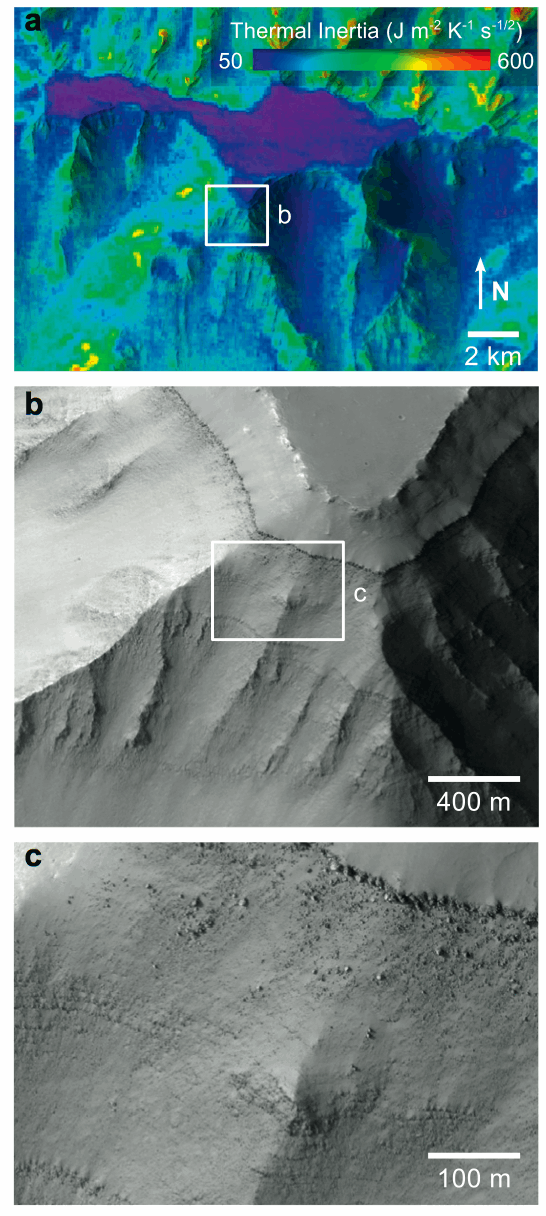
SOFT SLOPES. The walls of Coprates Chasma in Valles Marineris are impressive, but slopes are modest (10° to 30°). Moreover, the weathering shows the wall materials are loosely consolidated and lacking the rocky cliffs that extensive lava flows would produce. Thermal inertia values (top frame) indicate weak cohesion, characteristic of material blown out of explosive volcanic eruptions. (Image taken from Figure 1 in the paper.)

The authors of a new paper in Icarus, led by Joshua Bandfield (University of Washington), argue that Mars’ style of volcanism was different in its early days, and that the early Martian crust was probably not built up from countless lava flows. Such a view has been suggested before, but the new work shows much evidence supporting it.

“A prevalent view of the upper Martian crust is that it is dominantly composed of lava flows that may have been subsequently disrupted by the creation of a mega-regolith through impact events,” the team writes. If this were true, they say, these crustal materials would have the physical properties found in highly fractured but competent blocks like those derived from lava flows or well-cemented sandstones.

The problem is, they don’t. Says Bandfield, “If Mars was made up of lava flows, we’d see piles and piles of rocks strewn all over the place — instead, we see lots of stuff with the consistency of dirt clods.” The place to look for competent blocky or solid materials, the team says, is in younger, less cratered regions.

The researchers used image-maps of thermal inertia to distinguish loosely consolidated materials from harder, more competent ones. Thermal inertia measures the resistance of materials to changes in temperature. High thermal inertia materials are tougher and more solid such as large blocks and outcrops of rock. Low thermal inertia surfaces, on the other hand, typically have loose and less cohesive materials such gravel, sand, and those that crumble easily as they weather.

The areas the scientists studied include Valles Marineris, Ares and Kasei Valles, and several large craters, particularly in the southern highlands. The team reports that, “the stratigraphy of the upper several kilometers of the Valles Marineris system dominantly displays repetitive bedding where more resistant layers are separated by tens of layers of less resistant, thinner layers.”

The more resistant layers, they note, display a rough texture at meter (yard) scales and produce boulders. The blocks, however, evidently break up after they roll only a few hundred meters downslope, suggesting they are also composed of weak materials.

Comparing Mars with Earth, the researchers say, “Where high strength rocks are present in arid, vegetation-free environments on Earth, they are associated with steep slopes such as canyon walls and commonly have talus slopes that form at the base and persist for extended periods of time.”

These features, they observe, appear only in isolated locations within older Martian terrain. They should be much more pervasive if high-strength blocky materials (such as lava flows and floods) dominated earlier times.

More evidence appears in the valley networks carved by outflows, say the scientists. The extensive erosion these networks imply would require less water and smaller floods if the surface materials were generally loose and less cohesive.

Similarly, most meteorites of Martian origin have younger dates. Potential meteorites from Mars’ early days were less likely to survive being ejected if they were made of weaker materials.

Explosive volcanism commonly occurs when molten magma meets groundwater (or ground ice), which flashes into steam. The results are steam-powered explosions and a lot of meltwater. In this light, the scientists say, the transition to effusive eruptions may have followed the general drying out of the planet’s mantle or its permafrost-rich upper crust — or both.

If that happened, Bandfield notes, it could connect with some other events in the Martian past. For example, he says, “the possible drying out of the mantle can be linked to less vigorous mantle convection, which can then be linked to less core convection and the shutting off of the Martian magnetic field. Abundant crustal water in early times might also have led to the formation of phyllosilicates [clays] during the same time period.”

Posted in Reports | Tagged , , , , , , , , , | 1 Comment

Not-so-everlasting hills

When the Mars Exploration Rover Spirit reached the top of Husband Hill in the Columbia Hills of Gusev Crater on August 22, 2005, it stood 107 meters (351 feet) above its landing site. Yet if recent work is right, the hill Spirit climbed was much lower and smaller than it was originally.

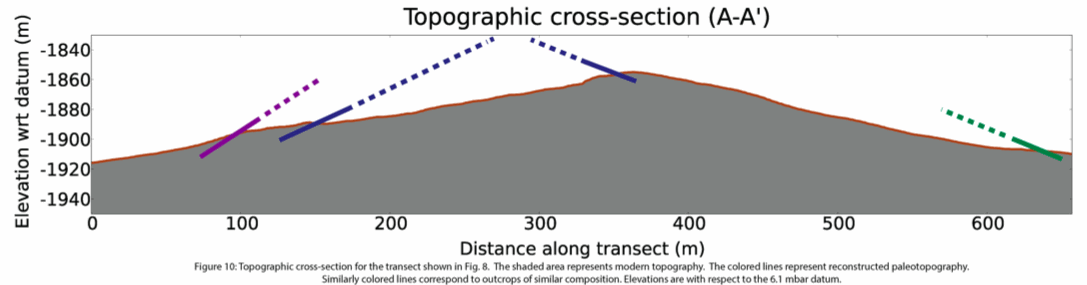
THE HILLS OF OLD. Today's Husband Hill in Gusev Crater is a smaller feature than it was in ancient times, when sedimentary layers draped across it. Details in the orientation and tilt of those layers led to a reconstruction of an ancient Husband Hill perhaps twice as high as it is currently. (Image taken from the poster paper.)

At the 2012 fall meeting of the American Geophysical Union, a team of scientists led by Shoshanna Cole (Cornell University) presented a poster paper with evidence for a significantly larger and higher Husband Hill in ages past.

Mars scientists have tentatively dated the Columbia Hills as Late Noachian to Late Hesperian (roughly 3.1 to 3.8 billion years ago). The Hills are likely the remnants of either Gusev’s central peak or overlapping rims from impact craters that formed within Gusev.

The team studied more than 7,000 Pancam and Navcam images from Spirit’s traverse of West Spur and Husband Hill. For each outcrop that showed layers, they measured the angle of the bedding planes and their direction of tilt (dip and strike, respectively), plotting these onto a HiRISE photomap of Husband Hill with contour lines giving elevations.

The team observed that the exposed outcrops show strikes and dips that fit what would be seen in layers draping across an older structure. But the dips were steeper than the slope of the ground surface at the outcrop. This led the team to conclude that the ancient Columbia Hills were larger and higher than the present-day ones.

How much higher? Hard to say, but the projected summit elevation could be twice the current one, or about 200 meters (700 ft).

Mapping the orientations of outcrops with similar compositions also showed another facet of the earlier Hills: their highest point lay to the northwest of the current summit (Husband Hill). It was above what is the modern Tennessee Valley and away from the central axis of today’s Columbia Hills.

Posted in Reports | Tagged , , , , , , , , | Comments Off

Loess in the lowlands

A team of geologists led by James A. Skinner, Jr. (U.S. Geological Survey) has discovered and mapped a previously unidentified unit in the Martian northern lowlands. The unit appears to give evidence of a major climate shift long ago in Martian history. Their report appears in the December 2012 issue of Geology.

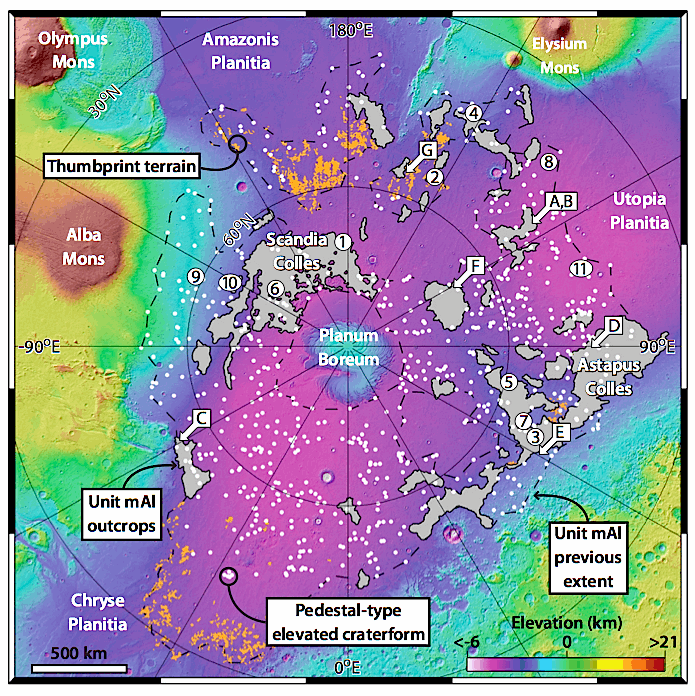
YESTERYEAR'S REMNANTS. A newly identified unit of soft sediments (gray areas) in Mars' northern lowlands offers evidence of a major climate change that occurred approximately 3.5 billion years ago. (Image taken from Figure 1 in the paper.)

Currently the unit, which lies in several patches and discrete outcrops, has a total area larger than 3 million square kilometers, or about 4.5 times the area of Texas. When originally deposited, the team says, its area was probably five times larger still. Today it averages 32 meters (105 feet) thick.

The age of the unit (Middle Amazonian, or about 3.5 billion years old) and physical details of its outcrops lead the researchers to suggest that the unit is made of materials eroded from the basal unit that underlies the north polar ice cap.

The scientists write, “Our observations are consistent with the widespread emplacement of a loess-like deposit tens of meters thick in the Martian northern lowlands during the Middle Amazonian due to climate-driven erosion of the north polar plateau.”

Loess is a friable compact silt-like sediment that accumulates from wind-blown rock dust. On Earth loess deposits can reach many tens of meters thick. The researchers noted that the draping and layering characteristics of the newly identified Martian unit fit an origin as fallout from the air.

The team used a Mars Orbiter Laser Altimeter (MOLA) digital elevation model; MOLA-derived slope, aspect, and roughness data sets; and Thermal Emission Imaging System (THEMIS) infrared images. They determined ages by crater-counting using Context Camera (CTX) images.

“Results of this study reveal that the Martian lowlands underwent a previously unrecognized phase of widespread sedimentation during the Middle Amazonian,” the scientists report. The episode lasted roughly a billion years and resulted in the burial of about 16 million square kilometers of Late Hesperian and Early Amazonian plains by a unit tens of meters thick.

While the polar caps reveal layering caused by periodic climate cycles, scientists can model these swings only over the last 10 million years. The newly identified unit is far older than this. The researchers suggest that deposition of the unit interrupted more than two billion years of inactivity in the lowlands, and it may have been caused by a major change in the climate due to a prolonged, large tilt of the Martian axis.

“In this scenario,” they write, “climate-induced downcutting of the paleo-polar plateau resulted in the southward transport and deposition of fine sediments and volatiles from the polar basal unit.” This produced an ice-enriched, loess-like deposit at least a few tens of meters thick on average.

When the climate changed again, this soft and friable unit began to erode, and its sediments traveled back north. There they were deposited as the Planum Boreum upper-layered deposits. Computer models for the remaining parts of the unit suggest that while it is porous, it has become partly or wholly dried out, with little or no subsurface ice remaining.

The team concludes, “We stress that the hemisphere-scale mapping presented herein is subject to refinement at larger (local) scales in order to more completely assess the history of lowland sedimentation during the Amazonian Period.”

Posted in Reports | Tagged , , , , , , , , | Comments Off

Caverns in the northern lowlands?

Vast quantities of water have poured across the surface of Mars in ages past. The evidence is obvious in dozens of outflow channels, large and small. The waters emerged, scientists think, from subsurface reservoirs when the frozen ground capping them was broken open.

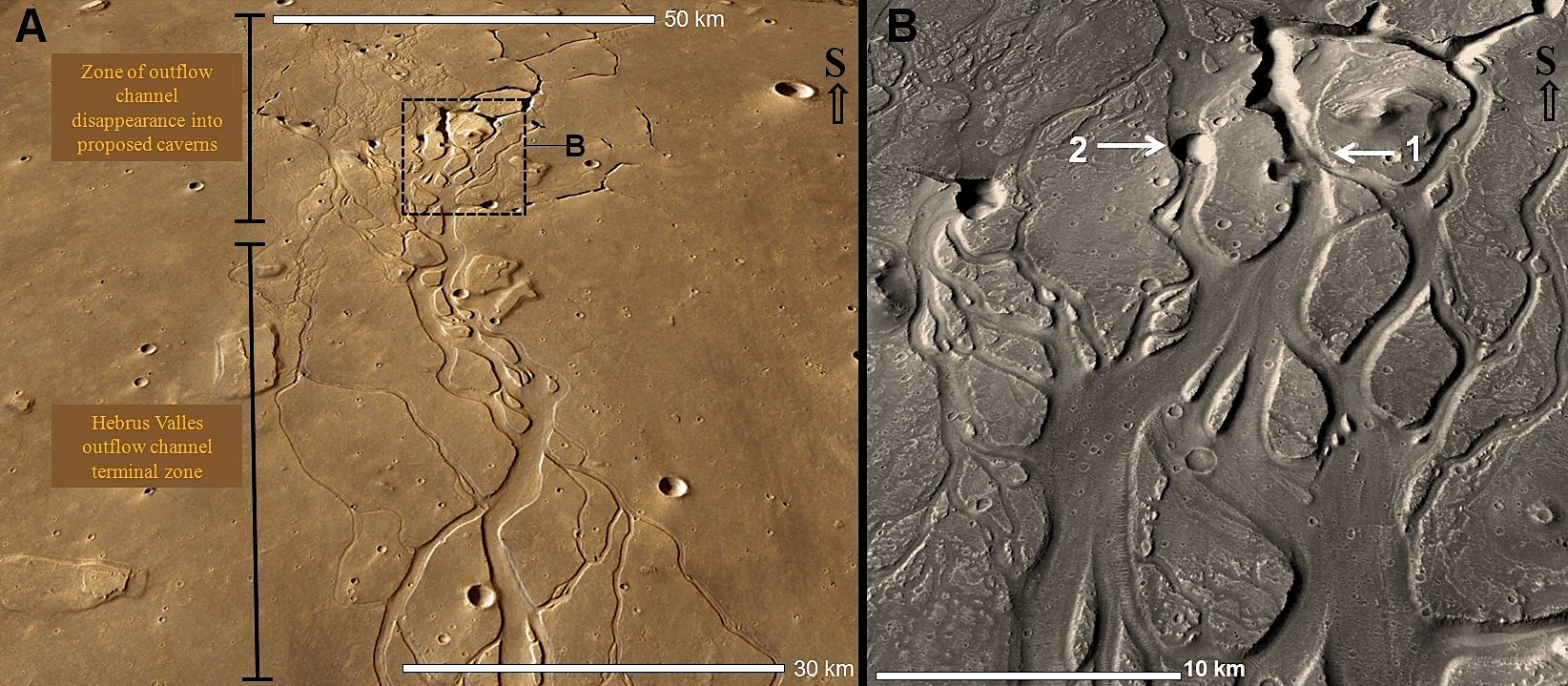
MARS FOR SPELUNKERS. At the end of its channel, the water that eroded Hebrus Valles appears to disappear underground. In image B, the flow changes from the surface to underground at the point marked 1. At point 2 is a potential collapsed roof of a cavern. (Image: NASA/JPL-Caltech/MSSS/PSI)

But where did the water end up? And what about eroded sediment carried along by the floods?

Studying Hebrus Valles and Hephaestus Fossae in the Utopia impact basin, the dozen authors of a new paper in Geophysical Research Letters write, “Our investigation indicates that outflow channel floodwaters were captured and reabsorbed into the subsurface in zones where caverns developed within the northern plains.”

Led by Alexis Rodriguez (Planetary Science Institute), the scientists used images from CTX and THEMIS coupled with topographic data from MOLA. “At some locations within the study region,” they write, “features interpreted as mud volcanoes cluster into linear ridges. These ridge patterns align with networks of individual pits, pit chains, and troughs.”

Linking the features, the team argues, are open voids in the subsurface, or caverns. “We suggest that within the study region, collapsed sections of cavern systems are expressed at the surface by these linear depressions.” The apparent connectivity of mud volcanoes with the pit and trough networks suggests a genetic link between mud volcanism and the development of cavern networks.

The scientists note that streams on Earth disappear into sinkholes, and underground conduits can carry large amounts of water and sediment.

They acknowledge that the estimated volume of the Hebrus outflow is 100 times greater than the trough networks where they end. However, they say, “we note that these trough networks likely represent only the portions of the cavern networks that collapsed.”

Caverns on Earth commonly form in carbonate rocks, such as limestone, where acidic rain and groundwater dissolves the rock starting along joints and cracks. However, if Mars has extensive carbonate rocks in the northern lowlands, geologists have yet to find them. The team, instead, proposes an alternative method of making caverns.

“Our model invokes the role of mud volcanism in the formation of subsurface caverns. High hydraulic pressures are thought to have led to mud volcanism along the southeast margins of the Utopia basin, as well as within other regions of the northern plains,” they explain.

They note that the occurrence of mud volcanoes along boundary plains fits with the idea of a pressurized hydraulic head within water-bearing rocks that extend across the highland-lowland boundary. Something – perhaps hot magma – increased the water pressure or melted the frozen ground, thus opening pathways for the water to reach the surface.

“Fluid circulation along the fractures led to the development of feeder conduits through which fluid-sediment mixtures erupted to construct mud volcanoes,” says the team. It was the enlargement of these conduits by subsurface erosion that led to the development of caverns.

How long would such caverns remain open? Potentially a very long time. The write, “At -60°C [–76°F], a predicted typical mean annual surface temperature for the investigated latitudes, permafrost could have had a mechanical strength close to that of limestone.” This could allow the formation of longterm, structurally stable caverns.

The researchers explain that “the gravity of Mars is 0.38 times that of Earth, which would have allowed for the development of 2.5 times deeper cavern systems.” Terrestrial caverns occur down to a maximum depth of about 2,000 meters (6,500 feet), thus gravity differences alone could allow Martian caverns to remain open to about 5,000 m (16,500 ft) depth – especially if deep-seated carbonates form extensive deposits within the northern lowlands’ upper crust.

Finally, the researchers note that Martian caverns could be bigger than those on Earth. “The maximum stable width of a cavern increases with the inverse square root of gravitational acceleration. Consequently, on Mars caverns within geologic materials that have similar mechanical strength could have about 60 percent wider roofs than on Earth.”

This means, they say, “If maximum cavern dimensions all scale similarly, Martian caverns could be more voluminous than Earth’s, perhaps four times greater.”

Posted in Reports | Tagged , , , , , , , | 1 Comment

Hurtling moon casts no cooling shadow

Total solar eclipses on Earth take hours to unfold, even if totality — the brief time when all the Sun is covered — lasts just a few minutes. Almost everyone who stands in the path of a solar eclipse notes how the air and ground become cooler as the eclipse deepens.

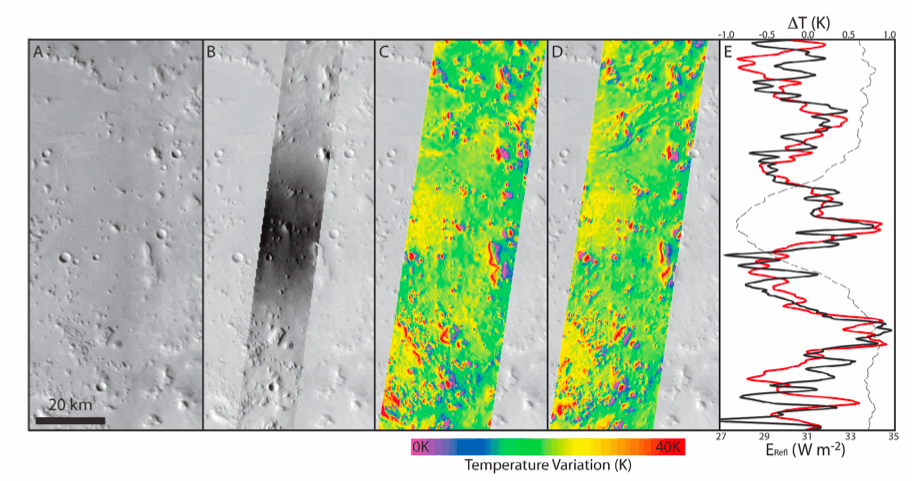
GONE WITHOUT A TRACE. Martian moon Phobos cast a shadow on the ground on November 24, 2010. At the time, the Mars Odyssey orbiter was passing overhead and imaged the shadow with the THEMIS camera at visual and infrared wavelengths. While the shadow was clearly visible (frames A and B), the moon's passage was too swift for any cooling to occur among the rocky materials on the surface. Frame C was taken during the shadow's passage and frame D was taken for reference a few days before the event. (Image taken from Figure 3 in the paper.)

Mars has no total solar eclipses, because neither Deimos nor Phobos is large enough to cover the whole Sun as seen from the surface of Mars. Yet both fast-moving moons do cross the Sun’s face as seen from the ground, causing partial eclipses. Phobos, the larger moon, produces eclipses that cover as much as 38 percent of the Sun.  How strong a thermal effect does the surface experience during a Martian solar eclipse?

No measurable surface cooling, say Sylvain Piqueux and Philip Christensen (both Arizona State University) in a recent paper published in Geophysical Research Letters.

“On November 19, 22, and 24, 2010,” they write, “the Thermal Emission Imaging System (THEMIS) onboard the Mars Odyssey spacecraft acquired a set of visible (VIS) and infrared (IR) images of the Martian surface during three transits of Phobos.”

During these events, which occurred around 4:30 pm local time and lasted 31 seconds each, about 20 percent of Sun’s disk was eclipsed. This reduced the incoming solar flux by a similar amount. While Phobos cast a clearly seen shadow on the ground (as imaged at visual wavelengths), the darkness and cooling came and went too quickly to change the temperature of the surface.

“In all three events,” the scientists say, “no obvious surface cooling is measurable.” This was despite the observations targeting the trailing edge of the Phobos shadow, where temperature drops would be the largest. THEMIS, they note, could have detected any temperature drop greater than half a kelvin, or about 1 degree Fahrenheit.

So what does this say about the Martian surface? The new results indicate that surface materials at the observation sites are somewhat rocky and have no significant blanketing by dust. (Dust heats up and cools off quickly, while harder materials — sand, gravel, grit, and rocks — change temperature more slowly.) This finding suggests that any dust present was less than a millimeter thick, which agrees with earlier work that studied similar surface geological units.

The team says, “Phobos shadow observations can contribute to bridge the gap between high-coverage, low-resolution orbital data and punctual-coverage high-resolution surface-based data obtained by rovers and landers.”

Posted in Reports | Tagged , , , , , , , , | Comments Off

Salty flows on Mars

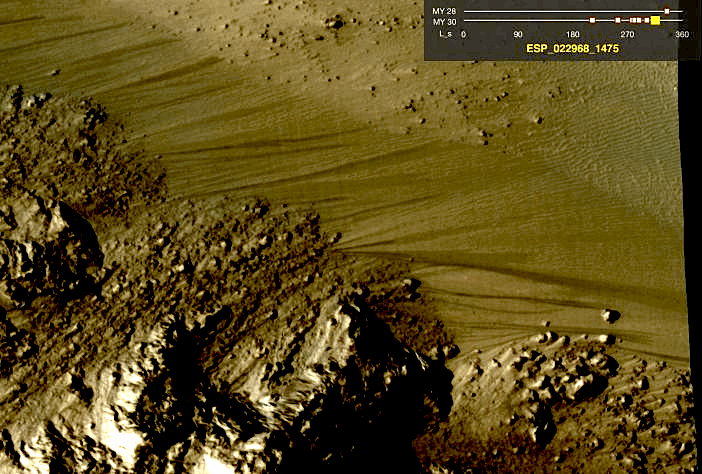
The features known as “recurring slope lineae” (RSL) are the best evidence going that liquid water can, and does, flow on present-day Mars. The lineae are small dark streaks that appear mostly on equator-facing slopes, are associated with slope channels, and occur during local spring and summer before fading and disappearing during autumn and winter.

DRIP, DRIP, DRIP. Dark streaks creep downhill during Martian spring and summer at certain locations. New research shows how these "recurrent slope lineae" can form and flow as liquid brines composed of magnesium- and calcium-chloride salts. (NASA/JPL-Caltech/University of Arizona)

According to a new paper in Geophysical Research Letters, the case for lineae being current-day flows of liquid is now stronger. Vincent Chevrier (University of Arkansas) and Edgard Rivera-Valentin (Brown University) write that they modeled the behavior under Martian atmospheric pressure conditions and temperatures of pure water and brines with varying mineral compositions and freezing temperatures that ranged from 273 kelvin (0°C, 32°F) down to 206 Kelvin (-67°C, -89°F).

Chevrier notes, “We used salts that have been indentified on Mars, or inferred from various models or observations. Salts with higher temperatures of freezing/melting are too unstable, and those with lower temperatures are too stable. They are almost always melted and thus could not form episodic flows.”

The researchers conclude, “Our results suggest that a solution with a freezing temperature of about 223 Kelvin [-50°C, -58°F] can best reproduce the observed seasonality.” In addition, they note that although most brines and even pure water could produce the lineae, salts such as magnesium and calcium chlorides are the best candidates to produce episodic seasonal melting.

“Relatively high surface evaporation rates at the lineae locations make the flows disappear over a single season,” the scientists say. The temperatures at which the brines can flow largely rule out slopes that face poleward — they’re just too cold.

The researchers add that the model “requires the presence of buried ice within the regolith column, which in the southern hemisphere is only considered stable for latitudes greater than 40° south.” And they note that the lineae “may indicate that a recharge mechanism is active in order to maintain a source of brine over even short geological timescales, which would have important implications for the Martian water cycle.”

Once melting occurs in the subsurface, either liquid-dominated or triggered flows are possible under present-day conditions provided they are made of concentrated salt solutions.

Yet a problem with brines as the flowing liquid has been the lack of spectroscopic evidence from orbit. The answer, the scientists suggest, lies in the high evaporation rates. “High surface evaporation explains why the lineae disappear relatively quickly and why MRO‘s Compact Reconnaissance Imaging Spectrometer for Mars (CRISM) could not identify water signatures.”

CRISM, the scientists note, “is sensitive down to about 100 micrometers’ [= 0.1 millimeter] depth. It would take only a few hours for liquid brines to evaporate down to such a depth. Therefore, unless the instrument caught the liquid while flowing, there is only a small chance for the signal to show any evidence of liquid water.”

Posted in Reports | Tagged , , , , , , | Comments Off