
Last Martian Ice Age still waning

The neutron and gamma-ray spectrometers on NASA’s Mars Odyssey discovered that water ice lies at shallow depths from the polar regions down to latitudes of about 55° north and south. Images of very recent craters by the HiRISE camera on the Mars Reconnaissance Orbiter have revealed fresh ice exposed in crater bottoms at latitudes as low as 43° north.
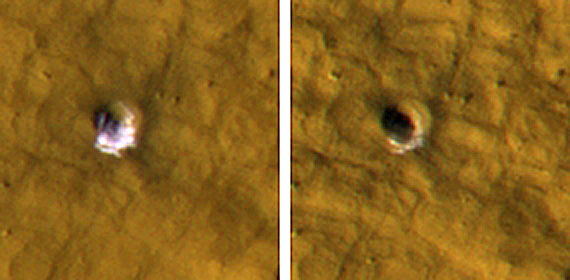
ICE IN RETREAT. A small crater, just 6 meters (20 feet) wide, shows ice in the bottom when the HiRISE camera imaged it in October 2008 (left), sometime soon after an impact made the crater. By January 2009 (right), much of the ice had disappeared. Left image is from HiRISE image PSP_010440_2235, right image is from ESP_011574_2235. Images: NASA/JPL-Caltech/University of Arizona

A paper in Icarus by Norbert Schorghofer (University of Hawaii) and Francois Forget (Université Paris) presents results of modeling how ground ice comes and goes on Mars. They argue that the ice-exposing impacts point to an underground ice sheet that’s still retreating from the last glacial maximum.

Models predict that the size of the subsurface ice layers in both hemispheres has changed over the past few million years. These shifts are driven by changes in the Martian orbit and shifts in the orientation of the planet’s rotation axis.

“Subsurface ice can be emplaced in two ways,” the researchers explain. “In one method, snowfall during a past climate period when the axis tilt was different may have led to the formation of a perennial snow cover that subsequently densified.” When this ice retreated, any dust caught in it would remain as a growing lag deposit of debris, eventually burying the ice.

The second mechanism, they note, is uncommon on Earth: underground ice is deposited directly from water vapor. “This ice fills the available voids between soil grains and is thus called pore ice or interstitial ice.”

Their modeling of subsurface ice and its interaction with the atmosphere leads them to three conclusions. First, when ice in soil forms from atmospheric vapor, it can grow gradually over a range of depths below an ice table. It can also grow if the ice table moves to shallower depths.

Second, at the Phoenix landing site (68° north), calculations predict three layers: dry soil, ice-cemented soil, and an underlying ice sheet. But the layer of ice-cemented soil may be only millimeters thick, thinner than expected.

Finally, the ice-exposing crater impacts at 43° north lie slightly closer to the equator than expected for subsurface ice in equilibrium. A likely explanation is a recent massive underground ice sheet that is still retreating because it has not yet reached equilibrium with the present day atmosphere and climate.

Posted in Reports | Tagged , , , , | Comments Off

“Olympic” ocean in Tharsis?

Two features of Olympus Mons have puzzled geologists since they were discovered decades ago. First are the “aureole” deposits, rough terrain extending as much as 400 kilometers (250 miles) from the volcano. And second is the scarp, about 8,000 meters (26,000 feet) high that surrounds the entire structure at the foot of the mountain.

WET FEET? The cliff at the base of Olympus Mons (seen here in cartoon form) resulted from lava flows being abruptly cooled by water as they reached the foot of the growing volcano. The chilled lava piled up, making a steep, unstable slope, which then collapsed in landslides. (Image taken from Figure 4 in the paper.)

A new paper in Planetary and Space Science by Fabio De Blasio (Sapienza University of Rome) suggests that both are the result of Olympus Mons being surrounded by an ocean for most of the time that repeated lava eruptions were building the volcano.

Olympus Mons is the largest volcano in the solar system, standing about 21 km (14 mi) higher than the plain around it. The volcano spreads 600 km (370 mi) wide, enough to cover the state of Arizona.

De Blasio writes, “Numerical simulations and a comparative study of similar volcanic structures on Earth suggest that a volcanic edifice with the characteristics of Olympus Mons cannot be formed without the presence of water at the base.”

The reason, he says, is that the highly fluid lavas erupted by Olympus Mons would have cooled slowly and produced gentle slopes (less than 1° to 5°) all the way down to the level of the surface surrounding the volcano. Instead, those slopes end at the boundary scarp, where they abruptly steepen to 12° to 15°, in places reaching 28°.

The solution is a body of water around the volcano, he explains. Water cools lava nearly a thousand times faster than air. The abrupt cooling where the lava touches the water creates a steep edge. As continuing lava flows pile up where they cool quickest, the edge becomes unstable and prone to collapse.

The water hypothesis also fits other evidence, De Blasio says. “There has been much interest in the last decades for the possible presence of an ancient ocean in the northern basin.” This has been called Oceanus Borealis, and scientists have estimated it was Noachian to Hesperian in age, roughly contemporaneous with the growth of Olympus Mons.

“Some interpretations have suggested the ocean would affect the Olympus Mons area,” he notes.

The water, De Blasio stresses, did not have to be as deep as the scarp is high. The scarp is what was left after gigantic landslides tore away the steep edge of the volcano. And with friction decreased by the water, the slide debris fanned out to form the aureole deposits.

Similar features, De Blasio notes, surround the Hawaiian Islands, where the Big Island is the one structure on Earth closest in size to Olympus Mons.

Posted in Reports | Tagged , , , , , | 2 Comments

Making polar spiders in the lab

The formation of “spiders” during Martian south polar spring is one of the most spectacular natural phenomena on the Red Planet. Briefly, what happens is that every winter carbon dioxide ice forms a translucent layer above the sandy ground. Then as spring sunlight passes through the layer to heat the ground, it causes CO2 gas to accumulate beneath the layer. When the pressurized gas finally bursts through in several places, geysers of gas and dust erupt violently, eroding converging spider-shaped channels under the ice and scattering dust fans on top of it.

LABORATORY SPIDERS. Real Martian polar spiders (top) and their made-in-the-laboratory cousins (below) have similar shapes and branching patterns. (Image taken from Figure 1 in the paper.)

Recently, a group of researchers led by Simon de Villiers (University of Oslo) recreated (on a much smaller scale) the formation of these “spiders” in a terrestrial laboratory. Their report appears in Geophysical Research Letters.

Dubbing the spider-like features “araneiforms,” the team found they could create very similar patterns inside a cell filled with air and unconsolidated granular material (spherical silicate glass beads).

The researchers drilled a small hole in the top cover (made of thin glass) of the cell. Then they slowly pulled the cell top upward, allowing air to enter the cell without disturbing the grains. Finally they let the cell cover drop quickly back to its original position.

This drove air and entrained particles out of the cell through the small hole in the top. After working the cell through several cycles, the team found they could produce converging dendritic patterns similar to those seen on Mars. Also, as they flexed the cell cover, they saw the formation of straight, braided, and quasiperiodic oscillating channels, unlike meandering channels on Earth.

“The experiments demonstrate that the erosion of granular material caused by gas flow and venting produces patterns similar to Martian araneiforms,” the team concludes. “And thus supports the hypothesis that these features are produced by the venting of CO2 gas during the Martian spring.”

Posted in Reports | Tagged , , | Comments Off

Duck & cover: good advice for Mars organics

Everyone knows Mars has a terrible environment: temperatures are bitter cold most of the time, there’s almost no air pressure, and solar ultraviolet light scours the surface unhindered.

COVER UP TO SURVIVE. Cosmic rays from space rapidly destroy organic materials that lie near the Martian surface. The exposure times (left side) indicate how long it takes cosmic rays to decrease the materials by a thousand-fold (SCR = solar cosmic rays, GCR = galactic cosmic rays). Image taken from Figure 3 in the paper.

Actually, it’s even worse. Alexander Pavlov (NASA Goddard Space Flight Center) and colleagues ran computer experiments in which they subjected organic compounds to the cumulated effects of cosmic rays from solar and galactic sources. Their report appears in Geophysical Research Letters.

The news, as the saying goes, is both good and bad. First, the bad: any organic compound lying close to the surface will be destroyed within a few hundred million years. This timescale, while long in human terms, counts as but a fraction of Mars’ 4.5 billion year history.

Galactic cosmic rays do the worst, they found, but both sources produce enough ionizing radiation to severely damage organic materials.

The good news is the flip side. Which is that any material buried more than 4 or 5 inches below the surface has a good chance of surviving mostly intact over geologic timescales.

“The preservation of ancient complex organic molecules in the shallow (~10 cm [4 inches] depth) subsurface of rocks could be highly problematic if the exposure age of a geologic outcrop would exceed 300 million years,” they team writes.

Looking at the chances of Curiosity, NASA’s Mars Science Laboratory, for finding organics, the researchers see problems looming. “[It] will pose a serious challenge for organic detection by MSL since its primary focus is to look for 3.5 billion-year-old organic biomarkers while only drilling 5 centimeters [2 inches] into the surface rock.”

However, some sampling options are available for the mission’s scientists and engineers. “Several straightforward strategies would still allow the MSL to sample relatively ‘fresh’ ancient rocks, ” they say. One strategy would be to look for recent craters in the 1 to 10 meter [3 to 30 feet] diameter range within Gale.

Another strategy would involve using Curiosity’s wheels to dig into soft sedimentary rock before drilling. Given the size of the rover’s wheels such digging could provide samples from about 20 centimeter [8 inch] depths.

“Although a depth of 20 cm is not enough to avoid degradation by galactic cosmic rays completely,” they note, “it can slow down the rate of organic destruction by about 30% and will eliminate degradation associated with solar cosmic ray irradiation completely.”

Posted in Reports | Tagged , , , , , , , | Comments Off

Wind triggers activity in north polar dunes

The sand sea surrounding the Martian north pole covers an area about a third the size of Earth’s Arabian Desert and is roughly equal in size to the Kalahari. Dunes are a common feature on Mars, just as in terrestrial sand sheets.

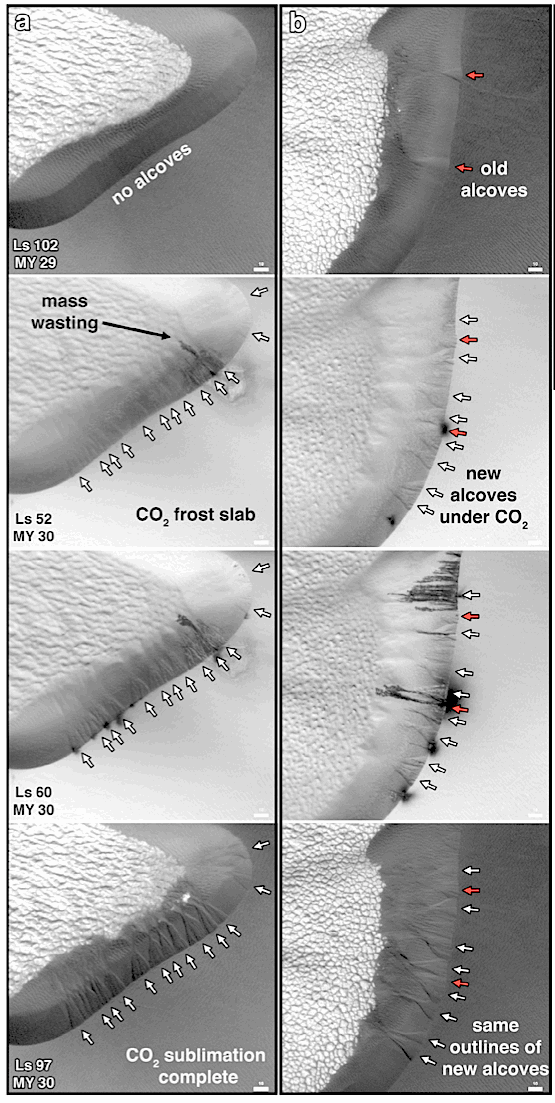
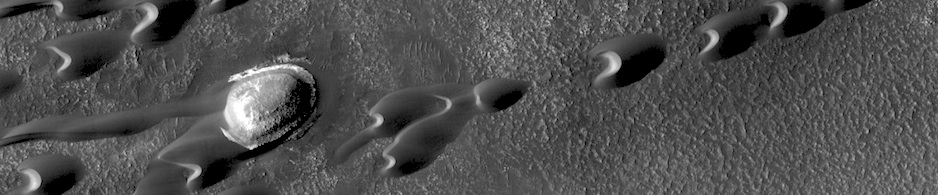
BLOW, SLIP, SLIDE. Winds, not evaporating CO2 frost, appear to cause alcoves and fans to form on dunes in Mars' north polar sand sea. The little white scale bars in the lower right corner of each panel measure 10 meters (33 feet) long. (Image taken from Figure 2 in the paper.)

Many Martian dunes appear active today and show features similar to those on terrestrial dunes, including ripples, steep lee-side slopes, alcoves, and fans. Produced by a sand avalanche, an alcove is a shallow, wedge-shaped depression at the top of a dune’s lee slope, while a fan of debris from the alcove lies below. On some dunes a short channel connects the two.

On Earth, avalanche-caused alcoves typically measure a few inches to a foot wide; on Mars however, they span a yard to tens of yards wide, for reasons that scientists haven’t yet figured out.

Scientists have also argued over what starts the formation of an avalanche and alcove on the north polar dunes. One suggested cause is a disturbance when the seasonal slab of carbon dioxide frost vigorously sublimates (evaporates directly into a gas) as spring sunlight warms it. The CO2 explanation has been popular because alcove features are seen clearly on dunes after the CO2 frost has gone, but they were not visible in images taken early in the previous summer.

However, a recent paper in Geophysical Research Letters by Briony Horgan and James Bell (both Arizona State University) points to winds as a more likely cause. The researchers used new meter-scale images from the HiRISE camera on Mars Reconnaissance Orbiter to track changes in north polar dunes during Mars Years 28 to 30 (Jan 2006 to Sept 2011).

The new images captured a more complete time sequence, which showed that alcoves and fans were already present underneath the CO2 frost slab as winter began. In addition, other clues such as orientation pointed to winds as the trigger.

The dominant wind direction is thought to be easterly, based on the shape of the dunes, the researchers note, but the alcove orientations don’t match easterly winds everywhere. “The alcoves line up with the easterly winds in only the western part of the sand sea, but elsewhere they line up really well with fresh ripples, which are a good indicator of the most recent winds,” the scientists say.

“The summer timeframe of formation, association with dune activity, and possible relationship with recent winds all suggest an origin for the alcoves related to eolian processes,” they conclude. “A very small flow starts on the dune slipface, creating an initial breakaway scarp, which expands laterally and moves upslope, forming an alcove at the dune brink.”

The researchers note that a lot of their insight on the processes involving in this hypothesis came from studying terrestrial sand dunes, especially those like the ones at White Sands National Monument in New Mexico and Great Sand Dunes National Park in Colorado. Says Bell, “Geologic features and environments on our own planet often provide excellent natural laboratories and analogs for understand what is happening on other worlds — and vice versa!”

Posted in Reports | Tagged , , , , , | Comments Off

“Blueberries” could date when Meridiani rocks were last wet

The relative amount of three chemical elements contained in Martian “blueberries” might offer scientists a way to date when these spherules were last inundated with water, according to recent research.

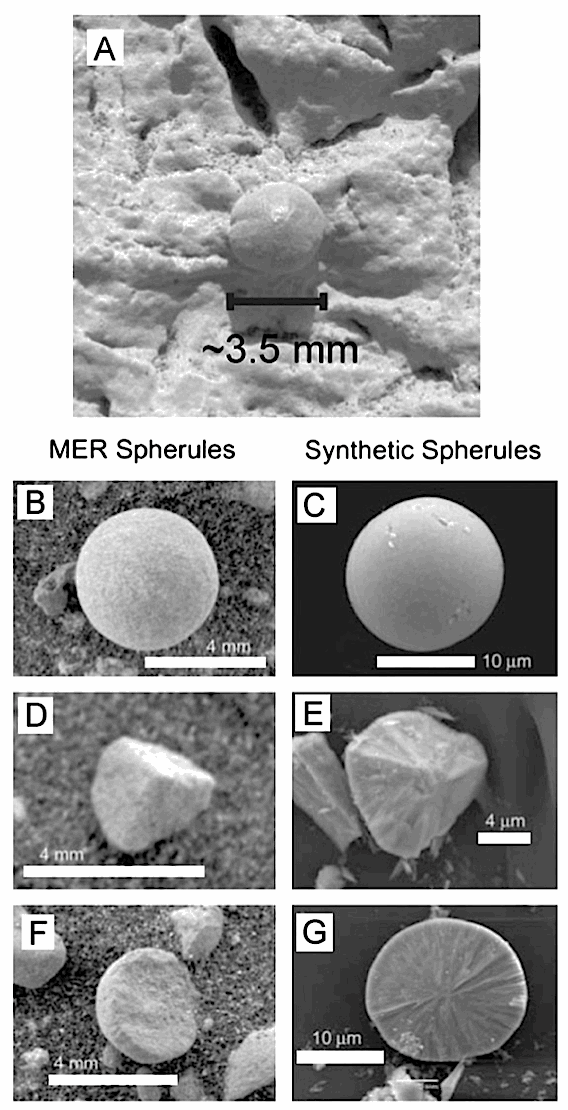
CATCH A DATE. Mars rover Opportunity found "blueberries" — spherules a few millimeters across — littering the ground and buried in the sediments of Meridiani Planum. These are hematite-rich concretions that formed within rocks when the sediments became soaked with groundwater. Lab experiments suggest a way to use ratios of uranium, thorium, and helium within the blueberries to date the last time water touched the sediments. (Image taken from Figure 1 in the paper.)

Rich in the iron mineral hematite, blueberries are small concretions, a few millimeters in diameter, that formed within the soft sandstones of Meridiani Planum when they were soaked with groundwater. The spherules were a key discovery made by the Mars Exploration Rover Opportunity as soon as it set down on Meridiani in January 2004. The blueberries, being harder than the surrounding sandstone, are weathering out of the rock and littering the surface where Opportunity set down.

A paper in Planetary and Space Science by Syracuse University scientists Joseph Kula and Suzanne Baldwin suggests that ages measured using the relative abundances of uranium, thorium, and helium in the blueberries could yield the time that has passed since water last wetted the sediments.

Although potassium and argon isotopes have been used by scientists for dating rocks much more often, Kula and Baldwin note that for more than a century, geologists have known that hematite retains helium produced by the radioactive decay of uranium and thorium. Measuring the relative abundances produces an age.

To test a crucial proviso — that the blueberries not lose any significant amount of helium since the wetting occurred roughly 4 billion years ago — Kula and Baldwin recalculated previously determined laboratory measurements for helium in variously shaped bits of hematite. These data were then coupled to the various shapes of blueberries observed by Opportunity.

They found that even if warm temperatures persisted over the last 4 billion years of Mars history, enough helium should be retained under Martian conditions to keep the method viable. Previously, they had examined how argon behaves in the iron-sulfate mineral jarosite, which is common at Meridiani. Jarosite would provide an alternate check on the process.

“Coupled jarosite and hematite ages could therefore constrain the timing and rates of groundwater movement,” they write, thus tracking the environmental transition from water-saturated conditions to arid.

There’s also a possible use by Curiosity, NASA’s Mars Science Laboratory rover, on target for an August 2012 landing in Gale Crater. Kula and Baldwin explain, “If Curiosity encounters hematite spherules, it can likely extract and measure helium using the ovens and mass spectrometer in the Sample Analysis at Mars (SAM) instrument.”

Measurement of the parent uranium and thorium is more problematic, they say, but “if these trace elements are of high enough abundance, measurement may be possible by gamma ray spectroscopy.”

In any case, they note, blueberries and other hematite-bearing rocks would be good samples to collect with an eye to retuning them to Earth in any future mission.

Posted in Reports | Tagged , , , , , , , , , , | Comments Off

Changing times in Syrtis Major

Early Mars appears to have been highly unlike today, being warmer and wetter. To find out why and how the environment changed, scientists look for inflection points in Martian history, where one geological regime gives way to another.

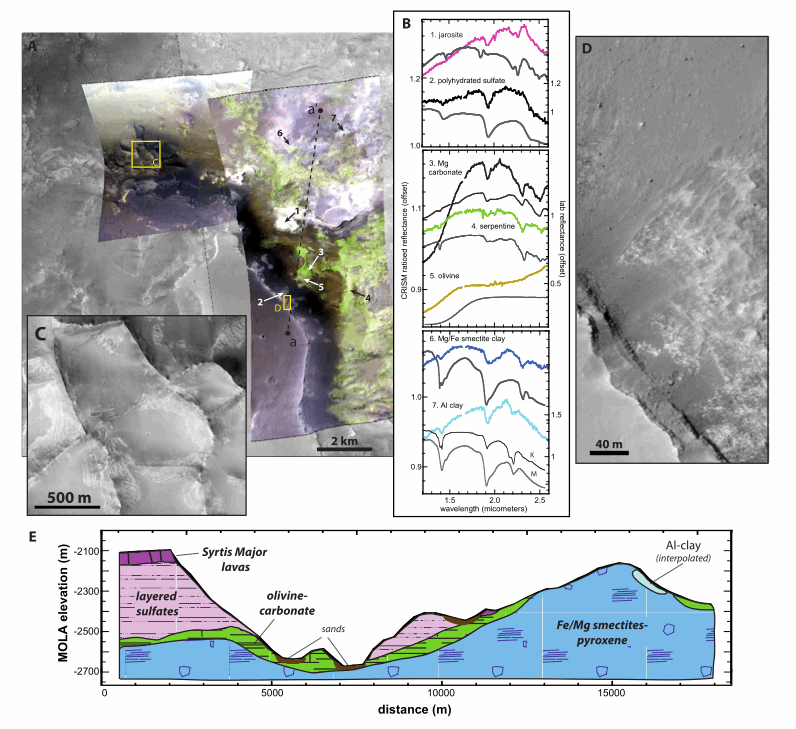
GEO-SLICE. A cross-section in northeast Syrtis tells a tale of change. Clay minerals (blue) lie on the bottom of the sediment stack, pointing to an early neutral or alkaline environment. On top them lies a veneer of carbonates (green), the product of different conditions. Sulfates (purple) topped with lava complete the picture of transition into a more acidic environment, thanks to abundant volcanic eruptions. (Image taken from Figure 2 in the paper.)

A report recently published in Geophysical Research Letters suggests that northeast Syrtis Major offers a sequence of deposits that straddles the boundary between the Noachian and Hesperian eras, the oldest and the next-youngest periods, from roughly 4.1 to 3.8 billion years ago. The paper is by Bethany Ehlmann (Caltech-JPL) and John Mustard (Brown University).

“The transition between the Noachian and Hesperian epochs on Mars is marked by evidence for a fundamental change in planetary-scale processes,” Ehlmann and Mustard write. Large volcanic provinces spread broadly across Mars, including the northern plains, Hesperia Planum, and Syrtis Major. Changes also included a shift from a chemically neutral, wetter environment with clay deposits to a drier and more acidic one in which sulfate minerals became common.

The researchers used data from the CRISM instrument on NASA’s Mars Reconnaissance Orbiter to explore the mineralogy of a tangled area where ancient Isidis basin deposits adjoin younger lavas from Syrtis Major.

“This geologic section captures three of the four major classes of water-related minerals discovered on Mars,” says Ehlmann. “Except for chloride minerals, which are missing here, they lie in a time-ordered stratigraphy.”

As the scientists reconstruct the history, igneous bedrock formed in the early Noachian, and water subsequently altered some of it to iron-magnesium bearing clays. This bedrock was disrupted by the Isidis basin impact, leaving deposits shattered in places. An olivine-rich unit was emplaced either from an impact melt sheet or as fluid lavas draped over the existing topography.

Then erosion carved channels, deposited clay- and carbonate-bearing sediments in craters and other topographic lows. Near-surface water activity created magnesium carbonates and aluminum-bearing clays. Sulfate-rich materials settled on top of the olivine-carbonate unit, filling in the low spots. Syrtis Major lavas then covered these.

“In contrast to the late Noachian to Amazonian stratigraphic section recorded in Gale Crater sediments,” they write, “the northeast Syrtis section captures an older period of impact bombardment, volcanism, and water alteration from the early Noachian through the Hesperian.”

The team notes this site was considered as a landing place for Curiosity, NASA’s Mars Science Laboratory rover, and it would make a good locale for a future rover mission looking at ancient climate change and habitability. Says the team, “This is one of the most well-preserved stratigraphic sections from early Mars and it provides a diverse set of units suitable for collecting samples to bring back to Earth.”

Posted in Reports | Tagged , , , , , , , , | Comments Off

UV light makes methane from meteorites

Methane gas, which can arise from both biological and geological sources, was detected in the Martian atmosphere by observations from Earth-based telescopes in 2003 and from the Mars Express orbiter (2004). As methane breaks down relatively quickly under Martian conditions, the amount measured implies a release of 200 to 300 tons of methane each year. The findings have caused much speculation about possible sources, including micro-organisms.

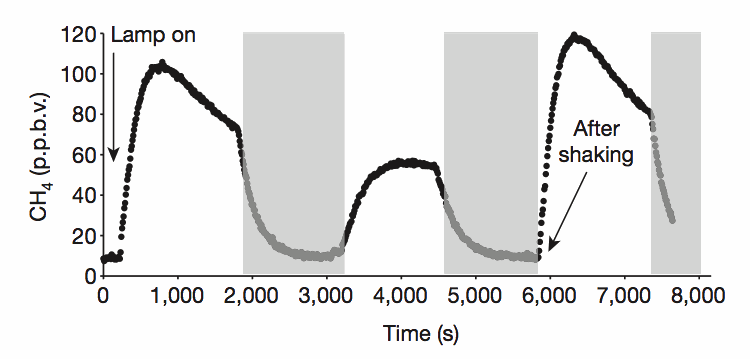
UNDER THE UV LAMP, methane (CH4) emerges from samples of the carbon-bearing Murchison meteorite in a test chamber flushed with nitrogen gas. The scale reads in parts per billion by volume, and the gray bands show calibration measurements of the nitrogen. (Image taken from Figure 1 in the paper.)

However recent experiments by a team of researchers led by Frank Keppler (Max Planck Institute for Chemistry, Germany) suggest a natural way to create Martian methane without biology. They published their report in Nature.

Keppler’s team exposed to ultraviolet light pieces of a carbonaceous meteorite that fell near the town of Murchison in Australia in 1969. The Murchison meteorite is a type CM2, one of the most chemically primitive meteorite types known. The researchers’ experiments found that as UV light struck carbon compunds in the meteorite, it decomposed the compounds and released methane gas.

“Methane is produced from innumerable small micrometeorites and interplanetary dust particles that land on the Martian surface from space,” says Keppler. The energy to power the extraction of methane, he says, comes from intense solar ultraviolet radiation, which reaches the surface largely unhindered by the thin atmosphere.

The UV reaction is also highly sensitive to temperature, the team found. As temperatures on Mars vary from –143° C (–225° F) at the poles to +17° C (63° F) at the equator, the scientists ran the experiment on samples at similar temperatures. The warmer the temperature, the more methane the meteoritic fragments released.

This temperature dependence also fits the different methane concentrations detected at various locations in the Martian atmosphere. In infrared spectra, the largest concentration of methane was found in the equatorial region, the warmest place on the planet.

Posted in Reports | Tagged , , , , , , | Comments Off

Gale Crater’s mound: part of the Medusae Fossae Formation?

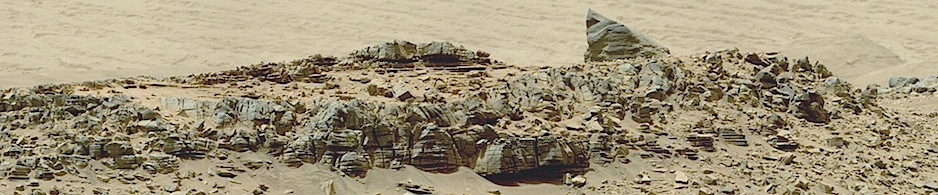
The Medusae Fossae Formation (MFF) is a thick deposit of soft materials that erodes easily by wind. The formation spreads in several large patches between the volcanic provinces of Elysium and Tharsis. In addition, outliers extend farther afield, with some reaching close to Gale Crater, the landing site for Curiosity, NASA’s Mars Science Laboratory rover, en route to an August 2012 landing.

COUSINS? SIBLINGS? The soft deposits of the Medusae Fossae formation (left) resemble those near the top of the giant mound in Gale Crater, landing site for the Curiosity rover. And these appear to have the same age, as determined by crater counts. Portions of HiRISE image PSP_006815_1780 on the left and PSP_008002_1750 on the right, to the same scale. (Image taken from Figure S2 in the paper's supplementary material.)

The origin of the Medusae Fossae Formation is thought by many scientists to be volcanic ash, possibly from Apollinaris Patera as one group of scientists has argued. But the question of its age is unanswered. For a long time, scientists estimated the entire formation as Amazonian in age, or younger than 3.5 billion years old.

James Zimbelman and Stephen Scheidt (National Air and Space Museum) argue in a brief report in Science Express that most of the Medusae Fossae formation is Hesperian in age, dating to 3.6 to 3.7 billion years old. The upper surface of the lowest MFF member appears Amazonian in age — about 3.4 billion years old — but that’s because erosion has erased the craters that would reveal its true age, which is Hesperian also.

The team arrived at these ages by counting craters in daytime infrared images from the THEMIS camera on Mars Odyssey. “We found the dust-mantled MFF materials actually show more subtle features better in daytime IR rather than with a high-resolution imager such as HiRISE. Daytime IR revealed very subtle slopes and more craters,” Zimbelman says.

When they examined the surfaces of the formation near Gale Crater, they found the lowest (oldest) layer shows enough craters that it must have formed before the late Hesperian. They also found that it’s difficult to see much difference between these lowest sediments in the Medusae Fossae Formation and those making up the top layers of Mt. Sharp, the 5-kilometer (3 mile) high mound in Gale.

“A Hesperian age for the western Medusae Fossae Formation has implications for materials at the Mars Science Laboratory landing site,” Zimbelman and Scheidt explain. “Our results are consistent with a recent cratering study for the entire Gale mound, which indicates a late Hesperian to early Amazonian exposure age.”

They add that there may not be a major time gap between the upper and lower parts of the Gale mound, despite an apparent erosion interval between the mound units. “The hypothesized ignimbrite origin for the Medusae Fossae Formation may thus apply to the regularly layered upper units of the Gale mound.”

And they note, “Curiosity may test this interpretation while exploring the Gale mound.”

Posted in Reports | Tagged , , , , , , , , | Comments Off

Mars has carbon — it’s just not biological

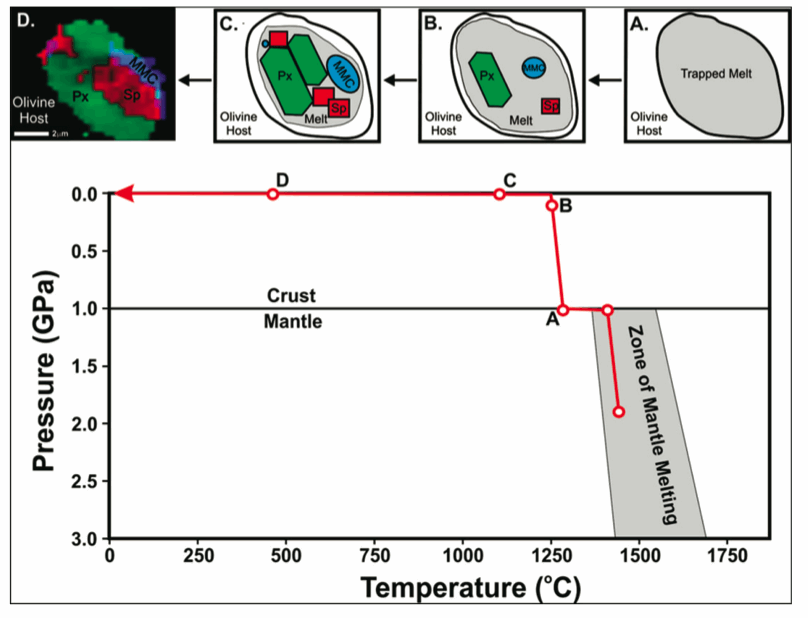
A highly detailed study of 11 meteorites that have come from Mars shows that although 10 of them contain the organic element carbon, the source of the carbon is not biological in origin. Instead, the carbon lies as molecules inside oxide minerals that formed in molten magma. When the minerals crystallized, the heat and pressure were such as to rule out biology as a source for the carbon.

TOO HOT FOR LIFE. A proposed crystallization sequence, given in schematic form, shows various minerals including carbon (MMC), spinel (SP), and pyroxene (Px) crystalizing from igneous mantle rocks that erupt at the surface. (Image taken from Figure 3 in the paper.)

The study, published May 24 in Science Express, was carried out by a group of scientists led by geochemist Andrew Steele (Carnegie Institution of Washington).

“Ten of the meteorites,” the team writes, “contain abiotic macromolecular carbon (MMC) phases detected in association with small oxide grains included within high-temperature minerals.” Scientists have detected carbon in Mars meteorites before, but disagreed over how the carbon formed.

The meteorites in the study are known to be pieces of Mars because they contain trapped gases whose composition fits the Martian atmosphere. They have ages ranging from 4.4 billion years old (ALH84001) to 190 million years (Zagami). These ages record when the rock was last melted or severely shocked. (Three of the meteorites have undetermined ages.) Regarding how long ago each landed on Earth, the meteorites span a range of 60,000 years (Dar al Gani 476) to 6 months (Tissint); four of the 11 have no known terrestrial arrival date.

The question of terrestrial contamination looms large in any study of extraterrestrial samples. Steele’s team reports that the carbon detected was located deep inside the mineral crystals, making it unlikely to have gotten there after the meteorites landed on Earth.

“With a combination of transmitted and reflected light,” Steele and colleagues write, “we determined the distance from the oxides to the surface and confirmed their isolation from any visible cracks.”

As these molecules were found in Martian meteorites of such an large span of ages, their presence means that Mars has been making its organic compounds throughout its history and apparently continues to do so today.

The scientists  note, “The youngest MMC-bearing meteorite (about 190 million years old), demonstrates that reduced carbon phases have been generated recently in Mars’ history, and therefore, the Martian reduced carbon budget was in flux during the late Amazonian, hinting that a true Martian carbon cycle may still be active.”

The researchers write, “Our results imply that primary organic carbon is nearly ubiquitous in Martian basaltic rocks. It formed through igneous, not biological, processes and was delivered over most of Martian geologic history to the surface as recently as the late Amazonian.” The Amazonian is the current Martian geologic era.

While Curiosity, NASA’s next Mars rover that’s due to land August 6, carries instruments to detect organic elements, the meteorite study suggests a caveat. As the team explains, because basaltic rocks are widespread on Mars, “a positive detection of organics by the Mars Science Laboratory…may be detecting this abiotic reservoir.”

Posted in Reports | Tagged , , , , , , , , | Comments Off